
Topic
Biblical Theology
1,075 sermons · All topics

The Resurrection and the Life, Part 4

The resurrection of Lazarus in John 11:38–46 sets before the reader the full display of Christ's two natures: the true humanity revealed in groaning, weeping, prayer, and command, and the true divinity revealed in the life-giving voice that draws a four-day-dead man from the tomb. The miracle is not a parlor trick but a deliberate act of the mediator, performed to glorify the Father and to call sinners to believe that Jesus is the Christ, the Son of God. The raised Lazarus is an analogy of the effectual call — the voice that issues the command carries with it the power to enable compliance — and a prefiguring of the general resurrection to come. The passage summons every hearer to confess with Martha, 'Thou art the Christ, the Son of God,' and to come forth from the grave clothes of sin into life in His name.

2LCF Chapter 1:5-10 - Hermeneutics
Paragraphs 5–10 of the Second London Confession's first chapter contain an implicit hermeneutical program that governs all responsible reading of Scripture. This session works through those paragraphs to identify six distinct interpretive principles: the Christocentric scope of all Scripture, the extent and finality of Scripture's sufficiency, the perspicuity of Scripture for salvation, the availability of Scripture through faithful translation, the analogy of Scripture and faith as the rule of interpretation, and the supreme judicial authority of Scripture over all human councils and traditions. The practical thrust is that every reader, learned or unlearned, is equipped by ordinary means and the Spirit's illumination to understand what God has revealed — and that bad presuppositions inevitably produce bad theology.

The Other Offerings
Leviticus 2–7 presents the grain, peace, sin, guilt, and trespass offerings alongside the burnt offering already treated in chapter 1, and the cumulative weight of this sacrificial legislation presses the reader toward two convictions: the absolute holiness of God and the radical sinfulness of man. Each offering — the substitutionary death of an unblemished animal, the sprinkling of blood, the atonement language repeated in nearly every pericope — functions as typology pointing forward to the one Lamb of God who would fulfill all that the system signified. The final summary verse of chapter 7 frames the entire system as divine law, not human suggestion, which carries direct implications for how the church must approach God in the new covenant era under the regulative principle of worship.

Jesus is GLAD when sinners believe!
John 11:15 records Jesus saying 'I am glad' — a statement that could sound troubling without understanding his purpose. This clip from a sermon on John 11 presses the question: what makes Jesus glad? The answer confronts hyper-Calvinist distortions of the gospel and affirms that Christ's gladness is bound up in sinners believing on him, a thread running from Genesis to Revelation across every tribe, tongue, people, and nation.

The Burnt Offering
Leviticus 1 presents the burnt offering as the paradigmatic Old Covenant sacrifice, establishing the pattern of how sinful man may approach a holy God. The chapter addresses the costliness of sacrifice, the worshiper's heart disposition, the laying on of hands as substitutionary transference, and the meaning of atonement as the satisfaction of divine justice. The New Testament interprets this system typologically: the male without blemish, the substitutionary slaughter, and the sweet aroma of acceptance all prefigure the penal substitutionary atonement of the Lord Jesus Christ. Believers are called to read the Old Testament as a Christ-centered book and to worship God only in the manner He has prescribed.

The Royal Wedding
Psalm 45 presents a royal wedding between the divine King and his bride, the church, composed centuries before the incarnation as a song of love pointing directly to the Lord Jesus Christ. The sermon moves through four sections: the psalmist's overflowing intention, the perfections and divine-human person of the King, the instruction to the bride concerning faith and repentance, and the declaration of the King's eternal glory. Christ is shown to be fairer than all the sons of men, advancing his kingdom through truth, humility, and righteousness rather than deception, while his priestly office — not only his kingly conquest — is pressed upon the hearer as the only ground of hope for sinners. The bride is clothed not in her own righteousness but in the imputed righteousness of Christ, received by faith alone, to be brought with gladness into the King's palace.

The Necessity of Christ's Passion
Matthew 16:21–23 presents the first formal announcement of what Christ himself calls a divine necessity: he must go to Jerusalem, suffer at the hands of the elders and chief priests, be killed, and be raised on the third day. The sermon traces this necessity through the covenant of redemption, the Old Testament prophetic witness — Psalms 22, 69, and 110, Isaiah 52–53, Daniel 9, Zechariah 9–14 — and a series of informal anticipations across Matthew's Gospel. Peter's sharp rebuke is examined as a representative failure to grasp the messianic agenda of a suffering Servant, and Christ's equally sharp response — 'Get behind me, Satan' — is shown to be the definitive affirmation that substitutionary curse-bearing is non-negotiable: error here is not a skin disease but a disease at the heart. The congregation is urged to hold fast to the doctrine of Christ crucified and risen as the only stable ground of perseverance in the Christian life.

Introduction to the Book of Leviticus
The book of Leviticus resolves a theological tension created at the close of Exodus: the tabernacle has become God's dwelling place, but no Israelite — not even Moses — can enter it. This introductory exposition surveys Leviticus 1:1 and the book as a whole, tracing three dominant theological themes: the holiness of God, the sacrificial system as God's own provision for sinful man's access to His presence, and the purity required of His covenant people. The Levitical types find their antitypes in the Lord Jesus Christ, who is simultaneously the high priest and the sacrificial victim, and whose atoning work is the substance toward which the entire ceremonial law pointed.

Live Stream - April 30, 2023
Psalm 2 presents the universal mutiny of man against Yahweh and his Christ, and God's sovereign response: not anxiety, but derision, followed by the installation of his appointed King on Zion. Expounding the psalm's four stanzas — the rebellion of the nations, the appointment of the Son, the revelation of the eternal decree, and the exhortation to kiss the Son — the sermon grounds the church's mission in the Covenant of Redemption, wherein the Father promised the nations to the Son as his inheritance. Sinners are called to cease their foolish opposition and, by faith alone, to kiss the Son, with the benediction of Psalm 2:12 — 'blessed are all those who put their trust in him' — as the psalm's own gospel summons.

The Conduct of the New Man, Part 1
Ephesians 4:25–28 grounds the Christian's ethical conduct not in legal compulsion but in the indicative of redemption: the old man has been put off, the mind is being renewed, and the new man has been put on. This sermon works through three prohibited actions — lying, sinful anger, and theft — each examined under its corresponding commandment from the Decalogue (the Ninth, Sixth, and Eighth), with a prohibition, an exhortation, and a motivation for each. The ethical demands of the New Covenant are not a new law but the restoration of the creational law now internalized by the Spirit according to Jeremiah 31:31–34. The hearer is called to put off deceit, guard against nursed anger that gives opportunity to the devil, and replace theft with diligent labor aimed at charitable surplus.
The Tabernacle Erected, and the Glory of God
Exodus 35–40 records the construction, assembly, and divine consecration of the Israelite tabernacle, culminating in the glory cloud filling the completed dwelling place. This session surveys those chapters as the climax of the book of Exodus, tracing the biblical-theological theme of God's dwelling with his people from Eden through the tabernacle, the Solomonic temple, and forward to the incarnate Word who tabernacled among us. A sustained exegetical focus falls on the tension in Exodus 40:35 — Moses unable to enter the glory-filled tabernacle — and its resolution in Leviticus 9, where blood atonement transforms God's dwelling place into a meeting place. The session closes by drawing out the regulative principle of worship, the typological significance of the tabernacle as a shadow of Christ, and the necessity of blood atonement for sinful creatures to approach a holy God.

Renewal of the Covenant, Part II
Exodus 34:10–35 records God's renewal of the Mosaic covenant with Israel following the golden calf apostasy of chapter 32. The passage demonstrates that the divine attributes proclaimed in verses 6–7 — mercy, grace, long-suffering, and abounding goodness — are not merely stated but actively exhibited in God's willingness to restore a covenant his people had shattered. The sermon works through three sections: the covenant renewed (vv. 10–28), with its prohibitions against religious, social, and political alliances with Canaanite nations; and the reflection of God's glory on Moses' face (vv. 29–35), which Paul's argument in 2 Corinthians 3 sets within the larger framework of old covenant and new covenant glory. The central application is that the same perfections God displayed toward covenant-breaking Israel are the perfections believers now experience in the gospel of the Lord Jesus Christ, whose new covenant ministry of righteousness far exceeds the fading glory of Moses.

Live Stream - March 26, 2023
John 10:7–10 presents Christ as the door of the sheep, the only access point into God's fold, against whom all false shepherds — past and present — stand condemned as thieves who steal, kill, and destroy. The sermon traces Christ's threefold commendation of his own ministry: he saves sinners completely and eternally, he sustains his sheep in green pastures, and he grants them abundant life — not a meagre sufficiency but the overflowing riches of grace. Three Old Testament witnesses (Jeremiah 23, Ezekiel 34, Isaiah 55) and the poetic declaration of Psalm 23 are brought forward to show that this abundant life was the burden of prophetic announcement long before the incarnation. The hearer is pressed either to rejoice in the Shepherd's infinite provision or, if still outside the fold, to enter through that door without delay.

The Good Shepherd, Part 2
John 10:7–10 presents Christ as the door of the sheep and the giver of abundant life, set in deliberate contrast to the false shepherds — thieves and robbers who steal, kill, and destroy. The sermon works through three movements: the identification of Christ as the exclusive door of access to God, the condemnation of corrupt religious leadership in Israel, and the commendation of Christ's ministry as one that saves, sustains, and enriches his sheep with life abundantly. Drawing on Jeremiah 23, Ezekiel 34, Isaiah 55, and Psalm 23, the sermon argues that the abundant life Christ promises is rooted in Old Testament prophecy, is grounded in definite atonement and the perseverance of the saints, and calls both unbelievers to come through the door and believers to respond with worship and gratitude.

The Gifts Given by the Ascended Christ, Part 4
Ephesians 4:15–16 concludes Paul's treatment of the gifts given by the ascended Christ by setting out the positive influence those gifts are designed to produce in the church: spiritual maturity through truth spoken in love, and corporate edification flowing from union with Christ the head. The sermon argues that the Christian ministry is not a free-for-all of entertainment or emotional stimulation but is governed by Christ himself, who gave pastor-teachers to equip the body for growth into the fullness of Christ. Against the twin dangers of internal spiritual complacency and external false teachers, the church is called to the use, consistent use, and persevering use of the ordinary means of grace — preaching, prayer, and the gathered assembly — as the God-ordained path to maturity.
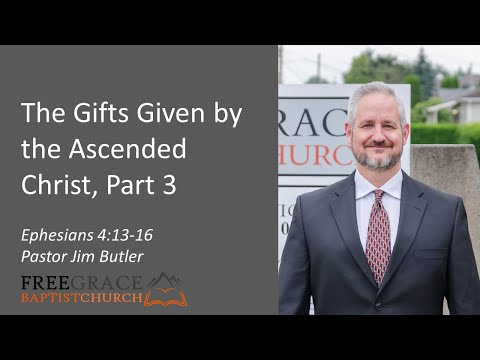
The Gifts Given by the Ascended Christ, Part 3
Ephesians 4:13–16 specifies the duration, goal, and effect of the teaching gifts Christ gives to the church — the pastor-teachers who continue until the Lord returns. The goal of that ministry is threefold: the unity of the faith, the knowledge of the Son of God, and the corporate maturity of the church measured against the fullness of Christ. A faithful preaching ministry functions as preventative maintenance, guarding the congregation against spiritual immaturity, doctrinal instability, and susceptibility to deceitful men. The sermon closes by calling the church to pray for the ascended Christ to raise up qualified men, and to receive their teaching as the God-ordained means of growth and stability.
The Promise of God's Presence
Exodus 33 confronts Israel with the consequences of the golden calf: God threatens to withhold His special presence, lest He consume a stiff-necked people in the wilderness. Moses responds not with passive acceptance but with escalating, bold intercession — arguing from grace received, from Israel's covenant identity, and finally from a desire to see God's glory itself. The sermon traces God's anthropomorphic self-disclosure, His accommodation of Moses' three petitions, and His self-proclamation as the God of sovereign grace and compassion. The controlling application is that it is the Giver, not the gift, that the people of God must desire above all things — and that access to His presence now comes through the mediation of Christ alone.

Live Stream - March 12, 2023
John 9:35–41 records the climax of the healing of the man born blind: not the physical restoration, but the spiritual salvation Jesus brings when he seeks out the cast-out man and presses upon him the question, 'Do you believe in the Son of God?' The sermon traces two movements — the salvation of the formerly blind man and the condemnation of the self-righteous Pharisees — to establish that Christ came to save those who see their spiritual bankruptcy and to judge those who trust in their own righteousness. Drawing on Matthew 9, 11, and the wider biblical narrative of a pursuing God, the sermon concludes with a call to preach both law and gospel: the law to shatter self-righteous complacency, the gospel to welcome every sinner who confesses, 'Lord, I believe.'

The Gifts Given by the Ascended Christ, Part 2
Ephesians 4:11–13 presents Christ's ascension gifts to the church — apostles, prophets, evangelists, and pastor-teachers — not as a support structure for general congregational ministry, but as the primary agents of three coordinate purposes: perfecting the saints, engaging in the work of ministry, and edifying the body of Christ. The sermon argues at length for a reading of verse 12 that sees all three prepositional phrases as dependent on the gifted men of verse 11, contesting the newer 'every-member ministry' interpretation found in modern translations and commentaries. The church's corporate maturity and doctrinal stability depend on qualified, diligent, Word-centered ministers whom Christ in his wisdom and kindness has given as gifts, and the congregation bears a corresponding responsibility to receive and honor that ministry.

The Healing of a Blind Man, Part 3
John 9:35–41 records the climax of the healing of the man born blind: not the restoration of his physical sight, but his salvation through faith in the Son of God. This sermon argues that providence and miracles do not save — only grace through faith in Christ does — and that Christ's coming pronounces both salvation on the spiritually blind who see their need and judgment on the self-righteous who claim to see but remain in their sin. The exposition closes with a direct appeal: the self-righteous require both the law, to expose the bankruptcy of their works-confidence, and the gospel, to offer the righteousness of Christ received by faith alone.
The Idolatry of Israel, Part III
Exodus 32:30–35 presents Moses interceding for Israel after the golden calf debacle, confessing their great sin and offering himself to be blotted out of God's book on their behalf. The sermon works through Moses's rebuke, his request, and God's response, giving particular attention to the theological question of whether God blots names from the Book of Life — resolving the tension by distinguishing the conditional Old Covenant (a covenant of works securing physical blessings) from the unconditional New Covenant, in which the elect are eternally secure in Christ. The Mosaic intercession is read typologically as pointing to Christ, who was, in effect, blotted out on behalf of his people. The sermon closes with application to the gravity of idolatry drawn from Romans 1 and a quote from John Stott.

The Idolatry of Israel, Part 2
Exodus 32:15–35 records the descent of Moses from Sinai and the immediate consequences of Israel's golden calf idolatry. This study covers four movements in the text: Moses' symbolic breaking of the covenant tablets, Aaron's evasive self-defense, the Levites' execution of three thousand offenders, and Moses' intercessory return to the Lord. The gravity of idolatry — as a direct assault on the being and honor of God — is traced from Sinai through Numbers 25 and Psalm 106, and pressed home with Calvin's warning that the human heart is a perpetual idol factory, turning even good gifts and the self into objects of ultimate devotion.

The Gifts Given by the Ascended Christ, Part 1
Ephesians 4:7–11 presents Christ the ascended Lord as the giver of gifts to His church. This sermon expounds the provision of God's grace in verse 7, the Christological argument drawn from Psalm 68 in verses 8–10, and the specific gifted men named in verse 11 — apostles, prophets, evangelists, and pastor-teachers. The preacher argues that Paul's appeal to Psalm 68 is typological: as Yahweh conquered Israel's enemies, received tribute, and distributed it to his people, so Christ conquered sin and death, ascended to the right hand of the Father, and now distributes gifts to His church through the Spirit. The practical weight of the sermon falls on killing pride, praying for elders and deacons, and recognising that the teaching ministry — not celebrity — is the bond that produces the love and unity Paul commands in verses 2–3.

The Healing of the Blind Man
John 9:1–12 presents the healing of a man born blind as a sign that Jesus is the light of the world — not merely a title (John 8:12) but a function he enacts in restoring both physical and spiritual sight. The sermon addresses the disciples' question about the cause of the man's blindness by distinguishing between suffering that is a direct consequence of particular sin and suffering that is ordained by God's sovereign providence to display his works. God's absolute sovereignty over all creatures and all their actions — including congenital affliction — is defended from Scripture and the 1689 LBCF chapter on providence, with Job, Paul, and the man born blind as converging witnesses that God's people walk by faith in Romans 8:28 when affliction comes. The sermon closes with an evangelistic appeal drawn from John's stated purpose: that readers believe Jesus is the Christ, the Son of God, and have everlasting life.

The Idolatry of Israel, Part 1
Exodus 32:1–14 records the catastrophic breach of Israel's covenant oath, sworn only weeks earlier in Exodus 24, as the people demand a visible god and Aaron fashions the golden calf. The passage exposes the persistent human tendency toward idolatry — rooted in total depravity and inflamed by impatience, carnality, and the craving for a manageable deity — and demonstrates that their sin was not a denial of Yahweh but a second-commandment violation: representing the true God by a forbidden image. The sermon then turns to Moses' masterful intercession, grounded in appeals to God's power, his glory before the nations, and his covenant oath to the patriarchs, and concludes with extended treatment of divine immutability and anthropopathism to explain why Exodus 32:14 ('the Lord relented') cannot be made to teach flux or change in God.

Live Stream - February 12, 2023
The cross of the Lord Jesus Christ is not a symbol or a bare historical fact but, as John Gill defined it, theological shorthand for the sacrificial, substitutionary, atoning death of Christ for his people. This exposition of the cross in the book of Acts traces six divine dimensions: purpose (the cross was decreed in eternity), promise (foretold by all the prophets), providence (carried out through the lawless hands of wicked men), power (accomplished by the divine Son who laid down his life voluntarily), proclamation (heralded by apostolic messengers to Jew and Gentile alike), and proficiency (effectually applied to all whom the Father gave to the Son). The closing exhortation calls believers to restore the art of marveling in Christ crucified — not as an occasional Sunday exercise but as the first motion of every morning.

The Joy of Abraham in the Day of Christ
John 8:54–59 presents the most concentrated claim to divine identity in this chapter: Jesus asserts unity with the Father, declares that Abraham rejoiced to see His messianic day, and finally identifies Himself as the eternal 'I Am' of Exodus 3:14. The sermon traces Abraham's anticipatory faith through the protoevangelium of Genesis 3:15, the Abrahamic covenant promises, and their fulfilment in Christ alone, demonstrating that old covenant saints were justified by grace alone through faith alone in Christ alone. The response of the religious leaders — picking up stones for blasphemy — confirms what they rightly understood Jesus to be claiming: equality with the Father. The sermon closes with a direct call to faith, contrasting the animosity of unbelieving Jerusalem with the joy of Abraham, and urging hearers not to harden themselves against the one who promises that whoever keeps His word shall never see death.

The Cross of Christ in the Book of Acts

The cross of Christ is not a threshold event left behind at conversion but the perpetual heartbeat of Christian life and worship. Working through the theme of the cross as it appears across the Book of Acts, this sermon traces six dimensions of the cross under six headings — divine purpose, divine promise, divine providence, divine power, divine proclamation, and divine proficiency — demonstrating that the crucifixion was planned in eternity, foretold throughout redemptive history, carried out through providential means, accomplished by the God-man himself, heralded by apostolic messengers, and effectually applied to all whom the Father gave the Son. The central application is a call to restore the art of marveling in the cross daily, not only on the Lord's Day, as the only fitting response to the reality that the God of heaven and earth took human flesh to bring many sons to glory.

The Apostle in Pisidian Antioch
Paul's sermon in the synagogue at Pisidian Antioch (Acts 13:38–43) proclaims two inseparable blessings at the heart of the apostolic gospel: the forgiveness of sins and justification by faith alone in Christ alone. The law of Moses exposes the sinner's total inability to meet God's demand for perfect righteousness, while Christ's life of obedience, substitutionary death, and resurrection supply both the pardon and the imputed righteousness the guilty sinner needs. The sermon concludes with a warning drawn from Habakkuk 1:5 against despising this gospel, and with the Gentiles' eager reception of the word as a pattern for which the church ought to pray in every generation.

The Champion of the Howling Wilderness
Matthew 4:1–11 presents the temptation of Christ not primarily as a model for personal resistance to sin, but as the decisive act of single combat in which the Lord Jesus Christ, as the second Adam and the true Israel, vicariously perfects obedience for his elect people. Where Adam fell in the garden amid every provision and where Israel failed in the wilderness under divine care, the Son of God enters a howling wilderness—hungry, alone, and unarmed—and vanquishes the devil point for point through resolute dependence on the word of God. The rich typological connections to Adam's expulsion, Israel's forty years of wandering, Moses' fast on Sinai, and David's unarmed single combat against Goliath converge on the one claim the passage presses: Christ alone is the covenantally faithful champion, and salvation belongs exclusively to those who trust in his doing, dying, and rising. Christians are therefore called to rejoice in their champion rather than to reduce this episode to a moral technique for fighting temptation.