
Theological term
Virgin Birth
9 sermons · All terms

The Gospel in the Furnace

Daniel 3 presents a true history of three faithful Jews who refuse to bow to Nebuchadnezzar's idolatrous decree, and in doing so become the occasion for a theophanic appearance of the pre-incarnate Son of God in the furnace. The chapter is set against the backdrop of the Mosaic covenant's curse sanctions: Israel's exile to Babylon is the direct consequence of their persistent covenant-breaking, and Babylon's rival liturgy — complete with herald, music, and threatened judgment — is a counterfeit of Israel's own God-ordained worship. The fire that Nebuchadnezzar intends as an instrument of destruction becomes instead an instrument of liberation, as the wicked are consumed, the bonds of the faithful are loosed, and the Son of God is revealed walking unhindered in the midst of the flames. The episode is a gospel pattern: Christ bears the fire of divine judgment so that those given to Him by the Father are not burned, and God's name is publicly vindicated before the nations.

2LCF Chapter 8 - Of Christ the Mediator, Part 4
The person of the Lord Jesus Christ — his true humanity, sinlessness, and mediatorial office — is examined through paragraphs 2, 3, and 7 of the 1689 London Baptist Confession of Faith chapter 8. The session works through the Virgin birth by the power of the Holy Spirit, the essential properties and common infirmities of Christ's assumed human nature, his sinlessness according to that nature, and the role of the Holy Spirit in equipping him for his mediatorial task. Paragraph 7's doctrine of the communicatio idiomatum is then treated, establishing what may and may not properly be said of Christ given the hypostatic union of two natures in one person.

The Promise of the Messiah

Genesis 3:14–24 contains the first announcement of the gospel — the proto-evangel — in which God promises that the seed of the woman will crush the head of the serpent, though at the cost of his own suffering and death. The sermon traces four observations from verse 15: the Redeemer would be a man born of a woman, would accomplish victory through suffering, through death, and in total victory over the devil. The latter half of the passage is then examined for the hope that extends beyond the fall: Adam's naming of Eve as 'mother of all living' as an act of faith in God's promise, and God's provision of tunics of skin as a typological foreshadowing of blood atonement. The hearer is urged to cast faith upon the seed of the woman — the Lord Jesus Christ — who has done what Adam and Eve, and what every sinner, could not do for themselves.
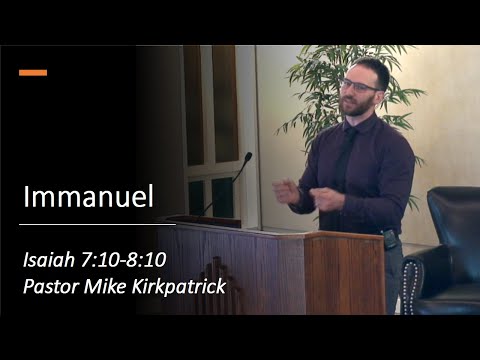
Immanuel

Isaiah 7:10–8:10 presents the Immanuel prophecy not as a comfortable seasonal text but as a word of judgment against Ahaz's faithless trust in Assyria and a word of hope for the covenant remnant. The sermon traces two contrasting realities: 'Assyria with us,' the consequence of royal unbelief, and 'God with us,' the promise that anchors the remnant through exile and desolation. The Immanuel sign finds its definitive fulfillment in Matthew 1, where the virgin-born Son saves his people from sin rather than merely political oppression — a truth that remains the ground of steadfastness for the church in every era of suffering and exile.

Genesis 11:27 - 12:20
Genesis 11:27–12:20 introduces the call of Abram from pagan Ur of the Chaldeans, setting in motion the Abrahamic covenant through which God promises to bless all the families of the earth. The passage is structured around two covenant themes — seed and land — with every circumstance (a barren wife, nomadic displacement, Canaanites in the promised land, famine, and Abram's own faithlessness in Egypt) designed to magnify divine initiative over human possibility. God's sovereign grace overcomes Abram's unbelief, protecting the holy seed even when Abram endangers Sarai through deception, demonstrating that the covenant rests entirely on God's faithfulness rather than the believer's. The sermon calls God's people to a lifelong posture of trust in Christ, Abram's promised seed, through whom all spiritual descendants of Abraham receive the blessings of the covenant of grace.
The Incarnation and True Humanity of Christ
Philippians 2:5–11 anchors a study of the incarnation and true humanity of the Lord Jesus Christ. Drawing on the Nicene, Constantinopolitan, Chalcedonian, and Athanasian creeds together with the 1689 London Baptist Confession of Faith, the study traces three aspects of the incarnation — assumption of human nature, the virgin birth, and the union of two natures in one person — before marshalling seven biblical proofs of Christ's full humanity. The central argument throughout is soteriological: the Son of God must be truly and perfectly man, body and soul, yet without sin, because only such a mediator can make propitiation for guilty sinners and be their faithful high priest.

Good Tidings of Great Joy
Luke 2:1–14 sets the birth of Jesus Christ within precise historical coordinates and a dense web of Old Testament prophecy, demonstrating that his coming was no accident of history but the fulfillment of promises stretching from Genesis 3:15 through Micah 5:2 and Isaiah 7:14. The sermon moves through three movements: the natal exposition of verses 1–7 (the period, the lineage of David, and the nativity itself), the angelic proclamation of verses 8–12 (the recipients, the herald, and the content of the gospel announcement), and the doxological exclamation of verses 13–14 (the heavenly choir and the meaning of 'peace on earth'). Christ is shown to be the true Savior over against the counterfeit claims of Roman imperial cult, truly divine, born of a virgin, in the house of bread, to those who are under the law, that he might redeem them. The sermon closes with a direct call to believe on Christ as the only source of true peace and to rejoice in him not merely at Christmas but throughout the year.
Who is Jesus?
Hebrews 1:1–3 presents Jesus Christ as the final and supreme revelation of God — prophet, priest, and king — whose identity is not negotiable. This sermon exposes the bankruptcy of reductive or sentimental views of Christ and argues that the message and the messenger are inseparable: to accept Jesus is to accept his exclusive claims. The exposition works through Christ's appointment as heir of all things, his role as creator and sustainer of the universe, his purging of sin as the perfect high priest, and his present session at the Father's right hand as the ground of the believer's confidence.
Sinful Kings, Interesting Women, and the Son of David
Matthew's genealogy of Jesus Christ (Matthew 1:2–17) is not a census document but a theological and covenantal argument: the Messiah is the legal heir to David's throne and the fulfillment of the Abrahamic promise that all nations would be blessed through his seed. The sermon examines the genealogy's three structural movements — Abraham to David, David to the exile, exile to Christ — attending closely to the sinful kings of Judah, the five women embedded in the line, and the passive construction 'of whom was born Jesus' that marks the Virgin Birth as the genealogy's climax. God's sovereign faithfulness to the Davidic covenant, not the righteousness of the human instruments, is the thread that binds the entire line and culminates in the one who saves his people from their sins.