
Theological term
Unconditional Election
15 sermons · All terms

The Command for the Conquest

Deuteronomy 7:1–11 sets out the divine policy for Israel's conquest of Canaan, commanding total destruction of the seven Canaanite nations and prohibiting political, social, and religious alliances with them. The passage answers the modern objection that God commanded genocide of innocent peoples by demonstrating from Leviticus 18 that the Canaanites were under divine judgment for extreme wickedness, and that God applied the same standard of judgment to Israel when Israel imitated their conduct. The distinction between Israel and Canaan rests entirely on sovereign, unconditional election — not Israel's numbers or righteousness — and finds its New Covenant fulfillment in the church as the true people of God united to Christ. The passage's prohibitions carry direct application to contemporary alliances: believers are to marry only in the Lord, avoid religious compromise on cardinal doctrines, and understand civil government's proper and limited role.

2LCF Chapter 10 - Of Effectual Calling

2LCF Chapter 10 expounds the doctrine of effectual calling — the sovereign, monergistic act by which God brings elect sinners from spiritual death to life in Jesus Christ. The chapter is read in full and examined in four paragraphs, with sustained attention given to the definition of effectual calling (paragraph 1) and its exclusively divine power (paragraph 2). God calls none but the predestinated, acts in his own appointed time, works through Word and Spirit, and employs no less power than that which raised Christ from the dead — leaving no room for human agency or merit in salvation. The session closes with brief pastoral notes on elect infants and the non-effectual gospel call, followed by congregational questions on infant salvation and the theology of divine simplicity undergirding unconditional election.

The Reaction to the Bread of Life Discourse
John 6:60–71 presents the sharpest crisis of Jesus's Bread of Life discourse: the mass departure of superficial disciples and the steadfast confession of the Twelve. This sermon traces three interrelated truths in Jesus's response — the life-giving Spirit as the sole agent of spiritual understanding, total depravity as the explanation for unbelief, and the sovereign grace of the Father as both the cause of faith and the ground of its perseverance. The application presses the church not to soften biblical truth before a resistant generation, but to press it, trusting that the Spirit alone opens the hearts of the dead to receive the words of eternal life.

The Bread of Life Discourse, Part 4
John 6:48–59 brings the Bread of Life discourse to its conclusion, with Christ pressing upon unbelieving hearers the absolute necessity of eating His flesh and drinking His blood — a sustained metaphor for saving faith in His atoning sacrifice. The sermon demonstrates that this language is not eucharistic or literal but is the equivalent of coming to, receiving, and believing on Christ as the one who gives His flesh for the life of the world. The exposition draws out five doctrines of grace embedded in the discourse — total depravity, unconditional election, particular redemption, irresistible grace, and the preservation of the saints — and closes by tracing the glory of Christ seen in the incarnation, His power to save, His divine origin, and His patient mercy in repeating the same call to faith before a rejecting audience.
Clip: Theology is crucial for every church and believer
Theology proper — the knowledge of who God is as Father, Son, and Holy Spirit — is not an academic luxury but the essential foundation of Christian life, worship, and witness. This sermon clip from an exposition of Ephesians 1:3–14 argues that the church's tendency to rush past doxological passages to practical ethics has left believers spiritually thin, prone to a mercenary relationship with God rather than one grounded in the infinite riches of his grace. The preacher calls the congregation to disciplined study of the Trinity, warning that without it believers become vulnerable to ancient heresies and lose the impetus to proclaim Christ to a lost world.

The Bread of Life Discourse, Part 2
John 6:35–40 presents Christ as the Bread of Life whose identity, sovereignty, and redemptive mission are inseparable. The sermon expounds three movements in the text: Christ's self-identification as the Bread of Life with its attendant promise that those who come to Him will never hunger or thirst; the declaration of divine sovereignty in verse 37, grounding the certainty of salvation in the Father's eternal gift of a people to the Son; and the revelation of the Father's will in verses 38–40, encompassing the Son's mediatorial mission, the preservation of all given to Him, and the call to every sinner to see the Son in the preaching of the Word and believe. The doctrines of grace — total depravity, unconditional election, definite atonement, irresistible grace, and the perseverance and preservation of the saints — are shown to arise directly from the text, and the sermon closes by pressing the free offer of the gospel against both Arminian uncertainty and hyper-Calvinist paralysis.

The Gracious Purpose of the Father
Ephesians 1:3–6 opens with what the Apostle Paul calls a 'barakah' — a formal blessing of God followed by specific reasons for that praise. This sermon expounds the Father's role in the covenant of redemption: His sovereign, unconditional election of sinners in Christ before the foundation of the world, and His predestinating purpose that those chosen would be made holy and blameless. Election is the cause, not the consequence, of faith and repentance — sinners dead in trespasses and sins are chosen not because of foreseen merit but according to the good pleasure of God's will alone. The sermon calls believers to respond to the doctrine of election not with defensive polemic but with the doxological posture Paul himself models: praise, blessing, and adoration to God Most High.

The Discourse on God's Salvation, Part 3
John 3:17–21 declares that the Son of Man's incarnation was a redemptive, not a condemnatory, mission — yet the world He entered was already under condemnation by virtue of Adam's sin and its own actual transgressions. The passage moves from the declaration of man's condemned state (vv. 17–18) to the demonstration of it (vv. 19–21): fallen humanity resists the light of Christ, loves moral darkness, and avoids exposure — the classic scriptural portrait of total depravity confirmed across Genesis, the Psalms, the Prophets, and the New Testament. The necessity of regeneration by the Holy Spirit follows directly: because sinners are constitutionally hostile to the light, they cannot come to Christ unless the Spirit first makes them alive and grants the graces of faith and repentance.
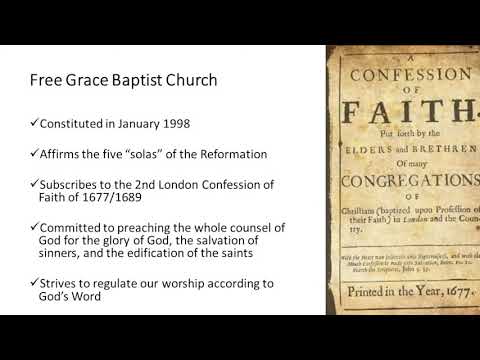
Introduction to the 1689 Second London Baptist Confession of Faith
Why should a church bind itself to a confession of faith? This introductory lesson on the Second London Baptist Confession of 1677/1689 grounds the answer exegetically in Ephesians 4 — where Christ gives gifted men to the church so that the body attains doctrinal unity and is no longer tossed about by every wind of teaching — and then traces the historical origins of the 1689 among the Particular Baptists, distinguishing them from Anabaptists, Presbyterians, and Congregationalists. Four functions of a confession are developed: defining, defending, discriminating, and disciplining with reference to the doctrine of the church. The lesson closes by distinguishing Reformed theology (Calvinism plus covenant theology plus the regulative principle) from mere five-point Calvinism, and by defending the confession's silence on matters of Christian liberty as a feature, not a defect.

The Content of Doxology
Jude's closing doxology (vv. 24–25) is not mere liturgical ornament but a theologically loaded ascription of praise to the Lord Jesus Christ that answers the heresy Jude has been combating throughout the epistle. The sermon works through three observations: Christ's exclusive preservation of his people, his singular greatness as the only God, the only Savior, and the only wise one, and the deserved praise that flows from those realities. The practical force is that the Christian's confidence under trial and the church's resistance to false teaching both rest on this one Christ, who keeps, presents faultless, and reigns with glory, majesty, dominion, and power, both now and forever.
Five Observations on Christ's Doctrine of Salvation (Part 1)
The doctrines of grace are not cold dogmatism but the very substance of the gospel, and Christ himself is their foremost teacher. Working from John 6:35–51 and ranging through the Gospel of John, this sermon opens a five-observation series on Christ's own doctrine of salvation, examining first the comprehensiveness of sin — total inability, bondage to the devil, and the love of darkness — and second, the unmitigated and unsolicited divine prerogative in salvation, by which God alone is the alpha and omega of the rescue of sinners. The third observation treats the precision and impeccability of Christ's crosswork: the Father's will that nothing given to the Son be lost, and the Son's answering cry of victory, 'It is finished,' as the ground of particular redemption. The unconverted are urged to see themselves as the Gadarene maniac — untamed, chained, and in need of the Christ who alone can bring a sinner to be clothed and in his right mind.
Five Truths that Demonstrate God's Glory, Part 2
Ephesians 1:3–14 sets the stage for the final two of five truths that demonstrate God's glory in salvation: irresistible grace and the preservation and perseverance of the saints. Drawing from Ezekiel 36, John 6, Romans 8, and Philippians 2, the sermon argues that regeneration precedes and produces saving faith (monergism), that God irresistibly draws the elect by transforming the heart rather than overriding the will, and that those united to Christ by grace alone through faith alone are kept by God until final glorification. The practical conclusion is that genuine salvation issues in Spirit-wrought perseverance expressed through the ordinary means of grace, grounded in gratitude for God's sovereign mercy.
Five Truths that Demonstrate God's Glory, Part 1
Ephesians 1:3–14 presents salvation as the coordinated work of the triune God — Father electing, Son redeeming, Spirit sealing — all directed to one end: the praise of God's glory. This sermon expounds the first three of five truths grounded in that passage: total depravity, unconditional election, and definite atonement. The preacher argues that only when sinners reckon with the depth of human corruption can they rightly appreciate the sovereign grace that saves, and that the proper response to these doctrines is not polemics but doxology.
One, Holy, Catholic, Apostolic Church
The four classical attributes of the church — one, holy, catholic, and apostolic — are not ecclesiastical slogans but biblical realities grounded in the redemptive work of Christ. Drawing from John 10:14–16 and John 17:15–23, this sermon argues that each attribute finds its source in Christ alone: his atoning blood purchases a universal people, his sanctifying work makes the church holy, his intercession secures her unity, and his apostles' doctrine defines her apostolicity. The sermon closes with a direct call to repentance for those outside of Christ and a summons to every believer to walk worthily of these gospel-given realities.
The Fall of Jerusalem
The fall of Jerusalem in 586 BC is not merely a military defeat but the executed decree of a sovereign God against a covenant people who refused to repent. Working through 2 Kings 23:28–25:21, this sermon traces four movements: the death of Josiah, the rise of Nebuchadnezzar, the four final kings of Judah, and the destruction and captivity of Jerusalem. The theological thread running through every catastrophe is divine sovereignty — Nebuchadnezzar is God's servant, the exile is God's rod, and even the closing note of hope in the survival of Jehoiachin is a witness that no empire can frustrate the Davidic covenant promise that finds its fulfillment in Jesus Christ.