
Theological term
Total Depravity
306 sermons · All terms

The Reaction to the Bread of Life Discourse

John 6:60–71 presents the sharpest crisis of Jesus's Bread of Life discourse: the mass departure of superficial disciples and the steadfast confession of the Twelve. This sermon traces three interrelated truths in Jesus's response — the life-giving Spirit as the sole agent of spiritual understanding, total depravity as the explanation for unbelief, and the sovereign grace of the Father as both the cause of faith and the ground of its perseverance. The application presses the church not to soften biblical truth before a resistant generation, but to press it, trusting that the Spirit alone opens the hearts of the dead to receive the words of eternal life.

The Bread of Life Discourse, Part 4
John 6:48–59 brings the Bread of Life discourse to its conclusion, with Christ pressing upon unbelieving hearers the absolute necessity of eating His flesh and drinking His blood — a sustained metaphor for saving faith in His atoning sacrifice. The sermon demonstrates that this language is not eucharistic or literal but is the equivalent of coming to, receiving, and believing on Christ as the one who gives His flesh for the life of the world. The exposition draws out five doctrines of grace embedded in the discourse — total depravity, unconditional election, particular redemption, irresistible grace, and the preservation of the saints — and closes by tracing the glory of Christ seen in the incarnation, His power to save, His divine origin, and His patient mercy in repeating the same call to faith before a rejecting audience.

The Bread of Life Discourse, Part 3
John 6:41–51 records the Jews' grumbling rejection of Jesus as the bread of life and his pointed rebuke of their unbelief. This sermon expounds that rejection in two movements: the nature of the Jews' complaint against Christ's divine origin, and Christ's twofold response — his assertion of the Father's sovereign, efficacious drawing of sinners and his appeal to the prophetic scriptures that learning from the Father issues in coming to the Son. The doctrines of total depravity and total inability are drawn from verse 44 and grounded in parallel texts from John 1, Romans 8, and Ephesians 2, establishing that salvation is possible only because the Father draws whom he will. The sermon closes with an exhortation to look to Christ in faith for everlasting life, the sole remedy for the problem of human sin.

The 8th Commandment, Part 2 & Economic Theory
The Eighth Commandment's prohibition against theft carries positive moral obligations — diligent labor, charitable giving, and biblical contentment — and provides the scriptural framework for evaluating economic and political systems. Drawing on the Mosaic law, the apostolic letters, and historical narrative, the sermon argues that socialism and communism are founded upon institutionalised theft and therefore stand under divine condemnation, while capitalism, for all its imperfections, respects the God-given right to private property. Israel's demand for a king in 1 Samuel 8 and Ahab's seizure of Naboth's vineyard in 1 Kings 21 are presented as biblical case studies in governmental confiscation. Hearers are exhorted to cultivate contentment, labor faithfully, give charitably, and judge all economic theory by the standard of Exodus 20:15.

The Redemptive Work of the Son, Part 1
Ephesians 1:6–7 sets forth the redemptive work of the Son within the triune economy of salvation, moving from the Father's electing purpose in eternity past to Christ's historic accomplishment of redemption in time. The sermon expounds two interlocking realities: the Father's sovereign initiative in bestowing grace upon the elect in the Beloved, and the Son's purchase of redemption through the shedding of his blood. Redemption is shown to be not a mere exercise of divine power but the payment of a ransom price, with the forgiveness of sins as its primary blessing — all flowing from the inexhaustible riches of God's grace. Hearers are called to respond with worship, gratitude, and increasing love for Christ, the Beloved of both the Father and the redeemed.

The Bread of Life Discourse, Part 2
John 6:35–40 presents Christ as the Bread of Life whose identity, sovereignty, and redemptive mission are inseparable. The sermon expounds three movements in the text: Christ's self-identification as the Bread of Life with its attendant promise that those who come to Him will never hunger or thirst; the declaration of divine sovereignty in verse 37, grounding the certainty of salvation in the Father's eternal gift of a people to the Son; and the revelation of the Father's will in verses 38–40, encompassing the Son's mediatorial mission, the preservation of all given to Him, and the call to every sinner to see the Son in the preaching of the Word and believe. The doctrines of grace — total depravity, unconditional election, definite atonement, irresistible grace, and the perseverance and preservation of the saints — are shown to arise directly from the text, and the sermon closes by pressing the free offer of the gospel against both Arminian uncertainty and hyper-Calvinist paralysis.
2LCF Chapter 11 - Of Justification, Part 1
What does it mean to be justified before a holy God, and on what basis does that standing rest? This confession study works through paragraphs one and two of Chapter 11 of the 1689 London Baptist Confession of Faith, examining the forensic nature of justification against both Roman Catholic infused righteousness and Baxterian neonomianism. The twin foundations of justification are established: the pardon of sins through Christ's passive obedience and the imputation of righteousness through his active obedience, both received by faith alone as a gift of God. The lecture closes by showing that justifying faith, though the sole instrument of justification, is never alone in the person justified but is always accompanied by sanctification.

The Bread of Life Discourse, Part 1
John 6:22–34 records the opening exchange of the bread of life discourse, in which Jesus confronts a crowd whose pursuit of Him is driven entirely by physical appetite rather than spiritual need. The sermon works through three movements: the exposed motive of the people (vv. 22–26), the Savior's exhortation to labor for food that endures to everlasting life (vv. 27–29), and the crowd's demand for a sign to rival Moses (vv. 30–34). Central to the exposition is Jesus' declaration that the 'work of God' is faith in the One the Father has sent — a faith that is itself God's gift — and His identification of Himself as the true bread of God who comes down from heaven to give life to the world, surpassing the manna of the wilderness and extending to every tribe, tongue, people, and nation.

The Gracious Purpose of the Father
Ephesians 1:3–6 opens with what the Apostle Paul calls a 'barakah' — a formal blessing of God followed by specific reasons for that praise. This sermon expounds the Father's role in the covenant of redemption: His sovereign, unconditional election of sinners in Christ before the foundation of the world, and His predestinating purpose that those chosen would be made holy and blameless. Election is the cause, not the consequence, of faith and repentance — sinners dead in trespasses and sins are chosen not because of foreseen merit but according to the good pleasure of God's will alone. The sermon calls believers to respond to the doctrine of election not with defensive polemic but with the doxological posture Paul himself models: praise, blessing, and adoration to God Most High.

2LCF Chapter 9 - Of Free Will
What does it mean that human beings have 'free will'? This confession-study exposition of 1689 London Baptist Confession chapter 9 argues that free will is real but always conditioned by the moral state of the heart — whether man is in original innocency, post-lapsarian sin, the state of grace, or the state of glory. The fourfold framework drawn from the Confession exposes the Pelagian and Arminian error of treating free will as unqualified and neutral, while grounding the sinner's inability and the believer's renewal entirely in sovereign, monergistic grace. The study closes with the pastoral application that even the believer's ongoing corruption is no surprise, and that the state of glory — not the present age — is where the will is at last perfectly and immutably free to good alone.

The Witnesses for the Defense
In John 5:31–40, Jesus faces charges of blasphemy and Sabbath-breaking and responds not by deflecting but by calling four corroborating witnesses to establish his consubstantiality with the Father: John the Baptist, his own works, the Father's testimony, and the Scriptures themselves. The sermon traces each witness in turn, showing that Christ's equality with God is not a later theological invention but the central claim of his own ministry, attested by every strand of divine revelation. The passage culminates in a sobering indictment: those who search the Scriptures seeking eternal life while refusing to come to Christ have missed the entire point of revelation, for Christ is the telos of all Scripture. Hearers are called to reckon with the gravity of sin and to come to Christ by grace through faith as the only ground of everlasting life.
The Consubstantiality of the Son, Part 2
John 5:24–30 presents Jesus responding to the Jewish charge that he made himself equal with God — not by retreating, but by affirming it through two divine functions: authority over life and authority over judgment. This sermon works through the declaration of that authority in eternal life (vv. 24–25), the rationale grounded in the eternal generation of the Son from the Father (vv. 26–27), and the promise of his authority on the final day of judgment (vv. 28–30, previewed). Central to the argument is the doctrine of consubstantiality — that the Son shares the one simple undivided divine essence with the Father from all eternity — which grounds both his power to effectually call dead sinners to life and his right to preside as judge of all the earth. The sermon calls hearers to receive Christ by faith, since only God himself can save sinners, and it is the voice of the Son of God alone that awakens the spiritually dead.

The Healing at Bethesda
John 5:1–15 presents the healing of a paralyzed man at Bethesda as a display of Christ's sovereign initiative, mercy, and power. The man's 38-year infirmity — physical, helpless, and rooted in personal sin — mirrors the spiritual condition of every sinner apart from grace: unable to save himself and without recourse. Christ seeks the man out from a great multitude, issues a word of command that effects immediate and complete healing, and then addresses the deeper need by calling him to repentance. Against this glory, the opposition of the Jewish leaders — fixating on Sabbath casuistry while ignoring a manifest work of God — warns against a religion so narrowly fastidious that it cannot acknowledge divine mercy.

Sanctity of Life
The Sixth Commandment — 'You shall not murder' (Exodus 20:13) — extends its protection to the pre-born, grounding the prohibition against abortion in the doctrine of man as image-bearer of God. This sermon works through three lines of argument: the precise meaning of the Hebrew word for murder, the consistent biblical testimony to the sanctity of human life at every stage from conception to old age, and the specific case law of Exodus 21:22–23, which affords the pre-born equal legal protection under the lex talionis. The sermon closes with a call to press the law upon a culture that celebrates abortion, while proclaiming that the blood of Christ is sufficient to forgive all who have participated in this sin.

The Depravity of Man
Romans 1:18–32 presents the universal human condition as one of willful suppression of God's self-disclosure in creation, resulting in inexcusability before a holy God. The sermon traces three movements in the passage: the revelation of divine wrath, the reason for that wrath in humanity's idolatrous exchange of the Creator for the creature, and the nature of God's judgment as a punitive giving-over of sinners to the very sins they pursued. The sermon argues that the preaching of the law — including the full weight of human depravity — is indispensable to the proclamation of the gospel, because sinners must understand their ruin before they will look to the remedy of blood atonement in Christ alone.

The Healing of the Nobleman's Son
John 4:43–54 records the second sign Jesus performed in Galilee: the healing of a royal official's son from a distance of sixteen miles. The passage exposes both the deficient faith that demands visible proof before believing and the sufficient power of Christ's spoken word, which heals without physical presence. The nobleman's earnest intercession for his dying son becomes a pointed application for parents to implore God persistently for their children's spiritual wellbeing. The sign itself points beyond physical healing to the life given to all who believe the word of Christ.

2LCF Chapter 6 - Of the Fall of Man, of Sin, and of the Punishment Thereof
The fall of man, as confessed in chapter 6 of the 1689 London Baptist Confession of Faith, is not merely a historical curiosity but the doctrinal foundation upon which the entire superstructure of redemption rests. This study works through all five paragraphs of the chapter, tracing the integrity of man at creation, the covenantal mechanics of the fall through Adam as federal head, and the resulting conditions of total depravity, total inability, imputed guilt, and remaining corruption in the regenerate. The covenants of redemption, works, and grace are shown to be structurally inseparable, so that any distortion of one inevitably corrupts the doctrine of justification by faith alone. Listeners are called to abandon any confidence in human free will for salvation, to extend charity toward fellow believers who struggle with remaining sin, and to marvel at a sovereign grace that alone can raise the spiritually dead.

The Crucifixion of Jesus, Part 4
What does it mean that Jesus cried out 'My God, my God, why have you forsaken me?' and then yielded up his spirit with a loud voice? This sermon on Matthew 27:47–50 reviews the cry of dereliction and then expounds the death of Jesus, arguing that Christ died not as a helpless victim but as the willing surety of the covenant of redemption, fulfilling the prophetic Scriptures to the last breath. The mockery of the bystanders — their misidentification of Elijah, their offer of sour wine — is set against the sovereign control of Christ, who lays down his life of himself. The sermon closes by drawing out three responses fitting the crucifixion: sober acknowledgment of human depravity, gratitude grounded in substitutionary atonement, and gospel proclamation that invites sinners to seek the altogether lovely Christ.

Exodus 18 - Jethro
Exodus 18 presents two interconnected events: the conversion of Jethro, priest of Midian, and his practical counsel to Moses on delegating judicial authority. The conversion of Jethro follows the pattern of one called out of polytheistic darkness into the knowledge of the true and living God — marked by joy, praise, confession of Yahweh's supremacy, and worship through sacrifice. The passage further grounds civil government in the fear of God and the rule of law, teaching that qualified civil rulers must be able, God-fearing, truthful, and free from covetousness — qualities that remain the standard for righteous governance in any age.

The Discourse on God's Salvation, Part 3
John 3:17–21 declares that the Son of Man's incarnation was a redemptive, not a condemnatory, mission — yet the world He entered was already under condemnation by virtue of Adam's sin and its own actual transgressions. The passage moves from the declaration of man's condemned state (vv. 17–18) to the demonstration of it (vv. 19–21): fallen humanity resists the light of Christ, loves moral darkness, and avoids exposure — the classic scriptural portrait of total depravity confirmed across Genesis, the Psalms, the Prophets, and the New Testament. The necessity of regeneration by the Holy Spirit follows directly: because sinners are constitutionally hostile to the light, they cannot come to Christ unless the Spirit first makes them alive and grants the graces of faith and repentance.

The Meeting with Nicodemus, Part 2
John 3:4–10 confronts every hearer with the absolute necessity of regeneration before any entrance into the kingdom of God. Working through Nicodemus's proud misunderstanding and Christ's patient explanation, this exposition argues that the new birth is entirely God's sovereign work — initiated by the Holy Spirit, prefigured in Ezekiel 36 and Deuteronomy 30, and entirely prior to saving faith. The sermon also draws out the Trinitarian theology embedded in Christ's wind analogy, showing that the Spirit's sovereign, effectual work in regeneration reveals who God is, not merely what He does.

The Meeting with Nicodemus
John 3:1–10 presents Jesus confronting Nicodemus — a ruler of the Sanhedrin sent by the Jerusalem religious leadership — with the doctrine of regeneration: that a man must be born again, born from above, before he can see or enter the kingdom of God. The sermon argues that the new birth is entirely a sovereign act of God Most High, not a command for the sinner to obey by his own power, and that regeneration logically precedes and produces saving faith rather than following it. Those born of God will evidence that new life through faith in Christ, a practice of righteousness, love for the brethren, and an overcoming of the world.

The Crucifixion of Jesus, Part 2
Matthew 27:39–44 records the threefold mockery of Christ on the cross — by passing bystanders, by the chief priests and scribes, and by the robbers crucified alongside him. Each taunt — that he could not save himself, that his kingship was fraudulent, that his claim to divine sonship was false — is shown to be an ironic confirmation of the very things the mockers deny: Christ's identity as temple builder, King of Israel, and Son of God. His refusal to descend from the cross is not weakness but the perfect obedience of the covenant of redemption, the very means by which he saves his people from their sins. The sermon closes with the conversion of the penitent thief as a trophy of sovereign grace and an argument for faith in a willing Savior.

The Testimony of John the Baptist, Part 2
John 1:29 records the Baptist's singular declaration — 'Behold the Lamb of God who takes away the sin of the world' — a phrase saturated with the weight of Old Testament redemptive history. This sermon works through the theological freight of that title, tracing the Lamb through Genesis 22, Leviticus 16, and Isaiah 53 to show that Christ's mission is substitutionary blood atonement: he takes up the sin of his people in order to take it away entirely. The 'world' from which sin is removed is not every individual without exception but men and women without ethnic or national distinction, saved by grace alone through faith in Christ alone.

2nd London Baptist Confession (Chapter 1) - June 20th
What makes Christian faith in the Bible something more than a blind leap? Working through the first five paragraphs of Chapter 1 of the 1689 London Baptist Confession of Faith, this exposition unpacks Sola Scriptura under three headings drawn from the Confession's opening line: the certainty, sufficiency, and infallibility of Holy Scripture as 'the only sufficient, certain, and infallible rule of all saving knowledge, faith, and obedience.' The sermon establishes that the Bible's authority rests on God himself as its author — not on church tradition, human reason, or self-referential claim — and that full persuasion of its divine origin comes through the inward testimony of the Holy Spirit (2LCF 1.5). Rational evidences — manuscript attestation, historical reliability, eyewitness testimony to the resurrection, and the fulfillment of prophecy — are presented not as the ground of faith but as means to bolster the believer's confidence and equip him to give a reasoned defense of the hope within him.
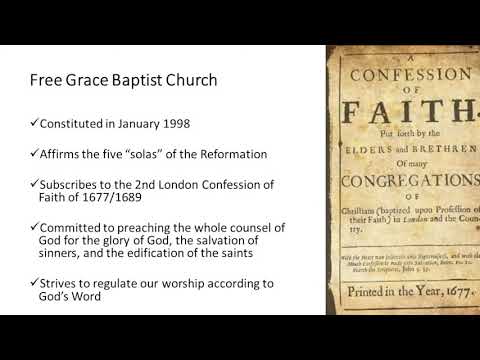
Introduction to the 1689 Second London Baptist Confession of Faith
Why should a church bind itself to a confession of faith? This introductory lesson on the Second London Baptist Confession of 1677/1689 grounds the answer exegetically in Ephesians 4 — where Christ gives gifted men to the church so that the body attains doctrinal unity and is no longer tossed about by every wind of teaching — and then traces the historical origins of the 1689 among the Particular Baptists, distinguishing them from Anabaptists, Presbyterians, and Congregationalists. Four functions of a confession are developed: defining, defending, discriminating, and disciplining with reference to the doctrine of the church. The lesson closes by distinguishing Reformed theology (Calvinism plus covenant theology plus the regulative principle) from mere five-point Calvinism, and by defending the confession's silence on matters of Christian liberty as a feature, not a defect.

The Mission of the Word, Part 2
John 1:10–13 presents two contrasting responses to the mission of the incarnate Word: the rejection of the world and of Israel, and the reception of those upon whom Christ confers the right to become children of God. The sermon works through the threefold use of 'world' in verse 10, the parallel between Israel's ancient rebellion and their rejection of the Messiah, and the sovereign grace underlying faith and new birth in verses 12–13. Central to the exposition is the Reformed insistence that regeneration precedes faith — those who receive Christ by believing do so because they have first been born of God — against both Pelagian and Arminian construals of conversion.

The Divine Savior and His Afflicted People
Matthew 14:22–33 confronts the church with the Christological reality that the presence of Christ does not guarantee the absence of trial. Working through the storm on the Sea of Galilee, Christ walking on the water, Peter's sinking, and the disciples' confession of Christ as the Son of God, this exposition presses the claim that the 'I Am' of Exodus and the Psalms is the same Lord who meets his afflicted people in the middle of their storm-tossed sea. The sermon closes with a direct rebuke of health-and-wealth theology and a call to displace the fear of man with a robust fear of God grounded in Christ's sovereign lordship over creation.

The Trial before Pilate, Part 2
Matthew 27:15–23 records Pilate's attempt to grant amnesty to Jesus through the Passover prisoner-release custom, a device that exposes the cowardice of the Roman governor, the envious malice of the Jewish religious leaders, and the terrifying moral bankruptcy of mob rule. The passage is expounded under five heads — the custom of amnesty, the leaders' motivation of envy, the warning of Pilate's wife, the demand of the multitudes, and Pilate's cross-examination — each of which illuminates the comprehensive reach of human depravity. The substitution of Barabbas for Jesus is treated as emblematic of definite atonement: the just going to the cross in the place of the unjust, securing both the forgiveness of sins and the imputed righteousness of Christ received by faith alone. Hearers are urged not to be carried along by ungodly leaders, to flee to Christ without delay, and to eat the Lord's Supper as a memorial of the blood atonement and active obedience of the Second Person of the Trinity wrought entirely on behalf of his people.

The Practice of the Church
Acts 2:41–47 describes the first-century church's response to apostolic preaching and, when read in light of the whole New Testament, is prescriptive for churches today. The sermon traces two main movements: the power of the gospel that produces faith, repentance, and baptism, and the fourfold practice of the church — steadfast continuation in the apostles' doctrine, fellowship, the breaking of bread, and prayer. Cessationism is applied to the signs and wonders of the apostolic era, while the ongoing marks of the church are drawn from the Belgic Confession's articles on the true church and the obligations of her members. The practical burden is that believers must resist both the reduction of church life to entertainment and the temptation to substitute online participation for embodied, corporate worship.