
Theological term
Sovereignty of God
169 sermons · All terms

The Trial Before Pilate, Part 1

John 18:28–32 records the opening of Jesus' trial before Pontius Pilate, but the wickedness on display there cannot be understood without first reckoning with the trial before the Sanhedrin in Matthew 26. The sermon works through both proceedings to expose two realities in collision: the hypocrisy, lawlessness, and impotence of the Sanhedrin, and the sovereign decree of God that ordained every detail of these events for the salvation of His people. Even the creedal phrase 'suffered under Pontius Pilate' is shown to root the faith in history, confirm Christ's innocence, and demonstrate that He endured this degradation not for any guilt of His own but entirely for the sake of those He came to save.

The LORD's Help in the Day of Trouble
Psalm 20 presents the prayer and confidence of the covenant people on behalf of their king going into battle, but its deeper register is the church's intercession for Christ — the true David — as he undertakes his redemptive mission. The sermon works through two movements: the petitions of verses 1–5 (the presence of trouble, the place of help, the provision of grace, and the response of joy) and the confidence of verses 6–9 (grounded in the Lord's salvation of his anointed, contrasted sharply with those who trust in chariots and horses). The expositor draws out the prophetic significance of the psalm, showing that what the old covenant church prayed for before the first advent is answered in the resurrection, ascension, and session of Christ, and applies the psalm's stark contrast between trusters in earthly strength and trusters in the name of the Lord to every hearer's standing before God on the day of judgment.

What Is Confessing the Faith 2026? | Understanding God's Decree | Reformed Baptist
This episode of Ask Free Grace Baptist Church introduces the 2026 Confessing the Faith conference (April 10–11, Chilliwack, BC), which will focus on 1689 London Baptist Confession chapter 3, the doctrine of God's decree. Three speakers — Dr. Jim Renihan and Dr. Richard Barcelos of the International Reformed Baptist Seminary, and Pastor David Charles — will address the biblical, historical, and pastoral dimensions of the decree. The conversation explains why the doctrine matters: God's sovereign ordination of all things is not fate or impersonal force but the purposeful governance of the God revealed in Scripture, producing stability, peace, and worship in his people.

The Defeat of the Wicked by the Lord
Psalm 52 confronts the believer who watches the wicked prosper, use their tongue to destroy the innocent, and appear to escape all consequence. Working through the psalm's three movements — the boasting of the evildoer, God's fourfold judgment from heaven, and the believing response — the sermon shows that the Lord's steadfast love is the anchor of hope when earthly circumstances seem out of control. The psalm is then read christologically: Christ is contrasted with the wicked who will be destroyed forever, Christ is the righteous one who laughs at his enemies, and Christ is himself the green olive tree in whom the believer finds safety. The sermon calls both believer and unbeliever to stay with Jesus, trusting his timing rather than demanding God act on a human schedule.

The Crucifixion of Christ
How did it come to pass that the only holy, harmless, and undefiled man who ever lived was led out to be crucified between two criminals? John 19:16–24 answers on two levels: on the surface, the wickedness of men — Pilate's cowardice, the Sanhedrin's envy, the multitudes' manipulation — and beneath it, the sovereign, predetermined purpose of God who sent His Son to be the Lamb of God, the substitute for sinners. The sermon traces the location at Golgotha as the fulfillment of Genesis 3:15, the charge written by Pilate as an unwitting confession of Christ's kingship, and the conversion of the dying thief as the paradigm case of saving faith — seeing nothing but a bloodied, dying man on a cross and confessing Him as Lord of a kingdom.
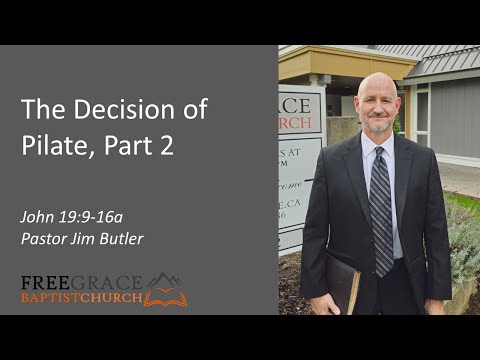
The Decision of Pilate, Part 2
John 19:9–16 records the exchange between Jesus and Pontius Pilate that culminates in the verdict of crucifixion. This sermon works through Pilate's confusion and arrogant assertion of authority, Christ's counter-declaration that all governing power derives from God Most High, and the theological weight of the greater sin belonging to those who delivered Christ up. The death of the Lamb of God at the hour of Passover preparation is no accident — it is the predetermined plan of the Father, the fulfillment of every Passover sacrifice, and the ground of forgiveness for wretched sinners who look to Christ in faith.

The Decision of Pilate
Pilate's encounter with the condemned Christ in John 19:5–16 exposes three interlocking realities: Pilate's own tension between justice and political cowardice, the divine authority behind all earthly power, and the sovereign verdict that sends the Son of God to the cross. The crowd's cry "Crucify him" and Pilate's capitulation, far from frustrating God's plan, enact it — the last Adam standing in judgment to accomplish what the first Adam forfeited. The sermon calls every hearer to look in faith to the one delivered up by divine appointment, receiving through his blood the forgiveness and imputed righteousness that alone secures acceptance before God.

The Believer's Response to Trials
James 1:2–8 addresses the Christian's response to trials — not with grief or complaint, but with counted joy grounded in a clear theological understanding of God's purpose in suffering. The sermon works through two movements: the believer's response to trials in verses 2–4 (identifying, expecting, and rightly receiving them) and the believer's request during trials in verses 5–8 (seeking wisdom from a generous God and coming in faith without double-mindedness). The central application is that Christians must lay up this theology before trials arrive, so that when affliction comes, they are equipped to respond with settledness, faith, and prayer rather than anger or despair.

The Oracles of Balaam, Part 1
Numbers 23 records the first two oracles of Balaam, in which God sovereignly overturns Balak's hired curse and compels a pagan seer to pronounce blessing upon Israel instead. The first oracle establishes the singularity of the covenant people — a nation dwelling apart, not reckoned among the nations — and the impossibility of cursing those whom God has not cursed. The second oracle grounds that protection in the immutability of God: because God is not a man that he should lie or repent of his word, no sorcery or divination can prevail against Jacob. The passage ultimately anticipates Romans 8:31 — if God is for his people, no Balak, no Balaam, and no adversary can stand against them.

The Meeting Between Balak and Balaam
Numbers 22 introduces the Balaam narrative by establishing why a pagan seer is summoned to curse Israel and what unfolds before he ever arrives at Balak's court. The chapter exposes Balaam as a prophet for hire whose heart is drawn by greed even as he formally complies with Yahweh's directives — a tension the narrator signals subtly but the New Testament resolves with unmistakable condemnation. God's sovereignty over Balaam is dramatized in the donkey episode: the seer who cannot see is outperformed by the beast he threatens to kill, and the angel of the Lord stands as adversary to any who would curse the covenant people. The chapter's governing message is that no king's treasury and no hired soothsayer can neutralize a nation over whom the living God fights.

The Conduct of the Believer
Philippians 1:27–30 presents a twofold exhortation to the church: that believers conduct themselves in a manner worthy of the gospel, and that they do so with courage in the face of adversaries. The sermon expounds the Greek word for citizenship as the governing concept of verse 27, grounding the call to worthy conduct in the reality of justification by faith — the life of sanctification flows necessarily from what God has graciously accomplished in the believer. Corporate unity in striving together for the faith of the gospel, and undaunted boldness before enemies, are shown to be not optional virtues but demonstrable proofs of sovereign grace at work in God's people.

The Salvation of Sinners on Pentecost
Peter's sermon on the day of Pentecost (Acts 2:22–42) declares the life, death, resurrection, and exaltation of Jesus Christ as the exclusive ground of salvation, and calls sinners to repentance and faith. The sermon examines what genuine repentance means — a change of mind inseparable from faith, not a prior moral reformation — and argues that baptism is the sign of what God has already accomplished internally, not the instrument of forgiveness. Acts 2:39 is addressed directly against paedobaptist appeals, with the promise of the Spirit shown to belong to all who are effectually called, not to the physical infants of believers. The sermon closes with an exhortation to follow the Pentecost pattern: preach the gospel, baptize disciples, and teach them in the church.

The Spirit's Conviction of the World
The Holy Spirit's conviction of the world — of sin, of righteousness, and of judgment — is not a promise that every hearer will be saved, but a declaration that the Spirit will confirm the identity and vindication of Jesus Christ through the apostolic proclamation. Drawing on John 16:8–11 alongside Acts 2 and Acts 24, this sermon argues that the Spirit's primary work in the world is to expose unbelief in Christ, to declare the sufficiency of Christ's imputed righteousness, and to announce the judgment already rendered against the ruler of this world at the cross. The church's calling is therefore not to measure success by numerical response but to preach sin, righteousness, and judgment faithfully, trusting the Spirit to do His own sovereign work.

The World's Greater Liability Before God
Jesus declares in John 15:21–25 that the world's hatred of his disciples flows from a deeper hatred of himself and the Father who sent him, making the rejection of Christ not merely a moral failure but a compounding of guilt before God. Increased revelation brings increased liability: those who witnessed Christ's word and works have no excuse for their unbelief, and their rejection of the Messiah is simultaneously a rejection of the triune God. The sermon argues that right Trinitarian theology is therefore not an academic luxury but a matter of eternal life and death, since to deny the Son is to deny the Father. Believers are called to stand fast in the word of God, rejoice in suffering as those united to Christ the master, and proclaim the exclusive claims of Jesus Christ without apology.

Anger at the Goodness of God

Jonah 4 exposes the problem of unrighteous anger with God's sovereignty, as the prophet sulks over the mercy God shows to Nineveh — the very enemies he wished to see destroyed. The passage sets God's character as the gracious covenant Lord, slow to anger and abounding in lovingkindness (Exodus 34), against Jonah's petty double standard: grieving more over a withered plant than over the souls of 120,000 people. God's gentle rebuke of Jonah magnifies rather than diminishes his sovereign mercy, which extends not merely to Israel but to the nations — a Gentile foretaste ultimately fulfilled in the proclamation of the gospel through Jesus Christ. The sermon calls hearers to repent of covetous anger at God's goodness toward others, and to trust that the same sovereign God who pitied Nineveh has pitied sinners in Christ Jesus.

The Ministry in Iconium, Part 2
Acts 14:1–7 records the apostolic ministry in Iconium: bold gospel preaching met by coordinated Jewish opposition, a divided city, a violent plot, and a strategic withdrawal to Lystra and Derbe. This exposition traces the pattern of persistent opposition to the gospel across Acts and the Old Testament, establishing that persecution is not an aberration but the ordinary condition of faithful gospel ministry. The sermon draws four conclusions: the inevitability of persecution for godly living, the perseverance required of gospel ministers, the wisdom to know when to stay and when to flee, and the indispensability of the Holy Spirit for any effectual proclamation of the Word.

What is Hyper-Calvinism?
Hyper-Calvinism so elevates the sovereignty of God that it cancels out the responsibility of man, producing a fatalism that paralyses sinners rather than calling them to repentance and faith. Over against both hyper-Calvinism and Arminianism, apostolic gospel preaching holds divine sovereignty and human responsibility as 100% true simultaneously — friends, not rivals requiring balance. The gospel is propositional revelation concerning Christ's life of perfect obedience, substitutionary death, and bodily resurrection, and sinners are commanded to believe and repent on the authority of that word alone. The brazen serpent of Numbers 21 illustrates the point: the remedy is look and live, not first examine yourself and then look.

The Introduction to the Upper Room Discourse
John 13:1–3 functions as the theological introduction to the entire Upper Room Discourse (John 13–16), establishing three controlling realities: the arrival of Christ's appointed hour, the opposition of the devil through Judas, and the resolute authority and mission of the Son of God. The love of Christ for his own — unchanging, constant, and infinite — is the motivating force behind everything he teaches his disciples in those chapters. Those whom the Father gave to the Son are not a morally superior class but guilty sinners chosen in sovereign grace, loved to the uttermost through the cross, resurrection, intercession, and into eternity. Sound Trinitarian doctrine, far from being merely academic, is the very fuel that moves the church to worship, witness, and perseverance.

Live Stream - January 14, 2024
Exodus 12 sets forth the institution of the Passover as a type pointing forward to the atoning work of Christ, the true Lamb of God. The sermon works through the preparation for the Passover (vv. 1–11) and its twofold significance in judgment and mercy (vv. 12–13), before drawing out the antitypical fulfillment: the identification, nature, appropriation, and particular benefits of Christ's sacrifice. A closing illustration from D. A. Carson presses the pastoral application that the ground of the believer's assurance before God is not the strength or quality of faith but the blood of the Lamb alone.

The Apostolic Sermon
Peter's sermon on the day of Pentecost, recorded in Acts 2:14–41, is the first apostolic proclamation of the risen Christ, and it follows a carefully constructed argument: correcting a false accusation, demonstrating from Old Testament Scripture who the Messiah is, and confronting the hearers with their guilt before the exalted Lord. The sermon examines how Peter builds his case through the life, death, resurrection, and ascension of Christ, drawing on Joel 2, Psalm 16, and Psalm 110 to show that every stage of Christ's humiliation and exaltation was foreordained. The hearers' anguished question — 'What shall we do?' — is answered with a call to repentance, faith, and baptism, which Peter grounds not in human decision alone but in the sovereign, effectual call of God. The application presses hearers to submit to Christ as Lord, to feel the weight of sin's horror, and to follow repentance and faith with public baptism and membership in the local church.

The Judicial Decision to Murder Jesus
The Sanhedrin's formal decree to execute Jesus, recorded in John 11:47–57, is the most extreme miscarriage of justice in human history — a body constituted to administer God's law plotting the murder of the only innocent man who ever lived. The sermon expounds the irony that Caiaphas, driven entirely by political self-preservation, nevertheless prophesied accurately: one man would die for the nation, and not for that nation only, but to gather the scattered children of God from every tribe, tongue, people, and nation. John's theological commentary on the high priest's words (vv. 51–52) unpacks the doctrinal heart of penal substitutionary atonement — the just for the unjust, the holy and harmless for the thoroughly defiled. The passage calls believers to stand in awe that Christ willingly walked into this kangaroo court, refused self-defense, and bore the wrath of godless men so that sinners might be freed from the wrath of God.
Clip: People MUST Come to the Saviour
The absolute sovereignty of God does not annul the responsibility of every hearer to come to Christ. Drawing on Acts 4:12, John 6:37, and John 8:51, this clip argues that hyper-Calvinism distorts the gospel by severing divine sovereignty from the genuine duty of sinners to repent and believe. The consistent biblical witness — confirmed by Calvin's reading of Habakkuk — is that those who despise the gospel bring a more severe judgment upon themselves, while those who come to Christ in faith will not be cast out.

The Believer's Response to Trials
James 1:2–8 addresses the believer's proper response to trials in a fallen world, pressing two demands: a joyful disposition toward suffering and a prayerful request for wisdom to navigate it. Drawing on John Calvin, Thomas Manton, and John Gill, the sermon distinguishes the trials of verse 2 (divine testing aimed at maturity) from the temptations of verse 13 (solicitations to sin), and traces the progression from endurance through testing to the perfection of verse 4. The sermon closes with a gospel call: the one who mastered suffering perfectly was Christ himself, whose righteousness is given to the believer by grace alone through faith alone.

The Lord's Prayer
True prayer is distinguished from hypocrisy and paganism not merely by form but by motivation, manner, and theological grounding. Matthew 6:5–13 exposes the Pharisee who prays to be seen by men and the heathen who employs vain repetition to coerce a god, and sets against both the secret, faith-driven communion of the genuine child of God with his Father. The Lord's Prayer is not a liturgical formula to be recited but a structured outline — ordering petition rightly, with God's name, kingdom, and will before any human need — rooted in the sovereignty of a Father who knows what his children require before they ask. The sermon calls believers to examine their own prayer lives: whether prayer functions as worship and dependence upon the triune God, or as a merely transactional exercise.

Live Stream - January 08, 2023
Ecclesiastes 8:10–17 confronts the believer with one of the sharpest enigmas of a fallen world: the wicked die unpunished, the righteous suffer unjustly, and God's judgment appears indefinitely delayed. The preacher argues that Solomon's response is not philosophical resignation but two concrete imperatives — fear God and enjoy what God gives — grounded in covenant trust rather than in sight. The sermon closes by pressing the theological significance of God's delayed judgment: without it there is no gospel, no day of grace, and no salvation for elect sinners who would otherwise have perished in their first sin.

The Reaction to Jesus and His Words
John 7:40–53 records the sharply divided public reaction to Jesus's preaching at the Feast of Tabernacles and the private opposition of the Sanhedrin to him and his followers. The crowd fractures over whether Jesus is the promised prophet of Deuteronomy 18 or the Christ himself, while the religious leadership responds not with argument but with contempt, attempting to silence him through force and scorn. The temple officers sent to arrest Jesus return empty-handed, confessing that no man has ever spoken as he has — a testimony that magnifies Christ's divine authority even as the Sanhedrin descends into lawlessness. The sermon calls hearers to abandon the confusion of the crowd and the hardness of the Sanhedrin, and instead to come to Christ in faith, receiving the everlasting life he freely offers.

The Arrest of Peter and John
Acts 4:1–12 presents the arrest of Peter and John by the Sanhedrin and Peter's Spirit-filled defense before the council, in which he declares Jesus of Nazareth — crucified and risen — as the sole name under heaven by which men must be saved. The sermon traces two movements: the sovereign advance of God's word despite the imprisonment of its preachers (the number of believers growing to five thousand), and the christological and soteriological content of Peter's address, which grounds salvation exclusively in Christ's active obedience, atoning death, and resurrection. The stone rejected by the builders has become the chief cornerstone, and those who refuse him will ultimately be crushed by him. The sermon applies these realities to the perpetual persecution of the church, the exclusivity of the gospel, and the urgent call to believe on Christ alone for salvation.

The Sovereignty of Yahweh of Israel

Psalm 29 is a polemic against the Canaanite storm god Baal, written by David to demonstrate that Yahweh alone is Creator and sovereign King over all powers—heavenly and earthly. The seven-fold repetition of 'the voice of the Lord' traces a storm from the Mediterranean through Lebanon, the supposed abode of Baal, into the wilderness of Kadesh, showing at each point that Baal is no rival but a fleeing creature before the Creator. The same sovereignty that sent Baal running and that enthroned God over Noah's flood is the ground of the church's peace amid the spiritual and geopolitical chaos of the present age. Those outside Christ are warned that a greater storm—the wrath of God—is coming, and the only shelter is repentance and faith in the Lord Jesus Christ.

The Call for Christian Growth
Unrepentant sin and a failure to desire the Word of God are the chief hindrances to Christian growth — and that growth is not merely a personal blessing but a corporate responsibility. Working through 1 Peter 2:1–5, this sermon argues that believers are living stones being built into a spiritual house, and that weak, doctrinally shallow Christians produce a structurally unsound church. The exhortation is concrete: mortify the sins of malice, deceit, hypocrisy, envy, and slander; cultivate an insatiable hunger for the pure milk of the Word; and do so knowing that justification rests on faith alone while sanctification calls every believer to steady, disciplined growth.

The Refuge for God's People
Psalm 46 sets the people of God in the midst of cosmic and political chaos and calls them to find their sole refuge in the Lord of hosts. This exposition works through four movements in the psalm — the assurance of God's presence, the demonstration of his power over creation and the nations, the invitation to rehearse his past works in redemptive history, and the command to be still and know that he is God. The sermon argues that Reformed Christians who rightly confess God's sovereignty in salvation must equally rest in that sovereignty under tyranny, pandemic, and war. The chief application is that the church must know God — his perfections, his names, his covenant fidelity — because it is the knowledge of God, not practical principles, that steadies the soul and fuels missionary confidence in the darkest of times.