
Theological term
Sola Scriptura
62 sermons · All terms

The Presence of the God of Peace

Philippians 4:8–9 presents two inseparable imperatives — meditate on whatever is true, noble, just, pure, lovely, and of good report, and then do what has been learned, received, heard, and seen in the Apostle Paul — with the promise that the God of peace will be with those who obey. The sermon argues that orthodoxy and orthopraxy are not alternatives but are inextricably bound: the failure to practice truth indicts the practitioner, not the doctrine. The source of right thinking is both the light of nature (general revelation accessible to all men) and the special revelation of Scripture, which governs and clarifies all truth. The hearer is called to fill the mind with God's word, live consistently with it in a pagan society, and trust that the grace which saves also teaches and equips for godly conduct.

Ask FGBC #55: How Many Valid Interpretations Can A Bible Passage Have?
How many valid meanings does a Bible passage have? Drawing on 1689 LBCF Chapter 1, paragraph 9, this Q&A session argues that Scripture has one intended meaning — the meaning the Holy Spirit inscribed — but that this single meaning carries a full sense that unfolds through continued study and canonical cross-reference. The difference between exegesis and eisegesis is examined, with the warning that preconceptions and pet doctrines distort rather than discover the text's meaning. Christ's gift of teachers to the church means that 'Scripture alone' as the infallible rule of interpretation does not license a 'me and my Bible alone' approach divorced from creeds, confessions, and faithful expositors.
The Defense of the Faith
Jude 3 commands every believer — not merely church officers — to contend earnestly for the faith once for all delivered to the saints. This sermon works through the exhortation (v. 3), the motivation supplied by the reality of internal heresy (v. 4), and the disposition required of faithful contenders (vv. 17, 20–21). The defense of objective Christian truth is grounded not in combative temperament but in the knowledge that God loves his people, and is sustained through the study of Scripture, prayer, and a forward orientation toward the return of Christ.

2LCF Chapter 1 - Of the Holy Scriptures (Paragraphs 1-3)
The 1689 London Baptist Confession of Faith opens with the doctrine of Holy Scripture because all subsequent confessional theology stands or falls on this foundation. This session works through paragraphs 1–3 of Chapter 1, establishing first the necessity of Scripture — grounded in the insufficiency of general revelation for saving knowledge and the cessation of direct prophetic revelation — and then the identity of Scripture, treating the question of canon (which books belong) and the exclusion of the Apocrypha. Three criteria for canonicity are examined: the providential exposure of books, the divine attributes Scripture bears, and apostolic origin broadly understood.
The Use of the 2nd London Confession
A confession of faith is not a human addition to Scripture but a tool the church uses to define, defend, discriminate, discipline, and delimit its doctrine. Drawing on passages from the Pastoral Epistles, Jude, and Ephesians 4, this Sunday School address argues that the Second London Baptist Confession of 1689 serves the local church in six concrete ways: it establishes doctrinal boundaries, equips members for apologetics, vets candidates for ministry, grounds church discipline, protects Christian liberty by identifying what lies outside its purview, and anchors the church in the catholicity of the Reformed tradition. The session closes with a call to reject autonomous biblicism in favour of confessional theology understood as the fruit of the Spirit's ongoing work in the teaching ministry of Christ's church.

CTF 2024 Session 7 - Q&A Panel Discussion
A conference Q&A panel addresses a wide range of confessional, theological, and pastoral questions arising from lectures on the 1689 Second London Baptist Confession and its relationship to broader Reformed orthodoxy. Topics range from the nature of creedal subscription and what it means to be Reformed, to the hermeneutics of typology, the mystery language of Ephesians 3, the humanity and knowledge of Christ, divine immutability and impassibility, and the differences between the Second London Confession and the Three Forms of Unity. The panel consistently grounds its answers in the churchly authority of confessions over individual interpretation, the centrality of the means of grace for generational faithfulness, and the necessity of theological humility before the accumulated witness of the church.

CTF 2024 Session 1: An Engaging Overview of the Second London Confession of Faith

The Second London Confession of Faith (1689) did not arise in a vacuum but was forged in response to specific doctrinal crises and pastoral needs within the 17th-century particular Baptist churches. This address traces the historical circumstances behind the Confession's 1677 publication — including the Christological heresies of Thomas Collier and Matthew Caffin, the threat of Quaker mysticism, fear of Roman Catholic resurgence, and the pastoral concern for family catechesis. The speaker then surveys the Confession's 32 chapters as a coherent theological architecture, showing how its structure reflects the covenant of grace viewed from both divine and human perspectives. Listeners are urged to recover the Confession as a living instrument of orthodoxy, protection, instruction, and proclamation for the church today.

Ask FGBC #1 - What is a Reformed Baptist?
What distinguishes a Reformed Baptist from a generic Calvinist or a generic Baptist? This question-and-answer exchange works through the defining marks of the Reformed Baptist tradition: the supreme authority of Scripture, covenant theology, the regulative principle of worship, the centrality of preaching, believers' baptism by immersion, and congregational church polity. The 1689 Second London Baptist Confession is identified as the clearest doctrinal touchstone, held not loosely but in full subscription — not as an authority alongside Scripture, but because it faithfully summarises Scripture's teaching. The historical designation 'Particular Baptist' is also commended as an accurate and less confusing alternative label for the same tradition.

2LCF Chapter 8 - Of Christ the Mediator, Part 1

What does it mean to confess that Jesus Christ is very God and very man, and why does the precision of that confession matter for eternal life? This introductory session on 2LCF Chapter 8 surveys the doctrine of Christ the Mediator by establishing both the necessary posture and the interpretive rules required for sound Christology, then sets out seven reasons why the study of Christ stands at the center of all Christian theology. The session moves from the scope of Scripture as Christ-centered revelation, through the connection of eternal life to a right knowledge of Christ, to the comprehensiveness of all redemptive benefits being located in union with Him, calling the hearer to pursue a high Christology as the only safe and saving confession.

The Infallible Rule of All Saving Knowledge
Second Timothy 3:16–17 grounds the authority and sufficiency of Scripture in its divine origin: God breathed out these words, making them infallible, inerrant, and profitable for every purpose of the Christian life and ministry. The sermon works through the identity of Scripture (the whole Old and New Testament canon), its authority as the God-breathed word that admits no human arbitration, and its fourfold utility — doctrine, reproof, correction, and instruction in righteousness. The specific profitability of verse 17 is shown to fit the man of God for every good work, with the primary work being the preaching of the word commanded in 2 Timothy 4:2. The practical summons is to receive Scripture's reproof and correction without shrinking, and to value sound doctrine as the very means by which God shepherds, sanctifies, and equips his people.

The Cessation of Revelatory Gifts
First Corinthians 13:8–13 declares that tongues, prophecy, and words of knowledge have a designed and determined end, giving way to the completed New Testament canon. This sermon argues from Acts 2, 1 Corinthians 13–14, Hebrews 1–2, Ephesians 2, and Daniel 9 that the revelatory gifts were temporary, apostolic, and tied to the first advent of Christ and the foundational era of the church. The 'perfect' of 1 Corinthians 13:10 refers not to the eschatological consummation but to the inscripturated fullness of divine revelation in the New Testament scriptures. Christians today are called to glory in the completed Word of God and in the abiding work of the Holy Spirit in regeneration and illumination, rather than seeking gifts that have ceased.

2LCF Chapter 2 - Of God and of the Holy Trinity
The doctrine of the Trinity is the capstone of the confession's treatment of God, asserting that the one divine and infinite being eternally exists as Father, Son, and Holy Spirit — three subsistences of one substance, power, and eternity, each possessing the whole divine essence undivided. This session works through six confessional affirmations: that Trinitarian monotheism excludes tritheism; that confessing one God in three persons is no contradiction; that the persons do not collectively comprise God in fractional parts; that the persons are distinguished solely by their eternal relations of origin; that Father, Son, and Holy Spirit are fully co-equal, co-eternal, and consubstantial; and that the doctrine of the Trinity is not a cold academic exercise but the very foundation of all communion with God and comfortable dependence on Him.

2LCF Chapter 1 - Of the Holy Scriptures, Part 1
The necessity of Holy Scripture, as confessed in 2LCF Chapter 1, paragraph 1, arises from the insufficiency of general revelation to communicate saving knowledge. While creation and providence manifestly display God's goodness, wisdom, and power — leaving all men without excuse — they do not and cannot reveal blood atonement, the incarnation, or justification by faith alone. It therefore pleased God to commit His will to writing, producing a Scripture that is the only sufficient, certain, and infallible rule of all saving knowledge, faith, and obedience. The session closes with extended discussion of cessationism, the distinction between inerrancy and infallibility, and the hermeneutical principle that Scripture interprets Scripture.

Introduction to the 1677/1789 2nd London Baptist Confession of Faith
The 1689 London Baptist Confession of Faith — formally composed in 1677 and adopted by particular Baptist churches in 1689 — stands in deliberate continuity with the Westminster Confession and the Savoy Declaration, adapting their language to reflect distinctively Baptist convictions while maintaining solidarity with the broader Reformed tradition. This introductory session traces the Confession's historical origins, its relationship to the First London Confession of 1644–46, and the legal and ecclesiastical context in which particular Baptists operated under the Act of Toleration. Six reasons are then advanced for why a 21st-century church should subscribe to a 17th-century confession: to define, defend, discriminate, discipline, distinguish matters of Christian liberty, and develop an appreciation for the history of the church. The session closes by urging that confessionalism, rightly understood, is not proud biblicism but the humble reception of gifts Christ has given to his church across the ages.

2LCF Chapter 30 - Of the Lord's Supper
The Lord's Supper is a divinely instituted ordinance of the New Covenant, not a repeated sacrifice but a perpetual memorial of Christ's once-for-all offering upon the cross. This confession study works through 2LCF Chapter 30 paragraph by paragraph, exposing the errors of Roman Catholic transubstantiation and Lutheran consubstantiation on Christological grounds — to predicate ubiquity of Christ's humanity is to deny true humanity — while recovering the Calvinian understanding of Christ's real spiritual presence by the Holy Spirit. The chapter is shown to be comprehensive: institution, nature, celebration, elements, and recipients of the supper are each addressed. Worthy receivers feed spiritually upon Christ crucified and all the benefits of his death; the supper functions as a means of grace confirming faith, nourishing the soul, and promoting obedience.

The Good Shepherd, Part 1
John 10:1–10 stands in direct continuity with John 9: having healed and saved the man born blind, Jesus turns to indict the Pharisees as thieves and robbers who exercised illegitimate authority over the sheepfold of God. The sermon works through Jesus' parabolic illustration in verses 1–6, showing that the true shepherd enters by the door (granted access by God the Father), calls his own sheep by name with a specific and effectual summons, and leads them out — while the sheep, made alive by the Spirit in regeneration, hear and follow his voice and flee the stranger's. The application is double: believers are called to seek the shepherd's voice in Scripture, family worship, and the preaching of the Word, and the unconverted are called to ask with the blind man, 'Who is he, Lord, that I may believe in him?'

The Freedom in Receiving the Son
John 8:30–36 sets before the reader a sharp contrast between the blessedness of spiritual liberty and the wretchedness of spiritual slavery. This sermon expounds the theological order of salvation — justification by grace alone through faith alone precedes and produces the disciple's abiding in Christ's word, not the reverse — and then traces what that freedom means: deliverance from the curse of the law, the condemnation of sin, the wrath of God, and the tyranny of the devil. The church's calling to be the pillar and ground of the truth (1 Timothy 3:15) demands that she identify, propagate, contend for, and protect that truth in every generation.
2LCF Chapter 1 - Of the Holy Scriptures, Part 2
Hermeneutics — the science of biblical interpretation — stands at the center of this study through paragraphs 5 to 10 of Chapter 1 of the 1689 London Baptist Confession of Faith. The session works through five principles: the scope of Scripture (Christ as its organizing center), the sufficiency of Scripture (including good and necessary consequences), the perspicuity of Scripture, the availability of Scripture through faithful translation, and the two classical interpretive rules — the analogy of Scripture and the analogy of faith. The study closes by defending the proper use of creeds, confessions, and the writings of faithful theologians as gifts Christ has given to his church, while insisting that Holy Scripture alone is the supreme and final judge in all controversies of religion.

2nd London Baptist Confession (Chapter 1) - June 20th
What makes Christian faith in the Bible something more than a blind leap? Working through the first five paragraphs of Chapter 1 of the 1689 London Baptist Confession of Faith, this exposition unpacks Sola Scriptura under three headings drawn from the Confession's opening line: the certainty, sufficiency, and infallibility of Holy Scripture as 'the only sufficient, certain, and infallible rule of all saving knowledge, faith, and obedience.' The sermon establishes that the Bible's authority rests on God himself as its author — not on church tradition, human reason, or self-referential claim — and that full persuasion of its divine origin comes through the inward testimony of the Holy Spirit (2LCF 1.5). Rational evidences — manuscript attestation, historical reliability, eyewitness testimony to the resurrection, and the fulfillment of prophecy — are presented not as the ground of faith but as means to bolster the believer's confidence and equip him to give a reasoned defense of the hope within him.
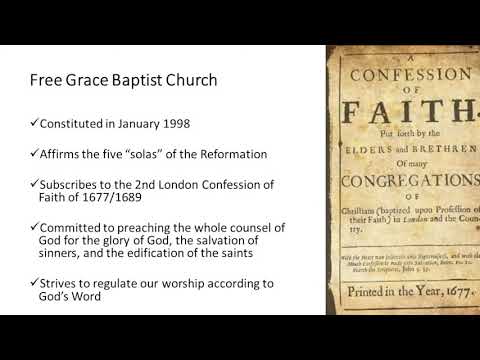
Introduction to the 1689 Second London Baptist Confession of Faith
Why should a church bind itself to a confession of faith? This introductory lesson on the Second London Baptist Confession of 1677/1689 grounds the answer exegetically in Ephesians 4 — where Christ gives gifted men to the church so that the body attains doctrinal unity and is no longer tossed about by every wind of teaching — and then traces the historical origins of the 1689 among the Particular Baptists, distinguishing them from Anabaptists, Presbyterians, and Congregationalists. Four functions of a confession are developed: defining, defending, discriminating, and disciplining with reference to the doctrine of the church. The lesson closes by distinguishing Reformed theology (Calvinism plus covenant theology plus the regulative principle) from mere five-point Calvinism, and by defending the confession's silence on matters of Christian liberty as a feature, not a defect.

The Utility of Confessions and Introduction to the Second London Baptist Confession
Confessions of faith are not competitors to Scripture but are faithful summaries of biblical doctrine, and the church has historically depended on them for good reason. This address introduces the Second London Baptist Confession of 1689, tracing its historical origins among the Particular Baptists of the 17th century and its relationship to the Westminster Confession and the Savoy Declaration. Five interlocking uses of a confession are then examined: defining church doctrine, defending it against error, discriminating between members and officers on doctrinal grounds, disciplining departures from orthodoxy, and distinguishing confessed doctrine from matters of Christian liberty. The goal is not confessional enslavement but confessional clarity — guardrails that protect the church and free her members to worship and grow in the grace and knowledge of Christ.

The Second Missionary Journey, Part 5
Acts 17:10–15 records the ministry and departure of Paul and Silas at Berea, where the Jewish hearers were commended as 'more noble-minded' than those in Thessalonica because they received the word with readiness and examined the Scriptures daily to verify Paul's proclamation of Jesus as the Christ. The sermon expounds three movements in the text — the perseverance of the missionaries, the tenacity of unbelieving opposition, and the noble-mindedness of the Bereans — and draws sustained application from Nehemiah 8 and the parable of the sower in Luke 8 on the right reception of God's word. The Berean example is pressed as a standing model for the church: Scripture is sufficient and self-evidencing, and the truth has nothing to hide and everything to gain by investigation. Hearers are exhorted to come to the word with expectancy, attentiveness, reverence, and responsiveness, since faith comes by hearing and hearing by the word of God.

The Council at Jerusalem, Part 3
James closes the Jerusalem Council (Acts 15:13–21) by grounding the inclusion of Gentiles in the covenant people of God not in human experience alone but in the prophetic word of Amos 9:11–12 and in the eternal decree of God. The rebuilding of David's tabernacle is the spiritual kingdom of Christ, which was purposed in eternity, announced through the prophets, and executed in the crosswork and exaltation of the Son. From this doctrinal foundation James renders a definitive verdict against Judaizing — that justification is by faith alone, apart from circumcision or the ceremonies of Moses — and then offers practical accommodations to facilitate communion between Jewish and Gentile believers in the one new humanity Christ has made.

The Builder of the Church
Peter's confession in Matthew 16:13–18 — 'You are the Christ, the Son of the living God' — is the theological axis around which the identity, foundation, builder, and triumph of the church all turn. The sermon expounds Christ as the rock on which the church is built, arguing against the Roman Catholic identification of Peter as that foundation and for the Protestant position that the church rests on Christ himself, the fulfillment of the Davidic covenant promise in 2 Samuel 7. The gates of Hades function as a defensive posture, not an offensive one, meaning the church is on mission against a kingdom that cannot finally hold, because its builder is King Jesus. The call to hearers is to make Peter's confession their own — that Christ is the Son of the living God — since no defective ecclesiology is fatal, but a wrong Christ is.
Free Grace Baptist Church - June 9, 2019 AM
The Christological unity of Scripture — the truth that the Old Testament prophets testified to Christ by the Spirit of Christ — grounds the believer's hope under suffering and shapes a properly Christocentric hermeneutic. Drawing from 1 Peter 1:10–12, this sermon argues that the Spirit of Christ was personally present in and through the prophets, disclosing the sufferings of Christ and the glories that follow, so that the Old Testament is not Israel-centric but Christ-centric in its ultimate focus. The sermon calls believers to read Scripture not merely for cognitive information but as a supernatural encounter with Christ himself, whose revealed glory transforms the reader into his likeness and sustains eschatological hope in the face of suffering and persecution.
The Samaritan Pentecost
Acts 8:14–17 records the coming of the Holy Spirit upon the Samaritan believers through the apostolic ministry of Peter and John — an event frequently misread as a proof text for Roman Catholic confirmation or Pentecostal second-blessing theology. This sermon argues that the Samaritan Pentecost is neither a repeatable pattern for individual Christian experience nor evidence of a subsequent work of the Spirit distinct from regeneration, but rather a unique, unrepeatable, redemptive-historical event marking the corporate inclusion of Samaritans into the one covenant people of God, in direct fulfillment of Acts 1:8. The three Pentecosts — Jerusalem (Acts 2), Samaria (Acts 8), and the Gentile household of Cornelius (Acts 10) — together attest Christ's messianic lordship from the Father's right hand and demonstrate the unity of His people across every ethnic division. Believers are called to receive the Word by faith, submit to baptism as its public sign, and embrace the corporate solidarity of the one new man in Christ.

The Rejection of the True Prophet of God
When Ahab of Israel gathered four hundred prophets to sanction his campaign at Ramoth-Gilead, he had already resolved what he wanted to hear — and hated the one man who would tell him the truth. This exposition of 1 Kings 22:1–28 traces the confrontation between King Ahab and the prophet Micaiah, examining how the rejection of the true prophet is ultimately the rejection of the Word of God itself. Drawing on the parallel Paul draws in 2 Timothy 4:1–4, the sermon calls hearers to guard their hearts against the perennial temptation to accumulate teachers who scratch itching ears, and to receive the whole counsel of God — rebuke and exhortation included — as the mercy of a wise and sovereign Father.

Wisdom from Above

James 3:13–18 presents heavenly wisdom in direct contrast to the earthly, sensual, and devilish wisdom that breeds jealousy, faction, and confusion. This exposition identifies four fundamental features of wisdom from above: it is communicated from the triune God through His Word and Spirit; it is a copy of God's own pure, immutable wisdom suited to finite creatures; it is contemplative, engaging the regenerate mind to perceive all things in relation to God; and it is consequential, bearing the practical fruit of peace, meekness, mercy, and a good life ordered by God. The sermon calls hearers to test whether they possess this wisdom by asking whether they trust Christ alone, love God, and earnestly seek to frame their lives in the order God has established.

The Believer's Commitment to the Lord
Proverbs 3:5–6 commands an entire, exclusive, and exhaustive commitment to Yahweh — a trust that spans salvation and all of ordinary life. The sermon works through three structural elements of the text: the command to trust in the Lord with all the heart, the prohibition against leaning on one's own understanding, and the exhortation to acknowledge God in all one's ways with the promise that He will direct the believer's paths. The doctrine of remaining corruption in the regenerate explains why this command is needed, while the perfections of God — His impassability, immutability, and divine simplicity — ground the assurance that His commitment to His people is equally entire, exclusive, and exhaustive. Hearers are called to search Scripture for explicit texts, implicit applications, and general principles, and to cultivate lives of prayer as a concrete expression of dependence upon God.

The Empty Tomb and the Risen Lord
The empty tomb of Matthew 28:1–10 is not merely an absence but a proclamation: Christ was raised bodily from the dead by the Father, vindicating His atoning work and confirming every prophetic word He spoke. The sermon works through the discovery of the empty tomb by the women and the appearance of the risen Lord, attending carefully to the apologetic weight of the narrative details — the guards' terror, the invitation to examine the tomb, the folded graveclothes, and the physical feet of Jesus grasped in worship. The message closes with 1 Corinthians 15, pressing the stakes of the resurrection: without it, faith is futile and sin remains unatoned; because Christ is risen, justification, sanctification, and glorification are secured for all His brethren.