
Theological term
Sola Gratia
187 sermons · All terms

The Freedom in Receiving the Son

John 8:30–36 sets before the reader a sharp contrast between the blessedness of spiritual liberty and the wretchedness of spiritual slavery. This sermon expounds the theological order of salvation — justification by grace alone through faith alone precedes and produces the disciple's abiding in Christ's word, not the reverse — and then traces what that freedom means: deliverance from the curse of the law, the condemnation of sin, the wrath of God, and the tyranny of the devil. The church's calling to be the pillar and ground of the truth (1 Timothy 3:15) demands that she identify, propagate, contend for, and protect that truth in every generation.

The Light of the World
In John 8:12, Jesus declares 'I am the light of the world,' a claim that situates him within the great 'I Am' tradition of Exodus 3:14 and the Isaianic servant songs, asserting both his full deity as the eternal Son and the universal scope of his messianic mission to Jew and Gentile alike. The sermon traces the 'I Am' statements across John's Gospel, showing that Jesus consciously identifies himself with Yahweh and that the light-imagery of the Old Testament finds its fulfillment in his person and work. Darkness in John is not physical but ethical — the guilt, depravity, and rebellion of a world that hates the light — and the follower of Christ, by grace through faith, passes from that darkness into the light of life. The church is therefore called to hold forth the word of the gospel as light in a morally darkened age, trusting that God is able to transfer sinners from the kingdom of darkness into the kingdom of his Son.

The Saving Grace of God, Part 3
Ephesians 2:8–10 demolishes every notion that the sinner contributes to his own salvation, whether by supplying the faith or by bringing meritorious works. This sermon works through the passage in two movements: the application of redemptive grace in verses 8–9, where salvation is shown to be by grace alone through a faith that is itself God's gift and not the sinner's offering, and the consequence of redemptive grace in verse 10, where the good works of the justified are presented not as the cause or condition of salvation but as its God-prepared effect. The controlling purpose is doxological — that in every age where sinners are saved, the exceeding riches of God's grace in Christ Jesus are displayed, and God alone receives the glory.

The Feast of Tabernacles, Part 4
On the last and greatest day of the Feast of Tabernacles, Jesus stood and cried out two declarations that divide all of humanity: 'Where I am, you cannot come,' addressed to those who persist in unbelief, and 'If anyone thirsts, let him come to me and drink,' addressed to all who would believe. This sermon expounds John 7:32–39, tracing the murderous intentions of the Pharisees and chief priests, the sovereign rejection of the reprobate by Christ himself, and the astonishing mercy that leads him to offer living water to the very crowd seeking his arrest. The evangelist's commentary in verse 39 is shown to be a post-resurrection theological statement linking the abundant giving of the Holy Spirit to the glorification of Christ, drawing on the Old Testament water-and-Spirit passages and fulfilled at Pentecost according to Joel's prophecy.

The Conversion of Rahab the Harlot
Joshua 2 presents the conversion of Rahab the harlot as a sovereign interruption of divine mercy within the context of holy war and Israelite conquest. Before Israel kills a single Canaanite, the narrative compels the reader to stand in awe of a God who justifies a pagan prostitute by grace through faith alone — faith that is demonstrated by treason against Jericho and the sheltering of two spies. Rahab's confession that Yahweh is God in heaven above and on earth beneath places her alongside the great confessions of Scripture, and her inclusion in the Messianic genealogy of Matthew 1 reveals that the conquest was always inseparable from the redemptive purposes of God. The sermon calls hearers to resist self-righteous judgmentalism, to trust in a Christ who saves to the uttermost, and to marvel that the ancestress of Jesus was the shady lady of Jericho.
Wedding Stream
Paul's prayer in Ephesians 3:14–19 frames the theological heart of this wedding message: that the strength, knowledge, and fullness believers need for godly marriage flow entirely from what God has accomplished in salvation. The sermon moves from the doctrinal foundation of Ephesians 1–2 through the spiritual petitions of chapter 3, arriving at the practical marital responsibilities of Ephesians 5 — the wife's submission and respect, the husband's sacrificial love and leadership after the pattern of Christ and the church. Drawn from Luther's counsel and the creation account in Genesis, the message calls both husband and wife to reflect the mystery of Christ's covenant union with his bride in the daily conduct of their marriage.

The Gracious Purpose of the Father, Part 2
Ephesians 1:5–6 presents predestination not as cold metaphysical fate but as an act of divine love, wherein God in love predetermined his elect unto adoption as sons by Jesus Christ, according to the good pleasure of his own will and not any foreseen merit in the creature. The sermon works through the motive of predestination (the love of God), the means (adoption as sons by Christ, grounded in the covenant of redemption), and the goal (the praise of the glory of God's grace), drawing extensively on parallel Pauline and Johannine texts. Against both Arminian and Pelagian objections, the preacher demonstrates that predestination to adoption is precisely what makes Christian praise coherent — the creature contributes nothing, and God receives all glory. Believers are called to live out their adopted status by walking in love, light, and wisdom as members of the household of God.

The Meeting with the Samaritan Woman, Part 1
John 4:1–15 presents Jesus passing through Samaria not merely as a geographical necessity but as a divine appointment rooted in his mission to save sinners without distinction of race, sex, or moral standing. The sermon examines the two natures of Christ as the theological ground for understanding why Jesus is both weary at the well according to his humanity and omnisciently aware of the woman's sin according to his divinity. The offer of living water is traced through its Old Testament antecedents — Isaiah, Jeremiah, Ezekiel, and Zechariah — and shown to signify the whole grace of salvation freely given, not earned, and never revoked. Hearers are pressed to see in the Samaritan woman's partial interest an indictment of those who have heard the gospel repeatedly yet remain indifferent, and are called to cry out to Christ for the living water he is willing to give.

The Crucifixion of Jesus, Part 3
Matthew 27:45–46 records the fourth of Christ's seven words from the cross — the cry of dereliction, 'My God, my God, why have you forsaken me?' — and its interpretation demands both exegetical precision and doctrinal care. The darkness from the sixth to the ninth hour was not a solar eclipse but a supernatural sign of divine judgment, recapitulating the ninth plague pattern and marking the moment the Passover antitype was slain. The cry itself does not imply any ontological division within the Trinity, any dissolution of the hypostatic union, or the suffering of all three persons; rather, it expresses the withdrawal of divine consolation from the Son according to his true humanity as he bore, in our place as surety, the full weight of penal wrath. Believers are called to ground their assurance not in felt divine presence but in the covenant faithfulness of the God to whom Christ still cried 'my God' even in the depth of his substitutionary suffering.
The Departure of Paul
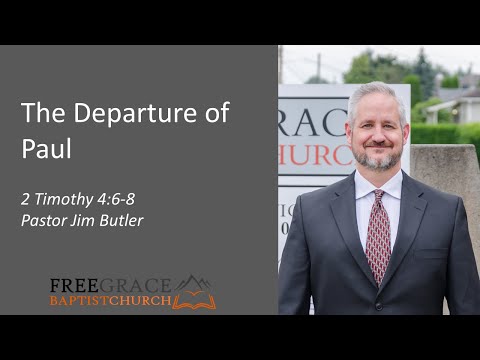
Paul's farewell words in 2 Timothy 4:6–8 — poured out as a drink offering, having fought the good fight, finished the race, and kept the faith — are examined as a model of faithful perseverance unto death. The sermon argues that the confidence Paul expresses at the 11th hour of his life was inseparable from the faithfulness he exercised throughout every preceding hour, and that the crown of righteousness he anticipates is entirely a gift of God's grace, not a payment for services rendered. Believers are called to examine whether they are now fighting, running, and keeping the faith so that they may, by grace, make the same confession at the end of their days; and unbelievers are warned to consider the infinite worth of Christ, the certainty of judgment, and the righteousness the righteous Judge freely offers in the gospel.

The Divinity of the Word, Part 2
John 1:3–5 teaches that the eternal Word is the creator of all things, establishing Christ unmistakably on the divine side of the creator-creature distinction. The sermon works through the Trinitarian doctrines of inseparable operations and appropriations, showing from Genesis 1, Psalm 33, Job 26, Colossians 1, and Hebrews 1 that creation is the undivided act of the one God, yet scripture distinctively attributes it to the Son. Because Jesus is creator, sustainer, and enthroned Lord, his people need not be paralyzed by circumstance — and the darkness, however violently it resists the light, cannot overcome it.

The Ethics of Motherhood
Titus 2:3–5 sets older women in the church as instructors of younger women in the domestic virtues that honor the created order and adorn the doctrine of God. Against a cultural moment that treats the word 'mother' as offensive and obliterates God-wrought gender distinction, the passage calls women to love husbands and children, to exercise discretion, chastity, and diligence in the home, and to submit to their own husbands — not as cultural accommodation but as a reflection of the eternal created order grounded in Genesis and reaffirmed by Christ's redemption. The overarching rationale Paul supplies is theological: the conduct of women in household and church either blasphemes or adorns the Word of God before a watching world. The sermon closes by grounding every duty in grace alone through faith alone in Christ alone, warning that no degree of faithful motherhood constitutes grounds for justification.

The Gospel and Jerusalem Sinners
Peter's Pentecost sermon in Acts 2:22–42 presents the gospel as an objective message focused on the life, death, resurrection, and exaltation of Jesus Christ — not a feeling or a personal response. This exposition works through Peter's call to repentance and baptism, the nature of imputed righteousness received by faith alone, and the sovereign scope of God's grace that reaches even the murderers of Christ. The sermon closes with the practice of the early church — steadfast continuance in apostolic doctrine, fellowship, the Lord's Supper, and prayer — as the pattern for all who are genuinely saved by grace.

The Second Missionary Journey, Part 9
Acts 18:12–28 traces the close of Paul's second missionary journey through three episodes: his trial before the Roman proconsul Gallio, his departure from Corinth back to Antioch, and a preview of the Alexandrian Jewish teacher Apollos. The exposition treats Gallio's dismissal of the Jewish charge against Paul as a model of properly bounded civil authority — punishing wrongdoing, not regulating theology — while also exposing Gallio's failure to protect Sosthenes as a departure from impartial justice. Paul's continued residence in Corinth after the hearing illustrates faith in the sustaining promises of Christ, and the sermon closes with a call to pray for faithful gospel preachers and an obedient people who respond to their ministry.

The Council at Jerusalem, Part 2
The Jerusalem Council of Acts 15 confronts the Judaizing error that Gentile salvation requires circumcision and law-keeping in addition to faith in Christ. Drawing on Peter's testimony in Acts 15:6–12 and its grounding in the Cornelius episode of Acts 10, the sermon argues that God himself made no distinction between Jew and Gentile, purifying hearts by faith alone — making any human addition to the gospel a direct testing of God. Faith is shown to be the empty hand that receives Christ's righteousness, not a virtue that earns it, and the church is called to guard the law-free gospel against every cultural or ecclesiastical supplement that would corrupt it.

The Council at Jerusalem, Part 1
Acts 15:1–5 introduces the Jerusalem Council by presenting the Judaizing heresy in its starkest form: certain men from Judea taught that circumcision must be added to faith in Christ for salvation, striking simultaneously at the law's proper use and at the sufficiency of Christ's finished work. The passage is set in its chronological context, distinguishing the events of Galatians 2 from the council itself, and showing that the problem was not merely one of Jewish-Gentile social relations but a soteriological crisis with eternal consequences. Paul and Barnabas respond with uncompromising confrontation, the church at Antioch sends delegates to Jerusalem, and the passage closes with the same Judaizing demand surfacing within the Jerusalem church — demonstrating the universality and perpetuity of the tendency to add human merit to sovereign grace. The exhortation is to resist every form of works-righteousness and to preach the law and gospel in their proper distinction, so that sinners are directed to Christ alone.

The Eighth Commandment
The eighth commandment — 'You shall not steal' — prohibits not only acts of theft such as burglary, robbery, kidnapping, and fraud, but also the inner dispositions of covetousness, discontentedness, and the idolatry of mammon. The sermon works through the prohibition, its theological rationale in God's sovereignty over property and the dignity of image-bearers, and the positive duties the commandment requires: diligent labor, charitable giving, and biblical contentment. Three uses of the law — civil, pedagogical, and normative — frame the concluding application, pointing sinners to justification by grace alone through faith alone in Christ alone, and directing the justified toward a life of honest industry and generosity.

The First Missionary Journey, Part 9
Acts 14:2–7 records the apostolic ministry in Iconium: Jewish opposition, the faithful perseverance of Paul and Barnabas, and the eventual division of the city. The sermon expounds these three movements in the text while devoting extended attention to a doctrinal excursus on the proper relationship between faith and repentance in gospel preaching — arguing that repentance is not a preparatory work the sinner performs before coming to Christ, but the inseparable companion of faith, both being gifts of God in the covenant of grace. The practical conclusion calls the church to faithful, courageous, wise, and Spirit-dependent proclamation regardless of mounting opposition.

The First Missionary Journey, Part 1
Acts 12:25–13:3 marks the launch of the first missionary journey and the pivotal moment when the church at Antioch, directed by the Holy Spirit, formally separates Barnabas and Saul for organised gospel mission to the Gentiles. The sermon traces this appointment back to the divine plan announced in Acts 9:15–16, showing that Paul's calling, suffering, and relentless preaching were purposed by Christ from the moment of his conversion on the road to Damascus. A sustained application argues that the local church — not parachurch agencies, mission boards operating independently, or individual self-appointment — is the proper centre for identifying, qualifying, and sending missionaries. The sermon closes with an appeal grounded in covenant theology: God's promise to Abraham that all nations would be blessed through his seed is the very engine driving the missionary enterprise recorded in Acts.

Free Grace Baptist Church - September 22, 2019 AM
Acts 10:9–16 presents Peter's vision of the great sheet as more than a curiosity about dietary law — it is a decisive turning point in redemptive history, signaling the formal inclusion of the Gentiles in the covenant promises of God. The sermon works through three particulars of the vision: its occasion (Peter's noon prayer on the housetop), the vision proper (the sheet with clean and unclean animals), and God's explanation ('What God has cleansed you must not call common'), tracing the contrast with Ezekiel 4 to show that where Ezekiel's unclean diet symbolized Israel's defilement among the Gentiles, Peter's vision announces the Gentiles' purification alongside Israel. The exposition addresses the threefold division of the law — moral, ceremonial, and judicial — demonstrating that the food laws were ceremonial and always purposed by God to be abrogated by Christ's fulfillment, with implications for how new covenant Christians navigate Christian liberty, avoid judgmentalism toward one another, and proclaim a gospel that comes to helpless sinners without additions or conditions.

The Joy of Keeping God's Law
Proverbs 29:18 sets before us two contrasting conditions: the lawlessness that follows the absence of God's revealed word, and the happiness that accompanies obedience to that word. This sermon works through the classic Reformed threefold use of the law — civil/political, pedagogical, and normative — applying the first two uses to the unbeliever and the third to the justified believer. The practical conclusion is that keeping God's law is simultaneously a consequence of justifying faith, a means of promoting assurance of salvation, and an expression of gratitude to God for sovereign grace.

The Duties of Christian Women
Titus 2:3–5 sets forth concrete duties for older and younger women within the covenant community, grounded not in cultural expectation but in the doctrine of grace. This exposition works through the instructions Paul gives to older women — reverence in conduct, guarded speech, sobriety, and the charge to teach younger women — before examining the cluster of virtues prescribed for younger women: love for husband and children, discretion, chastity, homemaking, goodness, and submission to their own husbands. The complementarian order is defended exegetically from 1 Timothy 2, 1 Corinthians 11 and 14, and 1 Peter 3, with creation and fall established as the theological foundation rather than cultural accommodation. The gospel itself is the undergirding motive: women are not saved by fulfilling these duties, but those redeemed by the grace that appeared in Christ are equipped by that same grace to adorn the doctrine of God their Savior in every sphere of life.

The Inclusion of Wretches in God's Covenant
Ephesians 2:1–10 presents the full arc of redemption — from the total deadness of sinners to their gracious vivification in Christ — and this exposition traces that arc through the origin, objects, and execution of salvation. The sermon grounds the covenant of grace in the prior covenant of redemption (Ephesians 1:3–14), showing that the Father's election, the Son's redemption, and the Spirit's sealing together exclude every contribution of the sinner. Salvation is by grace alone through faith alone, with faith itself a gift conveyed by God to the spiritually dead — not a human instrument brought to the table that God then rewards. The exposition closes by distinguishing justification from sanctification and warning against both Roman Catholic and Federal Vision distortions of grace, anchoring the believer's final acceptance before God solely in the active and passive obedience of Christ.
Stephen's Defense, Part 3
Stephen's defense before the Sanhedrin, as recorded in Acts 7:9–16, turns on the narrative of Joseph: a man chosen by God, sent to his people, and rejected by his own brothers. The sermon traces two movements in Stephen's argument — the patriarchs' envious rejection of Joseph, and God's sovereign providence overruling that evil for the preservation of Israel — and shows how each element constitutes a deliberate typological indictment of the council that condemned Jesus. The controlling hermeneutical claim is that Christ is the proper key to the Old Testament, and that the ceremonial law and the temple were always types pointing forward to him, not ends in themselves.
The Unity and Charity in the Church
Acts 4:32–37 presents Luke's summary portrait of the early Jerusalem church under three headings: its unity, its apostolic instruction, and its generosity. The sermon argues that the voluntary, cheerful sharing of material resources among the believers was not a social programme but the fruit of gospel preaching — the apostles' witness to the resurrection of Christ produced the grace that moved God's people to give. Crucially, the passage grounds charity in justification: the people of God are not charitable in order to be saved, but because they have been saved by grace through faith in Christ alone. Hearers are called to examine whether their own generosity reflects the one-heartedness that true faith produces, and to resist any reduction of Christian giving to state-coerced redistribution or voluntary moralism divorced from the gospel.

Genesis 8:1-22
Genesis 8 records the abatement of the flood, the exit of Noah's family from the ark, and God's covenantal promise never again to destroy every living creature by water. The chapter is structured as a mirror image of chapter 7: everything that came upon the earth in judgment now reverses in restoration. Noah's first act upon leaving the ark is not to secure food or shelter but to build an altar and offer burnt offerings — the response of a man who walks with God by grace through faith. God's promise in verses 21–22 establishes what will be developed in chapter 9 as the Noahic Covenant, a common-grace covenant that stabilises the created order so that God's redemptive purposes may unfold until Christ comes to deal definitively with sin.

Genesis 7:1-24
Genesis 7 records the command to enter the ark and the arrival of the floodwaters — a worldwide, catastrophic judgment of God upon all flesh outside the ark, and a sovereign act of divine preservation for Noah and his household. The flood is not myth or moral fable but datable history, rooted in the protoevangelium of Genesis 3:15: God preserves the seed of the woman so that Messiah may come. Noah's righteousness did not merit God's grace; rather, grace preceded and produced the faith that issued in obedience, with justification preceding sanctification — a pattern consistent throughout both Testaments. The ark stands as a type of Christ, the refuge for all of God's Noahs, and the passage calls believers to the same costly, faithful obedience Noah displayed in a faithless world.

The Sight of Salvation

How do believers apprehend Christ now, before the sight of glory? Expounding 1 Peter 1:8–9, this sermon traces the apostle Peter's contrast between the present age — marked by faith, love, and unspeakable joy in an unseen Christ — and the age to come, when faith reaches its divinely appointed telos in the full, final, and bodily sight of the glorified Mediator. Faith is shown to be the foundation of every other grace: love for Christ and joy in Christ are impossible apart from it, and both are sovereign gifts of divine mercy, not works stirred up from within the believer. The sermon closes by pressing the necessity of saving faith as the only preparation for glory, calling the unconverted to flee to Christ and assuring the tried believer that no promise of God in Christ will fail.

The Woman Who Was a Sinner
Luke 7:36–50 presents three parties — a repentant woman, a judgmental Pharisee, and the Lord Jesus Christ — whose interactions disclose the theology of justification by grace alone through faith alone. The woman's extravagant acts of devotion at Christ's feet are not the ground of her forgiveness but its fruit: she loves much because she has been forgiven much. The Pharisee's self-righteousness exposes the danger of confusing surface morality with saving grace, and of imagining any sinner to be beyond the reach of Christ. The sermon calls believers to examine the warmth of their love for Christ as the chief evidence of genuine justifying faith, and invites the unconverted to come to the Savior whose mercy is wider than any sinner's guilt.

The Believer's Commitment to the Lord
Proverbs 3:5–6 commands an entire, exclusive, and exhaustive commitment to Yahweh — a trust that spans salvation and all of ordinary life. The sermon works through three structural elements of the text: the command to trust in the Lord with all the heart, the prohibition against leaning on one's own understanding, and the exhortation to acknowledge God in all one's ways with the promise that He will direct the believer's paths. The doctrine of remaining corruption in the regenerate explains why this command is needed, while the perfections of God — His impassability, immutability, and divine simplicity — ground the assurance that His commitment to His people is equally entire, exclusive, and exhaustive. Hearers are called to search Scripture for explicit texts, implicit applications, and general principles, and to cultivate lives of prayer as a concrete expression of dependence upon God.