
Theological term
Session
14 sermons · All terms

The King's Exaltation and Future Triumph

Psalm 21 celebrates the exaltation of the true David, the Lord Jesus Christ, whose resurrection, ascension, and session at the right hand of the Father fulfill what the church prayed for in Psalm 20. The psalm moves from a declaration of the king's joy and the Father's bestowal of blessing, crown, and eternal reign upon the Son as mediator of the new covenant, to a prophetic anticipation of his final triumph over all remaining enemies at the second advent. What is true of the exalted head belongs to the body: the church's permanence, blessing, and ultimate glory are secured in Christ's own immovability and intercession. The sermon closes with a call for sinners to flee to the triumphant king and for the church to recover the militant confidence that comes from feasting on the Psalms of the true David.

The LORD's Help in the Day of Trouble
Psalm 20 presents the prayer and confidence of the covenant people on behalf of their king going into battle, but its deeper register is the church's intercession for Christ — the true David — as he undertakes his redemptive mission. The sermon works through two movements: the petitions of verses 1–5 (the presence of trouble, the place of help, the provision of grace, and the response of joy) and the confidence of verses 6–9 (grounded in the Lord's salvation of his anointed, contrasted sharply with those who trust in chariots and horses). The expositor draws out the prophetic significance of the psalm, showing that what the old covenant church prayed for before the first advent is answered in the resurrection, ascension, and session of Christ, and applies the psalm's stark contrast between trusters in earthly strength and trusters in the name of the Lord to every hearer's standing before God on the day of judgment.

The Resurrection and Justification
Romans 4:25 binds the death and resurrection of Christ together as twin pillars of the doctrine of justification by faith alone. Christ was delivered up because of the offenses of his people — bearing the substitutionary curse that divine justice demanded — and was raised because of their justification, the resurrection serving as the Father's public testimony that satisfaction had been rendered and righteousness secured. The sermon works through four reasons why Paul links the resurrection to justification: the resurrection declared Christ to be the Son of God with power, testified that his sacrifice was accepted, confirmed that satisfaction was rendered, and marked the completion of redemption and the inauguration of Christ's present session. Believers are called to rest their entire confidence for standing before God on this finished work, and the unconverted are urged to confess and believe in the risen Lord Jesus.

Live Stream - April 13, 2025
Philippians 2:9–11 sets forth the exaltation of Christ as the direct consequence and divine vindication of his humiliation. The sermon works through three considerations in the nature of that exaltation — the consequences of Christ's humiliation for the sinner (freedom from sin's penalty and power, from Satan's bondage, from the law's curse, and free access to God), the Father's approbation of the Son's finished work, and the manifestation of Christ's divine identity in the name given above every name. The significance of the exaltation presses toward a universal, unavoidable submission: every knee will bow and every tongue confess, whether in saving faith now or in compelled acknowledgment on the last day. The sermon closes by pressing sinners to confess Christ willingly in the present day and by reminding believers that the pattern of Christ's humiliation leading to exaltation both grounds their salvation in his active and passive obedience and shapes their life of humble, others-centered love in the church.

The High Priestly Prayer, Part 1
John 17:1–5 records the opening of Christ's high priestly prayer, in which the Lord Jesus — praying according to His humanity as the Mediator of the New Covenant — petitions the Father for glory, because glory given to the Son redounds to the glory of the Father. The sermon works through the occasion of the prayer, the derived and delegated authority granted to Christ over all flesh, and the particular redemptive purpose for which that authority was given: that He should grant eternal life to all whom the Father has given Him. Particular redemption is grounded in the text itself, and the sermon closes by pressing the definition of eternal life in verse 3 — the knowledge of God and of Jesus Christ — as a summons to pursue theology, Scripture reading, and corporate worship with renewed seriousness.

The Resurrection and Justification
Romans 4:25 encapsulates the whole gospel in a single verse: Christ was delivered up because of our offenses and raised because of our justification. This sermon expounds the redemptive purpose behind both the death and the resurrection of Christ, showing that the cross satisfies divine justice through substitutionary atonement while the empty tomb confirms that satisfaction was accepted and justification accomplished. The doctrine of justification by faith alone — the forgiveness of sins and the imputation of Christ's righteousness — rests inseparably on the historical and theological reality of the resurrection. Believers are called to live daily in light of the finished work of the Son, and those without Christ are urged to look to Him in faith for everlasting life.

Better Things in Christ

Hebrews 1:1–4 presents Jesus Christ as the apex of divine revelation, the eternal Son who bears the undiminished nature of the Father, and the perfect High Priest whose finished work secures salvation for all His people. The sermon moves through three considerations: the singular greatness of Christ's revelation over all prior prophetic speech, the infinite excellency of His person as the brightness of the Father's glory and the exact imprint of His nature, and the perfection of His redemptive regency demonstrated in His expiatory sacrifice and His session at the right hand of the Majesty on high. Against any drift toward lesser things — whether Old Covenant shadows, Roman Catholic purgatory, or the kenotic diminishment of Christ's deity — the congregation is called to hold fast their Christ, rejoice in the revelation God has given, and fear the consequences of neglecting so great a salvation.
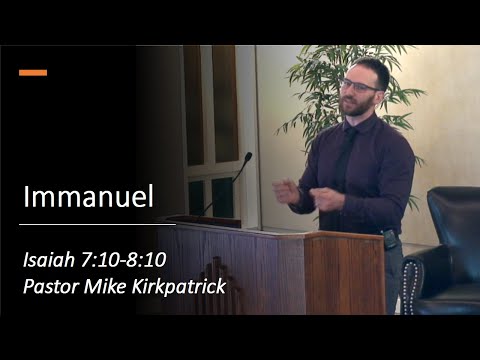
Immanuel

Isaiah 7:10–8:10 presents the Immanuel prophecy not as a comfortable seasonal text but as a word of judgment against Ahaz's faithless trust in Assyria and a word of hope for the covenant remnant. The sermon traces two contrasting realities: 'Assyria with us,' the consequence of royal unbelief, and 'God with us,' the promise that anchors the remnant through exile and desolation. The Immanuel sign finds its definitive fulfillment in Matthew 1, where the virgin-born Son saves his people from sin rather than merely political oppression — a truth that remains the ground of steadfastness for the church in every era of suffering and exile.
The Resurrection and Justification
Romans 4:25 declares that Christ 'was delivered up because of our offenses and was raised because of our justification' — a verse Charles Hodge called a comprehensive statement of the gospel and Matthew Poole called an abridgment of the whole. The sermon works through two inseparable redemptive realities: the substitutionary, particular atonement accomplished in Christ's death, and the five-fold testimony of the resurrection to the validity of that work. The central application is that a robust grasp of justification by faith alone — the imputation of Christ's righteousness received through faith — is the irreplaceable foundation for Christian stability, comfort, and peace with God.
A Thoughtful Diligence in Fellowship
Hebrews 10:24–25 contains the third of three apostolic exhortations grounded in Christ's blood and high-priestly office: a thoughtful diligence in corporate fellowship that stirs one another to love and good works. The sermon traces the call to mutual consideration — looking away from self and toward brothers and sisters in Christ — and grounds its motivation in the incarnate humility of the Son of God, who made himself of no reputation to serve sinners. Forsaking the assembly is not a private failure but a breach of the covenantal reciprocity that belongs to those who rest on so great a salvation.
The Resurrection and Justification
Romans 4:25 is, as Matthew Poole observed, 'an abridgment of the whole gospel' — binding Christ's penal death for specific offenses to His bodily resurrection for the justification of those who believe. The sermon expounds the redemptive purpose of both events: the Father delivered up the Son to satisfy divine justice for the sins of the elect, and raised Him to testify that the sacrifice was accepted, that satisfaction was rendered, and that redemption was accomplished. Against the moral-exemplary reduction of the atonement, the sermon insists on substitution, propitiation, and particular redemption as the irreducible ground of peace with God. Hearers are called to look away from every incapacity of their own — as Abraham did — and to rest entirely on the one who was delivered up for offenses and raised for justification.

Past, Present, and Future at the Lord's Supper
The Lord's Supper operates across three tenses simultaneously: it is a memorial ordinance calling believers to remember Christ's humiliation, substitutionary suffering, and death as prophesied in Isaiah 53; it is a present means of grace conferring real spiritual communion with the exalted Christ by the Spirit, not merely a conscious recollection; and it is an eschatological anticipation, pointing the church toward the consummation when the ordinance itself will give way to the marriage supper of the Lamb. Against both Roman Catholic transubstantiation and a bare memorialist view, the sermon argues from 1 Corinthians 10–11 that the bread and wine remain unchanged in substance while serving as conduits by which the risen Lord nourishes and confirms the faith of His gathered people.

Pentecostal Preaching, Part 2
Peter's sermon in Acts 2:22–36 does not rest on myth or legend but on the verified historical reality of Christ's resurrection, attested by the firsthand eyewitness accounts of the apostles and a company of more than five hundred. From that established historical fulfillment, the sermon draws three weighty Christological implications: Christ has been exalted to the right hand of God, He has poured out the Holy Spirit upon His church, and He has been made both Lord and Christ — with authority to crush His enemies and to save all who call upon His name. Hearers are urged to receive the gospel's certainty with the highest confidence and to find in the risen, reigning Christ a champion to whom no earthly rival compares.
The Ascension of Jesus Christ
The ascension of Jesus Christ is not religious myth but historically verified fact with profound doctrinal and practical consequences for the believer and the church. Working through Acts 1:9–11, five observations are drawn: the ascension was visible, bodily, and glorious; it sets the pattern for Christ's bodily and glorious return; and it resulted in his enthronement at the right hand of the Father. The sermon applies this doctrine to personal holiness, corporate joy, evangelistic zeal, faithfulness to the next generation, and the call to sinners to look to the enthroned Christ in faith.