
Theological term
Second Causes
15 sermons · All terms

CTF 2026 - Session 1: God's Decree in the Puritan Confessions

The doctrine of God's eternal decree, as confessed in the Westminster Confession of Faith, the Savoy Declaration, and the Second London Baptist Confession of 1677/1689, is not a single isolated chapter but a thread woven through the entire fabric of Reformed confessional theology. Drawing on Isaiah 46:8–11, this study traces the decree from its grounding in the doctrine of divine simplicity through creation, providence, the fall, covenant, redemption, the ordo salutis, perseverance, the spread of the gospel, and final judgment. The three Puritan-era confessions are shown to form a deliberate family — Westminster as parent, Savoy as child, and the Second London as grandchild — sharing common language and structure while registering careful Baptist and Congregationalist revisions. The study calls hearers not to speculative curiosity but to humble worship before the sovereign God whose decree is simply God decreeing.
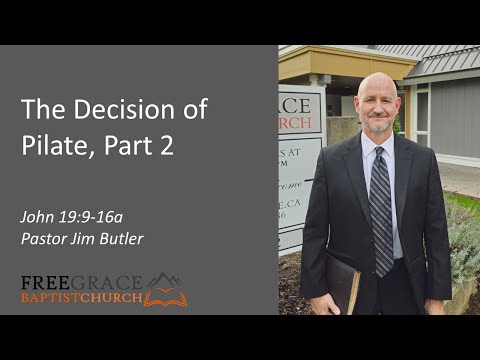
The Decision of Pilate, Part 2

John 19:9–16 records the exchange between Jesus and Pontius Pilate that culminates in the verdict of crucifixion. This sermon works through Pilate's confusion and arrogant assertion of authority, Christ's counter-declaration that all governing power derives from God Most High, and the theological weight of the greater sin belonging to those who delivered Christ up. The death of the Lamb of God at the hour of Passover preparation is no accident — it is the predetermined plan of the Father, the fulfillment of every Passover sacrifice, and the ground of forgiveness for wretched sinners who look to Christ in faith.

The Commendation of Timothy
Paul's brief commendation of Timothy in Philippians 2:19–24 reveals the qualities that distinguish a genuine gospel minister from those who seek their own interests. The sermon examines Timothy's like-mindedness with Paul, his sincere concern for the church's welfare rather than his own, and his proven character demonstrated through sacrificial service alongside the apostle. The exposition draws out the contrast between Timothy-like ministers — doctrinally sound, sincerely devoted, and servant-hearted — and those who treat ministry as an occasion for personal advancement, with direct application to how churches ought to identify and receive men for the eldership.

2LCF Chapter 3 - Of God's Decree
God's decree — His eternal, immutable purpose to foreordain whatsoever comes to pass — is the subject of 2 London Baptist Confession of Faith Chapter 3. This study works through paragraphs 1–7, establishing that the decree is absolute and unconditional, covers all events including the free and sinful actions of creatures without making God the author of sin, and that election unto life is grounded solely in God's free grace rather than any foreseen condition in the creature. The session addresses the distinction between preterition and double predestination, the infralapsarian and supralapsarian debate, and closes with the confession's insistence that this high doctrine is to be handled with prudence, producing praise, humility, diligence, and abundant consolation in those who sincerely obey the gospel.

2LBC - Chapter 2 - Of God and the Holy Trinity
What does it mean that God is one, simple, immutable, immense, and triune — and why does any of it matter for Christian worship? This confession study works through the Second London Baptist Confession of Faith Chapter 2 ("Of God and the Holy Trinity"), tracing the three movements of the chapter: God's essential glory in paragraph 1, God's transcendent relations in paragraph 2, and God's triune majesty in paragraph 3. Along the way, foundational interpretive principles for speaking rightly about God are established — the legitimate use of logical consequences from Scripture, the necessity of extra-biblical vocabulary to guard biblical truth, and the reading of anthropomorphic language according to the meaning rather than the letter. The session closes with a direct application: the doctrine of God is not speculative labor but the very foundation of communion with Father, Son, and Holy Spirit, and of the creature's comfortable dependence upon him.

Sunday School Confession Study - Oct 15, 2023
The 1689 London Baptist Confession of Faith, chapter 5, 'Of Divine Providence,' paragraphs 2–7 sets the agenda for this study. After reviewing paragraph 1's foundational statement that God upholds, directs, and governs all creatures by his most wise and holy Providence, the study works through the confession's treatment of second causes, the ordinary use of means, the relation of Providence to sin (both in its general scope and in the specific cases of believers and unbelievers), and the special providential care God exercises over his church. The central concern throughout is theodicy properly grounded: that God's absolute sovereignty over first and second causes does not make him the author or approver of sin, while also refusing the weak refuge of 'bare permission.' The study closes with the encouragement that whatever befalls the elect is by God's appointment for his glory and their good, and that Providence's ultimate telos is the perfecting of the church as the bride of the Lamb.

2LCF Chapter 3 - Of God's Decree

God's eternal decree—that He has foreordained whatsoever comes to pass, freely and unchangeably, from the counsel of His own most wise and holy will—is the subject of 2LCF Chapter 3. This study works through all seven paragraphs of the confession, grounding the doctrine first in divine sovereignty (God is most absolute, most free, and all-sufficient), then examining the decree's scope over all things, its special application to the predestination of the elect through Jesus Christ, and the reprobation of the wicked to the praise of His glorious justice. The decree is shown to be identical with the divine essence itself—eternal and unchangeable—and the means ordained by God (the redemptive work of Christ, the preaching of the Word, and the effectual work of the Spirit) are likewise foreordained. The proper posture before this doctrine is not boasting but humility, reverence, and abundant consolation in the God who saves sinners by His sovereign grace alone.

2LCF Chapter 5 - Of Divine Providence
The 1689 London Baptist Confession of Faith, Chapter 5, on Divine Providence, teaches that God upholds, directs, disposes, and governs all creatures and all their actions from the greatest to the least — not by blind fate or fortune, but according to his infinite power and wisdom, his infallible foreknowledge, and the free and immutable counsel of his will. The chapter unfolds in seven paragraphs, moving from the general definition of providence (paragraph 1) through its relation to second causes, ordinary means, miracles, the fall, remaining sin in believers, the hardening of unbelievers, and finally the special care God exercises over his church. God's sovereignty does not make him the author of sin nor does it remove human responsibility; first causality establishes rather than annuls second causality. The doctrine is a source of deep comfort: whatever befalls the elect is by God's appointment for his glory and their good.

2LCF Chapter 3 - Of God's Decree
God's decree — his eternal, comprehensive, and unchangeable purpose over all things — is the subject of 1689 London Baptist Confession Chapter 3. The confession affirms that God has foreordained whatsoever comes to pass, including the free and sinful actions of men, without becoming the author of sin or violating the will of the creature. Paragraph 2 refutes the Molinist and Arminian claim that God's decree is grounded in his foreknowledge of human choices, insisting instead that election puts sinners in Christ rather than finding them there. The doctrine is shown to be practically consoling, doxologically oriented, and inseparable from the character of God as defined in Chapter 2.
1 Kings 15:25–16:7
How does a sovereign God relate to the sinful actions of wicked men? Expounding 1 Kings 15:25–16:7, this study traces the reigns of Nadab and Baasha, kings of the northern kingdom of Israel, demonstrating that God employs even regicide and political treachery to fulfill prophetic word while holding the perpetrators fully culpable for their sin. The structural instability of the north — in stark contrast to the covenantal preservation of Judah — illustrates that God measures rulers not by political or military achievement but by obedience to His revealed law. The doctrine of divine providence that emerges calls believers to neither deny God's sovereignty nor abuse it as license for sin, but to find comfort in the certainty that no evil escapes either God's governance or His just judgment.
2LCF Chapter 5 - Of Divine Providence
Divine providence — God's upholding, directing, disposing, and governing of all creatures and things — is the subject of 2nd London Baptist Confession chapter 5, here expounded in a single-session overview. The chapter is read in full, then traced through its seven paragraphs: the definition and scope of providence, the relationship of God's sovereign first cause to secondary causes, the place of sin within providence (both for believers and unbelievers), and the special providential care God exercises toward his church. The session presses toward pastoral comfort: because the God of chapter 2 — infinitely wise, holy, and good — is the God of chapter 5, whatever befalls the elect is by divine appointment for God's glory and their good.
2 Samuel 24:1-25
Second Samuel 24 closes David's reign with a sobering account of a sinful census, divine judgment, and the necessity of atonement — raising difficult questions about divine sovereignty, second causes, and human culpability. The chapter sets David's genuine repentance in sharp contrast to Saul's hardness, and traces the themes of propitiation and substitution that run through all of redemptive history. The threshing floor of Araunah is identified as Mount Moriah — the future site of Solomon's temple — so that the sacrifice David offers becomes a typological pointer to the atoning work of Christ. The sermon calls hearers to maintain short accounts with God through prompt confession, to receive the Spirit's conviction as a mercy rather than an offense, and to offer worship that costs something.
2 Samuel 16
When David flees Jerusalem, he encounters three enemies — Ziba the manipulator, Shimei the curser, and Ahithophel the treacherous counselor — yet his response to each reveals a man who trusts the sovereign hand of God rather than the sword of his own men. This study of 2 Samuel 16 traces how David's suffering under divine chastisement, provoked by his own sin in 2 Samuel 11–12, fulfills Nathan's prophetic word and demonstrates a practical faith in God's comprehensive sovereignty over the wicked acts of men. David's refusal to retaliate against Shimei and his hope that God might 'repay him with good' prefigures Christ, who when reviled did not revile in return but committed himself to him who judges righteously. The study closes by urging believers to read the Psalms in light of their historical background, to embrace God's sovereignty over trials, and to cast themselves upon divine mercy when waves of affliction come together.
2LCF Chapter 3 - Of God's Decree
God's decree — his eternal, free, and unchangeable foreordination of all things whatsoever come to pass — is grounded in his absolute sovereignty and is comprehensive in scope, extending to the free acts of men, chance occurrences, sinful acts, the affairs of nations, and the final destinies of both the elect and the reprobate. This confession-study exposition of 1689 London Baptist Confession Chapter 3 works through five aspects of the decree: its foundation in divine sovereignty, its inviolable and unfrustratable character, its comprehensive reach, its unconditional nature (contra Arminian foreseen-faith schemes and Molinist middle-knowledge frameworks), and its relation to redemption through election and reprobation. The decree of election terminates not upon election itself but upon the praise of God's glorious grace, while the decree of reprobation terminates not upon damnation itself but upon the praise of God's glorious justice. Listeners are called to rest in a God whose sovereign will is the first and final cause of all things, leaving nothing to chance or creaturely contingency.

Samson's Victory at Gaza
Judges 16 presents Samson not as a man driven by fleshly passion but as a Spirit-empowered covenant agent executing divine judgment against Israel's Philistine oppressors. Careful attention to the narrative parallels between Judges 16 and Joshua 2 challenges the assumption that Samson sinned with the harlot at Gaza, revealing instead a strategic military mission consistent with God's call on his life from the womb. Though Samson's capitulation to Delilah's manipulation brings catastrophic consequences, the grace of God is displayed precisely in the nadir of Samson's failure, as God hears his prayer and grants him a victory in death greater than any he achieved in life — a pattern that points forward to Christ, who was delivered up by his own people and accomplished more in his death than in his earthly ministry.