
Theological term
Sanctification
470 sermons · All terms

The 4th Commandment (Part 3)

The Christian Sabbath is grounded in both creation and redemption, and the New Testament establishes Sunday — the Lord's Day — as the day of corporate worship by precedent and pattern rather than by bare precept. This third installment in a study of the Fourth Commandment examines three apostolic texts (Acts 20:7, 1 Corinthians 16:1–2, Revelation 1:10) that demonstrate the early church's practice of gathering on the first day of the week, then turns to two alleged anti-Sabbatarian passages (Romans 14 and Galatians 5) to show that neither addresses the weekly Sabbath but rather deals with Jewish calendar observances and the question of justification by works. The moral principle of one day in seven set apart for God remains binding on New Covenant believers, while the positive law has lawfully shifted the day from Saturday to Sunday in light of Christ's resurrection.

The Judgment Throne of Christ
Matthew 25:31–46 presents not a parable but a prophecy: the Son of Man, identified as Daniel's divine king, will sit on the throne of glory and separate all nations into the righteous and the wicked. The passage is examined to show that it does not overturn justification by faith alone, but rather demonstrates that those justified by grace will inevitably produce the good works that serve as fruits and evidences of saving faith. The sermon sets the evidentiary nature of works — care for Christ's brethren — against any works-righteousness reading, drawing on Galatians 5:6, Ephesians 2:8–10, James 2, and the 1689 London Baptist Confession to ground the argument. Hearers are called to confess Christ now, since the same Lord who bids 'come' in his earthly ministry will bid 'come' or 'depart' on the day of judgment.

2LCF Chapter 7 - Of God's Covenant, Part 2
1689 London Baptist Confession of Faith, Chapter 7, paragraph 3 sets out three theological covenants — the covenant of grace, the covenant of redemption (pactum salutis), and the covenant of works — as the structural architecture of all Scripture. This sermon expounds each in turn, demonstrating from texts in Genesis, Isaiah, Hosea, Galatians, and Romans that the covenant of grace is founded on an eternal transaction between the Father and the Son, and that it is God's provision for sinners rendered incapable of acceptance with God since Adam's fall. The covenant of works is shown to be indispensable to a right understanding of justification: without it, the imputed righteousness of Christ collapses into either moralism or antinomianism, and the distinction between forgiveness and imputation is lost. Covenant theology is pressed not as academic machinery but as the very ground of the believer's comfort, assurance, and stability before God.

The Seventh Commandment
The seventh commandment, 'You shall not commit adultery' (Deuteronomy 5:18), governs not merely the act of adultery but the full range of sexual conduct God defines in Scripture. Preached against the backdrop of Canada's Bill C-4, this sermon grounds sexual ethics in the creation order of Genesis 2, expounds twelve prohibited acts — from adultery and fornication through homosexuality, transgenderism, and pornography — and confronts the state's attempt to criminalise biblical teaching on sexuality. The law is preached so that sinners will see their need for Christ, whose blood alone washes, sanctifies, and justifies those who come to Him in faith.
Exhortations in Light of So Great a Salvation

Peter's exhortations in 1 Peter 1:13–16 are grounded in the prior theological indicatives of the epistle: the elect have been saved by the triune God, unto an incorruptible inheritance, and must now respond with corresponding imperatives. Two commands govern this passage — set your hope fully on the grace to be revealed at Christ's return, and live a holy life in all your conduct — each requiring mental intentionality, self-control, and an understanding of the regenerate nature as 'children of obedience.' The sermon argues that sanctification involves both mortification of former lusts and vivification of the new nature of obedience, while insisting that this holiness contributes nothing to justification, which rests wholly on Christ's perfect active obedience and atoning death.

The Riches of Christ
How can the eternal, omnipotent Son of God be said to have 'become poor'? Expounding 2 Corinthians 8:9, this sermon traces the riches of Christ to His divine nature and works as the second person of the Trinity, and His poverty to the Incarnation, His lowly life, and His sufferings and death. The hypostatic union — two whole natures inseparably joined in one person — is shown to be not merely a speculative doctrine but the theological ground on which the Apostle Paul appeals to the Corinthians for generous giving. The riches believers receive through Christ's poverty are spiritual: justification, sanctification, glorification, and adoption, purchased by His obedience, suffering, and resurrection.

The Conversion of the Philippian Jailer
Acts 16:16–34 presents the arrest and imprisonment of Paul and Silas as the God-ordained means by which a Roman jailer was brought to saving faith in Jesus Christ. The sermon traces two movements: the exorcism of a python spirit that provoked false charges and a severe beating, and the subsequent earthquake and gospel conversation that issued in the jailer's conversion and household baptism. Paul and Silas's midnight prayers and hymns amid unjust suffering demonstrate that Christ is worth all suffering, while the jailer's question — 'What must I do to be saved?' — receives the apostolic answer: believe on the Lord Jesus Christ. The sermon closes with three baptisms that embody the same gospel the Philippian jailer heard, illustrating that believers' baptism by immersion is the fitting public sign of union with Christ in His death and resurrection.

Introduction to the Decalogue
Exodus 20:1–2, the preface to the Decalogue, reveals God as the sovereign Lawgiver who redeems before He commands — a pattern in which grace precedes obligation that runs from Sinai through the new covenant. The sermon examines three classical uses of the Ten Commandments (civil, pedagogical, and normative) and the threefold division of the law (moral, ceremonial, judicial), demonstrating that the moral law alone abides in its full binding force for all people and all ages. Believers are not justified by the law but are directed by it as the objective standard of sanctification, so that love for God and neighbor is never left undefined or sentimental.

Exodus 19
Exodus 19 records Israel's arrival at Sinai and God's formal entry into covenant with the nation — a covenant that functions as a republication of the covenant of works, in which Israel, like Adam before them, is called to obedience and fails, thereby pointing forward to the last Adam, Jesus Christ. The chapter unfolds in three movements: the exhortation to faithfulness through the covenant terms (vv. 1–8), the consecration of the people for readiness (vv. 9–15), and the theophanic demonstration of divine glory (vv. 16–25). The Sinai theophany, with its thunder, fire, and death-boundary around the mountain, teaches that God's people require a mediator — a lesson that finds its fulfillment in Christ, the Mediator of the New Covenant. The church, as the true Israel of God, inherits the vocation of Exodus 19:6 — a royal priesthood, a holy nation — and is therefore called to proclaim the praises of God with reverence befitting the consuming fire she approaches in worship.

The Qualifications for Elders
What qualifications does Scripture require of a man before he may serve as an elder in a local church? Expounding 1 Timothy 3:1–7, this sermon establishes that the elder, overseer, and pastor are three terms for one office, and that the qualifications Paul lists are not recommendations but binding mandates. The sermon works through the first qualification — a genuine, rightly-motivated desire for the office — and frames it within four criteria for evaluating a call to ministry: right motives, graces indicating genuine Christian experience, gifts indicating divine provision (especially aptness to teach), and providential opportunity. The congregation is exhorted to apply these standards carefully and not to install any man, however virtuous or personable, who lacks the God-given ability to preach and teach the word.

The Earthly Temple in Stephen's Defense
Stephen's defense before the Sanhedrin in Acts 7:44–50 is not an attack on the temple but a demonstration that the Sanhedrin itself has misunderstood it. Working through the tabernacle, David's desire, Solomon's building, and Isaiah's oracle, Stephen shows that Israel's entire sacrificial and dwelling-place theology was typological — pointing forward to the Lord Jesus Christ as the true temple in whom God dwells with his people. The sermon argues that the dispensational expectation of a rebuilt physical temple in Jerusalem represents a retreat from fulfilled typology, and calls hearers to receive Christ as the antitype of all that the earthly sanctuary signified.
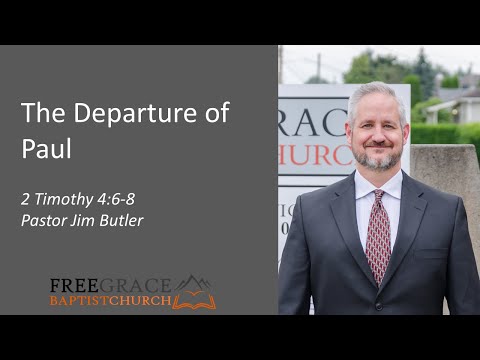
The Departure of Paul
Paul's farewell words in 2 Timothy 4:6–8 — poured out as a drink offering, having fought the good fight, finished the race, and kept the faith — are examined as a model of faithful perseverance unto death. The sermon argues that the confidence Paul expresses at the 11th hour of his life was inseparable from the faithfulness he exercised throughout every preceding hour, and that the crown of righteousness he anticipates is entirely a gift of God's grace, not a payment for services rendered. Believers are called to examine whether they are now fighting, running, and keeping the faith so that they may, by grace, make the same confession at the end of their days; and unbelievers are warned to consider the infinite worth of Christ, the certainty of judgment, and the righteousness the righteous Judge freely offers in the gospel.

The Defense of the Faith
Jude 3 commands every believer — not merely pastors or theologians — to contend earnestly for the faith once for all delivered to the saints. This sermon examines the exhortation itself, the internal threat posed by sneaky, ungodly apostates who pervert grace and deny Christ, and the practical preparedness Jude prescribes: remembering apostolic warning, building up on the most holy faith through Scripture and prayer, and resting in the assurance that God himself preserves his people. The defense of the faith is not pessimistic trench-holding but confident advance grounded in Christ's promise to build his church against which the gates of Hades shall not prevail.

The Ministry of the Word
What is the basis and method of God's ordained means for saving sinners? This sermon on 2 Timothy 4:2 argues that the preaching of the Word stands as the primary instrument through which God saves the lost and builds his church, grounding that claim in the logical chain of Romans 10, the divine pleasure announced in 1 Corinthians 1, and the final apostolic charge of Paul to Timothy. The sermon challenges the contemporary drift toward audience-driven church strategies, calling both preachers and hearers to fidelity to the proclaimed Word as the irreplaceable means of grace.

The Incarnation of the Word, Part 2
John 1:15–17 presents the preeminence of the incarnate Word and the fullness of grace and truth that flows from Him to needy sinners. The testimony of John the Baptist — that Christ ranks before him because He was before him — is an affirmation of Christ's co-eternity, distinctness, and consubstantiality with the Father, in accord with the Nicene Creed. Verse 17 is not a sharp antithesis between Moses and Jesus but a contrast in the mode of divine revelation: the law was mediated through Moses, while grace and truth came through the mediator Himself, who is the very embodiment of God's glory. The sermon calls hearers to stand in awe of the preeminent Redeemer, to find every spiritual need met in His inexhaustible fullness, and to close with Christ without delay.

The Mission of the Word, Part 1
John 1:6–9 introduces John the Baptist not as an independent figure but as a divinely commissioned witness whose entire ministry exists to point to the Word made flesh. This sermon examines the origin, nature, and function of that witness ministry, demonstrating that the Baptist's testimony belongs to a network of overlapping witnesses — Father, Son, Holy Spirit, Scripture, and signs — that ground saving faith in historical reality rather than a blind existential leap. The function of John's witness is inseparable from its purpose: that sinners would believe on Christ as the Lamb of God who takes away the sin of the world, not merely imitate him as a moral example. The sermon closes with a call to keep law and gospel in their proper places, so that sinners driven by the law's killing power may look by grace to the one who is both the true light and the only hope of the world.

The Christian Sabbath, Part 3
Three passages in the New Testament — Romans 14, Galatians 4, and Colossians 2 — are commonly marshalled against the abiding validity of the Fourth Commandment, but careful exegesis reveals that none of them address the weekly Lord's Day Sabbath. Romans 14 concerns Christian liberty over matters indifferent, principally Jewish dietary laws and Israel's feast calendar; Galatians 4 rebukes the Judaizers' demand that calendar observance supplement faith in Christ for justification; and Colossians 2 warns against a syncretistic heresy that mingled Christ, Judaism, and angel worship. In each case Paul is dealing with Israel's ceremonial calendar, not the moral Sabbath commandment rooted in creation and redemption, which remains binding on the new covenant people of God and is observed on the first day of the week in light of Christ's resurrection.

How to Treat One Another in the Church

First Timothy 5:1–2 instructs Timothy — and by extension all Christians — on how to treat members of the congregation according to age and gender, framing those relationships by analogy to the family. The sermon grounds this instruction in the Fifth Commandment, drawing on Westminster Larger Catechism questions 124–131 to show that the commandment's scope extends beyond natural parents to all relationships of authority, age, and equality. Pastors must exhort older men as fathers, younger men as brothers, older women as mothers, and younger women as sisters with all purity — avoiding harshness on the one side and laxity or impropriety on the other. The closing application presses the doctrine of adoption: because believers are children of God and joint-heirs with Christ their elder brother, the church is a genuine household, and its members bear mutual responsibility to encourage and bear one another's burdens without waiting for pastoral direction.

The Cross Predicted and Rejected
Mark 8:31-33 records Jesus' first explicit prediction of His suffering, death, and resurrection — a proclamation that shattered every nationalist expectation of a triumphant Messiah. The sermon works through two movements: the cross predicted (vv. 31-32a), where Jesus identifies Himself as the suffering Son of Man whose death and resurrection were decreed by God from eternity, and the cross rejected (vv. 32b-33), where Peter's rebuke earns the reply 'Get behind me, Satan' because man's thoughts about the Messiah stand in direct opposition to God's. Rooted in Isaiah 53, Daniel 7, Hosea 6, and Psalm 118, the exposition argues that penal substitutionary atonement — the Son of Man bearing the wrath sinners deserve — is the only ground of eternal life, and that the same Christ who prepared His disciples for His own suffering now calls His people to take up their crosses in this present evil age.

The Great Commission
The Great Commission (Matthew 28:18–20) constitutes Christ's formal mandate to his church for this age: going, making disciples, baptizing believers, and teaching them to observe all that he commanded. The authority behind the commission is Christ's present, universal lordship — not a future investiture but a reigning reality — and the assurance sustaining it is his promised presence to the end of the age. Baptism is treated as believers' baptism by immersion, an initiatory ordinance that publicly identifies the disciple with the triune God and symbolises union with Christ in his death, burial, and resurrection. The sermon calls the church to be comprehensively about this single focused mission — preaching the gospel for justification, then grounding the justified in sanctification through the teaching ministry of the local church.

The Meeting with James in Jerusalem
Acts 21:17–40 narrates Paul's final recorded visit to Jerusalem, where he meets with James and the elders before being seized by a mob in the temple. The sermon works through four aspects of the meeting — reception, report, response, and recommendation — to demonstrate that James and Paul were in full theological harmony, both preaching justification by grace alone through faith alone in Christ alone. The arrest that follows illustrates both the rage of unbelieving Israel and the sovereign providence of God, who uses Roman civil authority to preserve his apostle. Hearers are urged to imitate Paul's spirit of conciliation on secondary matters, insist on the gospel above all else, and trust the God who receives sinners.

The Believer's Gratitude Toward God
Psalm 103 grounds thanksgiving not in vague sentiment but in the specific mercies of a covenant-keeping God toward those He has redeemed. Working through David's threefold structure — the reminder to bless God, the reasons for blessing God, and the reflection on God's kingdom — the sermon traces the chief benefit of divine grace as the forgiveness of sins accomplished in Christ, before moving outward to temporal providences, divine mercy measured against human frailty, and the universal summons of all creation to praise. The sermon draws on Deuteronomy's warnings against forgetting God's benefits and Paul's account of the worthy walk in Colossians 1 to show that detailed, specific thanksgiving is a mark of those who have received grace. The congregation is called to speak to their own souls, directing them away from self-absorption and toward the God whose mercy extends from everlasting to everlasting.

The Third Missionary Journey, Part 7
Acts 20:32–38 concludes Paul's farewell address to the Ephesian elders at Miletus, functioning as a pastoral charge that moves from doctrinal grounding to ethical example to affectionate departure. The sermon treats three movements: Paul's commendation of the elders to God and the Word of His grace as the only sufficient resource for long-term ministry, Paul's example of non-covetousness and manual labor as a rebuke against ministerial greed, and the tearful parting as a model of godly gratitude for the instruments of grace. A sustained excursus defends the biblical warrant for paying pastors from 1 Corinthians 9, 1 Timothy 5, and 2 Timothy 2, establishing that Paul's voluntary self-support was the exercise of a right, not the abolition of one. The sermon closes with a call to pray for faithful ministers and to value the means God ordains for the salvation of sinners.

The Whole Armor of God
Ephesians 6:10–20 calls the people of God to don the whole armor of God — not as an invitation to physical combat, but as a summons to faithful spiritual warfare against the devil and his hosts. The sermon works through three movements: the commands to be strong in the Lord and to put on the armor, the reasons rooted in the nature of the spiritual enemy, and a pastoral survey of each piece of armor from the belt of truth to the sword of the Spirit and prayer. The controlling emphasis falls on standing — not heroics, but covenantal steadfastness in union with Christ, who is already exalted far above all principalities and powers.

Pressing On In Christ for Sanctification
Philippians 3:10–21 sets out the doctrine of sanctification as the necessary and purposeful continuation of justification — not its cause. The justified believer, having been conformed to Christ's death by the Spirit's regenerating work (Romans 6), is called to press forward in mortification of the old nature and vivification of the new, never resting in past attainments. Christ's purpose in saving sinners is not merely to deliver them from hell but to conform them to his image for the glory of God — the ordo salutis moving through justification and sanctification toward final glorification. The sermon calls believers to disciplined, Christ-dependent pressing on through Word, prayer, church attendance, and zealous good works, while warning that those who corrupt the gospel by mingling works with grace are enemies of the cross whose end is destruction.

The Believer's Response to Trials
James 1:2–8 commands believers to count trials 'all joy' — a disposition that runs counter to every natural instinct. This exposition works through the passage in two movements: the believer's response to trials (vv. 2–4), which establishes the identification, expectation, disposition, and divine purpose of affliction; and the believer's request during trials (vv. 5–8), which calls for the pursuit of wisdom and the exercise of faith. The central burden is that God's redemptive purpose in suffering — conformity to the image of Christ — supplies both the ground for joy and the reason to seek wisdom rather than mere deliverance.

Waging the Good War
First Timothy 1:18–20 charges Timothy to wage the good warfare of the Christian faith, grounded in faith and a good conscience. This exposition identifies two weapons of the faithful minister—trust in the living God and a conscience calibrated by sound doctrine—set against the backdrop of false teachers who have shipwrecked the faith by rejecting the gospel of free and sovereign grace. The sermon then turns to the solemn consequence of neglecting that warfare, tracing the excommunication of Hymenaeus and Alexander as a case study in church discipline executed for the purity of the church and the potential restoration of the offender. Hearers are pressed to examine whether they possess genuine discernment regarding the gospel and genuine sensitivity toward sin, waging the warfare not to earn salvation but in response to the grace already secured in Christ.

The Prediction of Desertion and Denial
Matthew 26:31–35 records Jesus predicting both the desertion of all His disciples and the specific denial of Peter on the night of His arrest. The passage demonstrates that the salvation accomplished at the cross was entirely the work of Christ alone — His friends fled, leaving no horizontal assistance — and that Scripture, citing Zechariah 13:7, had appointed this scattering from eternity. The sermon draws out the persistent problem of remaining corruption in the regenerate: the pride, self-confidence, and lofty self-assessment that Peter epitomizes are not unique to him but are symptomatic of all God's people. The remedy is not stronger resolution but a biblical self-assessment that drives the believer away from confidence in the flesh and toward continual dependence on the grace and Spirit of God.

The Second Missionary Journey, Part 8
Acts 18:1–11 records Paul's arrival and eighteen-month ministry in Corinth, one of the most morally degenerate cities of the ancient world. The sermon traces Paul's gospel strategy — reasoning in the synagogue, enduring Jewish opposition, and turning to the Gentiles — before dwelling on Christ's night vision to Paul: 'Do not be afraid, for I have many people in this city.' The doctrine of election explains how Christ could speak with certainty of many yet-unconverted people awaiting the call; the gospel, not moral reform or civil intervention, is the sole instrument for transforming a corrupt culture. The sermon closes with a call to pray for and to be men who preach Christ and Him crucified, stand under opposition, persevere in weakness, and believe the promise that Christ is present with His church in the great commission.

The Manifestation of God's Grace
Titus 2:11–15 presents God's grace not merely as the ground of salvation but as the very teacher of holy living. This exposition traces four aspects of grace in the passage: its appearance in the incarnation and atoning work of Christ, its instruction toward denial of ungodliness and worldly lusts and pursuit of sober, righteous, and godly life, its demonstration in the deity of the returning Christ and the definite redemption he accomplished, and its proclamation through authoritative gospel ministry. The controlling hermeneutical key is the grammatical and theological priority of the indicative over the imperative: believers obey not in order to be saved but because they have been saved, and inverting that order collapses the gospel into moralism.