
Theological term
Reprobation
51 sermons · All terms
2LCF Chapter 32 - Of the Last Judgment

The biblical doctrine of the Last Judgment—its nature, purpose, and practical relevance—is examined through 1689 LBCF Chapter 32. God has appointed a day on which He will judge the world in righteousness through Jesus Christ as covenant mediator, to manifest both His mercy in the eternal salvation of the elect and His justice in the eternal damnation of the reprobate. Romans 9 grounds the theocentric purpose of judgment in God's sovereign disposition of mercy and wrath, while 2 Thessalonians 1 supplies the apostolic warrant for the believer's rejoicing in divine justice. The session concludes with an overview of the major millennial positions and their hermeneutical foundations, urging the church to let eschatology produce holiness, consolation, and gospel urgency rather than pride or speculation.

The Gospel Foundation for Corporate Prayer
The apostle Paul grounds the church's corporate prayer in a three-part theological rationale drawn from 1 Timothy 2:3–7: the nature of God, the office of Christ, and the ministry of Paul. The phrase 'all men' in verses 1–4 refers not to every individual without exception but to all kinds of men without distinction — Jew and Gentile, slave and king — a reading demanded by Paul's own doctrine of reprobation in Romans 9 and confirmed by the scope of his apostolic commission to the Gentiles. Christ's mediatorship is shown to require both a divine and a human nature, and his ransom is definite in its design — paid for all kinds of men, not all men without exception — precluding both universalism and any notion of unmet desires in God. The sermon closes by pressing the congregation to show up for corporate prayer, to pray specifically for the salvation of those in civil authority, and to exhort all around them to flee to Christ.

2LCF Chapter 10 - Of Effectual Calling

Effectual calling is the sovereign, gracious act by which God brings those predestinated unto eternal life from spiritual death to faith in Christ, through His word and Spirit, with no contribution from the creature. This lesson works through all four paragraphs of 2LCF Chapter 10, tracing the definition and character of the effectual call, its Trinitarian foundation, the two-fold nature of outward word and inward Spirit, the extraordinary provision for elect infants and those incapable of hearing the word, and the fixed inability of the reprobate. The session closes by pressing the doctrine against Pelagian, Semi-Pelagian, Arminian, Socinian, and Roman Catholic errors, and by insisting that there is no salvation outside of Jesus Christ for those who receive not the Christian religion.

The Confirmation of His Death
John 19:31–37 records the confirmation of Christ's death by Roman soldiers and the apostle John, providing decisive historical and theological testimony against any swoon theory or denial of His true humanity. The soldiers' breaking of the legs of the other condemned men — but not of Jesus, who was already dead — and the piercing of His side with a spear fulfills two strands of Old Testament prophecy: the unbroken bones of the Passover lamb (Exodus 12:46; Numbers 9:12) and the piercing of Israel's Messiah (Zechariah 12:10). John's eyewitness testimony is given with a stated evangelistic purpose — 'that you may believe' — grounding the gospel call in verified historical fact. The sermon closes with an exhortation to confident, prayer-filled gospel proclamation on the basis of Christ's finished, sovereign work of redemption.

2LCF Chapter 3 - Of God's Decree
God's decree — His eternal, immutable purpose to foreordain whatsoever comes to pass — is the subject of 2 London Baptist Confession of Faith Chapter 3. This study works through paragraphs 1–7, establishing that the decree is absolute and unconditional, covers all events including the free and sinful actions of creatures without making God the author of sin, and that election unto life is grounded solely in God's free grace rather than any foreseen condition in the creature. The session addresses the distinction between preterition and double predestination, the infralapsarian and supralapsarian debate, and closes with the confession's insistence that this high doctrine is to be handled with prudence, producing praise, humility, diligence, and abundant consolation in those who sincerely obey the gospel.

The High Priestly Prayer, Part 7
John 17:20 records Christ's intercession extending beyond the apostles to all who would believe through their word — a prayer that excludes the world and encompasses the elect of every age. The verse yields five doctrinal implications: justification is by faith alone; the apostolic word is the ordained instrument of that faith; Christ assumes gospel advance and missions; sovereign election and predestination undergird the certainty that there will be believers; and the world possesses a solidarity in enmity against God that mirrors, and indicts, the disunity too common among God's people. Practically, the sermon calls the church to gospel-centred ministry, qualified and instructional preaching, the earnest pursuit of unity, and calls the unconverted to believe on the Lord Jesus Christ without delay.

2LCF Chapter 32 - Of the Last Judgement
2 London Baptist Confession of Faith Chapter 32 examines the doctrine of the Last Judgment under three heads: the concept of the Day of Judgment (its divine appointment, its agent in Christ, and its comprehensive scope over angels and all humanity), the goal of that day (the manifestation of God's mercy in the eternal salvation of the elect and his justice in the eternal damnation of the reprobate), and its practical relevance (deterring sin, consoling the afflicted people of God, and keeping believers watchful). The session concludes with a survey of the three millennial positions and four interpretive approaches to the book of Revelation, explaining why the Confession deliberately avoids resolving those disputes in order to function as a broad consensus document. The consistent ethical burden throughout is that contemplation of the coming judgment should shape present conduct: purifying the elect, driving evangelism, and giving the suffering saints confidence that divine justice will prevail.

Ask FGBC - Dec 2024 Podcast with Pastors Butler and Porter, Batch 4
A panel of two pastors works through a batch of listener-submitted questions spanning baptism and the Lord's Supper, the eternity of hell, church membership, faith and fear, the unpardonable sin, images of Christ, dry preaching, and extra-biblical theological vocabulary. Across each topic the answers are grounded in Scripture and the 1689 London Baptist Confession, with particular attention to second-commandment concerns, the nature of saving faith, and the perseverance of the saints. Listeners are urged to anchor their assurance not in the strength of their own grip on Christ but in the immutable decree of election and the intercession of the Triune God.

The Oracles of Balaam, Part 2
Numbers 24 records the third and fourth oracles of Balaam, an unconverted soothsayer compelled by the Spirit of God to bless Israel rather than curse her at Balak's command. The sermon traces the messianic trajectory of these oracles — the star out of Jacob, the scepter rising from Israel, the dominion of one from Judah — arguing that Balaam is ultimately preaching Christ and the triumph of his kingdom, which finds its New Covenant terminus in the church as the Israel of God. The text becomes a call to faithful gospel ministry: if a reprobate soothsayer could handle the Word of God accurately, the church has every right to demand that her ordained ministers do likewise.

The Future Prospect of the Apostle, Part 2
Philippians 1:21–26 presents Paul's conviction and anticipation as an apostle facing imprisonment and the real prospect of execution. The sermon works through Paul's declaration 'for to me to live is Christ, and to die is gain,' showing that his union with Christ in life and his glory with Christ in death make it impossible for any earthly power to harm or stop him. The intermediate state — the soul's immediate presence with Christ at death — is set against the benefit of continued gospel ministry, and Paul's others-minded anticipation of release grounds his confidence that the Philippians' progress in faith and joy will abound. The sermon closes by pressing the question whether each hearer can say with honest self-examination that Christ is their all in life and death.

The Announcement of the Betrayal
John 13:18–30 records Jesus announcing the betrayal of Judas Iscariot in the upper room, and this exposition works through the passage in two movements: the announcement of the betrayal (vv. 18–20) and the identification of the betrayer (vv. 21–30). Three features of the announcement receive careful attention — the fulfillment of Psalm 41:9 in Christ's passion, the absolute divinity of Christ declared in the repeated 'I am' of verse 19 (grounded in Exodus 3:14), and the nature of apostolic discipleship as delegated ambassadorship. The removal of Judas from the disciple group exposes the distinction between holding church office and possessing saving grace, a distinction pressed as a question of self-examination for every hearer.

The Demonstration of Servanthood
John 13:4–17 presents the foot washing not merely as an act of hospitality but as an emblem pointing simultaneously to the incarnation, the passion, regeneration, justification, and sanctification. The Son of God who stoops to wash the dirty feet of dirty men is the same Son of God who goes to the cross to wash the dirty hearts of dirty sinners. Peter's initial refusal and subsequent capitulation illustrate the sinner's need for union with Christ — a union granted only through being washed, born again, and cleansed by the blood of Christ. Disciples who have received this washing are therefore obligated to go and serve others in humility, self-sacrifice, and love as the means by which they advance the gospel.

Sunday School Confession Study - Oct 15, 2023
The 1689 London Baptist Confession of Faith, chapter 5, 'Of Divine Providence,' paragraphs 2–7 sets the agenda for this study. After reviewing paragraph 1's foundational statement that God upholds, directs, and governs all creatures by his most wise and holy Providence, the study works through the confession's treatment of second causes, the ordinary use of means, the relation of Providence to sin (both in its general scope and in the specific cases of believers and unbelievers), and the special providential care God exercises over his church. The central concern throughout is theodicy properly grounded: that God's absolute sovereignty over first and second causes does not make him the author or approver of sin, while also refusing the weak refuge of 'bare permission.' The study closes with the encouragement that whatever befalls the elect is by God's appointment for his glory and their good, and that Providence's ultimate telos is the perfecting of the church as the bride of the Lamb.

2LCF Chapter 3 - Of God's Decree
God's eternal decree—that He has foreordained whatsoever comes to pass, freely and unchangeably, from the counsel of His own most wise and holy will—is the subject of 2LCF Chapter 3. This study works through all seven paragraphs of the confession, grounding the doctrine first in divine sovereignty (God is most absolute, most free, and all-sufficient), then examining the decree's scope over all things, its special application to the predestination of the elect through Jesus Christ, and the reprobation of the wicked to the praise of His glorious justice. The decree is shown to be identical with the divine essence itself—eternal and unchangeable—and the means ordained by God (the redemptive work of Christ, the preaching of the Word, and the effectual work of the Spirit) are likewise foreordained. The proper posture before this doctrine is not boasting but humility, reverence, and abundant consolation in the God who saves sinners by His sovereign grace alone.

2LCF Chapter 32 - Of the Last Judgment
The Last Judgment is not a peripheral doctrine but the telos toward which all of Scripture drives — appointed by God, executed by Christ, and comprehensive in scope over angels and all humanity alike. This study of 2 London Baptist Confession of Faith chapter 32 moves through three divisions: the concept of the Last Judgment (paragraph 1), the goal of the Day of Judgment as the manifestation of God's mercy in the salvation of the elect and His justice in the damnation of the reprobate (paragraph 2), and the practical relevance of that day for deterring sin, consoling the godly in adversity, and maintaining watchful expectation (paragraph 3). Romans 9 anchors the argument that God's sovereign purposes in election and reprobation are the foundation for understanding why the judgment will unfold as it does. The doctrine calls the people of God not to despair but to look forward with expectation to the coming of Christ, the righteous Judge, who rules and reigns at the Father's right hand even now.
The Danger of Rejecting the Son
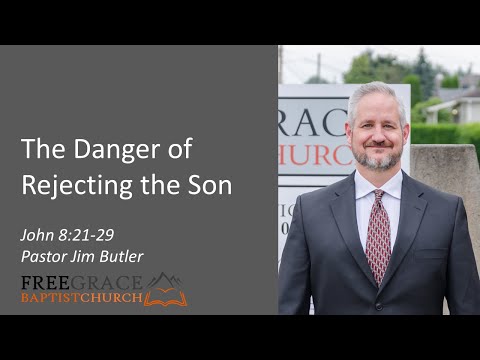
John 8:21–29 records Jesus warning a hostile religious leadership that they will die in their sins if they do not believe that He is the great I Am — the divine Son eternally generated from the Father, sent into the world in the economy of redemption. The sermon works through the passage in three movements: the announcement of Christ's departure and the condemnation it implies, the question of His identity and the slander levelled against Him, and the reference to His crucifixion as the moment of disclosure. The central doctrinal burden is that a deficient Christology — whether ancient Arianism, Sabellianism, or modern proposals of eternal functional subordination — amounts to the very unbelief Christ condemns, and that the church's primary calling is to preach the triune God with particular weight on who the Son is and what He has done for sinners.

The Feast of Tabernacles, Part 4
On the last and greatest day of the Feast of Tabernacles, Jesus stood and cried out two declarations that divide all of humanity: 'Where I am, you cannot come,' addressed to those who persist in unbelief, and 'If anyone thirsts, let him come to me and drink,' addressed to all who would believe. This sermon expounds John 7:32–39, tracing the murderous intentions of the Pharisees and chief priests, the sovereign rejection of the reprobate by Christ himself, and the astonishing mercy that leads him to offer living water to the very crowd seeking his arrest. The evangelist's commentary in verse 39 is shown to be a post-resurrection theological statement linking the abundant giving of the Holy Spirit to the glorification of Christ, drawing on the Old Testament water-and-Spirit passages and fulfilled at Pentecost according to Joel's prophecy.

The Gracious Purpose of the Father, Part 2
Ephesians 1:5–6 presents predestination not as cold metaphysical fate but as an act of divine love, wherein God in love predetermined his elect unto adoption as sons by Jesus Christ, according to the good pleasure of his own will and not any foreseen merit in the creature. The sermon works through the motive of predestination (the love of God), the means (adoption as sons by Christ, grounded in the covenant of redemption), and the goal (the praise of the glory of God's grace), drawing extensively on parallel Pauline and Johannine texts. Against both Arminian and Pelagian objections, the preacher demonstrates that predestination to adoption is precisely what makes Christian praise coherent — the creature contributes nothing, and God receives all glory. Believers are called to live out their adopted status by walking in love, light, and wisdom as members of the household of God.

2LCF Chapter 6 - Of the Fall of Man, of Sin, and of the Punishment Thereof
The fall of man, as confessed in chapter 6 of the 1689 London Baptist Confession of Faith, is not merely a historical curiosity but the doctrinal foundation upon which the entire superstructure of redemption rests. This study works through all five paragraphs of the chapter, tracing the integrity of man at creation, the covenantal mechanics of the fall through Adam as federal head, and the resulting conditions of total depravity, total inability, imputed guilt, and remaining corruption in the regenerate. The covenants of redemption, works, and grace are shown to be structurally inseparable, so that any distortion of one inevitably corrupts the doctrine of justification by faith alone. Listeners are called to abandon any confidence in human free will for salvation, to extend charity toward fellow believers who struggle with remaining sin, and to marvel at a sovereign grace that alone can raise the spiritually dead.

2LCF Chapter 5 - Of Divine Providence
The 1689 London Baptist Confession of Faith, Chapter 5, on Divine Providence, teaches that God upholds, directs, disposes, and governs all creatures and all their actions from the greatest to the least — not by blind fate or fortune, but according to his infinite power and wisdom, his infallible foreknowledge, and the free and immutable counsel of his will. The chapter unfolds in seven paragraphs, moving from the general definition of providence (paragraph 1) through its relation to second causes, ordinary means, miracles, the fall, remaining sin in believers, the hardening of unbelievers, and finally the special care God exercises over his church. God's sovereignty does not make him the author of sin nor does it remove human responsibility; first causality establishes rather than annuls second causality. The doctrine is a source of deep comfort: whatever befalls the elect is by God's appointment for his glory and their good.

2LCF Chapter 3 - Of God's Decree, Part II
God's decree, as confessed in 2LCF Chapter 3, encompasses both predestination unto life and the reprobation of the non-elect — a distinction the confession handles with care but which Scripture addresses with directness in passages such as Proverbs 16:4, Matthew 11:25-28, and Romans 9:17-23. The sermon distinguishes three theological frameworks integral to understanding the decree in salvation: the Pactum Salutis (the pre-temporal, intra-Trinitarian covenant of redemption), the Historia Salutis (the unfolding of redemption in space and time), and the Ordo Salutis (the application of redemptive benefit to the elect). God ordains not only the end — the salvation of a definite number — but also all the means, grounding the church's obligation to preach the gospel, make disciples, and pursue the lost. The doctrine, rightly received, produces praise, reverence, admiration, humility, diligence, and abundant consolation rather than either hyper-Calvinist passivity or Arminian nervousness.

2LCF Chapter 3 - Of God's Decree
God's decree — his eternal, comprehensive, and unchangeable purpose over all things — is the subject of 1689 London Baptist Confession Chapter 3. The confession affirms that God has foreordained whatsoever comes to pass, including the free and sinful actions of men, without becoming the author of sin or violating the will of the creature. Paragraph 2 refutes the Molinist and Arminian claim that God's decree is grounded in his foreknowledge of human choices, insisting instead that election puts sinners in Christ rather than finding them there. The doctrine is shown to be practically consoling, doxologically oriented, and inseparable from the character of God as defined in Chapter 2.

Exodus 11
Exodus 11 announces and describes the tenth plague — the death of the firstborn throughout Egypt — which God executes directly and immediately, without mediation through natural means. The chapter is structured around three movements: the promise of liberty and prosperity to Israel, the announcement of sweeping judgment upon every household in Egypt, and Pharaoh's continued, God-ordained rebellion. The hardening of Pharaoh's heart is treated not as mere divine permission but as a just act of sovereignty, displaying God's power, holiness, and mercy simultaneously — mercy to Israel being inseparable from judgment upon her oppressors.

The Conversion of Cornelius
Acts 10:34–48 records the official inclusion of Gentiles in the covenant promises of God — a watershed moment in redemptive history. Peter's sermon before Cornelius and his household sets forth the peace, person, work, and prophetic witness of Jesus Christ, culminating in the declaration that through His name, whoever believes will receive remission of sins. The sovereign Holy Spirit falls upon the hearers before Peter has even finished speaking, confirming that salvation is of the Lord and that divine initiative — not human free will — drives the conversion of sinners. The passage concludes with the baptism of the entire household, a commanded public identification with the Triune God that pictures, but does not accomplish, the inward work already wrought by grace through faith.

The Second Missionary Journey, Part 2
Acts 16:6–15 traces the divine hand behind the second missionary journey's westward turn into Macedonia and the conversion of Lydia in Philippi. The Spirit's successive prohibitions of ministry in Asia and Bithynia are not judgments on those regions but demonstrations that God actively directs the missionary enterprise according to his sovereign purpose. The conversion of Lydia — a woman whose heart was dead in trespasses until God opened it to receive Paul's preaching — illustrates that the efficient cause of every conversion is divine grace, not human ingenuity, while the instrumentality of gospel proclamation and the responsibility of hearers to believe remain fully intact. The sermon calls the church to define missionary work precisely as the Spirit-sent, church-commissioned preaching of Christ crucified, rejecting both Arminian confidence in the sinner's free will and hyper-Calvinist reluctance to call sinners to faith.

Genesis 36
Genesis 36 presents the genealogy of Esau (Edom), a passage easily dismissed as a bare list of names. This study examines why Moses inserts this extended genealogy at the precise hinge between the narrative of Isaac and the narrative of Jacob, arguing that it serves as a demonstration of divine faithfulness: God fulfilled every promise made to the non-elect son — nationhood, territorial blessing, and temporal prosperity — which grounds the believer's confidence that His covenant promises to the elect will be no less certainly realized. The contrast between Esau's temporal inheritance and Jacob's spiritual and eternal inheritance sharpens the distinction between common providence and saving grace, and the goodness God shows even to the reprobate is intended to lead sinners to repentance.

The Gracious Invitation of Christ
Matthew 11:25–30 sets before the reader three interlocking realities that ground Christian thanksgiving: the sovereign will of the Father who hides gospel truth from the self-sufficient and reveals it to the humbled, the mediatorial office of the Son who alone has authority and power to reveal the Father to sinners, and the gracious invitation of Christ who calls the weary and sin-laden to come, receive rest, take His yoke, and learn from Him. The sermon works through six observations on verses 28–30 — the exhortation to come, the persons addressed, the promise of rest, the call to submit, the invitation to learn, and the light burden of discipleship — demonstrating that justification precedes sanctification and that the gospel call is issued indiscriminately to all. Hearers are urged to study the law until the weight of sin is felt, to flee to Christ rather than away from Him, and to respond to sovereign grace with daily, unreserved thanksgiving.
The Sovereignty of God
Proverbs 3:19–20 grounds God's sovereignty not merely in creation but in every sphere of existence — the world was founded by divine wisdom, and that same sovereign wisdom governs all of history and secures the redemption of His people. Drawing widely from Proverbs alongside Genesis, the Psalms, Daniel, and Romans, this sermon traces three distinct expressions of God's sovereignty: His free, unconstrained creation of all things; His comprehensive providence over human affairs including civil government; and His eternal purpose in redemption, centred in the pre-existent Christ of Proverbs 8. The practical force of the message is that divine sovereignty — rightly understood — produces neither fatalism nor hyper-Calvinist passivity, but rather deep comfort, stable faith, and the use of appointed means, all to the glory of God.

The Replacement for Judas
The replacement of Judas Iscariot in Acts 1:12–26 raises questions about the nature of apostolic authority, the sovereignty of God over human treachery, and the continuing rule of the risen Christ over his church. Peter's leadership in securing Matthias as the twelfth apostle demonstrates that the apostolic college was not dissolved by Judas's defection but reconstituted by Christ's own direction — through prayer, Scripture, and the casting of lots. The sharp contrast between Peter, restored by grace after his denial, and Judas, who went to his own place as a reprobate, anchors the sermon's gospel appeal: no sin is too great for the pardoning mercy of God in Christ, and sinners are urged to look to Christ and live.

The Defense of the Faith
Jude 3 issues a universal call—addressed not to clergy alone but to every believer, the 'beloved'—to contend earnestly for the faith once for all delivered to the saints. The sermon works through three movements: the exhortation itself and its five implications, the reason for that exhortation in the apostates of verse 4, and the practical preparedness of the contender outlined in verses 20 and 21. Doctrinal fidelity is not optional maintenance for specialists; it is the privilege and duty of every member of the covenant community, sustained by Scripture reading, prayer, and a constant looking to Christ. The sermon closes with a direct call to the unconverted to flee to the Lord Jesus Christ, in whom alone forgiveness of sins and the imputation of his righteousness are received by faith alone.