
Theological term
Remnant
44 sermons · All terms

Deuteronomy 16:1-17 - The Annual Feasts of Israel

Deuteronomy 16:1–17 presents three annual feasts — Passover and Unleavened Bread, Weeks, and Tabernacles — as divinely ordained memorials calibrated to keep Old Covenant Israel's allegiance fixed on Yahweh. Each feast commemorates a distinct aspect of God's redemptive work: deliverance from Egypt, provision at harvest, and sustenance through wilderness wandering. The Passover's substitutionary logic — where efficacy rested in God's provision rather than the offerer's moral worthiness — typologically prefigures Christ as the Lamb whose blood alone secures the sinner's safety. The sermon draws out the connection between the central sanctuary requirement of Deuteronomy 12 and the New Covenant church as the God-ordained means by which worship is preserved from corruption and believers are hedged against apostasy.
The Propagation of Israel's Faith
Deuteronomy 6:6–9 commands Israel not merely to profess allegiance to the one true God but to propagate that truth — first by internalizing it personally, then by transmitting it diligently to children and grandchildren in both formal and informal settings. The passage is read against the wider covenantal structure of Deuteronomy and set in parallel with Ezra 7:10, Psalm 119, and Ephesians 6:4 to show that receiving, doing, and teaching God's word are inseparable obligations running across both covenants. The sermon presses home that teaching children the law and the gospel is not a specialist calling for the especially devout but a natural reflex of redemptive grace, as ordinary and non-negotiable as providing food and shelter. Parents are urged to establish modest, consistent patterns of family worship — Scripture reading, catechism, prayer, and informal covenantal conversation — as the primary means of inoculating children against the idolatry of the surrounding world.
The Confidence of the Believer
Micah 7 presents the prophet lamenting the moral and covenantal collapse of Israel — corrupt leaders, treacherous neighbors, fractured households — only to pivot on a single word: 'therefore.' Rather than despair, Micah models the posture of the godly remnant: looking to God, waiting on God, and confessing sin without self-defense. The sermon traces the chapter's three movements — lamentation (vv. 1–6), exhortation (vv. 7–13), and doxological prayer (vv. 14–20) — and presses the question of what genuine faith looks like when the church and civil society have both gone far astray. The closing doxology, 'Who is a God like you, pardoning iniquity,' is held up as the ground of the believer's confidence and the fitting frame for the Lord's Supper.

The Necessity of Faithful Obedience, Part 2
Moses concludes the historical prologue of Deuteronomy with a programmatic warning to the second generation of Israel: idolatry will bring exile, but repentance will meet a merciful God. The sermon expounds Deuteronomy 4:25–49, tracing the consequences of covenant-breaking, the grounds of covenant mercy, and the incomparability of Israel's God as the only legitimate basis for obedience. The practical application presses the necessity of self-government, the danger of forgetfulness, and the trans-covenantal obligation of parents to pass covenant instruction to their children.
Departure from Sinai
Numbers 10:11–36 records Israel's long-awaited departure from Sinai, the first movement of a covenant community organized around the visible presence of God. The passage is examined under three headings: the ordered departure of the tribes, Moses' invitation to Hobab as an exercise of providential wisdom, and the petitionary prayers at departure and rest that frame the entire march. The sermon draws out a sustained tension between the ideal covenant life depicted in the legislation of Exodus and Leviticus and the realistic failure narrated immediately in Numbers 11–12, pressing the parallel to New Covenant believers who are fickle yet sustained by a faithful God and the advocacy of Jesus Christ.

The Promise of Blessings and Curses (Part 1)
Leviticus 26:1–13 opens with a promise of blessing conditioned on Israel's obedience — a structure that raises the question of how the Old Covenant relates to the New. This study expounds the covenantal framework underlying Leviticus 26, arguing that the Old Covenant operated as a covenant of works at the national level, distinct from the covenant of grace realized in Christ. The blessings of rain, peace, and God's presence promised to Israel find their fulfillment in the New Covenant, where the obedience that secures blessing is Christ's own, imputed to his people by faith alone.
Holiness in the Daily Lives of Old Covenant Israel
Leviticus 19:19–37 presents a series of miscellaneous laws governing mixed breeding, pagan practices, sacred prostitution, necromancy, care for the elderly and the stranger, and fair trade — all set within the covenant calling of Israel to be holy as God is holy. These laws are classified under the threefold Reformed distinction of moral, ceremonial, and judicial law, with the ceremonial portions fulfilled and abrogated in Christ while their embedded moral duties remain, traceable to the Ten Commandments. The passage is expounded to show that Israel's separation from surrounding nations was not arbitrary but theologically grounded in God's own act of separating Israel as his covenant people. The enduring application is that the law's pedagogical function — exposing sin and driving the people to the Lamb of God — is as operative for the New Covenant believer as it was for ancient Israel.

Our Good God Judges the Wicked

Nahum 1:7–14 sets the goodness of God against the backdrop of his unstoppable vengeance, and the two cannot be separated. The Lord is good precisely because he is a stronghold for his covenant people and because he will make an utter end of the wicked who oppress them — salvation and judgment belong together. Nineveh, the brutal capital of Assyria, stands under a certain death sentence, while Judah, even in a self-inflicted affliction, is promised the breaking of every chain. The passage calls the people of God to flee to Christ as the only refuge from end-time judgment, confident that his mercy endures forever toward those who trust in him.

The Other Offerings
Leviticus 2–7 presents the grain, peace, sin, guilt, and trespass offerings alongside the burnt offering already treated in chapter 1, and the cumulative weight of this sacrificial legislation presses the reader toward two convictions: the absolute holiness of God and the radical sinfulness of man. Each offering — the substitutionary death of an unblemished animal, the sprinkling of blood, the atonement language repeated in nearly every pericope — functions as typology pointing forward to the one Lamb of God who would fulfill all that the system signified. The final summary verse of chapter 7 frames the entire system as divine law, not human suggestion, which carries direct implications for how the church must approach God in the new covenant era under the regulative principle of worship.

The Good Shepherd, Part 2
John 10:7–10 presents Christ as the door of the sheep and the giver of abundant life, set in deliberate contrast to the false shepherds — thieves and robbers who steal, kill, and destroy. The sermon works through three movements: the identification of Christ as the exclusive door of access to God, the condemnation of corrupt religious leadership in Israel, and the commendation of Christ's ministry as one that saves, sustains, and enriches his sheep with life abundantly. Drawing on Jeremiah 23, Ezekiel 34, Isaiah 55, and Psalm 23, the sermon argues that the abundant life Christ promises is rooted in Old Testament prophecy, is grounded in definite atonement and the perseverance of the saints, and calls both unbelievers to come through the door and believers to respond with worship and gratitude.

The Future King of Zion
Micah 5:2–5a prophesies a coming king whose identity encompasses both true humanity and eternal divinity — a king born in the obscure village of Bethlehem, yet whose goings forth are 'from of old, from everlasting.' This sermon traces two movements in the passage: first, the identification of the king in verse 2, where the hypostatic union is set forth in prophetic form through the doctrines of incarnation and eternal generation; second, the mission of the king in verses 3–5a, where Christ is shown to be the Shepherd who feeds and protects his remnant people, and himself their peace. The congregation is pressed to nourish perseverance through the ordained means — reading Scripture, prayer, and corporate worship — trusting the covenant faithfulness of the God who announced his Son seven centuries before he arrived.

The Confidence of the Believer
Micah 7 opens with a prophet's anguished cry — 'Woe is me' — over the collapse of covenant faithfulness in Israel: corrupt leadership, broken families, and the absence of godly community. The sermon works through three movements in the chapter: Micah's lamentation over the state of the covenant people (vv. 1–6), his counsel to the faithful remnant to look to God and trust his promises (vv. 7–13), and his petitions and doxology to the God who pardons iniquity, subdues sin, and casts all transgressions into the depths of the sea (vv. 14–20). The central corrective the prophet offers is the same one the just have always lived by: not optimism, not realism, but faith in the sovereign God of the covenant, whose compassions are new each morning and whose purposes for his remnant cannot be frustrated.

The Ministry in Rome
Acts 28:11–31 records the Apostle Paul's arrival in Rome under house arrest and his sustained ministry to the Jewish leaders there, demonstrating that divine providence — not Roman law or Jewish opposition — governs the advance of the gospel. The sermon traces Paul's two meetings with the Roman Jews: his defence of his innocence and his grounding of the gospel in the hope of Israel, and then his full-day exposition of Christ from Moses and the prophets, which divides his hearers between belief and hardened unbelief. The open-endedness of Acts is shown to be deliberate fulfilment of Acts 1:8 — Christ's commission to witness from Jerusalem to the uttermost parts of the earth has been accomplished. Hearers are called to resist fear, to proclaim Christ from the Scriptures with confidence, and to rest in sovereign grace as the sole explanation for why any sinner believes.
Immanuel
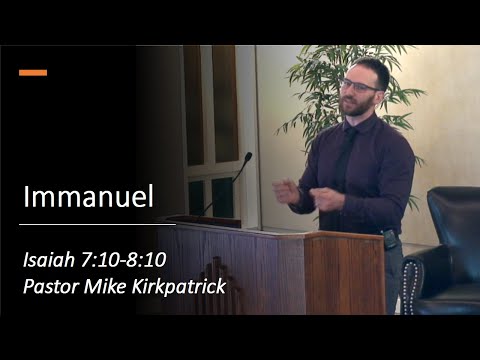
Isaiah 7:10–8:10 presents the Immanuel prophecy not as a comfortable seasonal text but as a word of judgment against Ahaz's faithless trust in Assyria and a word of hope for the covenant remnant. The sermon traces two contrasting realities: 'Assyria with us,' the consequence of royal unbelief, and 'God with us,' the promise that anchors the remnant through exile and desolation. The Immanuel sign finds its definitive fulfillment in Matthew 1, where the virgin-born Son saves his people from sin rather than merely political oppression — a truth that remains the ground of steadfastness for the church in every era of suffering and exile.

The Prophet Under the Broom Tree
What was Elijah actually doing under the broom tree — fleeing in faithless self-pity, or acting out of zealous grief for the glory of God? Working through 1 Kings 19:1–18, this sermon challenges the dominant commentatorial tradition that reads Elijah's flight and depression as a crisis of faith, arguing instead that his despondency was provoked by legitimate covenantal grief over Israel's continued apostasy after the contest at Carmel. God's response — rest, food, a journey to Horeb, and a formal covenant lawsuit — vindicates the prophet and reveals the divine program of justice and grace through Hazael, Jehu, Elisha, and a reserved remnant of 7,000. The pastoral application is direct: faithful people suffer depression, and those who minister to them must respond with the same patience, kindness, and provision that Yahweh himself showed to Elijah.

Genesis 4:16-26
Genesis 4:16–26 traces two diverging lines from Adam: the ungodly line of Cain, marked by escalating sin, polygamy, and bloodlust, and the godly line of Seth, which ends with men calling on the name of the Lord. The passage raises questions about cultural achievement, common grace, and the preservation of God's people in the midst of rampant wickedness. Eve's naming of Seth reveals genuine covenant faith in the promise of Genesis 3:15, trusting that God would yet raise up the seed of the woman. The sermon calls believers to grow in faith as those who possess not only the promise of the Redeemer but its fulfillment in Christ.

Free Grace Baptist Church - March 28, 2018 Bible Study
This Bible study works through the fall of Jerusalem as recorded in 2 Kings 25, tracing the Babylonian conquest, the destruction of the temple, the deportation of the people of Judah, and the provisional governorship under Gedaliah. The session draws out the covenantal significance of the temple's destruction — that the visible symbol of God's presence among his people had been removed — while pressing toward the hope embedded even in judgment, that God's promise to his people and to the line of David was not finally extinguished. Listeners are urged to pray for those in positions of governing authority and to trust that God's redemptive purposes persist beyond catastrophe.
2 Kings 25
The fall of Jerusalem in 2 Kings 25 is not merely a record of military conquest — it is a theological verdict on covenant unfaithfulness. The chapter traces the Babylonian siege, the systematic destruction of the temple and city, the appointment and assassination of Gedaliah, and the exile of Judah, reading as a sustained fulfillment of the curses pronounced in Deuteronomy 28. Yet the chapter's closing verses, recording the release and elevation of Jehoiachin in Babylon, preserve a glimmer of Davidic hope that Matthew 1 traces forward to Jesus Christ, the son of David whose kingdom has no end.

2 Kings 19:1-37
Second Kings 19 narrates the Assyrian crisis under Sennacherib and Hezekiah's response — a pattern of seeking God through the prophet Isaiah, spreading the enemy's letter before the Lord, and praying with conspicuously theological concern for God's honor rather than merely for personal safety. The sermon moves through three sections: the prophet's word of encouragement, Hezekiah's model prayer, and the divine defeat of 185,000 Assyrian troops by the angel of the Lord. Hezekiah's David-like rationale — that all the kingdoms of the earth may know that the Lord alone is God — illustrates why theology matters in trial, and why the best pleas in prayer are those taken from God's honor.

2 Kings 17:1-23
The fall of the northern kingdom of Israel to Assyria in 722 BC is not mere political history but theological history: the exile of the ten tribes was the direct judgment of God upon a nation that had spent over two centuries filling up the measure of its guilt through idolatry, covenant-breaking, and the rejection of every prophet sent to call them back. Working through 2 Kings 17:1–23, this study traces the instrument of God's judgment (Shalmaneser and Sargon of Assyria), the reasons for it (Israel's fear of false gods, imitation of the nations, rejection of the prophets, and repudiation of the Mosaic covenant), and its result (removal from God's sight — a loss not merely of land but of divine fellowship). The passage warns that those who follow worthlessness become worthless, while those who worship the living God are conformed to His image — and it calls every hearer to heed the warnings God has given before the same measure of guilt is filled.

2 Kings 15
2 Kings 15 surveys five successive kings of the northern kingdom of Israel in the eighth century BC, four of whom seized power through assassination, as the nation spirals toward its destruction by Assyria in 722 BC. The chapter is framed by two relatively stable kings of Judah — Azariah (Uzziah) and Jotham — whose reigns contrast sharply with the chaos in the north, even as they share the sin of leaving the high places intact. The relentless refrain that each northern king 'did not depart from the sins of Jeroboam the son of Nebat' is the biblical author's stated rationale for the divine judgment that falls in chapter 17. The study closes with application drawn from Amos 4: when God sends chastening, the right response is repentance and return to Him, not continued rebellion.

2 Kings 9
Second Kings 9 records the anointing of Jehu and his swift execution of God's long-deferred judgment upon the house of Ahab — a judgment decreed in 1 Kings 19 and pronounced by Elijah in 1 Kings 21. This sermon works through the chapter in two movements: the instrument of that judgment (the anointing of Jehu, vv. 1–13) and the execution of it (the deaths of Joram, Ahaziah, and Jezebel, vv. 14–37). The exposition draws out the comprehensive sovereignty of God over history, politics, and retribution, tracing how every detail — the location of Naboth's field, the presence of both kings in Jezreel, the dogs and the chariot — fulfills specific prophetic promises decades in the making. Listeners are called to take seriously both the justice of God against the wicked and the legitimate rejoicing of the righteous when that justice is displayed.

2 Kings 4:38-44
Two miracles in 2 Kings 4:38–44 — the purification of a deadly stew and the multiplication of bread for one hundred men during a famine — reveal a God who governs both the rise and fall of nations and the smallest necessities of ordinary life. The famine itself is a covenant curse (Leviticus 26; Deuteronomy 28), yet within that judgment God provides for his remnant with conspicuous abundance, feeding the prophets and leaving surplus. Elisha functions throughout as a type of Christ, whose own feeding miracles echo and surpass this episode. The passage calls believers to resist carnal anxiety and fear by resting on God's demonstrated sovereignty in everyday, earthy circumstances.

1 Kings 19:8-21
Elijah's journey to Horeb in 1 Kings 19:8–21 is not a story of prophetic cowardice or self-pity, but of a faithful covenant prosecutor bringing a formal lawsuit against Israel for her apostasy before the God of the covenant. The divine theophany at Horeb — wind, earthquake, and fire yielding to a still small voice — teaches that God's redemptive purposes advance not through spectacular display but through the prophetic word, historical providence, and sovereign grace. God's answer to Elijah's complaint is both judgment (through Hazael, Jehu, and Elisha) and mercy (a reserved remnant of seven thousand), affirming that God will always preserve a people for Himself. The call of Elisha that follows illustrates the decisive break from natural relations, familiarity, financial security, and self-advancement that marks genuine response to God's call.

1 Kings 18:41 - 19:8
When Elijah calls for rain after the contest at Carmel, he prays persistently through seven divine silences before a small cloud rises from the sea, demonstrating that God's sovereignty over nature does not remove the necessity of prayer but rather grounds it. The passage then traces Elijah's flight from Jezebel's death threat, and the study mounts a careful exegetical defense of Elijah: his departure is not a crisis of faith or narcissistic self-pity, but the brokenness of a prophet grieved over Israel's covenant unfaithfulness, directed to Horeb by divine prompting, and met there by a God who feeds, rests, and commissions rather than rebukes. God's varied ways of answering prayer — immediately, after extended pleading, or not at all — resist reduction to any formula, and his tender provision for an exhausted prophet reveals a character utterly unlike Baal.

The Confidence of the Believer
Micah 7 presents one of the most concentrated confessions of faith under duress in all of Scripture: a prophet who surveys moral collapse, political corruption, and the breakdown of domestic trust, yet steadfastly declares, 'I will look to the Lord.' This sermon works consecutively through Micah 7 in three movements — the prophet's lamentation over the state of the covenant community, his counsel to the godly remnant, and his closing doxology — to show what it means in practice for the just to live by faith. The doxology of verses 18–20 grounds that faith not in optimism or circumstance but in the revealed character of God: his pardoning of iniquity, his delight in mercy, his subduing of remaining sin, and his unbreakable covenant faithfulness. The sermon closes with a direct exhortation to feed faith on Scripture and sound theology, because faith cannot lay hold of what it does not know.

A Psalm of Habakkuk
Habakkuk 3 is a psalm composed by the prophet on the brink of the Babylonian devastation of Judah, and it shows what it looks like when a man lives out the principle of Habakkuk 2:4 — 'the just shall live by his faith.' Working through the psalm's three movements — petition, remembrance, and refuge — the sermon traces four gifts that faith provides in tumultuous times: rest in the day of trouble, joy in God amid devastation, stability grounded in God's strength, and material for the corporate worship of the church. The evangel is pressed home at the close: no human righteousness commends a sinner to God, and the sole instrument by which a sinful soul enters saving union with Christ is faith receiving and resting on Christ and His imputed righteousness.

The Impending Judgment of Israel
Matthew 23:34–36 records Christ's announcement of impending divine judgment upon the generation of Israel that would reject him and murder his sent messengers. The sermon traces three interlocking movements: the rejection of the prophets Christ sends in the new covenant era, the accumulation of blood-guilt from Abel to Zechariah spanning the entire Hebrew canon, and the prophetic assurance — sealed with Christ's own 'amen' — that all these things would fall upon that first-century generation in the destruction of AD 70. The exposition situates Matthew 23 within a consistent covenantal pattern running from the Mosaic curses through the Assyrian and Babylonian captivities to AD 70, and closes with a direct call to flee to the Righteous One whose shed blood is the only escape from the condemnation of hell.
The Parable of the Vineyard, Part 1
Matthew 21:33–39 presents the Parable of the Vineyard, in which Christ identifies himself as the Son sent by the divine Landowner to a covenant people who have repeatedly rejected and killed God's prophets. Drawing on Isaiah 5, Psalm 80, and a range of Old Testament and New Testament texts, the sermon establishes that Israel's religious leaders had filled up the measure of their covenant guilt, and that their rejection of the Son would culminate in the judgment executed upon Jerusalem in A.D. 70. The sermon argues that God's extraordinary patience toward covenant-breakers — patience that extended across centuries of prophetic witness — is designed to provoke repentance, and calls hearers to receive rather than resist the servants of God and to flee to Christ while the call of the gospel stands.
The Massacre at Nob
First Samuel 22:6–23 records one of the darkest episodes in Saul's reign: the massacre of 85 priests at Nob and the destruction of the entire city at the hand of Doeg the Edomite. This exposition traces Saul's paranoid pity party in Gibeah, his contempt for due process and the law of God, and the bloody consequences of political tyranny unchecked by the fear of Yahweh. Yet even in this ghastly scene the sovereignty of God is on display — the carnage at Nob fulfills the word of judgment pronounced on the house of Eli a generation earlier, Abiathar escapes to David, and the kingdom of God advances. The sermon closes by setting David's shelter of the fleeing priest against Christ's eternal high priesthood, urging sinners to flee to the one priest who ever lives to make intercession.