
Theological term
Regulative Principle
449 sermons · All terms

The Wisdom of Little Things

Proverbs 30:24–28 presents four creatures — ants, conies, locusts, and a spider or lizard — each marked by inherent weakness yet possessing a compensatory wisdom that enables them to thrive. Expounding Agur's numerical proverb, this sermon draws out four corresponding virtues for the people of God: industry in preparation, caution before danger, unity in cooperation, and persistence under adversity. Both temporal and spiritual dimensions of each lesson are developed — from Sabbatarian labor ethics and self-defense to readiness for the day of judgment and the endurance of the Christian race. The whole is gathered under a call to honest self-awareness: to know one's limitations, refuse indolence and complaint, and by grace overcome through wisdom.

The 4th Commandment (Part 3)
The Christian Sabbath is grounded in both creation and redemption, and the New Testament establishes Sunday — the Lord's Day — as the day of corporate worship by precedent and pattern rather than by bare precept. This third installment in a study of the Fourth Commandment examines three apostolic texts (Acts 20:7, 1 Corinthians 16:1–2, Revelation 1:10) that demonstrate the early church's practice of gathering on the first day of the week, then turns to two alleged anti-Sabbatarian passages (Romans 14 and Galatians 5) to show that neither addresses the weekly Sabbath but rather deals with Jewish calendar observances and the question of justification by works. The moral principle of one day in seven set apart for God remains binding on New Covenant believers, while the positive law has lawfully shifted the day from Saturday to Sunday in light of Christ's resurrection.

2LCF Chapter 22 - Of Religious Worship and the Sabbath Day, Part 1
The fourth commandment, 'Remember the Sabbath day to keep it holy' (Exodus 20:8–11), is grounded not in Mosaic legislation alone but in the creational ordinance of Genesis 2:1–3, where God's sabbathing after six days of work establishes the one-in-seven pattern binding upon all his image-bearers. The Deuteronomy 5 parallel adds redemption alongside creation as a second rationale, and these twin foundations carry into the New Covenant. Surveying Genesis 2–4, Exodus 16, Mark 2, Isaiah 56 and 58, and Jeremiah 31, this exposition demonstrates the trans-covenantal utility of the Decalogue and argues that the Sabbath is not a burdensome restriction but a gracious gift through which God's people enter into fellowship with their Creator.
Chapter 7 - Of God's Covenant
1689 London Baptist Confession chapter 7 traces the biblical and theological architecture of God's covenant: from the necessity of divine condescension (paragraph 1), through the gracious character of the covenant of grace (paragraph 2), to the three theological covenants — grace, redemption, and works — and their progressive historical unfolding (paragraph 3). The session contrasts covenant theology with dispensationalism and New Covenant theology as competing hermeneutical frameworks, argues that the Old (Mosaic) Covenant functioned as a republication of the covenant of works rather than an administration of the covenant of grace, and demonstrates from Genesis 3:15 through Jeremiah 31 and Matthew 26 that all historical covenants advance a single promise of redemption finally and fully disclosed in the new covenant inaugurated by Christ. The practical payoff is a robustly confessional case for believers-only baptism: the new covenant community is defined by inward regeneration, universal knowledge of the Lord, and definitive forgiveness — marks that exclude the external-and-internal covenant structure required to justify paedobaptism.

The Meeting with the Samaritan Woman, Part 2
John 4:16–26 presents Jesus exposing a Samaritan woman's sin through the law in order to drive her to the living water of eternal life, then correcting the corrupted worship of Samaria and declaring the arrival of new covenant worship. The sermon argues that true worship of God is irreducibly Trinitarian: the Father is the object, the Son is the mediator and the truth through whom access is granted, and the Holy Spirit is the enabling power. Jesus' self-disclosure as the great I Am — the fulfillment of Exodus 3:14 and the prophetic expectation of Deuteronomy 18 — confirms that the Messiah the woman anticipated is the very one speaking to her. Hearers are called to receive the living water freely offered and to engage in the distinctly Trinitarian worship that Christ here commands.
The Appointment of the Seven
Acts 6:1–7 records the Jerusalem church's response to a logistical crisis that threatened to pull the apostles away from prayer and the ministry of the Word. The passage establishes the diaconate in seed form: men of good reputation, full of the Holy Spirit and wisdom, appointed to serve the practical needs of the congregation so that those charged with preaching and teaching may be undistracted. Expounding 1 Timothy 3:8–13 alongside the Acts text, this sermon examines the qualifications, function, and appointment of deacons, and the connection between a biblically ordered church — with both elders and deacons — and the advance of the gospel.

The Conduct of a Faithful Minister
What does faithfulness look like in the life and ministry of a gospel minister? Expounding 1 Timothy 4:12–16 as a capstone to a study of elder qualifications in 1 Timothy 3:1–7, this sermon examines four dimensions of ministerial conduct: the minister's example before the congregation, his public ministry of reading, exhortation, and doctrine, his personal growth through sustained meditation on the Word, and his perseverance in both personal piety and sound teaching. The closing application extends these same marks to the congregation, calling the saints to receive the Word with joy, reject heresy with discernment, pursue Christian virtue, and prize the public means of grace.

Exodus 19
Exodus 19 records Israel's arrival at Sinai and God's formal entry into covenant with the nation — a covenant that functions as a republication of the covenant of works, in which Israel, like Adam before them, is called to obedience and fails, thereby pointing forward to the last Adam, Jesus Christ. The chapter unfolds in three movements: the exhortation to faithfulness through the covenant terms (vv. 1–8), the consecration of the people for readiness (vv. 9–15), and the theophanic demonstration of divine glory (vv. 16–25). The Sinai theophany, with its thunder, fire, and death-boundary around the mountain, teaches that God's people require a mediator — a lesson that finds its fulfillment in Christ, the Mediator of the New Covenant. The church, as the true Israel of God, inherits the vocation of Exodus 19:6 — a royal priesthood, a holy nation — and is therefore called to proclaim the praises of God with reverence befitting the consuming fire she approaches in worship.

Exodus 18 - Jethro
Exodus 18 presents two interconnected events: the conversion of Jethro, priest of Midian, and his practical counsel to Moses on delegating judicial authority. The conversion of Jethro follows the pattern of one called out of polytheistic darkness into the knowledge of the true and living God — marked by joy, praise, confession of Yahweh's supremacy, and worship through sacrifice. The passage further grounds civil government in the fear of God and the rule of law, teaching that qualified civil rulers must be able, God-fearing, truthful, and free from covetousness — qualities that remain the standard for righteous governance in any age.

The Qualifications of Elders, Part 3
What qualifies a man for the office of elder extends far beyond his pulpit gifts — Paul's requirements in 1 Timothy 3:1–7 encompass his household, his maturity in the faith, and his standing before outsiders. This third installment in an expository series on elder qualifications examines three remaining criteria: the man's domestic faithfulness (ruling his wife and children well), his experience in the faith (not a novice), and his testimony among those outside the church. The sermon draws on Ephesians 5–6, Titus 1, Proverbs, and Spurgeon's 'Lectures to My Students' to show that these qualifications protect both the church and the man being considered for ministry.
Exodus 16 - Bread from Heaven
Exodus 16 records Israel's complaint in the wilderness and God's provision of quail and manna, revealing that grumbling against His appointed servants is ultimately grumbling against God Himself. The chapter is expounded under three headings: the promise of bread (vv. 1–12), the presence of bread (vv. 13–31), and the preservation of bread (vv. 32–36). The manna narrative carries a Sabbatarian argument — the double portion on the sixth day presupposes Sabbath observance that predates Sinai, pointing back to Genesis 2 and forward to Exodus 20 and Hebrews 4. The episode also functions typologically, anticipating Christ as the true bread from heaven in John 6, and calls God's people in every covenant administration to daily dependence on their Provider rather than grumbling against His providence.

Exodus 15 - Song of Moses
Exodus 15 records the Song of Moses, a celebration of divine redemption and righteous judgment sung by Israel after the destruction of Pharaoh's army in the Red Sea. The sermon expounds the threefold structure of the song — the triumph of the Lord, the defeat of the Egyptians, and the majesty and incomparability of God — before tracing its prophetic reach into the nations' fear of Yahweh and the ultimate goal of covenant dwelling. The bitter waters of Marah complete the chapter, exposing Israel's reflexive grumbling as a failure to trust the God who had already done the greater work of redemption. Hearers are called to praise God for both his saving mercy and his just judgment, and to pass that doxological heritage to the next generation.

The Qualifications for Elders
What qualifications does Scripture require of a man before he may serve as an elder in a local church? Expounding 1 Timothy 3:1–7, this sermon establishes that the elder, overseer, and pastor are three terms for one office, and that the qualifications Paul lists are not recommendations but binding mandates. The sermon works through the first qualification — a genuine, rightly-motivated desire for the office — and frames it within four criteria for evaluating a call to ministry: right motives, graces indicating genuine Christian experience, gifts indicating divine provision (especially aptness to teach), and providential opportunity. The congregation is exhorted to apply these standards carefully and not to install any man, however virtuous or personable, who lacks the God-given ability to preach and teach the word.

The Cleansing of the Temple
Jesus' cleansing of the temple in John 2:13–17 is not an aberration from his character but a direct expression of his identity as the Son of God and the antitype of the temple itself. The passage reveals two inseparable realities: the apostasy of first-century Israel's worship and the messianic zeal prophesied in Psalm 69, Malachi 3, and the post-exilic prophets. Christ's authority to purge the temple rests on his sonship by nature, not adoption, and his action announces that the entire Old Covenant sacrificial system finds its fulfillment in him. The sermon calls the church to recover zeal for the purity of God's worship, to identify and resist the defections of contemporary Christendom, and to look in faith to the Lamb who has displaced every animal sacrifice.

The Enthronement of the Priest-King
Psalm 110, the most frequently cited Old Testament passage in the New Testament, presents the Messiah as the divinely enthroned Priest-King whose universal dominion is secured by the oath of God. This exposition traces three movements in the psalm: the enthronement and government of Christ the King (vv. 1–3), his eternal priesthood after the order of Melchizedek (v. 4), and the triumphant conquest of his enemies (vv. 5–7). The sermon draws on Peter's argument in Acts 2, Paul's application in 1 Corinthians 15 and Ephesians 1, and the author of Hebrews to show that Christ's present session at the right hand of the Father is not passive but active — he reigns, subdues, and intercedes. Christians living in tumultuous times are urged to resist despair by fixing their confidence in the sovereign rule of the enthroned Priest-King rather than in the shifting circumstances of earthly politics.

Not Ashamed of the Gospel

Paul's final letter charges Timothy — and every believer — not to be ashamed of Christ's gospel or of those who suffer for it. Expounding 2 Timothy 1:8–12, this sermon confronts the tendency to romanticize persecution in the abstract while failing to stand when actual pressure comes, drawing pointed application from recent governmental restrictions on church gatherings. The ground of unashamed endurance is the gospel itself: God's eternal purpose of grace, accomplished in Christ who has abolished death and brought immortality to light, and entrusted to a church that shall never finally fail. Christians are called to pray for courage in times of peace precisely so they do not waver when suffering arrives.

2nd London Baptist Confession of Faith (1689) - Sunday School Study - July 18, 2021
The self-authenticating authority of Scripture cannot be separated from sound principles for reading it. This 1689 London Baptist Confession of Faith Sunday school study works through chapter one, paragraphs five through ten, drawing out the hermeneutical principles the divines embedded there: the scope of Scripture (all glory to God through Christ), the sufficiency of Scripture (confined to God's glory, man's salvation, faith, and life), the perspicuity of Scripture (salvation truths are plain even to the unlearned), and the availability of Scripture in translation. The session also addresses textual criticism, the transmission history of the biblical manuscripts, and the distinction between necessary inference and explicit statement as sources of scriptural authority. Hearers are called to come to the biblical text with humility, the illumination of the Spirit, and a due use of ordinary means rather than intellectual pride or lazy avoidance.

The Elements of Family Worship
Deuteronomy 6:6–7 commands parents to teach God's word diligently to their children in every season of daily life, and this sermon traces that mandate across both Testaments — from Abraham's household religion in Genesis 18, through the Psalms and Proverbs, to Paul's charge in Ephesians 6:4 and the example of Timothy's mother and grandmother. The preacher argues that family worship is a clear biblical obligation whose specific form is left to the conscience, and that failure to instruct children in the fear of God — illustrated negatively by Eli and Samuel's sons — leaves them unguarded against a culture actively hostile to Christ. Fathers and mothers are exhorted to commit first to public Lord's Day worship, to honour the sanctification of the Sabbath, and then to establish a family altar consisting of Scripture reading, prayer, and singing — scaled appropriately for their household — as the primary means of passing covenant knowledge to the next generation.
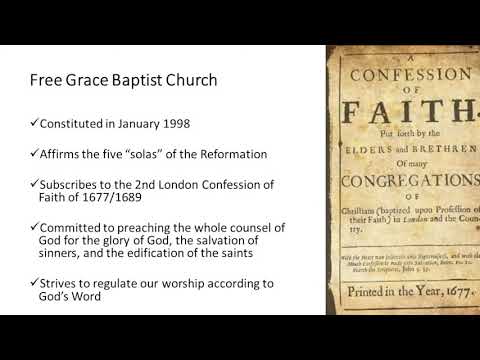
Introduction to the 1689 Second London Baptist Confession of Faith
Why should a church bind itself to a confession of faith? This introductory lesson on the Second London Baptist Confession of 1677/1689 grounds the answer exegetically in Ephesians 4 — where Christ gives gifted men to the church so that the body attains doctrinal unity and is no longer tossed about by every wind of teaching — and then traces the historical origins of the 1689 among the Particular Baptists, distinguishing them from Anabaptists, Presbyterians, and Congregationalists. Four functions of a confession are developed: defining, defending, discriminating, and disciplining with reference to the doctrine of the church. The lesson closes by distinguishing Reformed theology (Calvinism plus covenant theology plus the regulative principle) from mere five-point Calvinism, and by defending the confession's silence on matters of Christian liberty as a feature, not a defect.

Introduction to the Book of Exodus
The book of Exodus, whose Hebrew title derives from its opening words ('these are the names'), sets forth the foundational redemptive act of the Old Testament — God's deliverance of Israel from Egyptian bondage in fulfillment of the Abrahamic covenant promise of Genesis 15. This session surveys the book's structure, authorship, and theological themes, including the threefold division of the law (moral, judicial, and ceremonial), the typological relationship between Moses and Christ, and the Baptist confessional distinction that identifies the Mosaic covenant as a covenant of works rather than an administration of the covenant of grace. The study closes by tracing how Exodus functions as a foundational template for redemptive history across both Testaments, climaxing in the antitypical work of the Lord Jesus Christ as the true Passover lamb and covenant mediator.

The Lord's Assessment of John the Baptist - Matthew 11:2-15
Matthew 11:2-15 presents Christ's own assessment of John the Baptist, and this exposition works through two movements: the question John sends from prison concerning the Messiah's identity, and the Lord's threefold commendation of John as no mere reed, no court prophet, but the greatest born of women and the anti-typical Elijah. The sermon argues that John's struggle was not with who Jesus was but with the implications of the messianic reign — why the herald of judgment should languish in prison while the Messiah's full justice remained deferred — a tension the church in every age must learn to hold without abandoning confidence in God's sovereign timetable. Listeners are called to pray for and expect ministers who combine the light of sound exegesis with the heat of genuine conviction, men who, like John, neither fear nor flatter any flesh.

The Good Soldier of Jesus Christ
The qualifications and character of faithful gospel ministry are examined through 2 Timothy 2:1–7, where Paul gives Timothy three interlocking commands: be strong in the grace of Christ, commit sound doctrine to faithful men who can teach others, and endure hardship as a soldier of Jesus Christ. Three metaphors — the devoted soldier, the disciplined athlete, and the diligent farmer — together with the dedication of the disciple, frame what faithfulness in pastoral ministry demands. The sermon presses both pastors and congregations to resist the pressure of cultural and governmental opposition, to identify and train men for ministry, and to understand that the dignity of gospel preaching warrants the highest standards of devotion, discipline, and endurance.

The Christian Sabbath, Part 3
Three passages in the New Testament — Romans 14, Galatians 4, and Colossians 2 — are commonly marshalled against the abiding validity of the Fourth Commandment, but careful exegesis reveals that none of them address the weekly Lord's Day Sabbath. Romans 14 concerns Christian liberty over matters indifferent, principally Jewish dietary laws and Israel's feast calendar; Galatians 4 rebukes the Judaizers' demand that calendar observance supplement faith in Christ for justification; and Colossians 2 warns against a syncretistic heresy that mingled Christ, Judaism, and angel worship. In each case Paul is dealing with Israel's ceremonial calendar, not the moral Sabbath commandment rooted in creation and redemption, which remains binding on the new covenant people of God and is observed on the first day of the week in light of Christ's resurrection.

The Problem of Sin and the Mercy of God
Proverbs 28:13 sets the problem of sin and its remedy in sharp relief: the one who covers his sin will not prosper, but whoever confesses and forsakes sin will have mercy. The sermon works through the anatomy of sin-covering — denial, minimization, blame-shifting, and self-righteousness — with biblical examples ranging from Adam and Eve to Ananias and Sapphira, demonstrating the futility of every human attempt at self-atonement. Confession is shown to be not merely verbal acknowledgment but a saving act of faith in Christ, inseparably joined to repentance, whereby the sinner lays the hand of faith upon the surety of the new covenant and receives imputed righteousness. The closing application calls both unbeliever and believer to stop covering sin and look in faith to Christ, the only authorized covering for guilt before a holy God.

The Christian Sabbath, Part 1
The Fourth Commandment's call to Sabbath observance is grounded not in Mosaic legislation alone but in the created order itself, the pattern of divine rest in Genesis 2, and the logic of redemption running through both Testaments. This sermon, the first in a series on the Christian Sabbath, expounds Deuteronomy 5:12–15 alongside key Old Covenant passages — Genesis 2, Exodus 16, Isaiah 56 and 58, and Jeremiah 31 — to argue that Sabbatarianism is a moral, perpetual, and trans-covenantal obligation rooted in creation and confirmed by covenant. The confession of the Second London Baptist Confession chapter 22 frames the doctrinal parameters, and the sermon closes with a call to receive the Sabbath not as a burden but as a blessed provision of God for his creatures.

How to Treat One Another in the Church
First Timothy 5:1–2 instructs Timothy — and by extension all Christians — on how to treat members of the congregation according to age and gender, framing those relationships by analogy to the family. The sermon grounds this instruction in the Fifth Commandment, drawing on Westminster Larger Catechism questions 124–131 to show that the commandment's scope extends beyond natural parents to all relationships of authority, age, and equality. Pastors must exhort older men as fathers, younger men as brothers, older women as mothers, and younger women as sisters with all purity — avoiding harshness on the one side and laxity or impropriety on the other. The closing application presses the doctrine of adoption: because believers are children of God and joint-heirs with Christ their elder brother, the church is a genuine household, and its members bear mutual responsibility to encourage and bear one another's burdens without waiting for pastoral direction.

The Great Commission
The Great Commission (Matthew 28:18–20) constitutes Christ's formal mandate to his church for this age: going, making disciples, baptizing believers, and teaching them to observe all that he commanded. The authority behind the commission is Christ's present, universal lordship — not a future investiture but a reigning reality — and the assurance sustaining it is his promised presence to the end of the age. Baptism is treated as believers' baptism by immersion, an initiatory ordinance that publicly identifies the disciple with the triune God and symbolises union with Christ in his death, burial, and resurrection. The sermon calls the church to be comprehensively about this single focused mission — preaching the gospel for justification, then grounding the justified in sanctification through the teaching ministry of the local church.

The Third Missionary Journey, Part 8
Acts 21:1–16 concludes Paul's third missionary journey with his determined journey to Jerusalem in the face of repeated prophetic warnings and the tearful pleas of fellow believers. The passage grounds Paul's resolve not in stoic courage but in his consuming vision of the gospel: men and women under God's wrath and curse, and Christ alone as the remedy. The sermon draws out Paul's love for the gathered people of God, his complementarian ecclesiology (defending male leadership in church office from 1 Timothy 2 and the cessation of revelatory gifts), and his example of a missionary strategy that planted self-governing, elder-led churches across the Roman Empire.

Bible Study - Exodus 3
Exodus 3 presents the burning bush theophany as a revelation of the character of God before it is a commission to Moses. The passage is expounded under three headings: the commission given to Moses (vv. 1–12), the revelation of the divine name Yahweh (vv. 13–15), and the instructions given to Moses concerning Israel and Pharaoh (vv. 16–22). The divine name 'I AM WHO I AM' discloses God's self-existence, eternality, immutability, and covenantal faithfulness — attributes that must frame corporate worship and undergird the believer's confidence in affliction.
Stewards of the Mystery
1 Corinthians 4:1–5 presents ministers of Christ not as celebrities or gurus but as servants and stewards entrusted with the mystery of the gospel — a role demanding faithfulness, not worldly success. Against the backdrop of the factionalism at Corinth, where worldly wisdom had infiltrated the church's evaluation of apostles, Paul asserts that the only judge competent to assess a steward's motives is the Lord himself. The sermon traces three movements: the nature of the steward's calling, the irrelevance of human verdict, and the eschatological praise that awaits the faithful at Christ's return.