
Theological term
Regeneration
224 sermons · All terms

The Saving Grace of God

Ephesians 2:8–10 presents the saving grace of God as entirely sovereign, with man described in verses 1–3 as dead in trespasses and sins — not merely wounded or hindered — and therefore incapable of initiating his own salvation. Salvation is by grace alone through faith alone, where faith itself is the gift of God and not a human contribution, excluding all boasting and rendering works irrelevant to justification. Verse 10 confirms rather than supplements verses 8–9: the good works believers walk in were prepared beforehand by God, demonstrating that even sanctified living flows from divine grace rather than native human capacity. The sermon concludes with an application to believers' baptism, which testifies outwardly to God's inward work of regeneration and justification, identifies the baptized with the triune God, and marks entry into Christ's church-building project.

The Psalmist's Contemplation on the Revelation of God, Part 2
Psalm 19:7–11 presents four attributes of Scripture — perfect, sure, right, and pure — and traces the effects each produces in the souls of those the Spirit converts. The sermon argues that 'law' in this psalm comprehends the entirety of God's Word, including the gospel, and that the attributes ascribed to Scripture are inseparable from the perfections of its divine Author. Against a merely convicting or condemning view of the law, the preacher demonstrates that the same Word that exposes sin is the instrument through which the Holy Spirit effectually converts, enlightens, and rejoices the heart of the sinner. Hearers are pressed to receive the Word with joy rather than religious duty, and any who are yet dead in sin are called to cast themselves upon the Lord Jesus Christ, in whom a willing and rejoicing Savior stands ready to save.
2LCF Chapter 29 - Of Baptism

The 1689 London Baptist Confession chapter 29 sets forth a thoroughgoing Baptist doctrine of baptism: its nature as a New Covenant ordinance ordained by the incarnate mediator, its proper recipients as professing believers alone, its proper element and Trinitarian formula, and its proper mode as immersion. The study presses the case for believers-only baptism across five arguments — from covenant theology, federal headship, the doctrine of salvation, New Testament clarity, and the regulative principle of worship — demonstrating that paedo-baptism is not merely a secondary matter but a violation of Christ's express institution. The session closes with extended Q&A engaging questions about baptismal regeneration, the formula 'in the name of Jesus only,' and the standing of paedobaptist believers.

The Conversion of Lydia
Acts 16:6–15 presents the Macedonian call and the conversion of Lydia as twin demonstrations of divine sovereignty in the advance of the gospel. The Holy Spirit's redirection of Paul's itinerary, the night vision, and the sovereign opening of Lydia's heart at the Philippian riverside together show that gospel missions proceeds by God's appointment, not human initiative or chance. Lydia's conversion illustrates the full ordo of grace: effectual calling, forgiveness in Christ's blood, and the imputation of his righteousness received by faith alone — all confirmed outwardly in her immediate baptism and hospitality. The sermon presses the church to embrace both the means of gospel preaching and confidence in God's sovereign grace as the only ground of missionary hope.

The Psalmist's Description of Depravity
Psalm 14 furnishes a comprehensive doctrine of total depravity, showing that man's rejection of God is not merely intellectual but ethical — a practical atheism that issues in universal corruption and abominable works. The psalmist's two-part structure moves from the description of the ungodly (vv. 1–3) to the deliverance of the godly (vv. 4–7), with Paul amplifying the same argument in Romans 1–3 by citing and structurally imitating the psalm. The only remedy for the corruption of the heart is not behavioral modification but the righteousness of Christ received through faith — the salvation that comes out of Zion — which gives believers both ground for evangelism and comfort in a sin-cursed world.

The Apostle's Charge to Timothy
Paul's charge to Timothy in 1 Timothy 1:3–7 commands the silencing of false teachers in Ephesus who taught other doctrine, devoted themselves to fables and endless genealogies, and generated disputes rather than godly edification. The charge is not motivated by power or animosity but by love flowing from a pure heart, a good conscience, and sincere faith — the fruit of regeneration. The false teachers compounded their error by combining ignorance of the law with arrogant confidence in their own assertions, a combination the apostle deems disqualifying. Churches today must hold the same line: qualifying teachers rigorously, refusing platforms to the heterodox, and measuring all teaching against the truth as it is in Jesus.

The Central Demand of the Covenant
Deuteronomy 10 presents the central demand of the Mosaic covenant — that Israel fear, love, and serve the Lord with all their heart and soul — set against the backdrop of the golden calf incident and the covenant's renewal. The sermon traces this demand from its roots in Deuteronomy 10:12–13 through its echoes in Genesis 18, Proverbs 21, Hosea 12, Zechariah 7, Micah 6, and Matthew 23, demonstrating that obedience rooted in heart religion has always been God's requirement of His people. The threefold division of the law is expounded, with the moral law established as perpetually binding while the ceremonial law finds its fulfillment in Christ and the judicial law expires with the Israelite theocracy. The sermon closes by pressing believers to hold fast to God, keeping His law not as a means of justification but as the pattern for sanctification purchased by Christ, the true Israel who alone fulfilled the covenant.

The Theater of His Glory

Psalm 19 sets creation and Scripture side by side as God's two books of revelation: the heavens declare His glory in every language to every people, while the Word of God converts the soul and opens eyes to see what unbelief cannot perceive. The sermon works through the psalm to show that general revelation leaves all people without excuse before God, yet only the regenerate, illumined by the Spirit through Scripture, properly receive the theater of God's glory. The three closing applications call Christians to train their children in a Christ-centered view of both books of revelation, to cultivate daily awareness of God's hand in creation, and above all to prize the Word of God as the supreme gift that leads to life and holiness.

Baptism in the Old Testament
The washings of the Old Covenant — priestly consecration, the Day of Atonement, and ritual purification — constitute the Old Testament type to which New Testament baptism is the antitype, not circumcision as pedobaptist argument typically asserts. This session of a three-part seminar argues that Jesus' baptism marked his public entry into priestly ministry, and that believers are baptized because they, too, are priests to God who must be consecrated for access into his presence. The session draws on Exodus, Leviticus, Numbers, Hebrews, and 1 Peter to build a biblical theology of water and cleansing, urging a recovery of genuine appreciation for baptism as a meaningful ordinance rather than a mere formality.

Ask FGBC #61: Conviction of Sin Before or After Regeneration?
The question of whether conviction of sin precedes or follows faith is examined through the lens of the ordo salutis. Conviction of sin necessarily precedes faith because without it the sinner would see no need for Christ, yet Scripture nowhere prescribes a fixed period of misery as a prerequisite for receiving the gift of faith. Conversion is the divine bestowal of the graces of faith and repentance together, not a staged sequence in which the sinner must accumulate sufficient guilt before God acts. The call of the gospel is not prolonged self-examination but immediate flight to Christ, and the doctrine of presumption that keeps sinners in unnecessary bondage is a Catholic, not Protestant, imposition on the gospel promise.

Ask FGBC #59: What is Faith?
Faith is defined in two senses in Scripture: as the objective content of the Christian religion (the propositions of the gospel to be believed) and as the subjective act of believing. In its saving sense, faith is the Spirit-given, empty-handed instrument by which a sinner rests upon and receives the Lord Jesus Christ and all the redemptive benefits secured by His obedient life, atoning death, and resurrection. Because regeneration precedes faith and faith itself is a divine gift, the strength of one's faith — or the feelings accompanying it — is never the ground of salvation; Christ alone is that ground. The discussion warns against distortions that load faith with feelings, smuggle faithfulness or love into its definition, or ground justification in evangelical obedience rather than in Christ received through faith alone.

What Is Faith? When Should I Be Baptized? & more| Ask FGBC Batch 6
This Q&A episode from a confessional Reformed Baptist church addresses twelve questions spanning baptism, faith, church membership, Scripture interpretation, seminary training, and the heresies of Federal Vision and Baxterianism. Particular attention is given to the definition of saving faith — distinguishing the objective content of the faith from the act of believing, warning against loading faith with feelings, faithfulness, or love as its ground, and insisting that faith is the empty instrument through which God-given grace lays hold of Christ alone. The episode closes with treatments of conviction of sin, catechetical instruction of children, and the importance of an educated ministry.

The Darkness of Depression
Proverbs 15:13 identifies the broken spirit as a genuine human affliction, and the broader witness of Scripture — from Elijah under the broom tree to the weeping prophet Jeremiah to the Saviour himself as a man of sorrows — confirms that depression and melancholy are realities in the lives of God's people, not marks of spiritual failure. This sermon works through the reality of depression, its manifold causes (physical, psychological, circumstantial, spiritual, and diabolical), and practical strategies for those who suffer and those who come alongside sufferers. The controlling remedy throughout is the means of grace: rest, diet, exercise, prayer, Scripture, and the gathered worship of God's people — with the warning that singing songs to a heavy heart, after the manner of Job's friends, is a pastoral failure Scripture explicitly condemns.

2LCF Chapter 10 - Of Effectual Calling
Effectual calling is the sovereign, gracious act by which God brings those predestinated unto eternal life from spiritual death to faith in Christ, through His word and Spirit, with no contribution from the creature. This lesson works through all four paragraphs of 2LCF Chapter 10, tracing the definition and character of the effectual call, its Trinitarian foundation, the two-fold nature of outward word and inward Spirit, the extraordinary provision for elect infants and those incapable of hearing the word, and the fixed inability of the reprobate. The session closes by pressing the doctrine against Pelagian, Semi-Pelagian, Arminian, Socinian, and Roman Catholic errors, and by insisting that there is no salvation outside of Jesus Christ for those who receive not the Christian religion.

The Burial of Christ
The burial of Jesus Christ in John 19:38–42 and Matthew 27:62–66 is not a peripheral narrative detail but a theological linchpin between the humiliation of the cross and the triumph of the resurrection. Through the actions of Joseph of Arimathea and Nicodemus — two secret disciples emboldened by the death of Christ — the gospel accounts establish the true humanity of the Son of God, confirm the reality of his death against ancient and modern denials, and set the stage for the empty tomb. The security measures taken by the Sanhedrin, far from suppressing the resurrection, served only to make the miracle undeniable and the wrath of men an instrument of God's glory. Sinners are called to receive the gospel as historical fact: that Christ died for sins, was buried, and rose again on the third day.

The Warning Against Judaizers
Philippians 3:1–3 contains the only sustained polemical section in the epistle, and the apostle Paul deploys it as a warning against Judaizers — those who insisted that faith in Christ must be supplemented by Mosaic ceremonies such as circumcision for acceptance with God. Working through Paul's strategy in verse 1, his three-fold warning in verse 2, and his corrective in verse 3, the sermon demonstrates that the Judaizing error — whether in its first-century form, in Roman Catholicism, or in modern movements such as the New Perspective on Paul and Federal Vision — nullifies the grace of God by refusing to let Christ be a whole Savior. The church's only boast, identity, and worship are grounded in Christ alone, received through faith alone, apart from any confidence in the flesh.
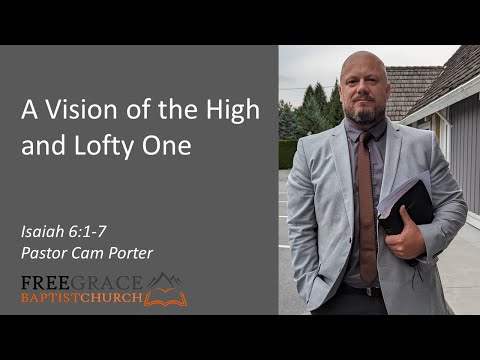
A Vision of the High and Lofty One
Isaiah 6:1–7 presents the prophet's visionary encounter with the enthroned Lord — holy, holy, holy — and his subsequent cleansing by a coal from the altar. This sermon works through five movements in the passage: the introductory contrast between dying earthly kings and the eternal High King of Heaven; the exemplary posture of the seraphim before the divine majesty; the superlative holiness, glorious titles, and unbounded presence of the Lord of hosts; Isaiah's fitting confession of his own uncleanness; and the gracious divine initiative in purification, which anticipates the definite atoning work of Christ. The congregation is called to approach the living God with the humility of Isaiah and the seraphim, confident that the same sovereign who commissioned his prophet will fill the whole earth with his glory through the proclamation of the gospel.

The Importance of Spiritual Exercise
Philippians 2:12–13 is not a self-salvation passage but a call to Spirit-enabled perseverance rooted in the sovereign grace of God. The sermon expounds the believer's responsibility to 'work out' a salvation already given — not to attain it, but to live in conscious, fear-driven obedience to the God who both justifies and sanctifies. Against hyper-Calvinist passivity on one side and Arminian self-effort on the other, the text holds together human duty and divine empowerment: God works in believers both to will and to do according to his good pleasure. The practical summons is to pursue sanctification — the whole of it, fear, trembling, cross-contemplation, and dependence on the Spirit — as those destined for glorification.

The High Priestly Prayer, Part 8
John 17:21–23 records Christ's high priestly petition for the unity of all believers across every age — a unity patterned on the mutual indwelling of the Father and the Son. The sermon works through the petition ('that they all may be one'), the divine paradigm (the perichoretic union of the Father and Son as the exemplar for creaturely unity), and the missional purpose (a unified church publishes to the world the reality of the Incarnation and the love of the Father). Believers are called to pursue a common faith, a common orientation, and a common goal — the glory of God — knowing that their corporate life is itself a testimony to the mission of the sent Son.
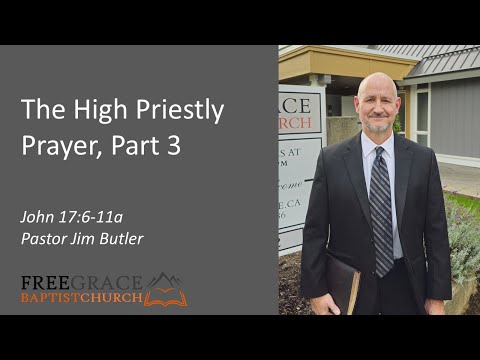
The High Priestly Prayer, Part 3
Jesus intercedes for his apostles in John 17:6–11a, and this sermon examines who those men are, what qualifies them as objects of his high priestly prayer, and why he prays for them rather than for the world. The exposition grounds the disciples' identity in the Father's sovereign, electing gift of them to the Son within the eternal covenant of redemption, their reception of the words the Father gave to the Son, and their growing recognition that the Son is one in being with the Father. The preacher draws out the implication that faithful gospel ministry, like the ministry of Christ himself, must declare only what has been received from God, without accommodation to cultural pressure or the demand for entertainment.

The Joy of the Gospel

Ephesians 2:1–10 presents the whole arc of redemption in miniature: total depravity, sovereign grace, and the new life of sanctification. This sermon works through that arc by contrasting the bad news of verses 1–3 — that every human being is spiritually dead, enslaved to fleshly desires, complicit with satanic powers, and deserving of divine wrath — with the good news of verses 4–10, where God's rich mercy, unearned grace, and sovereign bestowal of faith rescue sinners who had nothing to offer Him. The central application is that the regenerate life is marked not by boasting but by the Spirit's fruit, and that the gathered church is itself a foretaste of the eternal communion for which God has prepared His people in Christ.

Ask FGBC - July 2024 Podcast with Pastors Butler and Kirkpatrick
Two pastors work through a wide-ranging set of questions submitted by listeners, covering the Reformed doctrine of the will, repentance and faith, holy days, Christian political engagement, believers' baptism, the New Covenant, forgiveness of unrepentant offenders, ongoing confession of sin, witnessing to homosexual neighbors, the Sabbath shift from Saturday to Sunday, the day of the Lord, the beatific vision, common grace, saving versus temporary faith, and the holy walk. Throughout, the answers are grounded in the 1689 London Baptist Confession and exposit the relevant biblical texts, consistently distinguishing the Reformed Baptist position from Arminian, dispensationalist, and paedobaptist alternatives. The session serves as accessible catechetical instruction for believers at all stages while modeling how confessional Reformed Baptist theology addresses both doctrinal and practical questions.

The Glory of Christ's Departure, Part 1
John 16:25–28 records the climactic doctrinal statement of the Upper Room Discourse, in which Christ declares His eternal generation from the Father, His incarnation into the world, and His impending ascension back to the Father. The sermon works through three heads: the manner of Christ's instruction in figurative language and the Spirit's coming role in illuminating the disciples; the access believers have to the Father through the Son in prayer; and the doctrinal creed embedded in verse 28, treating eternal generation, incarnation, and ascension in sequence. The unchanging love of the Father for those who are in Christ by grace through faith is held out both as the chief encouragement for disciples going into a world of tribulation and as the ground of the gospel call to sinners to look to Christ for blood and righteousness.

The Salvation of Sinners on Pentecost
Peter's sermon on the day of Pentecost (Acts 2:22–42) declares the life, death, resurrection, and exaltation of Jesus Christ as the exclusive ground of salvation, and calls sinners to repentance and faith. The sermon examines what genuine repentance means — a change of mind inseparable from faith, not a prior moral reformation — and argues that baptism is the sign of what God has already accomplished internally, not the instrument of forgiveness. Acts 2:39 is addressed directly against paedobaptist appeals, with the promise of the Spirit shown to belong to all who are effectually called, not to the physical infants of believers. The sermon closes with an exhortation to follow the Pentecost pattern: preach the gospel, baptize disciples, and teach them in the church.

Ask FGBC #25: How do I handle family members, friends, etc, not believing?
A questioner is grieved by family members and friends who refuse to believe the gospel, citing a theology that demands a prolonged crisis of sin and misery before conversion is credible. The response addresses both the pastoral burden of watching loved ones reject Christ and the theological confusion that treats immediate repentance and faith with suspicion. Practical counsel includes persisting in prayer, reading Scripture together rather than arguing theology, and pointing to the diverse conversion experiences in the New Testament and in works such as Pilgrim's Progress to show that Scripture nowhere requires a prescribed experiential cycle before a sinner may come to Christ.

The Baptism of Saul of Tarsus
The baptism of Saul of Tarsus in Acts 9:17–25 demonstrates the proper order of Christian baptism: conversion precedes the ordinance, which then publicly marks the believer as a disciple of Christ. The passage is treated as a direct answer to Stephen's dying prayer in Acts 7:60, with Saul's transformation from chief persecutor to chief preacher serving as a vivid display of sovereign, redeeming grace. The sermon draws out three observations from Saul's early ministry — the immediacy, the effects, and the hostility of his preaching — and closes with the baptism of three new believers, each of whom gives a brief testimony of their own conversion.
Gospel Treasure in Human Weakness
Gospel ministry is defined by the preaching of Christ alone, not the self-promotion of the minister. Expounding 2 Corinthians 4:5–7, this sermon traces four marks of faithful gospel ministry: the obscurity of the minister who refuses to preach himself, his bondservice to the congregation for Christ's sake, the divine illumination that enables true proclamation, and the humility of an earthen vessel that magnifies the treasure it carries rather than the vessel itself. The call throughout is for preachers to disappear so that only Christ is seen, and for congregations to demand nothing less.

The Gratitude of the Apostle
Paul's opening lines to the Philippians (1:3–8) reveal an apostle whose gratitude, commendation, and affection are all grounded not in the merits of his friends but in the sovereign grace of God. The sermon works through three movements: the object and fruit of Paul's gratitude (prayer with joy), his commendation of the Philippians for their fellowship in the gospel and his confidence in God's preserving grace, and his oath-backed declaration of personal affection for them. The assurance of salvation rests not in the believer's perseverance but in the faithfulness of the God who begins and completes every good work, a truth the church is called to receive with gratitude and express through active participation in gospel ministry.

The Love of Christ and Love to One Another
John 15:9–11 presents the love of Christ for his disciples as the pattern, precept, and purpose of the Christian life. The Father's love for the Son — infinite, eternal, and unchangeable — is the very measure of Christ's love for his people, a love that is not conditional upon the disciples' obedience but is rather the ground from which obedience springs. Keeping Christ's commandments is not the cause of the disciple's acceptance before God but the consequence of justification freely received: the blood and righteousness of Christ alone secure standing with the Father. The sermon closes with an urgent call to unbelievers to cease searching for joy in creatures and to come to Christ, in whom fullness of joy is found both now and in glory.

The Vine, the Vinedresser, and the Branches, Part 2
John 15:3–8 sets forth the doctrines of regeneration, justification, and sanctification through the metaphor of the vine and branches. The passage establishes that union with Christ — not moral resolve or covenantal externalism — is both the ground and the sustaining power of the Christian life. The sermon refutes paedo-baptist readings of the text and the health-wealth distortion of Christ's promise of answered prayer, arguing instead that fruitbearing flows necessarily from a living faith-union with the true vine. The exhortation to abide is therefore not a condition of salvation but the calling of those already justified freely by grace.