
Theological term
Propitiation
216 sermons · All terms

The Redemptive Work of the Son, Part 2

Ephesians 1:8–12 grounds the individual believer's redemption within a cosmic divine purpose: God's wisdom in the plan of salvation maintains all his holy perfections without compromise, the mystery of his will now openly revealed in the gospel calls sinners from every tribe and nation, and all things will be recapitulated — gathered up and set in order — under the lordship of Christ at his return. The inheritance of the elect is secured by predestination, not by human performance, so that the redeemed exist 'to the praise of his glory' — as a trophy case of grace before angels and the entire created order.

The Redemptive Work of the Son, Part 1
Ephesians 1:6–7 sets forth the redemptive work of the Son within the triune economy of salvation, moving from the Father's electing purpose in eternity past to Christ's historic accomplishment of redemption in time. The sermon expounds two interlocking realities: the Father's sovereign initiative in bestowing grace upon the elect in the Beloved, and the Son's purchase of redemption through the shedding of his blood. Redemption is shown to be not a mere exercise of divine power but the payment of a ransom price, with the forgiveness of sins as its primary blessing — all flowing from the inexhaustible riches of God's grace. Hearers are called to respond with worship, gratitude, and increasing love for Christ, the Beloved of both the Father and the redeemed.

The Rejection of the Son
John 5:41–47 records Christ's closing rebuke to the Jewish religious leaders who rejected Him despite the testimony of John the Baptist, His works, the Father, and the Scriptures. The sermon expounds two principal charges Jesus levels against His opponents: their refusal to receive the honor that comes from God alone, and their complete absence of love for God — demonstrated precisely by their rejection of the One the Father sent. Working through the accusation by Moses in verses 45–47, the exposition shows that to reject Christ is simultaneously to reject Moses, to reject the Father, and to worship an idol in place of the living God. The sermon closes with a call to receive Christ by faith, in whom alone eternal life is found.

2LCF Chapter 8 - Of Christ the Mediator, Part 2
Christ the Mediator, as confessed in chapter 8 of the 1689 London Baptist Confession of Faith, is examined through Hebrews 10 and supporting Scripture, tracing the pre-temporal appointment of the Son in the covenant of redemption, his hypostatic union, his anointing for the mediatorial office, and the execution of his saving work. The confession's account of Christ's perfect obedience, sacrificial death, and resurrection is shown to satisfy divine justice, procure reconciliation, and secure an everlasting inheritance for all the Father has given him. Particular attention is given to the retrospective communication of Christ's redemptive benefit to elect saints under the old covenant, demonstrating that salvation has always been by grace through faith in Christ alone. The study exhorts believers to find stability, comfort, and assurance in a precise knowledge of who Christ is and what he has accomplished.

2LCF Chapter 8 - Of Christ the Mediator, Part 1
Chapter 8 of the 1689 London Baptist Confession opens with the pre-temporal appointment of Christ as mediator in the covenant of redemption, then moves to the historical stages of that mediatorial work, beginning with the incarnation. The confession affirms that the Son of God, consubstantial and co-eternal with the Father, took on true human nature — with all its essential properties and common infirmities, yet without sin — so that two whole and distinct natures are inseparably united in one person: the hypostatic union. Drawing on John 1, Hebrews 2, 4, and 7, Galatians 4, and the Chalcedonian Definition of 451, the study traces the biblical and creedal foundations of Reformed Christology, and shows how the confession's language connects the Reformed Baptist tradition to the settled Christological consensus of the ancient church.

Redeemed by the Precious Blood of Christ

God is an impartial judge who will call every person to account for every transgression of his law, and no corruptible thing — no silver, gold, religious ritual, or moral effort — can satisfy the demands of that justice. Redemption comes exclusively through the precious blood of Christ, the spotless Lamb foreordained before the foundation of the world, whose death made propitiation for sin and whose perfect obedience is imputed to the believer's account. Drawing from 1 Peter 1:17–21, this sermon expounds the condition, command, reason, and result of the Christian's call to conduct life in reverent fear: not a slavish terror born of misunderstanding God's character, but a reverent awe that flows from knowing the God who is both perfectly just and perfectly merciful. The believer's ongoing faith and hope are to rest continually in God — grounded in Christ's resurrection, confirmed by his ascension to glory, and oriented toward the certain hope of the new heaven and new earth.

The Magnitude of Salvation
1 Peter 1:10–12 raises a question that magnifies the gospel: if the Old Testament prophets searched so carefully for what believers now possess, how great must this salvation be? The sermon traces three witnesses to that greatness — the prophets who inquired but did not receive the full disclosure, the apostles who proclaimed what the Spirit now made plain, and the angels who bend over in perpetual wonder at a redemption they themselves never needed. The pattern of Christ's sufferings followed by glory is shown to be the shape of every believer's life, grounding present endurance in the certainty of future inheritance.
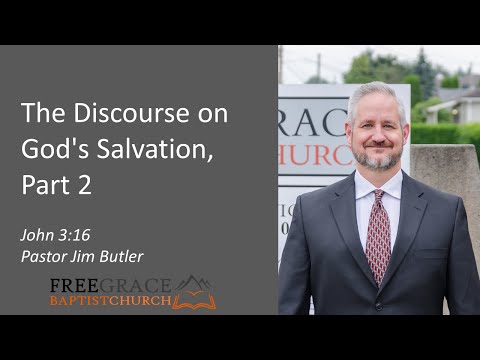
The Discourse on God's Salvation, Part 2
John 3:16 — Luther called it 'the Bible in miniature,' and this exposition treats it as precisely that: a compressed statement of the whole Christian gospel. The sermon moves through three divisions of the verse — the declaration of God's love, the demonstration of that love in the gift of the only begotten Son, and the description of those who receive God's redemptive love through faith. Central to the argument is the insistence that God's love is the source, not the consequence, of the atonement, and that 'the world' in John's vocabulary denotes persons from every tribe and tongue without ethnic distinction, not every individual without exception — a conclusion that grounds particular redemption in the wider theology of John's writings. The sermon closes with a direct appeal to unbelievers: the one way of salvation is to believe on Jesus Christ alone, whose active obedience supplies the righteousness that sinners need and whose substitutionary death removes the condemnation they deserve.

The Crucifixion of Jesus, Part 3
Matthew 27:45–46 records the fourth of Christ's seven words from the cross — the cry of dereliction, 'My God, my God, why have you forsaken me?' — and its interpretation demands both exegetical precision and doctrinal care. The darkness from the sixth to the ninth hour was not a solar eclipse but a supernatural sign of divine judgment, recapitulating the ninth plague pattern and marking the moment the Passover antitype was slain. The cry itself does not imply any ontological division within the Trinity, any dissolution of the hypostatic union, or the suffering of all three persons; rather, it expresses the withdrawal of divine consolation from the Son according to his true humanity as he bore, in our place as surety, the full weight of penal wrath. Believers are called to ground their assurance not in felt divine presence but in the covenant faithfulness of the God to whom Christ still cried 'my God' even in the depth of his substitutionary suffering.

The Pharisee and the Publican
This exposition of Luke 18:9–14 examines the parable of the Pharisee and the publican as a penetrating diagnosis of self-righteousness and a declaration of justification by faith alone. The sermon works through the occasion of the parable, the contrasted characters of the two men, and Christ's concluding verdict that the tax collector — not the Pharisee — went home justified. The central contention is that acceptance before God rests entirely on the imputed righteousness of Christ received through faith, not on any moral performance or religious accomplishment, and that those who understand this will be marked by humility rather than contempt toward others.

The Testimony of John the Baptist, Part 2
John 1:29 records the Baptist's singular declaration — 'Behold the Lamb of God who takes away the sin of the world' — a phrase saturated with the weight of Old Testament redemptive history. This sermon works through the theological freight of that title, tracing the Lamb through Genesis 22, Leviticus 16, and Isaiah 53 to show that Christ's mission is substitutionary blood atonement: he takes up the sin of his people in order to take it away entirely. The 'world' from which sin is removed is not every individual without exception but men and women without ethnic or national distinction, saved by grace alone through faith in Christ alone.

The New and Living Way
Hebrews 10:19–25 presents two grounds of confidence for the people of God — boldness of access to the Holy of Holies through Christ's blood and flesh, and the possession of a great high priest over the house of God — and then presses three exhortations upon that foundation: draw near, hold fast the confession of hope, and consider one another to stir up love and good works. The sermon traces the problem of sinful man's exclusion from God's presence from Exodus 40 through the Levitical sacrificial system to its resolution in the incarnation and definite atonement of Christ, who consecrated a new and living way. Particular attention is given to the prohibition against forsaking the assembly, argued to be grammatically tied to the third exhortation and theologically governing all three, so that corporate Lord's Day worship is the ordained context in which God's people draw near, are educated in hope, and mutually provoke one another to love and good works. The sermon closes by calling the unconverted to look to Christ and the converted to embrace their shared responsibility for one another's souls through faithful churchmanship.

The Cross Predicted and Rejected

Mark 8:31-33 records Jesus' first explicit prediction of His suffering, death, and resurrection — a proclamation that shattered every nationalist expectation of a triumphant Messiah. The sermon works through two movements: the cross predicted (vv. 31-32a), where Jesus identifies Himself as the suffering Son of Man whose death and resurrection were decreed by God from eternity, and the cross rejected (vv. 32b-33), where Peter's rebuke earns the reply 'Get behind me, Satan' because man's thoughts about the Messiah stand in direct opposition to God's. Rooted in Isaiah 53, Daniel 7, Hosea 6, and Psalm 118, the exposition argues that penal substitutionary atonement — the Son of Man bearing the wrath sinners deserve — is the only ground of eternal life, and that the same Christ who prepared His disciples for His own suffering now calls His people to take up their crosses in this present evil age.

The Victory of David Over Goliath, Part 2
David's victory over Goliath in 1 Samuel 17 is fundamentally a theological event, not a heroic self-help narrative. The sermon works through David's preparation, his declaration of faith in the name of the Lord of hosts, the decisive defeat of Goliath, and the rout of the Philistines, arguing that the emphasis falls squarely on who Yahweh is rather than on what David achieves. The fatal headshot dealt to Goliath is then traced through the biblical-theological thread of Genesis 3:15, illustrated in Judges 4 and 9, and shown to culminate in Christ's crushing of the serpent's head through His own suffering, death, and resurrection — the definitive victory to which David's victory is typological.

The Salvation of Zacchaeus
Luke 19:1–10 presents the salvation of Zacchaeus as a concrete demonstration of sovereign, irresistible grace applied to an utterly unworthy sinner. The sermon traces two movements: first, the description of Zacchaeus as a chief tax collector — condemned before God, rich through corruption, possessing nothing to commend him to divine favor — and second, the mission of Christ, who sovereignly summons Zacchaeus from the tree and brings salvation to his house. The crowd's complaint that Christ eats with sinners is shown to be, unwittingly, the very proclamation of the gospel, while Christ's own declaration — 'the Son of Man has come to seek and to save that which was lost' — is set forth as the irreducible statement of His redemptive purpose. Hearers are exhorted to find their hope not in moral accomplishment but in the seeking and saving God who invades the lives of sinners they have given up on.

The Messiah, The Baptist, And The Kingdom
Matthew 11:2–15 presents three interlocking questions: who is Jesus the Messiah, who is John the Baptist, and what is the nature of the kingdom of heaven? The sermon works through John's imprisoned inquiry — not as rank unbelief but as a struggle with the shape of the messianic agenda — and Christ's answer, which grounds assurance in fulfilled Old Testament prophecy rather than in political deliverance. John is then assessed by Christ himself as more than a prophet, the very subject of Malachi's covenant-messenger prophecy, a man of unflinching courage who stands as a model for preachers and all believers. The enigmatic kingdom-violence saying of verse 12 is read as a positive-negative pairing: the kingdom forcefully advances through proclamation and regeneration, but violent men persist in opposing and plundering it until Christ's enemies are made his footstool.

The Prediction of Desertion and Denial
Matthew 26:31–35 records Jesus predicting both the desertion of all His disciples and the specific denial of Peter on the night of His arrest. The passage demonstrates that the salvation accomplished at the cross was entirely the work of Christ alone — His friends fled, leaving no horizontal assistance — and that Scripture, citing Zechariah 13:7, had appointed this scattering from eternity. The sermon draws out the persistent problem of remaining corruption in the regenerate: the pride, self-confidence, and lofty self-assessment that Peter epitomizes are not unique to him but are symptomatic of all God's people. The remedy is not stronger resolution but a biblical self-assessment that drives the believer away from confidence in the flesh and toward continual dependence on the grace and Spirit of God.
The Resurrection and Justification
Romans 4:25 declares that Christ 'was delivered up because of our offenses and was raised because of our justification' — a verse Charles Hodge called a comprehensive statement of the gospel and Matthew Poole called an abridgment of the whole. The sermon works through two inseparable redemptive realities: the substitutionary, particular atonement accomplished in Christ's death, and the five-fold testimony of the resurrection to the validity of that work. The central application is that a robust grasp of justification by faith alone — the imputation of Christ's righteousness received through faith — is the irreplaceable foundation for Christian stability, comfort, and peace with God.

Free Grace Baptist Church - October 6, 2019 PM
What does it mean that the Father has 'bestowed' his love on sinners so that they should be called children of God? Expounding 1 John 3:1 in the context of a Lord's Supper service, this sermon examines the divine love under four headings: the call to consider it, the object in view, the blessed result of adoption, and the attendant conflict with the world. The love of God is grounded in his impassibility and immutability — he is 'most loving' not as an emotional fluctuation but as an unchanging perfection — and the doctrine of adoption is carefully distinguished from and harmonized with John's language of new birth, following B.B. Warfield's analysis. The sermon closes by directing communicants to fix their minds on Christ rather than on themselves as they receive the bread and cup.
The Conversion of Cornelius, Part 1
Acts 10:1–8 records the opening of the Cornelius narrative, which Luke presents as the pivotal, formal inclusion of Gentiles in the covenant of grace. This sermon examines Cornelius's identity and his preparatory vision, arguing from five lines of evidence within Acts 10–11 that Cornelius was not yet saved before Peter's arrival — his devout almsgiving, prayer, and God-fearing religion notwithstanding. The passage is set against contemporary Catholic and Protestant inclusivism, which the sermon rejects in favour of the exclusive claim that remission of sins comes only through conscious faith in Christ. The practical call is to refuse the delusion that religious conduct commends a sinner to God, and to rest instead in the blood and righteousness of Jesus Christ alone.

The Nature of the Gospel
Galatians 1:1–5 is not merely a conventional greeting but a compressed summary of the gospel itself. Working through each clause of verses 4–5, this exposition identifies five defining features of Christ's death: it was voluntary, it consisted in penal substitution, it secured deliverance from this present evil age, it was determined by the Father according to His eternal will, and it promotes the glory of God alone. The sermon presses toward the Lord's Supper, calling each hearer to examine whether they can say with Paul in Galatians 2:20, 'He loved me and gave Himself for me,' and to receive the bread and cup only on that ground.

The Suffering Servant
1 Peter 2:21–25 sets forth Christ's suffering as redemptive before it is exemplary: Peter's primary purpose is not to give believers a moral template but to ground their conduct in the substitutionary, sin-bearing work of the Servant prophesied in Isaiah 53. The sermon traces the description of Christ's redemptive suffering — his sinlessness, his silence under reviling, and his substitutionary death on the tree — before turning to its results: the freedom of God's people from sin's penalty and power, and the recovery of straying sheep by the Shepherd and Overseer of their souls. Believers are therefore called not to whine or revile under unjust treatment, but to commit themselves to him who judges righteously, following the pattern of the one whose stripes have healed them.

The Justice of God and the Gospel
Proverbs 17:15 declares that justifying the wicked and condemning the just are alike an abomination to God — yet the gospel does precisely both: God condemned the sinless Christ and justifies ungodly sinners. This sermon works through the theological architecture that vindicates God from any charge of self-contradiction in the gospel, tracing the doctrines of covenant representation and imputation from Genesis through the Prophets and into Paul's argument in Romans 3–5. The three acts of imputation — Adam's sin to all mankind, the elect's sin to Christ, and Christ's righteousness to the elect — are shown to be the biblical answer to the problem Proverbs 17:15 raises, grounding assurance in an alien righteousness received by faith alone.

From Alienation to Reconciliation
Colossians 1:21–23 sets the condition of fallen humanity — alienated from God, hostile in mind, and characterised by wicked works — against the sovereign act of divine reconciliation accomplished through the incarnation and substitutionary death of Christ. This sermon works through Paul's three-part description of man's former state before turning to the means and goal of reconciliation: the bodily death of Christ to present his people holy, blameless, and above reproach. The exposition closes with a call to perseverance grounded not in the believer's resolve but in the completed work of the one who reconciles, redeems, and saves to the uttermost.
The Judgment of God upon Idolaters
Romans 1:18–32 expounds Paul's indictment of Gentile idolatry as the root of all human unrighteousness, demonstrating that ungodliness — the rejection of the true and living God — inevitably produces the full range of moral disorder catalogued in verses 29–31. General revelation renders every person without excuse before God, yet it is insufficient to save; only the special revelation of the gospel, culminating in the propitiation of Romans 3:21–26, provides the antidote to mankind's idolatrous condition. The sermon traces the descent from suppressed knowledge of God through exchanged glory, divine abandonment, and catalogued vice, and closes by calling hearers to identify their own idols — theological, material, and self-oriented — and to look to Christ alone for justification.

The Mission of the Son of Man
Matthew 20:20–28 confronts the persistent problem of pride and the inverted logic of kingdom greatness. Against the backdrop of Christ's third passion prediction, the ambitious request of James and John exposes a desire common to all God's people: the crown without the cross. The sermon works through Christ's twofold instruction — rejecting the Gentile model of top-down authority and embracing servant-greatness — before landing on the theological heart of verse 28: the Son of Man gave his life as a ransom for many, a payment securing the definite salvation of his people and providing the interpretive key to the entire passion narrative of Matthew 21–27.

Free Grace Baptist Church - September 30, 2018 PM
Psalm 143 confronts the fundamental problem of human unrighteousness: in God's sight no one living is righteous, and David's only refuge is not his own covenant faithfulness but God's righteousness, faithfulness, and hesed. The sermon traces David's two movements — his appeal to God's righteousness in the face of a crushed soul (vv. 1–6) and his petitions for God's guidance as a troubled servant (vv. 7–12) — showing that both sections keep the focus relentlessly on who God is rather than on the psalmist's circumstances. Luther's description of Psalm 143 as a Pauline psalm is vindicated by Paul's verbal allusion in Romans 3:20, where the same confession that no flesh is justified by works of the law becomes the pivot to the righteousness of God through faith in Jesus Christ. The sermon calls believers to let their prayers be preoccupied with God's character and Christ's imputed righteousness rather than their own merit, and invites the unbeliever to look to Christ for a righteousness entirely outside themselves.
The Death, Burial, and Resurrection of Christ

What is the gospel, and why does its content matter for the Lord's Supper? Expounding 1 Corinthians 15:1–20 with focused attention on verses 3–4, this sermon argues that the gospel is defined by three inseparable historical and theological events: the death, burial, and resurrection of Christ. Each event carries precise atoning weight — the death is substitutionary, propitiatory, and expiatory; the burial confirms the reality of that death and sets the stage for resurrection; the resurrection vindicates Christ's saving work, bears witness to the justification of his people, and establishes him as judge of the living and the dead. Delivered in the context of the Lord's Supper, the sermon calls believers to a wonder-filled, theologically informed observance of the ordinance, and warns unbelievers that the risen Christ who died for sinners will also be their judge.
The Precious Blood of Christ
1 Peter 1:18–20 presents the redemption accomplished by Christ as grounded in the infinite value of his sinless sacrifice, the eternal decree of the triune God, and the certainty of its historical occurrence. This sermon expounds three dimensions of the 'precious blood of Christ': its surpassing worth measured against corruptible earthly things; its origin in the determined counsel of God before the foundation of the world; and its singular reality as a manifest historical event attested by eyewitnesses. The Lord's Supper, observed the same evening, provides the pastoral occasion for calling both believers to joyful reflection on the blood that cleanses from all iniquity and unbelievers to repentance and faith in the one Lamb without blemish and without spot.

Genesis 3:14-24
Genesis 3:14–24 records the consequences of the fall, and the heart of this study is the protoevangelium of Genesis 3:15 — the first gospel promise in Scripture. God's curse upon the serpent contains within it an announcement of the Messiah: the seed of the woman who would crush the serpent's head, accomplishing total victory through suffering and death. The sermon traces this skull-crushing seed through the biblical narrative — from the typological head-wounds of Judges and David's defeat of Goliath, to New Testament fulfillment in Colossians, Hebrews, 1 John, and Revelation 12 — demonstrating that the cross of Christ is the decisive blow against the devil foreshadowed in Eden. The study closes by examining the consequences for the woman and the man in verses 16–19, situating the tensions of marriage and labor in a post-lapsarian world that Christ's redemptive work is already beginning to address.