
Theological term
Perseverance of the Saints
386 sermons · All terms

The Reaction to the Bread of Life Discourse

John 6:60–71 presents the sharpest crisis of Jesus's Bread of Life discourse: the mass departure of superficial disciples and the steadfast confession of the Twelve. This sermon traces three interrelated truths in Jesus's response — the life-giving Spirit as the sole agent of spiritual understanding, total depravity as the explanation for unbelief, and the sovereign grace of the Father as both the cause of faith and the ground of its perseverance. The application presses the church not to soften biblical truth before a resistant generation, but to press it, trusting that the Spirit alone opens the hearts of the dead to receive the words of eternal life.

The Apostle's Prayer for the Ephesians, Part 2
Ephesians 1:19–23 presents the climax of Paul's apostolic prayer: that believers would know the exceeding greatness of God's power. This sermon expounds three demonstrations of that power in Christ — his resurrection from the dead, his current session at the right hand of the Father, and his dominion over all things for the sake of the church. The doctrines of inseparable operations and appropriations ground the Trinitarian account of these events, while the universal and eternal sovereignty of the enthroned Christ is set forth as the foundation for perseverance, praise, and fearlessness in the face of hostile spiritual and civil powers.
2LCF Chapter 12 - Of Adoption
Adoption into the family of God is a sovereign act of grace grounded entirely in union with Christ and received only by those who are justified. Drawing on 1689 London Baptist Confession chapter 12, this exposition distinguishes the creational sense in which all men are God's offspring from the redemptive grace of adoption that belongs to the justified alone. The benefits of adoption — inclusion in God's family, the Spirit of adoption, boldness of access to the throne of grace, God's fatherly pity, protection, provision, discipline, and the inheritance of everlasting salvation sealed by the Holy Spirit — are unfolded through an extensive range of Scripture passages. Adopted sons and daughters are called to walk in love, light, and wisdom, resting in the indicative of the cross as the foundation for all obedience.

The Ministry of the Holy Spirit, Part 2
Ephesians 1:13–14 presents the Holy Spirit as both the seal and the guarantee of the believer's inheritance, grounding the security of salvation not in human performance but in the inseparable operations of the triune God. The sermon traces the instrumentality of the word of truth — showing that sinners must hear the gospel before they can believe — and then expounds the sealing of the Spirit as authentication, ownership, and security. The guarantee of the Spirit is the first installment of a heavenly inheritance that awaits the full redemption of the purchased possession at the consummation of the age. Believers are therefore urged to rest their assurance in the Father who chose, the Son who redeemed, and the Spirit who seals and guarantees.

The Bread of Life Discourse, Part 4
John 6:48–59 brings the Bread of Life discourse to its conclusion, with Christ pressing upon unbelieving hearers the absolute necessity of eating His flesh and drinking His blood — a sustained metaphor for saving faith in His atoning sacrifice. The sermon demonstrates that this language is not eucharistic or literal but is the equivalent of coming to, receiving, and believing on Christ as the one who gives His flesh for the life of the world. The exposition draws out five doctrines of grace embedded in the discourse — total depravity, unconditional election, particular redemption, irresistible grace, and the preservation of the saints — and closes by tracing the glory of Christ seen in the incarnation, His power to save, His divine origin, and His patient mercy in repeating the same call to faith before a rejecting audience.

The Bread of Life Discourse, Part 3
John 6:41–51 records the Jews' grumbling rejection of Jesus as the bread of life and his pointed rebuke of their unbelief. This sermon expounds that rejection in two movements: the nature of the Jews' complaint against Christ's divine origin, and Christ's twofold response — his assertion of the Father's sovereign, efficacious drawing of sinners and his appeal to the prophetic scriptures that learning from the Father issues in coming to the Son. The doctrines of total depravity and total inability are drawn from verse 44 and grounded in parallel texts from John 1, Romans 8, and Ephesians 2, establishing that salvation is possible only because the Father draws whom he will. The sermon closes with an exhortation to look to Christ in faith for everlasting life, the sole remedy for the problem of human sin.

2LCF Chapter 11 - Of Justification, Part 2
The 1689 London Baptist Confession of Faith, Chapter 11 (Of Justification), paragraphs 3–6 are expounded in this Sunday school session, building on an earlier treatment of paragraphs 1–2. The study examines the basis of justification in Christ's penal substitutionary atonement and the satisfaction of divine justice (paragraph 3); the ordering of justification in time against the error of eternal justification (paragraph 4); the ongoing forgiveness of post-conversion sin in light of remaining corruption, with David's Psalm 51 as a case study (paragraph 5); and the uniformity of justification across both testaments, showing that Old and New Covenant saints are saved by grace alone through faith alone in Christ alone (paragraph 6). The Westminster Larger Catechism's distinctions between justification and sanctification are brought in to guard against both antinomianism and perfectionism, and the session closes urging justified sinners to run to their Advocate rather than wallow in guilt.

The Bread of Life Discourse, Part 2
John 6:35–40 presents Christ as the Bread of Life whose identity, sovereignty, and redemptive mission are inseparable. The sermon expounds three movements in the text: Christ's self-identification as the Bread of Life with its attendant promise that those who come to Him will never hunger or thirst; the declaration of divine sovereignty in verse 37, grounding the certainty of salvation in the Father's eternal gift of a people to the Son; and the revelation of the Father's will in verses 38–40, encompassing the Son's mediatorial mission, the preservation of all given to Him, and the call to every sinner to see the Son in the preaching of the Word and believe. The doctrines of grace — total depravity, unconditional election, definite atonement, irresistible grace, and the perseverance and preservation of the saints — are shown to arise directly from the text, and the sermon closes by pressing the free offer of the gospel against both Arminian uncertainty and hyper-Calvinist paralysis.

The Redemptive Work of the Son, Part 1
Ephesians 1:6–7 sets forth the redemptive work of the Son within the triune economy of salvation, moving from the Father's electing purpose in eternity past to Christ's historic accomplishment of redemption in time. The sermon expounds two interlocking realities: the Father's sovereign initiative in bestowing grace upon the elect in the Beloved, and the Son's purchase of redemption through the shedding of his blood. Redemption is shown to be not a mere exercise of divine power but the payment of a ransom price, with the forgiveness of sins as its primary blessing — all flowing from the inexhaustible riches of God's grace. Hearers are called to respond with worship, gratitude, and increasing love for Christ, the Beloved of both the Father and the redeemed.

The Confidence of the Believer
Micah 7 opens with a prophet's anguished cry — 'Woe is me' — over the collapse of covenant faithfulness in Israel: corrupt leadership, broken families, and the absence of godly community. The sermon works through three movements in the chapter: Micah's lamentation over the state of the covenant people (vv. 1–6), his counsel to the faithful remnant to look to God and trust his promises (vv. 7–13), and his petitions and doxology to the God who pardons iniquity, subdues sin, and casts all transgressions into the depths of the sea (vv. 14–20). The central corrective the prophet offers is the same one the just have always lived by: not optimism, not realism, but faith in the sovereign God of the covenant, whose compassions are new each morning and whose purposes for his remnant cannot be frustrated.

The Refuge for God's People
Psalm 46 sets the people of God in the midst of cosmic and political chaos and calls them to find their sole refuge in the Lord of hosts. This exposition works through four movements in the psalm — the assurance of God's presence, the demonstration of his power over creation and the nations, the invitation to rehearse his past works in redemptive history, and the command to be still and know that he is God. The sermon argues that Reformed Christians who rightly confess God's sovereignty in salvation must equally rest in that sovereignty under tyranny, pandemic, and war. The chief application is that the church must know God — his perfections, his names, his covenant fidelity — because it is the knowledge of God, not practical principles, that steadies the soul and fuels missionary confidence in the darkest of times.
Wednesday Night Bible Study (Feb 23, 2022) - 4th Commandment, Part V
This concluding session on the Fourth Commandment (Exodus 20:8-11) surveys the entire biblical-theological arc from creation through the new covenant, demonstrating that the weekly sabbath is a perpetual moral obligation rooted in creation and redemption, not a ceremonial shadow abolished at the cross. The lecture reviews the progression from Genesis 2, Exodus 16, and Sinai through the prophets, the ministry of Christ, apostolic practice, and Hebrews 4, before working through the 1689 LBCF chapter 22, paragraphs 7 and 8, on the Christian sabbath. Application addresses the threefold use of the law with respect to sabbath, answers objections from alleged anti-sabbatarian texts in Romans 14, Galatians 4, and Colossians 2, and closes by grounding sabbath keeping in the active obedience of Christ imputed to believers.

The Prophet's Faith in a Time of Distress
Habakkuk 3 presents the prophet's response to the announced Babylonian invasion of Judah: not despair, but a structured movement from fearful petition through deliberate theological remembrance to confident refuge in God. The sermon traces three movements in the psalm — petition, remembrance of God's acts in redemptive history, and refuge — arguing that a perplexed faith steadies itself not by self-reflection but by rehearsing who God is and what He has done. The doctrine of justification by faith (Habakkuk 2:4), appropriated in the New Testament, is shown here in its practical dimension: the just do not merely begin by faith but continue to live and persevere by it through every extremity. The congregation is called to imitate the prophet by building their own 'collage' of God's mighty works in Scripture, thereby finding rest, joy, and stability in God alone when earthly supports fail.
The Prayer of the Persecuted Church
When the early church faced arrest and official prohibition of gospel preaching, its first instinct was corporate prayer — not political agitation or fearful compliance. This exposition of Acts 4:23–31 traces the structure of that prayer: an invocation of God as sovereign Creator, an exposition of Psalm 2 applied to the conspiracy against Christ and his people, and a pointed supplication not for safety or comfort but for boldness to declare the word. The sermon calls the contemporary church to the same God-centred prayer, understanding persecution as something always beneath the sovereign hand of God, and faithfulness in proclamation as the unchanging vocation of every Christian steward.

The Crucifixion of Jesus, Part 5
The death of Christ on the cross was not a bare historical event but a theologically charged act that immediately reshaped the covenant order between God and man. This sermon expounds Matthew 27:51–56, examining the three signs that followed the crucifixion — the torn temple veil, the earthquake and split rocks, and the resurrection of the saints — as divine testimony to the efficacy of Christ's atoning work and the inauguration of the New Covenant. The witnesses to that death, both the confessing Roman soldiers and the faithful women who had followed Jesus from Galilee, confirm that the one crucified is truly the Son of God. Believers are called to rest in Christ's completed atonement, which has opened access to the Holy of Holies for all who come through him, and to look forward to the bodily resurrection he has secured for his people.

The Meeting with the Samaritan Woman, Part 1
John 4:1–15 presents Jesus passing through Samaria not merely as a geographical necessity but as a divine appointment rooted in his mission to save sinners without distinction of race, sex, or moral standing. The sermon examines the two natures of Christ as the theological ground for understanding why Jesus is both weary at the well according to his humanity and omnisciently aware of the woman's sin according to his divinity. The offer of living water is traced through its Old Testament antecedents — Isaiah, Jeremiah, Ezekiel, and Zechariah — and shown to signify the whole grace of salvation freely given, not earned, and never revoked. Hearers are pressed to see in the Samaritan woman's partial interest an indictment of those who have heard the gospel repeatedly yet remain indifferent, and are called to cry out to Christ for the living water he is willing to give.

The Discourse on God's Salvation, Part 3
John 3:17–21 declares that the Son of Man's incarnation was a redemptive, not a condemnatory, mission — yet the world He entered was already under condemnation by virtue of Adam's sin and its own actual transgressions. The passage moves from the declaration of man's condemned state (vv. 17–18) to the demonstration of it (vv. 19–21): fallen humanity resists the light of Christ, loves moral darkness, and avoids exposure — the classic scriptural portrait of total depravity confirmed across Genesis, the Psalms, the Prophets, and the New Testament. The necessity of regeneration by the Holy Spirit follows directly: because sinners are constitutionally hostile to the light, they cannot come to Christ unless the Spirit first makes them alive and grants the graces of faith and repentance.
The New Heaven and New Earth
Revelation 21:1–8 presents the new heaven and new earth not as the annihilation and replacement of creation but as its renovation — the consummation of covenant blessing in which God dwells fully and finally with his redeemed people. Working through four elements of the vision (the new creation, the bride, the announcement of blessing, and the voice from the throne), this exposition situates John's language within the broader biblical storyline of paradise lost in Adam and paradise restored in Christ, and interprets the new Jerusalem as the church — the covenant community that has replaced apostate Israel as the bearer of God's covenant promises. The sermon closes with a meditation on individual eschatology, drawing on Job, the Psalms, and the Apostle Paul to comfort believers with the certainty that those who die in Christ pass immediately into his presence, and that the fullness of covenant blessing awaits them in the age to come.

1 Peter 1:3-5

The believer's hope of glory, grounded in 1 Peter 1:3–5, is not a vague aspiration but a certain inheritance secured by God's sovereign mercy and the resurrection of Christ. Peter's doxology unfolds the doctrine of salvation under three headings: God the Father as its author, the nature of that salvation as a living hope pointing to a new creation, and the certainty of preservation by divine power. Because both the inheritance and the heirs are kept — the one reserved in heaven, the other shielded by omnipotence through faith — believers facing trial are called to reorient every earthly sorrow toward the glory that is to come.

1 Peter 1:6-9
The paradox of simultaneously rejoicing and grieving marks the Christian life as Peter describes it in 1 Peter 1:6–9. Trials are not accidents of providence but a necessary divine instrument: God uses suffering to prove and purify a faith that is more precious to Him than refined gold is to men, and that tested faith will issue in praise, honor, and glory at the revelation of Jesus Christ. The principle for maintaining joy amid suffering is not mere willpower but a growing, knowledge-grounded faith fixed on Christ — His cross, His resurrection, and the inheritance He has secured — so that joy becomes the constant fruit of right focus rather than a fluctuating response to circumstances.

Not Ashamed of the Gospel

Paul's final letter charges Timothy — and every believer — not to be ashamed of Christ's gospel or of those who suffer for it. Expounding 2 Timothy 1:8–12, this sermon confronts the tendency to romanticize persecution in the abstract while failing to stand when actual pressure comes, drawing pointed application from recent governmental restrictions on church gatherings. The ground of unashamed endurance is the gospel itself: God's eternal purpose of grace, accomplished in Christ who has abolished death and brought immortality to light, and entrusted to a church that shall never finally fail. Christians are called to pray for courage in times of peace precisely so they do not waver when suffering arrives.
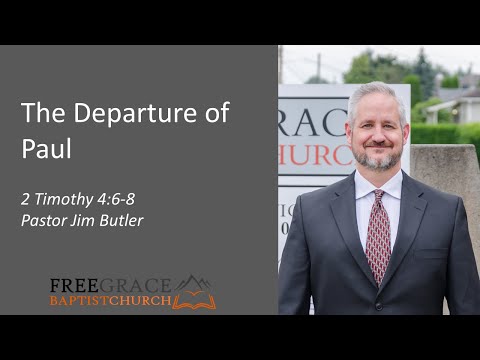
The Departure of Paul
Paul's farewell words in 2 Timothy 4:6–8 — poured out as a drink offering, having fought the good fight, finished the race, and kept the faith — are examined as a model of faithful perseverance unto death. The sermon argues that the confidence Paul expresses at the 11th hour of his life was inseparable from the faithfulness he exercised throughout every preceding hour, and that the crown of righteousness he anticipates is entirely a gift of God's grace, not a payment for services rendered. Believers are called to examine whether they are now fighting, running, and keeping the faith so that they may, by grace, make the same confession at the end of their days; and unbelievers are warned to consider the infinite worth of Christ, the certainty of judgment, and the righteousness the righteous Judge freely offers in the gospel.

The Defense of the Faith
Jude 3 commands every believer — not merely pastors or theologians — to contend earnestly for the faith once for all delivered to the saints. This sermon examines the exhortation itself, the internal threat posed by sneaky, ungodly apostates who pervert grace and deny Christ, and the practical preparedness Jude prescribes: remembering apostolic warning, building up on the most holy faith through Scripture and prayer, and resting in the assurance that God himself preserves his people. The defense of the faith is not pessimistic trench-holding but confident advance grounded in Christ's promise to build his church against which the gates of Hades shall not prevail.
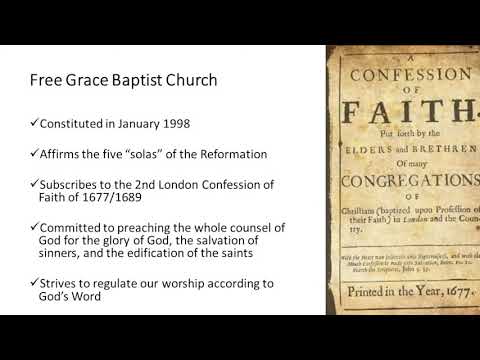
Introduction to the 1689 Second London Baptist Confession of Faith
Why should a church bind itself to a confession of faith? This introductory lesson on the Second London Baptist Confession of 1677/1689 grounds the answer exegetically in Ephesians 4 — where Christ gives gifted men to the church so that the body attains doctrinal unity and is no longer tossed about by every wind of teaching — and then traces the historical origins of the 1689 among the Particular Baptists, distinguishing them from Anabaptists, Presbyterians, and Congregationalists. Four functions of a confession are developed: defining, defending, discriminating, and disciplining with reference to the doctrine of the church. The lesson closes by distinguishing Reformed theology (Calvinism plus covenant theology plus the regulative principle) from mere five-point Calvinism, and by defending the confession's silence on matters of Christian liberty as a feature, not a defect.

The Divine Savior and His Afflicted People
Matthew 14:22–33 confronts the church with the Christological reality that the presence of Christ does not guarantee the absence of trial. Working through the storm on the Sea of Galilee, Christ walking on the water, Peter's sinking, and the disciples' confession of Christ as the Son of God, this exposition presses the claim that the 'I Am' of Exodus and the Psalms is the same Lord who meets his afflicted people in the middle of their storm-tossed sea. The sermon closes with a direct rebuke of health-and-wealth theology and a call to displace the fear of man with a robust fear of God grounded in Christ's sovereign lordship over creation.

The Problem of Sin and the Mercy of God
Proverbs 28:13 sets the problem of sin and its remedy in sharp relief: the one who covers his sin will not prosper, but whoever confesses and forsakes sin will have mercy. The sermon works through the anatomy of sin-covering — denial, minimization, blame-shifting, and self-righteousness — with biblical examples ranging from Adam and Eve to Ananias and Sapphira, demonstrating the futility of every human attempt at self-atonement. Confession is shown to be not merely verbal acknowledgment but a saving act of faith in Christ, inseparably joined to repentance, whereby the sinner lays the hand of faith upon the surety of the new covenant and receives imputed righteousness. The closing application calls both unbeliever and believer to stop covering sin and look in faith to Christ, the only authorized covering for guilt before a holy God.

The Lukewarm Laodiceans
Revelation 3:14–22 confronts the church in Laodicea with a charge of spiritual lukewarmness — not outright apostasy, but ineffectual, self-satisfied religion that neither heals nor refreshes. Drawing on the city's historical wealth, its piped-in tepid water supply, and the covenantal language of Leviticus 18, this exposition argues that lukewarm Christianity is, in the end, no Christianity at all. Christ's threatened judgment is not arbitrary but covenantal, and his counsel to buy gold, white garments, and eye salve from him is an act of love that calls the church to honest self-assessment, renewed zeal, and genuine repentance.

The Christian Sabbath, Part 2
The Christian Sabbath, grounded in both creation and redemption, does not cease in the New Covenant but is transformed by the resurrection of Christ from the seventh day to the first day of the week. Working through the ministry of Christ in Matthew 5 and 12, the resurrection accounts across all four Gospels, and the apostolic teaching in Hebrews 4, Acts 20, 1 Corinthians 16, and Revelation 1, this exposition argues that the moral obligation of one day in seven for the worship of God remains perpetually binding on the church. The shift from Saturday to Sunday Sabbath is grounded in Christ's completed redemptive work, which mirrors the Father's rest at the close of creation, establishing the Lord's Day as the Christian Sabbath. Believers are called to receive this day not as a legal burden but as a gracious gift from God, a weekly foretaste of the consummate rest that awaits the people of God.

The Christian Sabbath, Part 1
The Fourth Commandment's call to Sabbath observance is grounded not in Mosaic legislation alone but in the created order itself, the pattern of divine rest in Genesis 2, and the logic of redemption running through both Testaments. This sermon, the first in a series on the Christian Sabbath, expounds Deuteronomy 5:12–15 alongside key Old Covenant passages — Genesis 2, Exodus 16, Isaiah 56 and 58, and Jeremiah 31 — to argue that Sabbatarianism is a moral, perpetual, and trans-covenantal obligation rooted in creation and confirmed by covenant. The confession of the Second London Baptist Confession chapter 22 frames the doctrinal parameters, and the sermon closes with a call to receive the Sabbath not as a burden but as a blessed provision of God for his creatures.

The New and Living Way
Hebrews 10:19–25 presents two grounds of confidence for the people of God — boldness of access to the Holy of Holies through Christ's blood and flesh, and the possession of a great high priest over the house of God — and then presses three exhortations upon that foundation: draw near, hold fast the confession of hope, and consider one another to stir up love and good works. The sermon traces the problem of sinful man's exclusion from God's presence from Exodus 40 through the Levitical sacrificial system to its resolution in the incarnation and definite atonement of Christ, who consecrated a new and living way. Particular attention is given to the prohibition against forsaking the assembly, argued to be grammatically tied to the third exhortation and theologically governing all three, so that corporate Lord's Day worship is the ordained context in which God's people draw near, are educated in hope, and mutually provoke one another to love and good works. The sermon closes by calling the unconverted to look to Christ and the converted to embrace their shared responsibility for one another's souls through faithful churchmanship.