
Theological term
Particular Redemption
293 sermons · All terms

The Believer's Gratitude toward God

Colossians 1:12–14 presents thankfulness not as a general Christian virtue but as an identifying mark of the believer — the fourth of four participles Paul uses to describe a walk fully pleasing to God. This sermon works through the structure of Paul's prayer in Colossians 1:9–14 before expositing the two great grounds of the believer's gratitude: the inheritance of the saints in the light, and the threefold deliverance from the power of darkness — comprising rescue from spiritual darkness, transfer into the kingdom of the Son of His love, and redemption from bondage through the blood of Christ. The Lord's Supper serves as the sermon's occasion, pressing the congregation to come to the table not as a religious routine but as those who genuinely reckon with what forgiveness, deliverance, and a heavenly inheritance cost the Son of God.

The Vainglory, the Virtue, and the Verity (Part 2)

Jeremiah 9:23–24 sets a prohibitive warning against glorying in wisdom, strength, and riches, and answers it with a positive prescription: glory exclusively in the understanding and knowledge of God. This sermon (Part 2) works through the 'virtue' and the 'verity' of that text — the virtue being the necessity of knowing God (as the source of all true wisdom, everlasting life, and proper humility), and the verity being the three attendant truths God announces about himself: he alone is the Lord, he exercises loving-kindness, and he governs in judgment and righteousness. The sermon closes with a direct call to those outside of Christ to abandon vainglorious boasting and close with the one in whom true wisdom, strength, and riches are found.

The Thief on the Cross
Luke 23:39–43 presents the conversion of the thief on the cross as one of the most remarkable examples of sovereign grace in all of Scripture. Examined under two broad headings — the conversion of the thief and the response of the Savior — the sermon traces five marks of genuine conversion in the criminal's transformation from blasphemer to confessor, and then turns to Christ as willing, able, and glorious Savior. The passage is shown to demolish both works-righteousness and sacramentalism, grounding salvation entirely in grace through faith in Christ alone. Hearers are urged not to defer repentance, to call upon Christ while He may be found, and to come to the Lord's Table with eyes fixed not on their own obedience but on the excellence of the Savior.

The Possession of the Church's Authority
Christ's declaration in Matthew 18:18 — 'whatever you bind on earth will be bound in heaven' — establishes that the local church possesses a real, though delegated, authority to exercise the keys of the kingdom through gospel preaching and church discipline. Drawing on the parallel passage in Matthew 16:19 and the Heidelberg Catechism's definition of the keys, the sermon argues that binding and loosing refer to the church's authority to exclude the unrepentant and restore the repentant, always in accordance with God's word and never by arbitrary preference. Verses 19 and 20 ground this authority in the corporate prayer and the promised presence of Christ himself among his people when they faithfully implement these keys. The sermon closes with a summons to love the church, exercise its authority prayerfully, and pursue its three primary duties — preaching, discipline, and the administration of the sacraments — without addition or subtraction.
2LCF Chapter 11 - Of Justification, Part 2
The forensic doctrine of justification — God's one-time legal declaration that the sinner is righteous on the sole ground of Christ's imputed righteousness — faces persistent assault in every era. This session surveys three modern deviations: Arminian evangelicalism (which collapses faith into a meritorious work or relocates righteousness within the believer), the New Perspective on Paul (which reframes Paul's argument as a corrective for ethnic exclusivity rather than a remedy for the condemnation of sin), and the Federal Vision (which renders righteousness relational, conflates Christ's faithfulness with the believer's, and anticipates a future eschatological justification grounded in covenantal obedience). Against all three, Scripture and the confession insist that justification is a completed legal verdict, not a process, and that its ground is exclusively the active and passive obedience of Christ credited to the elect.
2LCF Chapter 10 - Of Effectual Calling
Effectual calling is the sovereign, monergistic act by which God brings his elect out of spiritual death and into saving union with Christ — by his Word and Spirit alone, apart from any foreseen merit or creaturely co-operation. Walking through 2LCF Chapter 10, paragraphs 1–4, this study situates effectual calling within the broader covenant structure of the confession, distinguishing it from the general gospel call that goes forth indiscriminately to all. The session addresses the regenerating work of the Spirit, the doctrinal grounding of infant salvation, the exclusion of the non-elect from saving grace, and the eternal perdition of those outside Christ regardless of moral sincerity — with a sustained application to how these truths ought to shape corporate prayer and gospel proclamation.
The Healing of a Demon Possessed Boy
Matthew 17:14–23 sets a desperate father's plea for his demon-possessed son against the disciples' failure to cast out the demon, and Christ's authoritative word that immediately effects the cure. The sermon works through four movements: the request for mercy, the Lord's rebuke of faithless Israel and the demon, instruction on the nature and exercise of faith, and the second formal passion announcement of Matthew's Gospel. Throughout, the contrast between Christ's kingdom of mercy and the devil's kingdom of self-destruction frames both the evangelistic and pastoral applications: sinners are called to come to the sovereign Christ who alone delivers, and parents are urged never to despair of the conversion of any soul, pressing the atoning work of the cross upon their children.
2LCF Chapter 8 - Of Christ the Mediator, Part 3
The perfection, particularity, and certain application of Christ's saving work — as confessed in 2LCF 8.5, 6, and 8 — is examined through an extended exposition of Hebrews, John, Romans, and related texts. Christ's once-for-all sacrifice fully satisfied divine justice, procured reconciliation, and purchased an everlasting inheritance for a fixed and particular multitude given to him by the Father before the world was. The confession's teaching is traced along three coordinates: the pactum salutis (the pre-temporal intra-Trinitarian covenant of redemption), the historia salutis (the historical accomplishment of salvation), and the ordo salutis (the Spirit's effectual application of that finished work to the elect). Believers are called to rest in the certainty that Christ's redemption is not a matter of 'perhaps' but of infallible, sovereign, and free grace from first to last.

The Hope and the Preaching
Titus 1:2–3 sets before believers a hope of eternal life that is neither wishful thinking nor earthly optimism, but a certain expectation grounded in the immutable character of God and the finished work of Christ. This sermon works through three headings: the believer's certain expectation of everlasting life as a goal of gospel ministry; the foundation of that hope in God's unchanging nature and eternal promises; and the ordained means by which those blessings are made known — namely, the preaching of the Word. The application is direct: believers are to rejoice daily in this sure hope, find comfort in God's immutability, and never despise the act of preaching; unbelievers are called to flee to Christ as the only ground of any lasting hope.

The Ministries of Paul and Timothy
Paul's appointment as preacher, apostle, and teacher of the Gentiles was not self-generated but rooted in the eternal decree of God, who foreordained both the salvation of the elect and every means by which that salvation arrives — including gospel proclamation. Examining 2 Timothy 1:11–14, this sermon traces Paul's God-given role, his suffering in that role, and his unashamed confidence in a sovereign God able to keep what has been committed to Him. Timothy is then charged with two complementary duties: to hold fast the pattern of sound words received from Paul, and to guard that apostolic deposit by the indwelling Holy Spirit — not for his own sake alone, but so that the church across successive generations remains anchored to the truth.

The Book of Ruth and the Incarnation, Part 2
Ruth 3 presents the plan of redemption as Naomi instructs Ruth to appeal to the kinsman-redeemer Boaz, prefiguring the willingness of Christ to secure the salvation of His people at any cost. The institution of the goel — the near kinsman responsible for redeeming distressed relatives — illuminates both the legal and covenantal framework within which Boaz acts and within which the incarnate Son of God acts on behalf of guilty sinners. God's sovereign providence, not circumstance or human ingenuity, orchestrates every detail in the story of Ruth toward the birth of the Messiah in Bethlehem. Sinners who recognize their need of redemption are called to look to Christ — the willing Redeemer — who came in the fullness of time to save His people from their sins.

The Unashamed Commitment to the Gospel
2 Timothy 1:9–10 sets before the reader the entire arc of God's redemptive plan, from its eternal origin to its historical execution in the appearing of Jesus Christ. The text answers Paul's command to Timothy in verse 8 — to be unashamed of the gospel and to suffer for it — by grounding that command in the glorious nature of the gospel itself. Salvation originates not in human will or works but in God's sovereign purpose and grace, decreed before time began and administered through the effectual calling of the elect. Because Christ has abolished death and brought life and immortality to light through the gospel, the preacher and every Christian has every reason to hold fast to this message without shame and to labor in its proclamation without relenting.
2LCF Chapter 6 - Of the Fall of Man, of Sin, and of the Punishment Thereof
1689 London Baptist Confession chapter 6, paragraph 1–5, traces the fall of man from its covenantal roots through its universal consequences and the only remedy found in Christ. The covenant of works established a principle of justice in the garden, making Adam's transgression a covenantal violation with representative consequences for all his posterity — every faculty of soul and body wholly defiled, every man by nature a child of wrath. The divine purpose in the fall was not an accident requiring a divine plan B, but was ordered by God according to His wise and holy counsel to manifest both His justice in reprobation and His grace in the redemption of the elect by the second Adam. Believers are freed from the power, guilt, and condemnation of sin by Christ alone, yet remaining corruption persists through this life, driving the regenerate to the means of grace.

The Authority of the Church
Christ's declaration in Matthew 16:19–20 invests the church with delegated authority — expressed through the metaphor of keys — to bind and to loose in the kingdom of heaven. This authority is not absolute and belongs to no single officer; it is entrusted to the church as a whole to be exercised through the faithful preaching of the gospel and the discipline of the membership. The sermon works through three observations: identifying the stewards of this authority, the nature of the authority delegated, and the specific functions of binding and loosing. The congregation is called to prize Christ's church, exercise her God-given authority through the Word alone, and testify freely that Jesus is the Christ, the Son of the living God.

The Divine Refuge
Psalm 46 proclaims God as the divine refuge of His covenant people in the midst of cosmic upheaval, national crisis, and personal trial. The sermon works through the psalm's four movements: the declaration of God's presence, the contrast between earthly chaos and divine stability, the invitation to behold God's redemptive works in Scripture, and the command to be still in God's sovereignty. The central comfort is covenantal: because Yahweh, the Lord of hosts, has bound Himself to His people in the covenant of grace, no trial, calamity, or fear can unseat Him from His throne or separate His people from His care. Believers are called to meet their sorrows not with fretting but with a deepening knowledge of God, which is itself the appointed means of comfort and strength.

The Thief on the Cross

Luke 23:39–43 presents three condemned men at Calvary — two criminals and the sinless Christ — and the radical difference between their responses exposes the nature of saving faith, sovereign grace, and the distinction between physical and spiritual death. The wretched criminal blasphemes even in his torment, seeking only physical deliverance; the repentant criminal confesses his guilt justly deserved, rebukes blasphemy, and clings by faith alone to a crucified King whose kingdom is eternal. The passage stands as the premier biblical refutation of works-based justification: this man was justified fully and clothed in Christ's righteousness with only hours of sanctification remaining, a display of free and sovereign grace that calls every unbeliever to repentant faith before death — which is fixed, though its day is unknown.
Gideon's Victory Over the Midianites
Judges 7 records God's reduction of Gideon's army from 32,000 to 300 men before routing the Midianites — not because Israel marshalled superior strength, but precisely so that no Israelite could claim the glory of victory. This sermon traces four movements in the narrative: the assembling of enemies and the Spirit's coming upon Gideon, the divinely-ordered troop reduction, God's patient encouragement of a fearful Gideon through a pagan soldier's dream, and the midnight rout of Midian. The controlling thesis is that God perfects His strength through human weakness so that glory belongs to Him alone, a principle the sermon applies to the church's ongoing mission and to the gospel call addressed directly to unbelievers in the congregation.

The Faith of the Canaanite Woman
A Canaanite woman — an ancestral enemy of Israel — confronts Israel's Messiah in Gentile territory and refuses to accept silence, rebuff, or unfavorable parable as the final word. This exposition of Matthew 15:21–28 traces her persistent petitioning through two encounters with Christ, showing that great need demands great earnestness and that true faith worships even when heaven appears silent. The sermon draws out three lessons: the triumph of faith expressed through dependence, humility, and persistence in prayer; the Christological display of Christ's mercy and sovereign power over demons; and the benefit of affliction, which drove a pagan mother to the Son of David and teaches parents to pray without ceasing for children under the power of sin and Satan.

The Content of Doxology
Jude's closing doxology (vv. 24–25) is not mere liturgical ornament but a theologically loaded ascription of praise to the Lord Jesus Christ that answers the heresy Jude has been combating throughout the epistle. The sermon works through three observations: Christ's exclusive preservation of his people, his singular greatness as the only God, the only Savior, and the only wise one, and the deserved praise that flows from those realities. The practical force is that the Christian's confidence under trial and the church's resistance to false teaching both rest on this one Christ, who keeps, presents faultless, and reigns with glory, majesty, dominion, and power, both now and forever.

The Significance of the Resurrection
Romans 4:25 presents what Charles Hodge called 'a comprehensive statement of the Gospel': Christ was delivered up because of our offenses and raised because of our justification. This sermon expounds the two parallel clauses of that verse, arguing that the death of Christ was a particular, substitutionary, propitiatory sacrifice for the definite sins of God's elect, and that the resurrection is the Father's public attestation that the atonement was fully accepted and justification secured. The practical implication is that justified sinners — not improved moralists — have peace with God and an unshakeable hope grounded not in exemplary preaching but in the historical, redemptive work of Christ.

The Betrayal and Arrest of Jesus
John 18:1–11 records the betrayal and arrest of Jesus, yet John's Gospel frames the scene not primarily as a display of suffering but as a revelation of divine glory. The great I AM steps forward to meet his captors, causes a detachment of soldiers to fall to the ground by the mere utterance of his name, and willingly drinks the cup of God's wrath — not as a victim, but as the covenant mediator and surety who executes the eternal decree of the Father. The sermon calls hearers to resist a narcissistic reading of the passion narratives and instead to bow in worship before the obedient Son of God, whose vicarious, substitutionary death is the sole ground of the sinner's justification.

The Excellence, the Wonder, and the Glory
Hebrews 1:1–4 presents the glory of Jesus Christ as the culmination and surpassing excellence of all divine revelation, redemption, and reign. This sermon works through the opening verses of Hebrews under three headings: the excellence of Christ's revelation over the partial and preparatory word of the prophets, the wonder of his redemption accomplished by one who is simultaneously the radiance of the Father's glory and the sovereign upholder of the universe, and the glory of his present reign at the right hand of the Majesty on high. Believers are called to rejoice in the removal of the guilt of sin through Christ's exclusive and perfectly executed atoning work, while those outside Christ are warned that to neglect so great a salvation leaves no escape.
Free Grace Baptist Church - March 21 Missions Event
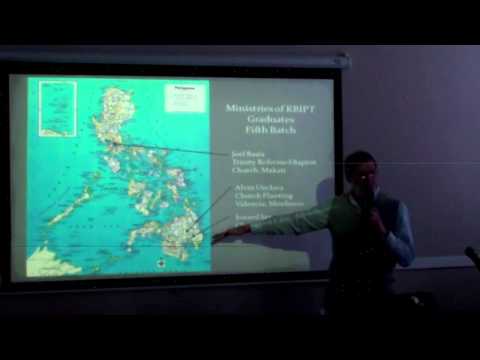
A Reformed Baptist missionary with thirty years of service in the Philippines presents an overview of the work in Metro Manila and beyond: church planting, a three-year pastoral training institute covering biblical languages and systematic theology, and itinerant teaching among pastors in remote provinces. The presentation is grounded in Revelation 5 and Romans 10 — Christ has purchased a people from every tribe, tongue, and nation, and messengers must be sent to gather them. The evening closes with prayer requests for the elders of Moonwalk Community Bible Church, the graduates scattered across the Philippine islands, and the ongoing effort to bring the gospel to Roman Catholics, Muslims, and those ensnared in health-and-wealth Christianity.

From Alienation to Reconciliation
Colossians 1:21–22 sets the alienation and enmity of sinners against the sovereign, monergistic reconciliation God effects through the incarnate death of His Son. The sermon moves through three aspects of the Colossian believers' transformation: their previous state as those alienated from God, hostile in mind, and outwardly manifesting wicked works; their present status as those God has reconciled through the physical, substitutionary death of Christ; and their future blessedness as those being presented holy, blameless, and above reproach — a goal that is the consequence of reconciliation, never its cause. Communion is the occasion for this exposition, pressing believers to remember the depth of the grace that drew them out of enmity and into fellowship with God.

The Parable of the Tares Explained
Matthew 13:34–43 records Christ's private explanation of the parable of the wheat and tares to His disciples, and the sermon works through that explanation in two movements: the purpose of parabolic teaching and the seven details of the parable itself. The disciples' question falls on the tares, not the wheat, and the sermon follows that emphasis — the final destiny of the wicked, cast into the furnace of fire, stands at the center of the exposition. The identity of the sons of the kingdom and the sons of the wicked one is traced from Genesis 3:15 through the New Testament, establishing that the antithesis between the two seeds runs the entire length of redemptive history. The sermon closes with urgent evangelistic appeal: flee to Christ now, for every person will stand before the Son of Man who is both Savior and Judge.
The Conduct of the Good Minister, Part 1
What marks a minister as truly 'good' in the sight of God? Expounding 1 Timothy 4:6–11, this sermon argues that ministerial faithfulness is defined not by popularity, giftedness, or leadership skill, but by the diligent instruction of the congregation in sound doctrine — the words of faith and good teaching. The pursuit of godliness, understood as rigorous training for the unhindered service of God, surpasses all bodily discipline because it carries promise for both the present life and the age to come. The sermon concludes by addressing the contested phrase 'Savior of all men' in verse 10, rejecting universalism and unlimited atonement in favour of a reading grounded in God's common grace and providential preservation, with special and saving grace belonging distinctively to those who believe.
The Parable of the Wheat and Tares
Matthew 13:24–30 presents the parable of the wheat and tares, in which Christ teaches that his kingdom advances through a world — and a visible church — where genuine believers co-exist with those sown by the devil. The sermon addresses the theodicy embedded in the parable: God's sovereignty over evil does not mean the immediate expulsion of wickedness, but its certain, final judgment at the eschaton. Hearers are called to grow as wheat, to resist an overly censorious spirit toward apparent tares, and to trust that the Master has the harvest entirely under his control.
The Conquering Power of the Davidic Son
Matthew 12:22–30 presents the healing of a demon-possessed, blind, and mute man as the occasion for a decisive confrontation over the identity of Jesus as the Davidic Son. The multitudes ask whether this could be the Son of David; the Pharisees respond by attributing Christ's power to Beelzebub. Jesus refutes this accusation with two arguments — a divided kingdom cannot stand, and the Jewish exorcists the Pharisees approve operate by the same power Christ claims — then draws three implications: the kingdom of God has arrived, the strong man has been bound, and there is no neutral ground. The sermon calls hearers to reckon with the absolute antithesis between the two kingdoms and to flee by faith to the conquering Davidic Son.
The Son of Man Lifted Up
John 12:27–36 presents Jesus in soul trouble as the hour of his crucifixion approaches — not merely fearing physical death, but facing the full weight of the Father's wrath against sin. The sermon expounds four redemptive results of Christ being 'lifted up': the judgment of the world, the casting out of Satan, the effectual drawing of all peoples without distinction to himself, and the glory of God the Father. Preached as a meditation preceding the Lord's Supper, the exposition calls the congregation to prize what they proclaim at the table — not a martyr's moral example, but a cosmic transaction in which the Son exhausted divine wrath on behalf of his people.
A Summary of Paul's Task
Acts 26:19–23 presents Paul's compressed account of his apostolic commission and ministry as a model for understanding how God's sovereign plan is carried out through human obedience, opposition, and divine provision. The sermon traces four observations from the text: Paul's obedience to the heavenly vision, the severe unbelieving reaction his preaching provoked, the divine aid that sustained him, and the glorious message he proclaimed — a message continuous with Moses and the prophets, centered on a suffering and risen Christ who brings light to Jew and Gentile alike. The trans-covenantal unity of Scripture is shown to rest not on cold theological systematizing but on the living reality that Jesus Christ is the sum and substance of both Testaments. Hearers are pressed to make the cross of Christ the chief constellation of their lives, and the unbelieving are called to repent and come to him.