
Theological term
Particular Redemption
293 sermons · All terms

2LCF Chapter 5 - God's Providence

God's providence, as defined in 2LCF Chapter 5, is not blind fate or impersonal chance but the active upholding, directing, disposing, and governing of all creatures and things by the good Creator, according to his infallible foreknowledge and the free and immutable counsel of his own will. The chapter roots providence in the eternal decree of Chapter 3 and traces its scope across four domains: the whole system in general, fortuitous events, the free actions of men, and even the sinful actions of men — the last illustrated supremely by the crucifixion of Christ in Acts 2:23, where God's absolute sovereignty and man's full culpability are held together without cancelling either. The session works through paragraph 1 of the chapter in detail, drawing on Psalm 73, Isaiah 46, Daniel 4, Acts 17, Proverbs 16 and 21, Ephesians 1 and 2, Philippians 2, and Genesis 50 to show that Scripture, not merely the confession, grounds these claims. Believers are exhorted to interpret every circumstance — including political wickedness and social evil — through the axiomatic principle that God is good, while continuing to pray, preach the gospel, and live according to God's revealed will rather than retreating into fatalism.

The Woman and the Pharisee

Luke 7:36–50 sets two figures in sharp contrast: a nameless woman whose many sins have been forgiven and a self-righteous Pharisee who sees no need of a Savior. The parable of the two debtors exposes the principle that those forgiven much love much, while those who imagine themselves barely indebted show no love at all. Christ's declaration — 'Your faith has saved you; go in peace' — demonstrates that forgiveness is received through God-given faith alone, not through any merit or priestly mediation. The sermon calls believers to let the magnitude of their own forgiveness produce humble, lavish love for Christ and gracious dealings with fellow sinners.

The Context of John 3:16, Part 2
John 3:14–16 is set against the backdrop of Numbers 21, where God appointed a single, unlikely remedy for snake-bitten rebels in the wilderness — a bronze serpent lifted on a pole. The sermon argues that humanity's condition before God is morally terminal, that God alone has planned the only rescue in His Son, and that this rescue is as unlikely in human reckoning as a bronze snake healing the dying. Saving faith is a gift from God, its sole object is Jesus Christ the only begotten Son, and the imputed righteousness He secured is the believer's standing before God — sufficient ground for perseverance and the rejection of every false remedy.

The Refuge for God's People
Psalm 46 sets the doctrine of God's sovereign presence as the only sufficient ground for courage in affliction. The psalm's threefold refrain — 'The Lord of hosts is with us; the God of Jacob is our refuge' — anchors the people of God against both natural catastrophe and the rage of hostile nations. Drawing on Job, the upper room discourse, Acts 14, and the letters to the seven churches in Revelation, this exposition argues that suffering is the normative texture of the Christian life, not an anomaly to be explained away. The command of verse 10 — 'Be still and know that I am God' — is not passive fatalism but a call to steady, covenant confidence in the God whose justice, power, and faithfulness guarantee the final exaltation of Christ among the nations.

The Riches of God's Grace
David's fall into adultery and murder in 2 Samuel 11 sets the stage for one of Scripture's most striking displays of divine grace in 2 Samuel 12:1–15. Nathan's parable exposes David's sin through the unstoppable initiative of God, and the prophet's indictment demonstrates that David's wickedness was aggravated, not mitigated, by the abundant grace God had already shown him. David's two-word confession — 'I have sinned against the Lord' — is met immediately with pardon, not because the confession was elaborate, but because forgiveness rests entirely on the atoning work of Christ, to whom David looked in faith through the promises of the Davidic covenant. The sermon calls both believer and unbeliever to receive the same grace: real forgiveness for real sinners, grounded in the righteousness of Christ imputed through faith alone.

The Vainglorious Quest, The Virtuous Path, and The Veracious Contemplation

Jeremiah 9:23–24 issues a threefold structure: a prohibitive warning against glorying in wisdom, might, or riches; a prescriptive call to glory in the understanding and knowledge of God; and a veracious contemplation of who God is and what He does. The sermon situates these commands within their covenantal context — the inevitable Babylonian judgment upon covenant-breaking Israel under the curses of Deuteronomy 28 — demonstrating that wisdom, strength, and riches will not avail in the face of irreversible divine justice. True glorying is exclusively God's due, and the knowledge of the one living and true God — Father, Son, and Holy Spirit — is the only wisdom, strength, and riches that profit eternally. Hearers are called to cast off vainglory, grow earnestly in the knowledge of God, and trust in Christ alone, in whom are found all true wisdom, strength, and riches.
The Day of Atonement
Leviticus 16 stands at the structural center of the Pentateuch, and its legislation governing the Day of Atonement reveals both the absolute holiness of God and the total sinfulness of man. The two goats — one slaughtered as a sin offering and one driven into the wilderness as the scapegoat — together signify substitutionary atonement and the definite removal of guilt from a specific covenant people. The high priest's own need for sacrifice before he could minister for Israel exposes the inadequacy of the Levitical priesthood and anticipates the once-for-all, self-sufficient sacrifice of Christ, whose blood retroactively atoned for Old Covenant believers and finally accomplished what the annual rite could only shadow. Believers in the New Covenant era need no further Day of Atonement ceremony; every observance of the Lord's Supper recalls the same removal of guilt that the scapegoat ceremony made visible to Israel.

The Resurrection and the Life, Part 4
The resurrection of Lazarus in John 11:38–46 sets before the reader the full display of Christ's two natures: the true humanity revealed in groaning, weeping, prayer, and command, and the true divinity revealed in the life-giving voice that draws a four-day-dead man from the tomb. The miracle is not a parlor trick but a deliberate act of the mediator, performed to glorify the Father and to call sinners to believe that Jesus is the Christ, the Son of God. The raised Lazarus is an analogy of the effectual call — the voice that issues the command carries with it the power to enable compliance — and a prefiguring of the general resurrection to come. The passage summons every hearer to confess with Martha, 'Thou art the Christ, the Son of God,' and to come forth from the grave clothes of sin into life in His name.

The Resurrection and the Life, Part 3
John 11:28–37 confronts the reader with the full weight of Christ's hypostatic union: the same person who will momentarily command a dead man to walk is here groaning in anger and weeping at the graveside. This passage presses the question of the Savior's true humanity — that he assumed human nature with all its essential properties and common infirmities, yet without sin — as the indispensable ground of redemption. The sermon traces Mary's complaint, the Lord's outrage at the ravages of sin and death, and his tears as expressions of genuine human emotion consistent with immutability in the divine nature, drawing on the Westminster Larger Catechism's answers on why the Mediator must be both God and man. The hearer is finally confronted with the same question Jesus put to Martha: 'Do you believe this?'

The Healing of a Blind Man, Part 3
John 9:35–41 records the climax of the healing of the man born blind: not the restoration of his physical sight, but his salvation through faith in the Son of God. This sermon argues that providence and miracles do not save — only grace through faith in Christ does — and that Christ's coming pronounces both salvation on the spiritually blind who see their need and judgment on the self-righteous who claim to see but remain in their sin. The exposition closes with a direct appeal: the self-righteous require both the law, to expose the bankruptcy of their works-confidence, and the gospel, to offer the righteousness of Christ received by faith alone.
The Idolatry of Israel, Part III
Exodus 32:30–35 presents Moses interceding for Israel after the golden calf debacle, confessing their great sin and offering himself to be blotted out of God's book on their behalf. The sermon works through Moses's rebuke, his request, and God's response, giving particular attention to the theological question of whether God blots names from the Book of Life — resolving the tension by distinguishing the conditional Old Covenant (a covenant of works securing physical blessings) from the unconditional New Covenant, in which the elect are eternally secure in Christ. The Mosaic intercession is read typologically as pointing to Christ, who was, in effect, blotted out on behalf of his people. The sermon closes with application to the gravity of idolatry drawn from Romans 1 and a quote from John Stott.

The Wondrous Love of God
God is love — not merely that love is one attribute among many, but that love is what God is, a statement grounded in the doctrine of divine simplicity: all that is in God is God. John's argument in 1 John 4:7–11 moves from declaration ('God is love', v.8) to demonstration: the sending of the only begotten Son into the world (v.9) and, supremely, the propitiation Christ accomplished on the cross (v.10), by which the wrath of God due to sinners was not deflected but fully absorbed and satisfied. The Son did not come to procure the Father's love; He came as the supreme manifestation of a love that was antecedent to any love or knowledge we have of God. Those who have been born of God and savingly know Him will therefore love the brethren — and the Lord's Supper proclaimed at this service is the corporate, horizontal expression of that same love.

Livestream - The Basis for Love and Unity
Ephesians 4:4–6 presents seven 'ones' — one body, one Spirit, one hope, one Lord, one faith, one baptism, and one God and Father — as the objective, Spirit-wrought basis for the love and unity to which Paul exhorts believers in verses 1–3. The sermon argues that these seven unities are not aspirational ideals but present realities constituted by the Holy Spirit in the production of the church, and that believers are therefore called to steward, not generate, the unity already given. The practical weight falls on bearing with one another in love, contending for the faith once delivered to the saints, and recognising that the Triune God — not social trinitarianism — is the foundation of all communion and the basis for genuine ecumenism among confessional Christians.

The Camel and the Needle
Luke 19:1–10 presents Zacchaeus — chief tax collector, rich man, notorious sinner — as a living demonstration of what Jesus declared in Luke 18:27: 'the things which are impossible with men are possible with God.' The sermon works through two movements: first, the person of Zacchaeus as the object of sovereign mercy, and second, the mission of Christ who seeks and saves the lost by divine initiative, not human worthiness. The effectual call of the Son of God upon Zacchaeus — who climbed the tree in curiosity but descended in love — illustrates that God's saving grace makes its object worthy rather than waiting to find one worthy.

The Triumph of the Lamb
Revelation 12 presents a cosmic drama in three acts — the incarnation of the Son, the defeat of the dragon in heaven, and the persecution of the woman — that together constitute a behind-the-scenes theological account of what Christ accomplished at His first advent. The serpent of old, identified as the devil and Satan of Genesis 3:15, suffers four successive and total failures: he cannot stop the birth of the male child, he is cast from heaven, he cannot destroy the woman in the wilderness, and his rage against the rest of her offspring only confirms that the decisive battle has already been lost. Christ's ascension to God's throne, not His second coming, marks the moment Satan is ejected from heaven and universal kingship is secured. The church, still militant on earth, overcomes not by health, wealth, or worldly ease but by the blood of the Lamb and the word of its testimony, persevering under persecution as the sign of Satan's defeat rather than his victory.

The Children of the Devil, Part 1
John 8:37–41 records Jesus systematically dismantling the religious establishment's claim that physical descent from Abraham constitutes spiritual standing before God. Working through the Jews' twofold assertion — that Abraham is their father and, in verse 41, that God is their father — Jesus marshals three evidences that expose the claim as groundless: their murderous intent toward him, their refusal to receive his word, and their rejection of the one he came from. The sermon drives toward the conclusion that membership in the family of God is secured not by race but by grace through faith in Jesus Christ, the promised seed of Genesis 3:15, and calls every hearer to examine whether they have received or rejected that word.

The Freedom in Receiving the Son, Part 2
John 8:33–36 sets two irreconcilable conditions before every person: slavery to sin or freedom in the Son. Working through Jesus' response to the objecting Jews — His declaration of spiritual slavery in verse 34, His illustration from the household in verse 35, and His promise of true liberty in verse 36 — this sermon argues that sin's bondage is total, that the sinner is constitutionally blind to his own condition, and that freedom comes exclusively through the only-begotten Son who abides in the Father's house forever. The law of God must be pressed upon the conscience so that sinners know their malady before they can receive the remedy: the Son who makes men free indeed.
The Danger of Rejecting the Son
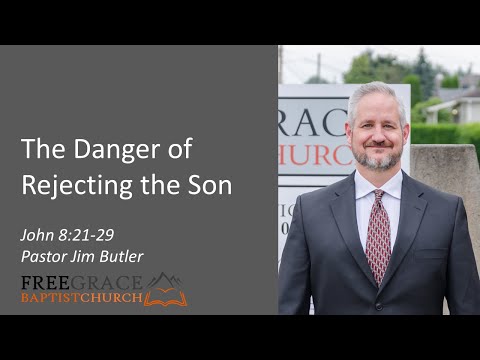
John 8:21–29 records Jesus warning a hostile religious leadership that they will die in their sins if they do not believe that He is the great I Am — the divine Son eternally generated from the Father, sent into the world in the economy of redemption. The sermon works through the passage in three movements: the announcement of Christ's departure and the condemnation it implies, the question of His identity and the slander levelled against Him, and the reference to His crucifixion as the moment of disclosure. The central doctrinal burden is that a deficient Christology — whether ancient Arianism, Sabellianism, or modern proposals of eternal functional subordination — amounts to the very unbelief Christ condemns, and that the church's primary calling is to preach the triune God with particular weight on who the Son is and what He has done for sinners.

The Truthful Testimony of the Lord
John 8:13–20 records the Pharisees' flat rejection of Christ's self-testimony — 'your witness is not true' — and his threefold response: the intrinsic truthfulness of his witness grounded in his divine origin and destination, the confirming unity he shares with the Father, and the law of two witnesses satisfied by Father and Son together. The passage closes with the Pharisees demanding to see the Father, only to be told that their ignorance of the Son proves their ignorance of the God they claim to worship. The sermon presses upon the hearer that to receive or reject Christ is to receive or reject the Father, and calls unbelievers to look in faith to the one mediator between God and men.

The Reaction to Jesus and His Words
John 7:40–53 records the sharply divided public reaction to Jesus's preaching at the Feast of Tabernacles and the private opposition of the Sanhedrin to him and his followers. The crowd fractures over whether Jesus is the promised prophet of Deuteronomy 18 or the Christ himself, while the religious leadership responds not with argument but with contempt, attempting to silence him through force and scorn. The temple officers sent to arrest Jesus return empty-handed, confessing that no man has ever spoken as he has — a testimony that magnifies Christ's divine authority even as the Sanhedrin descends into lawlessness. The sermon calls hearers to abandon the confusion of the crowd and the hardness of the Sanhedrin, and instead to come to Christ in faith, receiving the everlasting life he freely offers.

The Perfection of Christ as the Prompting of His People
Hebrews 10:19–25 marks the great hinge of the epistle, where doctrinal exposition gives way to exhortation. The perfection of Christ's sacrifice and priesthood — the absolute sufficiency of His once-for-all offering and His unceasing high-priestly office — forms the irreplaceable ground upon which three congregational imperatives rest: draw near to God in full assurance of faith, hold fast the confession of hope without wavering, and consider one another in order to stir up love and good works. Christians are not called to seek experiential novelty or emotional stimulation, but to the settled, corporate, and simple obedience of gathered worship, resting entirely upon the finished work of the One who consecrated a new and living way through His own flesh.

The Feast of Tabernacles, Part 1
John 7:1–13 presents the Feast of Tabernacles as the backdrop for intensifying hostility toward Jesus, whose unbelieving half-brothers urge Him to seek public exposure — a suggestion rooted in a man-centered, politically distorted messianic expectation. Christ refuses to act on their counsel, insisting instead on the divine timetable that governs every movement of His redemptive mission. The passage confronts two errors simultaneously: the assumption that physical proximity to Jesus produces saving faith, and the temptation to shrink from confessing Christ under social pressure — both of which the text answers by pointing to sovereign grace and the covenant community as God's appointed means of steadying His people.

The Conversion of Matthew
Matthew 9:9–13 records the sovereign call of a tax collector — among the most despised and morally compromised figures in first-century Jewish society — to follow Christ and ultimately to author the first Gospel. The sermon works through three movements: Christ's effectual call of Matthew to discipleship, the feast Matthew hosts to honour Christ and evangelize his associates, and the confrontation with the Pharisees in which Jesus declares the nature of his mission — not to call the self-righteous but sinners to repentance. The account is pressed into seven marks of genuine discipleship, closing with an appeal to the unconverted to look to Christ as the great physician of sin-sick souls.

The Conversion of Rahab the Harlot
Joshua 2 presents the conversion of Rahab the harlot as a sovereign interruption of divine mercy within the context of holy war and Israelite conquest. Before Israel kills a single Canaanite, the narrative compels the reader to stand in awe of a God who justifies a pagan prostitute by grace through faith alone — faith that is demonstrated by treason against Jericho and the sheltering of two spies. Rahab's confession that Yahweh is God in heaven above and on earth beneath places her alongside the great confessions of Scripture, and her inclusion in the Messianic genealogy of Matthew 1 reveals that the conquest was always inseparable from the redemptive purposes of God. The sermon calls hearers to resist self-righteous judgmentalism, to trust in a Christ who saves to the uttermost, and to marvel that the ancestress of Jesus was the shady lady of Jericho.

The Need for Gospel Ministers
Matthew 9:35–38 presents Christ surveying the multitudes of Galilee and responding not primarily to their political oppression but to their spiritual destitution — harassed and scattered like sheep without a shepherd because Israel's religious leaders had failed and become predators of the very flock they were charged to keep. The sermon traces the shepherd-and-harvest imagery through Numbers 27, 1 Kings 22, Jeremiah 23, and Micah 5 to demonstrate that God's remedy for faithless shepherds has always been the raising up of faithful men under the Messiah's authority. Christ's compassion, exercised according to his human nature, issues not in mere sympathy but in effective action: commanding his disciples to pray the Lord of the harvest to send out laborers, then immediately appointing and commissioning the Twelve. The congregation is called to share Christ's own compassion for the spiritually destitute, to believe that the harvest is genuinely plentiful across every tribe and nation, and to pray, give, identify, train, and send qualified men into gospel ministry.

The Reaction to the Bread of Life Discourse
John 6:60–71 presents the sharpest crisis of Jesus's Bread of Life discourse: the mass departure of superficial disciples and the steadfast confession of the Twelve. This sermon traces three interrelated truths in Jesus's response — the life-giving Spirit as the sole agent of spiritual understanding, total depravity as the explanation for unbelief, and the sovereign grace of the Father as both the cause of faith and the ground of its perseverance. The application presses the church not to soften biblical truth before a resistant generation, but to press it, trusting that the Spirit alone opens the hearts of the dead to receive the words of eternal life.

The Bread of Life Discourse, Part 4
John 6:48–59 brings the Bread of Life discourse to its conclusion, with Christ pressing upon unbelieving hearers the absolute necessity of eating His flesh and drinking His blood — a sustained metaphor for saving faith in His atoning sacrifice. The sermon demonstrates that this language is not eucharistic or literal but is the equivalent of coming to, receiving, and believing on Christ as the one who gives His flesh for the life of the world. The exposition draws out five doctrines of grace embedded in the discourse — total depravity, unconditional election, particular redemption, irresistible grace, and the preservation of the saints — and closes by tracing the glory of Christ seen in the incarnation, His power to save, His divine origin, and His patient mercy in repeating the same call to faith before a rejecting audience.
Clip: Theology is crucial for every church and believer
Theology proper — the knowledge of who God is as Father, Son, and Holy Spirit — is not an academic luxury but the essential foundation of Christian life, worship, and witness. This sermon clip from an exposition of Ephesians 1:3–14 argues that the church's tendency to rush past doxological passages to practical ethics has left believers spiritually thin, prone to a mercenary relationship with God rather than one grounded in the infinite riches of his grace. The preacher calls the congregation to disciplined study of the Trinity, warning that without it believers become vulnerable to ancient heresies and lose the impetus to proclaim Christ to a lost world.
The Lord Who Treads the Waves
John 6:16–21 records the fifth of the seven signs in John's Gospel: Jesus walking on the Sea of Galilee toward his storm-tossed disciples. The sermon works through two movements — the disciples' vulnerability in the storm and the Savior's sovereign approach across the water — to establish that Jesus, by treading the waves, enacts what the Old Testament attributes exclusively to Yahweh (Job 9:8; Psalm 77:19; Isaiah 43:16), thereby demonstrating his consubstantiality with the Father and his lordship over the natural order. The divine self-disclosure 'I am' (ego eimi), voiced both here and at key junctures throughout John's Gospel, is shown to be Jesus' deliberate appropriation of the covenant name revealed to Moses in Exodus 3:14. The sermon closes by pressing the theological remedy for the fear that afflicts God's people: a right knowledge of Christ as the great I AM displaces anxiety about trials, persecutions, and earthly circumstances.

The Gracious Purpose of the Father
Ephesians 1:3–6 opens with what the Apostle Paul calls a 'barakah' — a formal blessing of God followed by specific reasons for that praise. This sermon expounds the Father's role in the covenant of redemption: His sovereign, unconditional election of sinners in Christ before the foundation of the world, and His predestinating purpose that those chosen would be made holy and blameless. Election is the cause, not the consequence, of faith and repentance — sinners dead in trespasses and sins are chosen not because of foreseen merit but according to the good pleasure of God's will alone. The sermon calls believers to respond to the doctrine of election not with defensive polemic but with the doxological posture Paul himself models: praise, blessing, and adoration to God Most High.