
Theological term
Particular Baptists
7 sermons · All terms
2LCF - Introduction to the 1689 London Confession of Faith

The 1689 London Baptist Confession of Faith (properly the 1677 Confession) did not arise in a vacuum: it was a deliberate act of theological stewardship by particular Baptists who stood inside the Reformed Protestant consensus, followed the Westminster Assembly and the Savoy Declaration in structure and wording, and published their confession to correct heterodoxy, serve a new generation, and demonstrate solidarity with fellow persecuted Protestants. This introductory session reads the original epistolary preface to the confession in full and then surveys its argument under five headings — continuity, catholicity, candor, confirmation, and conversation — showing how the confessors understood creeds and confessions as the church's Berean effort to articulate what the Bible says, not to add to it. The session closes with a call to receive the confession in the same spirit in which it was written: not contention, but a whole-souled, humble, and Spirit-dependent owning of the faith once for all delivered to the saints.

2LCF Chapter 28 - Of Baptism and the Lord's Supper
Chapter 28 of the Second London Confession of Faith introduces baptism and the Lord's Supper as the two ordinances of the New Testament church, distinguishing the particular Baptist position from both Roman Catholic sacramentalism and paedobaptist covenant theology. The Baptists' deliberate use of 'ordinance' rather than 'sacrament,' and their inclusion of 'positive institution,' reflects a credobaptist insistence that only regenerate believers can obey these commands of Christ, the sole lawgiver of his church. The confession grounds both ordinances in Christ's mediatorial work, connects them to the means by which faith is increased and preserved (2LCF 14.1, 17.3), and reserves their administration for those qualified and called according to Christ's commission. Neglecting these ordinances is not a minor failure but a forfeiture of appointed means of grace and a disservice to the covenant community.
Ask FGBC #65: Are Reformed Baptists Really Just Anabaptists?

The claim that Reformed Baptists (specifically, Particular Baptists) descended from the Anabaptists is examined historically and found to be without evidential basis. Drawing on primary-source scholarship by historians such as Matthew Bingham and James Renihan, the discussion establishes that the Particular Baptists emerged from English Reformation Congregationalism — not from the continental Anabaptist movement — and that no documentary connection exists between the two bodies in the extant 17th-century literature. The conversation also notes that the Anabaptists themselves were not a monolithic group, making the category 'Anabaptist' less precise than popular usage suggests.

2LCF Chapter 24 - Of the Civil Magistrate
What does the Bible teach about civil government, and how should Christians relate to governing authorities? Working through 2 London Baptist Confession of Faith Chapter 24, this study expounds the divine origin and limited purpose of civil magistracy, the lawfulness of Christian participation in government, and the qualified obedience owed to rulers who govern within God-ordained bounds. The particular Baptists are shown to occupy a distinct position between the Anabaptist rejection of civil authority and the Erastian tendencies of their Presbyterian contemporaries, grounding Christian submission not in the authority of the magistrate but in the sovereign ordination of God over all nations.

Ask FGBC #1 - What is a Reformed Baptist?
What distinguishes a Reformed Baptist from a generic Calvinist or a generic Baptist? This question-and-answer exchange works through the defining marks of the Reformed Baptist tradition: the supreme authority of Scripture, covenant theology, the regulative principle of worship, the centrality of preaching, believers' baptism by immersion, and congregational church polity. The 1689 Second London Baptist Confession is identified as the clearest doctrinal touchstone, held not loosely but in full subscription — not as an authority alongside Scripture, but because it faithfully summarises Scripture's teaching. The historical designation 'Particular Baptist' is also commended as an accurate and less confusing alternative label for the same tradition.
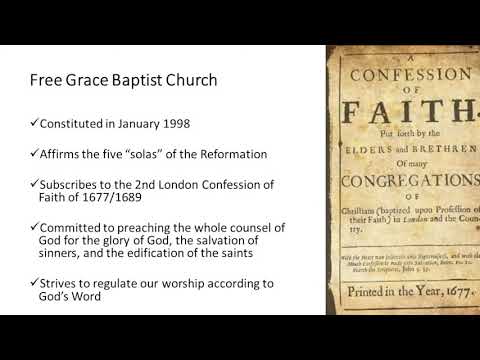
Introduction to the 1689 Second London Baptist Confession of Faith
Why should a church bind itself to a confession of faith? This introductory lesson on the Second London Baptist Confession of 1677/1689 grounds the answer exegetically in Ephesians 4 — where Christ gives gifted men to the church so that the body attains doctrinal unity and is no longer tossed about by every wind of teaching — and then traces the historical origins of the 1689 among the Particular Baptists, distinguishing them from Anabaptists, Presbyterians, and Congregationalists. Four functions of a confession are developed: defining, defending, discriminating, and disciplining with reference to the doctrine of the church. The lesson closes by distinguishing Reformed theology (Calvinism plus covenant theology plus the regulative principle) from mere five-point Calvinism, and by defending the confession's silence on matters of Christian liberty as a feature, not a defect.

The Utility of Confessions and Introduction to the Second London Baptist Confession
Confessions of faith are not competitors to Scripture but are faithful summaries of biblical doctrine, and the church has historically depended on them for good reason. This address introduces the Second London Baptist Confession of 1689, tracing its historical origins among the Particular Baptists of the 17th century and its relationship to the Westminster Confession and the Savoy Declaration. Five interlocking uses of a confession are then examined: defining church doctrine, defending it against error, discriminating between members and officers on doctrinal grounds, disciplining departures from orthodoxy, and distinguishing confessed doctrine from matters of Christian liberty. The goal is not confessional enslavement but confessional clarity — guardrails that protect the church and free her members to worship and grow in the grace and knowledge of Christ.