
Theological term
Particular Atonement
31 sermons · All terms

The Freeness of the Priceless Feast, Part 1

Isaiah 55:1–2 issues what this sermon calls an 'imperatival invitation' — a divine summons that carries the grammatical weight of a command and the gracious warmth of an offer. The sermon argues that the feast of water, wine, milk, and bread is not a bare general provision but a Christological feast: Christ himself is every element, secured by the infinite-worth payment of Isaiah 53's suffering servant, and therefore freely given because it cannot be purchased at any price. The squandering madness of spending wages on 'not bread' — whether in Israel's idolatry or in every Christless cosmology — is set against the freeness of the priceless feast to which God, as town crier, summons all hearers without condition of merit.

The Permanence and Primacy of Christ and Christianity
Paul's argument in Galatians 3:19–26 is pressed from every angle: the Mosaic law was given because of transgressions, temporary in design, never a rival to the promise but a servant of it, and fulfilled entirely in the coming of Christ. The law functioned as a pedagogue — restraining sin, exposing guilt, and driving the sinner toward the one it signified — but with Christ's advent that tutelage has ended. True sonship before God belongs not to national Israel nor to any who ground their standing in works of law, but exclusively to those united to Christ by faith, who are thereby Abraham's seed and heirs of the promise. The sermon calls the church to be guarded against any doctrine that introduces human works into the ground of justification, and to be ardently and exclusively attached to Christ as the sole Savior of sinners.
2LCF Chapter 6 - Of the Fall of Man, of Sin, and of the Punishment Thereof
The fall of Adam and Eve was not an unforeseen catastrophe but an event God sovereignly permitted according to his wise and holy counsel to order to his own glory. Working through all five paragraphs of 2LCF Chapter 6, this study traces the anatomy of the fall — from man's original uprightness under the covenant of works, through the willful transgression of the law of their creation, to the imputation of guilt and conveyance of corrupt nature to all of Adam's posterity by ordinary generation. The totality of sin's consequences — total depravity, total inability, spiritual death, and the inheritance of wrath — makes the second and last Adam, Jesus Christ, the only and necessary answer, whose active and passive obedience reverses both the imputation and the inheritance fallen humanity bears in the first Adam.
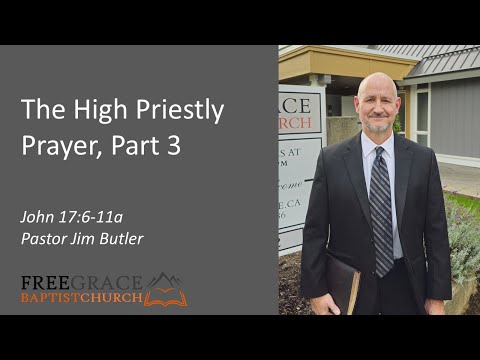
The High Priestly Prayer, Part 3

Jesus intercedes for his apostles in John 17:6–11a, and this sermon examines who those men are, what qualifies them as objects of his high priestly prayer, and why he prays for them rather than for the world. The exposition grounds the disciples' identity in the Father's sovereign, electing gift of them to the Son within the eternal covenant of redemption, their reception of the words the Father gave to the Son, and their growing recognition that the Son is one in being with the Father. The preacher draws out the implication that faithful gospel ministry, like the ministry of Christ himself, must declare only what has been received from God, without accommodation to cultural pressure or the demand for entertainment.

The Sixth Commandment
The Sixth Commandment — 'You shall not murder' (Exodus 20:13) — addresses far more than the physical act of killing; it presupposes the dignity of every human being as an image-bearer of God and condemns unrighteous hatred of the heart. This sermon expounds the Hebrew word for murder, distinguishing it from lawful killing in capital punishment, just war, and self-defense, before pressing the command's indictment of abortion and euthanasia as violations of the sanctity of life. Jesus's teaching in Matthew 5 extends the commandment's reach to unwarranted anger and character assassination, and the three uses of the law — civil, pedagogical, and normative — frame both the church's public witness and the believer's ongoing sanctification. The sermon closes by insisting that the most faithful response to a death culture is to preach both the law and the cross of Christ.

CTF 2024 Session 1: An Engaging Overview of the Second London Confession of Faith

The Second London Confession of Faith (1689) did not arise in a vacuum but was forged in response to specific doctrinal crises and pastoral needs within the 17th-century particular Baptist churches. This address traces the historical circumstances behind the Confession's 1677 publication — including the Christological heresies of Thomas Collier and Matthew Caffin, the threat of Quaker mysticism, fear of Roman Catholic resurgence, and the pastoral concern for family catechesis. The speaker then surveys the Confession's 32 chapters as a coherent theological architecture, showing how its structure reflects the covenant of grace viewed from both divine and human perspectives. Listeners are urged to recover the Confession as a living instrument of orthodoxy, protection, instruction, and proclamation for the church today.

The Blessings of the Ascended Christ
The ascended and glorified Christ actively dispenses blessings to his church from the right hand of the Father. Expounding Acts 2:22–47, this sermon traces three categories of those benefactions: his proclamational gifts (the gift of preachers, the preaching of the Word, and the Spirit's empowering of that preaching), his salvific gifts (effectual calling and the forgiveness of sins), and his ecclesiastical gifts (the creed of the church, the building and unity of the church, the gathering around apostolic doctrine, and the new covenant ordinances of baptism and the Lord's Supper). Believers are exhorted to pray for Spirit-empowered preaching, to attend diligently upon all the appointed means of grace, and to find their unity in the objective content of Christian confession rather than in secondary things.

The Apostle in Pisidian Antioch
Paul's sermon in the synagogue at Pisidian Antioch (Acts 13:38–43) proclaims two inseparable blessings at the heart of the apostolic gospel: the forgiveness of sins and justification by faith alone in Christ alone. The law of Moses exposes the sinner's total inability to meet God's demand for perfect righteousness, while Christ's life of obedience, substitutionary death, and resurrection supply both the pardon and the imputed righteousness the guilty sinner needs. The sermon concludes with a warning drawn from Habakkuk 1:5 against despising this gospel, and with the Gentiles' eager reception of the word as a pattern for which the church ought to pray in every generation.

The Children of the Devil, Part 3
John 8:44–47 records Christ's unflinching indictment of the unbelieving Jewish religious leaders as children of the devil, a verdict he confirms by exposing three marks of their paternity: they reject the truth he speaks precisely because it is truth, they cannot convict him of a single sin, and they do not hear God's words because they are not of God. The sermon draws out the theological weight of each mark — the devil as murderer and father of lies in contrast to Christ as life and truth — and applies these diagnostic tests to the question of assurance: those who are of God love Christ and love the Word. The exposition closes with a call to both the congregation and the unconverted to rest in the imputed righteousness of Christ, received by faith alone, as the only ground of a right relationship with God the Father.
2LCF Chapter 20 - Of the Gospel and of the Extent of the Grace Thereof
2 London Baptist Confession of Faith Chapter 20, 'Of the Gospel and of the Extent of the Grace Thereof,' addresses a chapter absent from the Westminster Confession but added by the Congregationalists in the Savoy Declaration and retained by the Particular Baptists to combat incipient deism and the General Baptist doctrine that sinners may be saved through general revelation alone. The sermon traces the chapter's four paragraphs through Romans 10, Luke 24, John 5, and Psalm 19 to demonstrate that the gospel of Christ has been the sole substance of special revelation since the protevangelium of Genesis 3:15, that general revelation is categorically insufficient to make Christ known, that God distributes gospel light with absolute sovereignty, and that effectual grace is indispensable alongside that revelation for the conversion of dead sinners. The double theme of the chapter — the necessity of special gospel revelation and the necessity of the Spirit's insuperable work — magnifies divine grace, grounds the missionary enterprise, and exposes the doctrine-of-sin deficiencies latent in every scheme that allows salvation apart from hearing Christ proclaimed.

The Bread of Life Discourse, Part 3
John 6:41–51 records the Jews' grumbling rejection of Jesus as the bread of life and his pointed rebuke of their unbelief. This sermon expounds that rejection in two movements: the nature of the Jews' complaint against Christ's divine origin, and Christ's twofold response — his assertion of the Father's sovereign, efficacious drawing of sinners and his appeal to the prophetic scriptures that learning from the Father issues in coming to the Son. The doctrines of total depravity and total inability are drawn from verse 44 and grounded in parallel texts from John 1, Romans 8, and Ephesians 2, establishing that salvation is possible only because the Father draws whom he will. The sermon closes with an exhortation to look to Christ in faith for everlasting life, the sole remedy for the problem of human sin.

The Redemptive Work of the Son, Part 2
Ephesians 1:8–12 grounds the individual believer's redemption within a cosmic divine purpose: God's wisdom in the plan of salvation maintains all his holy perfections without compromise, the mystery of his will now openly revealed in the gospel calls sinners from every tribe and nation, and all things will be recapitulated — gathered up and set in order — under the lordship of Christ at his return. The inheritance of the elect is secured by predestination, not by human performance, so that the redeemed exist 'to the praise of his glory' — as a trophy case of grace before angels and the entire created order.

The Judgment Throne of Christ
Matthew 25:31–46 presents not a parable but a prophecy: the Son of Man, identified as Daniel's divine king, will sit on the throne of glory and separate all nations into the righteous and the wicked. The passage is examined to show that it does not overturn justification by faith alone, but rather demonstrates that those justified by grace will inevitably produce the good works that serve as fruits and evidences of saving faith. The sermon sets the evidentiary nature of works — care for Christ's brethren — against any works-righteousness reading, drawing on Galatians 5:6, Ephesians 2:8–10, James 2, and the 1689 London Baptist Confession to ground the argument. Hearers are called to confess Christ now, since the same Lord who bids 'come' in his earthly ministry will bid 'come' or 'depart' on the day of judgment.

2LCF Chapter 3 - Of God's Decree, Part II
God's decree, as confessed in 2LCF Chapter 3, encompasses both predestination unto life and the reprobation of the non-elect — a distinction the confession handles with care but which Scripture addresses with directness in passages such as Proverbs 16:4, Matthew 11:25-28, and Romans 9:17-23. The sermon distinguishes three theological frameworks integral to understanding the decree in salvation: the Pactum Salutis (the pre-temporal, intra-Trinitarian covenant of redemption), the Historia Salutis (the unfolding of redemption in space and time), and the Ordo Salutis (the application of redemptive benefit to the elect). God ordains not only the end — the salvation of a definite number — but also all the means, grounding the church's obligation to preach the gospel, make disciples, and pursue the lost. The doctrine, rightly received, produces praise, reverence, admiration, humility, diligence, and abundant consolation rather than either hyper-Calvinist passivity or Arminian nervousness.

The Ministry of the Word
What is the basis and method of God's ordained means for saving sinners? This sermon on 2 Timothy 4:2 argues that the preaching of the Word stands as the primary instrument through which God saves the lost and builds his church, grounding that claim in the logical chain of Romans 10, the divine pleasure announced in 1 Corinthians 1, and the final apostolic charge of Paul to Timothy. The sermon challenges the contemporary drift toward audience-driven church strategies, calling both preachers and hearers to fidelity to the proclaimed Word as the irreplaceable means of grace.
The Bridled Tongue
James 1:26 confronts professing Christians with a concrete test of genuine faith: the bridling of the tongue. The sermon expounds the passage within its context of James's call to be doers of the Word, arguing that an unbridled tongue is not a minor failing but a symptom of self-deception — a religion James pronounces useless. Drawing on the Decalogue, the Proverbs, Romans 1, and James 3–4, the preacher demonstrates that Scripture condemns sins of speech — gossip, slander, backbiting, hypocrisy — with the same severity as the grosser immoralities the church is quick to discipline. The sermon closes by grounding the believer's hope not in perfected speech but in Christ, who alone fulfilled the law of the tongue in his sinless life, and calls hearers to pursue tongue-discipline as a fruit of sovereign grace and dependence on God.

The Olivet Discourse, Part 2
Jesus' Olivet Discourse opens not with a timetable for the end of all things but with two commanding exhortations: 'Take heed that no one deceives you' and 'See that you are not troubled.' Expounding Matthew 24:4–8 within a preterist framework, this sermon argues that Christ's description of false messiahs, wars, famines, pestilences, and earthquakes depicts the conditions preceding the Roman destruction of Jerusalem in A.D. 70 — the covenant curses of Leviticus 26 and Deuteronomy 28 falling at last upon an apostate people who rejected their Messiah. The practical burden is twofold: guard theological sanity by submitting to the Word rather than to prophecy speculators, and guard emotional stability by resting in God's sovereign governance of history rather than panicking at world events.
2LCF Chapter 30 - Of the Lord's Supper
The Lord's Supper, as confessed in chapter 30 of the 1689 London Baptist Confession of Faith, is examined across all eight paragraphs under four headings: its nature, administration, elements, and reception. The session expounds the Confession's positive affirmations — that the Supper is a divine ordinance of perpetual remembrance, proclamation of Christ's finished sacrifice, and a means of grace by which the risen Christ spiritually nourishes His people by the Holy Spirit — alongside its sharp rejection of Roman Catholic transubstantiation, the Mass as a propitiatory sacrifice, and Lutheran consubstantiation. The 17th-century polemical context is traced, showing that the particular Baptists aligned with Presbyterian and Congregationalist confessionalism against both Roman Catholic sacerdotalism and the anti-Trinitarian Socinian memorial-only reduction. The session closes with an urgent call to faithful, frequent participation in the Lord's Supper as an act of communion with Christ and with one another, refusing both careless neglect and the errors of Rome.

The Parable of the Wedding Feast
Matthew 22:1–14 presents the parable of the wedding feast as a sobering account of divine invitation, human rebellion, and eschatological judgment. The parable unfolds three responses to God's sovereign call — unwillingness, indifference, and violent opposition — each met by the king's patient re-invitation and, ultimately, his righteous wrath. The destruction of Jerusalem in AD 70 is identified as a visible, covenantal judgment prefiguring the final day when every mouth will be stopped before God. The sermon closes by pressing the imputed righteousness of Christ as the only wedding garment that makes a sinner fit for the feast, and by urging the church to pursue gospel mission with urgency.
2LCF Chapter 20 - Of the Gospel and of the Extent of the Grace Thereof
The necessity and exclusivity of special gospel revelation for salvation — not natural revelation — is the central concern of 2LCF Chapter 20. Against the errors of incipient deism (which denied the need for special revelation) and General Baptist soteriology (which allowed for salvation via the light of nature), the confession affirms that the gospel promise of Christ, inaugurated at Genesis 3:15, is the sole appointed means of calling the elect in every age. Divine sovereignty governs the dispensation of that gospel to nations and persons, and the effectual, insuperable work of the Holy Spirit upon the whole soul is necessary alongside the outward proclamation for any sinner to be converted.

The Precious Blood of Christ
What is the value of Christ's blood, and why does the New Testament insist that nothing corruptible — no silver, gold, or human religious tradition — can redeem a sinner? Drawing from 1 Peter 1:18–19 in the context of a Lord's Supper meditation, this sermon works through three considerations: the vanity of any bloodless redemption, the aimless sinfulness that necessitated a blood redemption, and the exclusive and infinite worth of Christ's precious blood. The application is direct — because believers have been purchased at such an infinite price, they are to hold Christ alone as precious and to conduct themselves in a manner worthy of that redemption.

The Son's Accomplishment of Redemption

Ephesians 1:7–12 sets forth the Son's accomplishment of redemption within the eternal Covenant of Redemption, in which the Father plans, the Son accomplishes, and the Spirit applies salvation. Working through four movements in the text — redemption by the Son's blood, the revelation of the mystery of God's will, the cosmic reconciliation of all things in Christ, and the reward of an eternal inheritance — the sermon shows that sinners enslaved to sin have been purchased at a cosmic price paid only by the eternal God-Man. The sermon closes by calling believers to meditate on and proclaim this redemption, and by urging unbelievers to believe on Christ before they die in their bondage.
Of God and the Holy Trinity (2LCF 2.1-3)
The doctrine of the Trinity — one divine and infinite being in whom there are three subsistences, Father, Son, and Holy Spirit — is not a speculative ivory-tower abstraction but the foundation of all Christian communion with God and comfortable dependence upon him. This session in the study of 2LCF Chapter 2 continues the examination of paragraph three, working through the personal distinctions of generation, filiation, and spiration; the confession's summary statement on unity and personal distinction; and the practical import of Trinitarian theology for prayer, worship, redemption, and assurance. Biblical proofs are drawn from Genesis, the Psalms, Isaiah, and the New Testament, demonstrating the revelatory development of the doctrine from its seed form in the Old Testament to its full flower in the New.

The One Who Justifies the Ungodly
Romans 4:5 announces that God justifies the ungodly — a declaration that seems to violate the standard of Proverbs 17:15, which condemns justifying the wicked. The doctrine of imputation resolves the apparent tension: God reckons, credits, and accounts righteousness to sinners not on the basis of moral transformation but on the basis of Christ's active and passive obedience received through faith alone. Three acts of imputation structure the biblical argument — Adam's sin imputed to his posterity, the elect's sin imputed to Christ, and Christ's righteousness imputed to the elect — establishing that the gospel upholds rather than undermines divine justice. This sermon was preached in the context of a Lord's Supper service, directing communicants away from any sense of personal worthiness and toward the finished work of Christ as the sole ground of acceptance before God.

The Justice of God in His Merciful Election
Romans 9:14–18 confronts the charge that God acts unjustly in electing particular sinners to salvation while passing over others. Drawing on God's declaration to Moses in Exodus 33 and His purpose in raising up Pharaoh, the sermon argues that divine election is just precisely because God, as the omnipotent Creator and sovereign Judge, retains the absolute right to bestow mercy on whom He wills and to harden whom He wills — a right He expressly claims and which no creature may dispute. The sermon situates election within the full ordo salutis and the pactum salutis, showing predestination to be the eternal foundation of every benefit of salvation applied in history. Hearers are called to find assurance in the marks of grace, to trust God's immutable purposes, and to proclaim the gospel as the ordained means by which the elect are called forth.
The Response to Persecution
Matthew 10:24–33 confronts disciples with the certainty of persecution and the threefold answer Christ gives to the fear that persecution produces. Jesus establishes first that suffering at the hands of men is inevitable — if they called the Master Beelzebul, they will do the same to his servants — and then forbids fear on three grounds: the gospel's truth will be fully proclaimed, persecutors can only kill the body while God alone holds power over soul and body, and God's sovereign providence extends even to sparrows and the hairs of one's head. The passage closes with a solemn double verdict: those who confess Christ before men will be confessed by Christ before the Father, while those who deny him will be denied — a call to bold, faithful witness grounded in the fear of God rather than the fear of man.
Only Christ Satisfies

Isaiah 55:4–5 presents Christ as witness, leader, and commander to the peoples — the sufficient Savior in whom every need of the soul is met. This sermon expounds the free offer of the gospel in Isaiah 55:1–3, showing that the unrestricted call to all thirsting sinners is the means by which God effectually gathers his elect from every nation through Christ's sovereign work. Drawing on the covenant of redemption, the sermon traces Christ's witness from the Old Testament prophets through his incarnation, resurrection, and present reign at the Father's right hand. Hearers are called to cast off self-sufficiency, submit to Christ's authority over the church in worship and practice, and live in contented obedience as those whom he will never leave nor forsake.
The Plan of Salvation
Two verses in 2 Timothy 1 contain a concentrated summary of the entire plan of salvation, and this sermon unpacks five observations from that text: God alone saves, the effectual call is the means employed, the basis is divine purpose and grace rather than human works, the plan originates before time began in the counsel of the triune God, and it is executed in history through the doing, dying, and rising of Jesus Christ. The sermon sets monergism against every form of synergism, argues that Athanasius's soteriological defense of Christ's deity depends on the incapacity of man to save himself, and traces the pactum salutis through John 17, Romans 16, and Ephesians 1. The hearer is pressed to rest all assurance on the finished work of Christ alone and to give God all praise for a salvation that is his from first to last.
The Superiority of Christ Over the Angels
Hebrews 1:4–14 opens the epistle's sustained argument for the superiority of Christ over the angels — an argument the apostle grounds not in assertion but in seven quotations from the Old Testament. The passage addresses Jewish Christians tempted to abandon Christ and return to old covenant rites, demonstrating from their own scriptures that the Messiah, as God-man and mediator, possesses a dignity and dominion infinitely exceeding that of the angels. The sermon traces two of four sections in the confirmation passage: Christ's unique filial relationship to the Father (Psalm 2:7; 2 Samuel 7:14), shown to be fulfilled in his resurrection and exaltation, and his relationship to the angels, who worship him and serve as his ministers. Throughout, the recurring motif of 'better' in Hebrews is shown to be the epistle's controlling theme: Christ and the new covenant are not merely different from the old, but surpassingly superior to it in every respect.
Five Observations on Christ's Doctrine of Salvation (Part 2)
John 6:35–51 presents a chain of divine activity in which the Father gives, the Son receives, and none are lost — a chain that rests entirely on sovereign, unconquerable grace. This second installment in a series on Christ's doctrine of salvation expounds two final observations: the unconquerable power of regenerating grace (irresistible grace), illustrated by Ezekiel's valley of dry bones and the raising of Lazarus, and the infallibility of the divine embrace paired with the indefectibility of those embraced (the preservation and perseverance of the saints). The sermon closes with a call to ground assurance not in self-examination or experiential motions but in the decree of election, the merits of Christ, and the sealing of the Holy Spirit, and with a direct gospel plea to any who do not yet know Christ.