
Theological term
Lord's Supper
62 sermons · All terms

The Supper on Betrayal Night

On the night of his betrayal, Christ instituted the Lord's Supper within the context of the Passover meal — a deliberate act of covenantal timing that pressed upon his disciples the reality of what his broken body and shed blood would accomplish. This sermon works through Luke 22:19–20 under two heads, the bread and the wine, tracing the biblical theology of each element: the bread overturning the curse of Genesis 3 by providing divine nourishment freely, and the cup of the new covenant corresponding to the third Passover cup of redemption in Exodus 6. The sermon calls Christians away from coldness and neglect of the Lord's Supper toward a warm, particular reception of the truth that Christ's body was given for you and his blood was shed for you.

The Priestly Blessing of the Ascending King
Luke 24:50–53 closes the Gospel with the ascending Christ lifting His nail-pierced hands to bless His disciples at Bethany — a gesture laden with Old Testament typology, most immediately the Aaronic priestly blessing of Leviticus 9. The sermon argues that this blessing is not a mere farewell gesture but an authoritative, ongoing priestly act: Christ ascended while still blessing, signifying that His intercession and the bestowal of divine favor upon His people never cease. Preached in the context of a Lord's Supper service, the exposition calls believers to receive the sacrament as participants in the everlasting blessing of the great High Priest, and to respond with the pattern of the early disciples — continuous, corporate, joyful worship of the Triune God.
The Opened Sanctuary
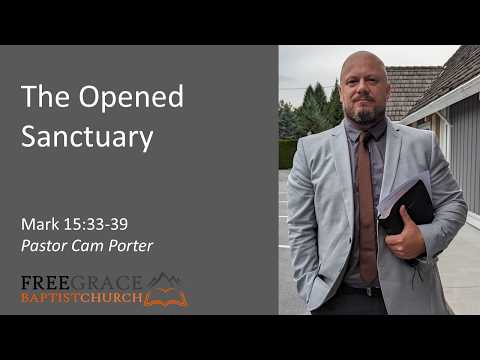
Mark 15:33–39 presents three interlocking realities at the crucifixion: the forsaken Son bearing divine wrath, the torn veil opening the sanctuary to God's presence, and a Roman centurion's confession inaugurating the gospel's reach to the nations. The noontide darkness fulfills Old Testament types — the Egyptian plague of darkness and Amos 8:9 — while Christ's cry of dereliction, drawn from Psalm 22, expresses not a severing of the Trinity but the full weight of divine justice borne substitutionarily by the Son as mediator. The tearing of the veil declares that the shadowy Old Covenant order is fulfilled, the true high priest has acted, and access to the holy presence of God is secured through the veil of Christ's flesh. Those who gather at the Lord's Supper are exhorted to glory in the Savior who bore the wrath His people deserved so that they need never cry out in God-forsakenness themselves.

The Mission and Ministry of the Church

What is the mission and ministry of the church, and how does the apostolic pattern in Acts 2 define both? This sermon works through Acts 2:22–42, showing that the church's mission is the proclamation of Christ — his life, atoning death, resurrection, and exaltation — accompanied by the killing work of God's law that convicts sinners of their guilt and drives them to the Savior. The ministry that follows is shaped by the four marks of the early church in verse 42: steadfast continuance in the apostles' doctrine, fellowship, the breaking of bread, and prayer — the simple means by which God feeds his blood-bought people.

The Power of the Word of God
Isaiah 55:10–11 declares that God's word, like rain and snow sent from heaven, does not return to him void but accomplishes precisely what he purposes. This sermon expounds that promise under two heads: the power of the written word and the glory of the incarnate word. The written word is shown to be efficacious in gospel proclamation — bringing either the aroma of life or of death — while the incarnate word, the eternal Son proceeding from the Father, accomplishes a definite redemption that cannot be frustrated. Both heads converge in a call to sinners to seek the Lord while he may be found and to believers to renew covenant at the Lord's Supper with confidence in the abundance of divine pardon.

Live Stream - April 27, 2025
Psalm 131 is a three-verse psalm of ascent in which David describes three things he did not do — lift up his heart in pride, raise his eyes in defiance, or occupy himself with matters too great and too marvelous — and one thing he did do: calm and quiet his soul like a weaned child beside its mother, in a silence of trust rather than fear. The sermon expounds all three verses, identifying hope in the Lord — grounded in who Yahweh is and in the promises of the new covenant secured by Jesus Christ, the faithful Son of David — as the active disposition that produces that inner calm. Three closing applications warn that we will lose our hope if we refuse to humble ourselves, if we expect what God has not promised, and if we place our hope in anything or anyone other than God through Jesus Christ.

Hope in the Lord - Psalm 131
Psalm 131 sets before the believer a threefold portrait of the soul at rest: what pride refuses to do, what humble trust actively does, and what Israel is therefore commanded to do. David's calm and quieted soul — like a weaned child beside its mother — is not the product of self-will but of covenant hope directed toward Yahweh and his promises, ultimately fulfilled in Jesus Christ, the great Son of David. The sermon closes with three warnings against losing that hope: refusing to humble the heart, expecting what God has not promised, and fixing hope on anything other than God through Christ.

The Example of the Savior, Part 3
Philippians 2:8 presents the humility of Christ not as incidental biography but as the doctrinal and ethical foundation for the church's conduct. This sermon examines first the declaration of Christ's humility — that he humbled himself voluntarily, according to his human nature as covenant mediator, in active obedience to every demand of God's law from his mother's womb — and then its demonstration in the extent of that humiliation: even the death of the cross, a death cursed by the law and laden with shame. The active and passive obedience of Christ, taken together, are the sole ground of justification by faith alone, which is why the Lord's Supper is received not as a reward for good conduct but as a proclamation of what the Savior accomplished on behalf of his people.

Ask FGBC #35: Believers Baptism Before Communion?
Should believers be baptized by immersion before taking the Lord's Supper? This Q&A exchange addresses the biblical order of the ordinances as established in the Great Commission and reinforced by Paul's teaching in Romans 6, arguing that baptism by immersion properly precedes participation in the Lord's Supper. The discussion also touches on how a local church exercises pastoral grace when visitors from paedobaptist backgrounds present themselves at the table, while maintaining that credobaptism by immersion is the biblical norm.

Ask FGBC #18: Should churches observe holy days?
The regulative principle of worship governs which days the church is obligated to observe, and the only holy day Scripture commands is the Lord's Day — the Christian Sabbath. Drawing on 1689 LBCF chapters 21 and 22, this Q&A explains why Reformed Baptist churches do not hold services on Good Friday, Christmas, or other traditional holy days: God has not commanded them, and imposing them binds consciences in ways Scripture does not authorize. The Lord's Supper, not Good Friday, is the appointed means of remembering Christ's death; every Lord's Day is already a resurrection celebration.

The Gospel of Christ in the Valley of Elah
David's victory over Goliath in 1 Samuel 17 is not merely an episode in Israelite history but a Christological shadow pointing forward to the greater conquest of Christ over Satan at Golgotha. This sermon works through twelve points of typological correspondence between David and Christ — from Bethlehem's birthplace, to the shepherd-king, to vicarious representation, to the skull motif of Genesis 3:15 — demonstrating that the whole of Scripture is organically unified around the person and work of the Lord Jesus Christ. The exposition serves as a Lord's Supper meditation, calling believers to rejoice in their conquering substitute and urging the unconverted to flee to the champion who uses death itself to destroy death.

The Institution of the Lord's Supper
What does Christ accomplish at the Lord's Supper, and how does it connect to the Passover, the new covenant, and the future kingdom? Expounding Matthew 26:26–30, this sermon traces the institution of the supper through its Old Covenant setting in the Passover, the covenantal and sacrificial significance of the bread and cup, and the eschatological anticipation of the messianic feast. The sermon argues for a real but spiritual presence of Christ at the supper — against transubstantiation, consubstantiation, and bare memorialism alike — grounding this in the Spirit's mediating work. Throughout, the ordinance is presented as a means of grace that communicates the forgiveness of sins purchased through Christ's substitutionary, penal death for the many.

The Lord's Supper
Paul's rehearsal of the Lord's Supper institution in 1 Corinthians 11:23–26 exposes the Corinthians' wretched conduct precisely because the ordinance comes by divine apostolic command and carries the full weight of Christ's atoning death. The sermon traces four aspects of the Supper: its character as a divine command, as a remembrance generally, as a remembrance of Christ specifically, and as a proclamation of His death until He comes. Christians who absent themselves from this ordinance rob themselves of the Spirit-wrought strengthening that God has annexed to this living symbol of the gospel.

Live Stream - January 14, 2024
Exodus 12 sets forth the institution of the Passover as a type pointing forward to the atoning work of Christ, the true Lamb of God. The sermon works through the preparation for the Passover (vv. 1–11) and its twofold significance in judgment and mercy (vv. 12–13), before drawing out the antitypical fulfillment: the identification, nature, appropriation, and particular benefits of Christ's sacrifice. A closing illustration from D. A. Carson presses the pastoral application that the ground of the believer's assurance before God is not the strength or quality of faith but the blood of the Lamb alone.

The Context of John 3:16, Part 2

John 3:14–16 is set against the backdrop of Numbers 21, where God appointed a single, unlikely remedy for snake-bitten rebels in the wilderness — a bronze serpent lifted on a pole. The sermon argues that humanity's condition before God is morally terminal, that God alone has planned the only rescue in His Son, and that this rescue is as unlikely in human reckoning as a bronze snake healing the dying. Saving faith is a gift from God, its sole object is Jesus Christ the only begotten Son, and the imputed righteousness He secured is the believer's standing before God — sufficient ground for perseverance and the rejection of every false remedy.

The Practice of the Early Church
Acts 2:41–47 describes the irreducible practices of the early church — the apostles' doctrine, fellowship, the breaking of bread, and prayer — and this sermon argues that those practices are not merely historical description but prescription for the church in every age. The gospel that created the church (sovereign grace working through proclamation to bring dead sinners to faith and repentance) also defines what the church does when it gathers. The sermon presses both the unconverted (to seek the Lord Jesus Christ in whom alone there is forgiveness and an imputed righteousness) and the congregation (to continue steadfastly in the ordained means of grace rather than chasing experience, ecstasy, or entertainment).

The Sabbaths and Annual Feasts
Exodus 23:10–19 legislates two kinds of Sabbath and three annual feasts within the Book of the Covenant, each designed to order Israel's life around the worship of Yahweh alone. The seven-year land Sabbath provided for the poor and beasts through a system of crop rotation, while the seventh-day Sabbath — whose moral principle is perpetual and now observed on the first day of the week in the new covenant — extended its restorative benefit to every member of the community, including servants and resident aliens. The three annual feasts (Unleavened Bread, Harvest/Weeks, Ingathering) were not merely ceremonial obligations but instruments for rehearsing redemptive history, promoting communal joy and reciprocity, and guarding the covenant people from idolatry. As judicial and ceremonial laws, these specific institutions have expired with Old Covenant Israel, yet their general equity and the moral principle of Sabbath rest continue to bind the new covenant community.

The Practice of the Church
Acts 2:41–47 describes the first-century church's response to apostolic preaching and, when read in light of the whole New Testament, is prescriptive for churches today. The sermon traces two main movements: the power of the gospel that produces faith, repentance, and baptism, and the fourfold practice of the church — steadfast continuation in the apostles' doctrine, fellowship, the breaking of bread, and prayer. Cessationism is applied to the signs and wonders of the apostolic era, while the ongoing marks of the church are drawn from the Belgic Confession's articles on the true church and the obligations of her members. The practical burden is that believers must resist both the reduction of church life to entertainment and the temptation to substitute online participation for embodied, corporate worship.

The Gospel and Jerusalem Sinners
Peter's Pentecost sermon in Acts 2:22–42 presents the gospel as an objective message focused on the life, death, resurrection, and exaltation of Jesus Christ — not a feeling or a personal response. This exposition works through Peter's call to repentance and baptism, the nature of imputed righteousness received by faith alone, and the sovereign scope of God's grace that reaches even the murderers of Christ. The sermon closes with the practice of the early church — steadfast continuance in apostolic doctrine, fellowship, the Lord's Supper, and prayer — as the pattern for all who are genuinely saved by grace.

The Institution of the Lord's Supper
Matthew 26:26–30 records the institution of the Lord's Supper by Christ on the night of Passover, and this sermon works through that text to establish the supper's setting, its elements, and its eschatological horizon. The bread and cup are not transformed in substance — transubstantiation is explicitly repudiated as repugnant to Scripture, reason, and the 1689 confession — but are consecrated from common use to signify Christ's broken body and shed blood. The blood of the new covenant is shed 'for many,' not all without exception, anchoring the supper in the doctrine of particular redemption and the forgiveness of sins as the chief covenantal benefit. Believers are exhorted to receive the supper not as a reward for good behavior but as a means of grace by which God strengthens, fortifies, and confirms the faith of His pilgrim people.

Free Grace Baptist Church - September 18, 2019 Bible Study
Genesis 26 traces Isaac's sojourn among the Philistines, his expulsion from Gerar, and his return to Beersheba, and the narrative is deliberately constructed as a series of parallels with the life of Abraham. The chapter demonstrates that the covenant promises of land and seed — sworn by God to Abraham and now confirmed to Isaac — are preserved not through the patriarchs' virtue but through God's sovereign faithfulness. Isaac's prosperity, the recovery of his father's wells, and the covenant made by his former adversaries all illustrate how God causes even a man's enemies to be at peace with him when his ways please the Lord. The exposition closes with the observation that every episode of Genesis points forward to the singular seed, the Lord Jesus Christ, in whom all the nations of the earth are blessed.

The LORD is my Shepherd

Psalm 23 is examined as a hymn of trust composed amid difficulty rather than prosperity, arguing that David's confident confession — 'The Lord is my shepherd, I shall not want' — is made precisely in the shadow of danger, not in spite of it. The sermon expounds the psalm under two headings: the covenant Lord as the shepherd who provides daily physical and spiritual provision, and as the gracious host who prepares a table in the presence of enemies. Christians are exhorted to make diligent use of the means of grace — private prayer and Scripture, corporate worship, the preached word, and the Lord's Supper — as the God-ordained way to walk with Christ through the valley of the shadow of death toward their eternal dwelling in the house of the Lord.

Reasons to Thank God
Psalm 103 summons the soul to deliberate, comprehensive praise — not as a once-yearly exercise but as the daily discipline of the redeemed. Working through David's three-part structure (the reminder to bless God, the reasons to bless God, and the exhortation to bless God), this exposition traces the spiritual and temporal gifts catalogued in the psalm, dwelling especially on the infinite, thorough, tender, sympathetic, and enduring character of divine mercy. The sermon warns that forgetfulness of God's benefits — as Deuteronomy repeatedly demonstrates — is the seedbed of apostasy, and it closes with a call to find in the cross of Christ the only sure foundation for a life of grateful blessing.

The Response to Peter's Sermon, Part 2
Acts 2:43–47 describes the ordinary but Spirit-wrought practice of the early Jerusalem church, and this exposition presses that description as a prescription for church life today. The sermon examines steadfastness in apostolic doctrine, fellowship, the Lord's Supper, and prayer; the fear of God that attends his presence; the voluntary charity of believers toward one another; and the public and private conduct of a congregation living under sovereign grace. Against both charismatic enthusiasm and worldly accommodation, the sermon argues that faithfulness in ordinary, Word-regulated worship and mutual edification — not signs, programs, or radical individualism — is the enduring mark of a church built by Christ.
The Death, Burial, and Resurrection of Christ
What is the gospel, and why does its content matter for the Lord's Supper? Expounding 1 Corinthians 15:1–20 with focused attention on verses 3–4, this sermon argues that the gospel is defined by three inseparable historical and theological events: the death, burial, and resurrection of Christ. Each event carries precise atoning weight — the death is substitutionary, propitiatory, and expiatory; the burial confirms the reality of that death and sets the stage for resurrection; the resurrection vindicates Christ's saving work, bears witness to the justification of his people, and establishes him as judge of the living and the dead. Delivered in the context of the Lord's Supper, the sermon calls believers to a wonder-filled, theologically informed observance of the ordinance, and warns unbelievers that the risen Christ who died for sinners will also be their judge.
The Precious Blood of Christ
1 Peter 1:18–20 presents the redemption accomplished by Christ as grounded in the infinite value of his sinless sacrifice, the eternal decree of the triune God, and the certainty of its historical occurrence. This sermon expounds three dimensions of the 'precious blood of Christ': its surpassing worth measured against corruptible earthly things; its origin in the determined counsel of God before the foundation of the world; and its singular reality as a manifest historical event attested by eyewitnesses. The Lord's Supper, observed the same evening, provides the pastoral occasion for calling both believers to joyful reflection on the blood that cleanses from all iniquity and unbelievers to repentance and faith in the one Lamb without blemish and without spot.

The Preaching of Peter on Pentecost
Acts 2:37–42 records the first gospel sermon of the apostolic church and the conversion of three thousand souls on the day of Pentecost. This exposition works through Peter's proclamation — centering the gospel in the life, death, resurrection, and ascension of Christ — and his call to repentance and baptism, showing that sin must be named plainly before the Savior can be received gladly. The sermon draws on John Bunyan's 'The Jerusalem Sinner Saved' to press the point that Christ's mercy is offered most conspicuously to the vilest of sinners, and closes with a direct call to believe, repent, and be baptized.
The Bread of Life
John 6:43–51 presents Jesus as the bread of life who alone can satisfy the hunger of the human soul. The sermon works through three headings: the participants of the bread of life are those whom the Father sovereignly draws, not those who seek Christ for temporal benefit; the identity of the bread of life is the eternal Son who has seen the Father and in whom the believer shall never hunger or thirst; and the benefit of the bread of life is everlasting life, contrasted with the manna in the wilderness that could not prevent death. The sermon applies these truths both as a call to unbelievers to look to Christ by faith and as a comfort to believers who presently possess eternal life in him.

Free Grace Baptist Church - October 1, 2017 PM
This Lord's Supper service exposition of 2 Samuel 6 traces three movements in the account of David bringing the Ark of the Covenant to Jerusalem: the desire for God's presence, the reminder of God's holiness in the death of Uzzah, and the celebration of God's goodness in David's exuberant worship. The Uzzah incident grounds an extended defense of the regulative principle of worship — God demands precise, commanded obedience, not well-intentioned innovation — while David's dancing in a linen ephod demonstrates that such precision does not exclude but rather secures gladness and joy. Each movement is drawn into parallel with the Lord's Supper: believers come seeking the presence of Christ, they are reminded that his body was broken and blood shed because God is holy and just, and they receive the Supper as a means of covenant renewal and joyful commemoration of the once-for-all sacrifice.
The Celebratory Worship of God
2 Samuel 6 records Israel's transfer of the ark of the covenant to Jerusalem — an act of celebratory worship that collapsed into tragedy and then triumph. This exposition traces the text through Uzzah's death, David's fear and delay, and the final joyful procession, drawing out the non-negotiable principle that God must be worshipped on his own terms, not according to human innovation. The sermon closes by drawing explicit parallels between the ark narrative and the Lord's Supper as a similarly appointed, similarly joy-filled, and similarly solemn act of covenant worship.