
Theological term
Justification
521 sermons · All terms

The Discourse on God's Salvation, Part 1

Jesus answers Nicodemus's question — 'How can these things be?' — by pointing to three realities: his own incarnation as the one who descended from heaven, the Old Testament typology of the bronze serpent in Numbers 21, and the necessity of his crucifixion as the antitype to whom sinners must look in faith. The sermon works through John 3:11–15, examining Christ's authority to speak of heavenly things, the doctrine of the hypostatic union and the communication of idioms, and the parallel between Israel's look-and-live prescription in the wilderness and saving faith in the crucified Son of Man. The application is direct: the antidote to sin is not moral reformation but faith in the lifted-up Christ, who alone secures justification and eternal life for believing sinners.

The Meeting with Nicodemus
John 3:1–10 presents Jesus confronting Nicodemus — a ruler of the Sanhedrin sent by the Jerusalem religious leadership — with the doctrine of regeneration: that a man must be born again, born from above, before he can see or enter the kingdom of God. The sermon argues that the new birth is entirely a sovereign act of God Most High, not a command for the sinner to obey by his own power, and that regeneration logically precedes and produces saving faith rather than following it. Those born of God will evidence that new life through faith in Christ, a practice of righteousness, love for the brethren, and an overcoming of the world.

The Qualifications for Elders
What qualifications does Scripture require of a man before he may serve as an elder in a local church? Expounding 1 Timothy 3:1–7, this sermon establishes that the elder, overseer, and pastor are three terms for one office, and that the qualifications Paul lists are not recommendations but binding mandates. The sermon works through the first qualification — a genuine, rightly-motivated desire for the office — and frames it within four criteria for evaluating a call to ministry: right motives, graces indicating genuine Christian experience, gifts indicating divine provision (especially aptness to teach), and providential opportunity. The congregation is exhorted to apply these standards carefully and not to install any man, however virtuous or personable, who lacks the God-given ability to preach and teach the word.

The Antitype of the Temple
John 2:18–25 presents Jesus as the antitype of the Old Testament temple — the reality to which the type pointed and in which it finds its fulfillment and realization. The Jews' demand for a sign of his authority after the temple cleansing is answered by the one definitive sign: the death and resurrection of Christ, which the apostle John interprets for the reader in verses 21–22. The sermon also treats the omniscience of Christ as evidence of his divinity, demonstrated in his refusal to entrust himself to those whose belief was superficial and temporary. Hearers are called to flee to Christ in genuine faith and repentance, receiving both forgiveness of sin and the imputed righteousness of Christ that avails before the Father.

The Earthly Temple in Stephen's Defense
Stephen's defense before the Sanhedrin in Acts 7:44–50 is not an attack on the temple but a demonstration that the Sanhedrin itself has misunderstood it. Working through the tabernacle, David's desire, Solomon's building, and Isaiah's oracle, Stephen shows that Israel's entire sacrificial and dwelling-place theology was typological — pointing forward to the Lord Jesus Christ as the true temple in whom God dwells with his people. The sermon argues that the dispensational expectation of a rebuilt physical temple in Jerusalem represents a retreat from fulfilled typology, and calls hearers to receive Christ as the antitype of all that the earthly sanctuary signified.

The Cleansing of the Temple
Jesus' cleansing of the temple in John 2:13–17 is not an aberration from his character but a direct expression of his identity as the Son of God and the antitype of the temple itself. The passage reveals two inseparable realities: the apostasy of first-century Israel's worship and the messianic zeal prophesied in Psalm 69, Malachi 3, and the post-exilic prophets. Christ's authority to purge the temple rests on his sonship by nature, not adoption, and his action announces that the entire Old Covenant sacrificial system finds its fulfillment in him. The sermon calls the church to recover zeal for the purity of God's worship, to identify and resist the defections of contemporary Christendom, and to look in faith to the Lamb who has displaced every animal sacrifice.

The Pharisee and the Publican
This exposition of Luke 18:9–14 examines the parable of the Pharisee and the publican as a penetrating diagnosis of self-righteousness and a declaration of justification by faith alone. The sermon works through the occasion of the parable, the contrasted characters of the two men, and Christ's concluding verdict that the tax collector — not the Pharisee — went home justified. The central contention is that acceptance before God rests entirely on the imputed righteousness of Christ received through faith, not on any moral performance or religious accomplishment, and that those who understand this will be marked by humility rather than contempt toward others.

1 Peter 1:6-9

The paradox of simultaneously rejoicing and grieving marks the Christian life as Peter describes it in 1 Peter 1:6–9. Trials are not accidents of providence but a necessary divine instrument: God uses suffering to prove and purify a faith that is more precious to Him than refined gold is to men, and that tested faith will issue in praise, honor, and glory at the revelation of Jesus Christ. The principle for maintaining joy amid suffering is not mere willpower but a growing, knowledge-grounded faith fixed on Christ — His cross, His resurrection, and the inheritance He has secured — so that joy becomes the constant fruit of right focus rather than a fluctuating response to circumstances.
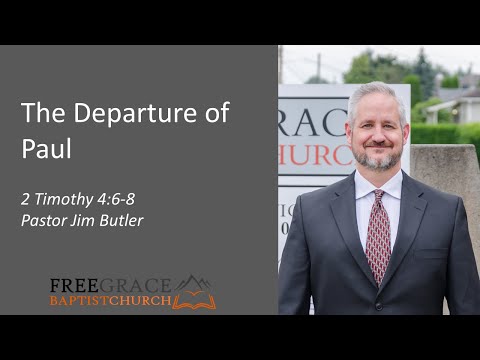
The Departure of Paul
Paul's farewell words in 2 Timothy 4:6–8 — poured out as a drink offering, having fought the good fight, finished the race, and kept the faith — are examined as a model of faithful perseverance unto death. The sermon argues that the confidence Paul expresses at the 11th hour of his life was inseparable from the faithfulness he exercised throughout every preceding hour, and that the crown of righteousness he anticipates is entirely a gift of God's grace, not a payment for services rendered. Believers are called to examine whether they are now fighting, running, and keeping the faith so that they may, by grace, make the same confession at the end of their days; and unbelievers are warned to consider the infinite worth of Christ, the certainty of judgment, and the righteousness the righteous Judge freely offers in the gospel.

The Incarnation of the Word, Part 2
John 1:15–17 presents the preeminence of the incarnate Word and the fullness of grace and truth that flows from Him to needy sinners. The testimony of John the Baptist — that Christ ranks before him because He was before him — is an affirmation of Christ's co-eternity, distinctness, and consubstantiality with the Father, in accord with the Nicene Creed. Verse 17 is not a sharp antithesis between Moses and Jesus but a contrast in the mode of divine revelation: the law was mediated through Moses, while grace and truth came through the mediator Himself, who is the very embodiment of God's glory. The sermon calls hearers to stand in awe of the preeminent Redeemer, to find every spiritual need met in His inexhaustible fullness, and to close with Christ without delay.

The Trial Before Pilate, Part 3
Matthew 27:24–26 records the sentencing of Jesus by Pontius Pilate — the culmination of a trial in which the governor thrice declared the accused innocent yet delivered him to crucifixion anyway. The sermon examines Pilate's hypocritical self-absolution by the washing of hands, the crowd's willing acceptance of blood-guilt and its ominous extension to their children, and the formal scourging and condemnation of Christ. Throughout, the exposition presses the double benefit of the gospel: the forgiveness of sins and the imputation of Christ's righteousness received by faith alone, both grounded in the penal substitutionary atonement symbolised by Barabbas going free while the just one goes to the cross.

The Mission of the Word, Part 1
John 1:6–9 introduces John the Baptist not as an independent figure but as a divinely commissioned witness whose entire ministry exists to point to the Word made flesh. This sermon examines the origin, nature, and function of that witness ministry, demonstrating that the Baptist's testimony belongs to a network of overlapping witnesses — Father, Son, Holy Spirit, Scripture, and signs — that ground saving faith in historical reality rather than a blind existential leap. The function of John's witness is inseparable from its purpose: that sinners would believe on Christ as the Lamb of God who takes away the sin of the world, not merely imitate him as a moral example. The sermon closes with a call to keep law and gospel in their proper places, so that sinners driven by the law's killing power may look by grace to the one who is both the true light and the only hope of the world.

The Trial before Pilate, Part 2
Matthew 27:15–23 records Pilate's attempt to grant amnesty to Jesus through the Passover prisoner-release custom, a device that exposes the cowardice of the Roman governor, the envious malice of the Jewish religious leaders, and the terrifying moral bankruptcy of mob rule. The passage is expounded under five heads — the custom of amnesty, the leaders' motivation of envy, the warning of Pilate's wife, the demand of the multitudes, and Pilate's cross-examination — each of which illuminates the comprehensive reach of human depravity. The substitution of Barabbas for Jesus is treated as emblematic of definite atonement: the just going to the cross in the place of the unjust, securing both the forgiveness of sins and the imputed righteousness of Christ received by faith alone. Hearers are urged not to be carried along by ungodly leaders, to flee to Christ without delay, and to eat the Lord's Supper as a memorial of the blood atonement and active obedience of the Second Person of the Trinity wrought entirely on behalf of his people.

The Practice of the Church
Acts 2:41–47 describes the first-century church's response to apostolic preaching and, when read in light of the whole New Testament, is prescriptive for churches today. The sermon traces two main movements: the power of the gospel that produces faith, repentance, and baptism, and the fourfold practice of the church — steadfast continuation in the apostles' doctrine, fellowship, the breaking of bread, and prayer. Cessationism is applied to the signs and wonders of the apostolic era, while the ongoing marks of the church are drawn from the Belgic Confession's articles on the true church and the obligations of her members. The practical burden is that believers must resist both the reduction of church life to entertainment and the temptation to substitute online participation for embodied, corporate worship.

The Empty Tomb and the Risen Lord
Matthew 28:1–10 narrates not the resurrection itself but the discovery of the empty tomb and Christ's first post-resurrection appearance — and the distinction matters theologically. This sermon works through the arrival of the women, the descent of the angel, the angelic announcement, and Christ's own greeting, demonstrating that the resurrection is attested historical fact whose denial collapses justification, undermines the prophetic witness, and renders the Christian hope pitiable. The risen Christ's address to the women — calling the disciples 'my brethren' despite their desertion — is shown to be a concentrated display of the grace and advocacy that sustains every believer who has sinned against the Lord he professes to love.

The Trial before Pilate, Part 1
Matthew 27:11–14 records the first stage of Jesus' trial before Pontius Pilate — his interrogation by the Roman governor. The passage unfolds in three movements: Pilate's opening question and Christ's guarded affirmation that he is indeed King of the Jews, the formal accusations brought by the chief priests and elders against which Jesus remains silent, and Pilate's astonished second question met again with silence. Christ's silence before Pilate is not passivity but purposeful obedience — fulfilling the fourth servant song of Isaiah 53 and accomplishing the active righteousness that is imputed to his people in justification. The sermon drives toward the twin realities of forgiveness and positive imputation: Christ's silence secured not only the remission of sins but the righteousness that avails with God, so that his people stand before the Father clothed in another's merit rather than their own.

How to Treat One Another in the Church

First Timothy 5:1–2 instructs Timothy — and by extension all Christians — on how to treat members of the congregation according to age and gender, framing those relationships by analogy to the family. The sermon grounds this instruction in the Fifth Commandment, drawing on Westminster Larger Catechism questions 124–131 to show that the commandment's scope extends beyond natural parents to all relationships of authority, age, and equality. Pastors must exhort older men as fathers, younger men as brothers, older women as mothers, and younger women as sisters with all purity — avoiding harshness on the one side and laxity or impropriety on the other. The closing application presses the doctrine of adoption: because believers are children of God and joint-heirs with Christ their elder brother, the church is a genuine household, and its members bear mutual responsibility to encourage and bear one another's burdens without waiting for pastoral direction.

The Victory of David Over Goliath, Part 2
David's victory over Goliath in 1 Samuel 17 is fundamentally a theological event, not a heroic self-help narrative. The sermon works through David's preparation, his declaration of faith in the name of the Lord of hosts, the decisive defeat of Goliath, and the rout of the Philistines, arguing that the emphasis falls squarely on who Yahweh is rather than on what David achieves. The fatal headshot dealt to Goliath is then traced through the biblical-theological thread of Genesis 3:15, illustrated in Judges 4 and 9, and shown to culminate in Christ's crushing of the serpent's head through His own suffering, death, and resurrection — the definitive victory to which David's victory is typological.

The Whole Armor of God
Ephesians 6:10–20 calls the people of God to don the whole armor of God — not as an invitation to physical combat, but as a summons to faithful spiritual warfare against the devil and his hosts. The sermon works through three movements: the commands to be strong in the Lord and to put on the armor, the reasons rooted in the nature of the spiritual enemy, and a pastoral survey of each piece of armor from the belt of truth to the sword of the Spirit and prayer. The controlling emphasis falls on standing — not heroics, but covenantal steadfastness in union with Christ, who is already exalted far above all principalities and powers.

Pressing On In Christ for Sanctification
Philippians 3:10–21 sets out the doctrine of sanctification as the necessary and purposeful continuation of justification — not its cause. The justified believer, having been conformed to Christ's death by the Spirit's regenerating work (Romans 6), is called to press forward in mortification of the old nature and vivification of the new, never resting in past attainments. Christ's purpose in saving sinners is not merely to deliver them from hell but to conform them to his image for the glory of God — the ordo salutis moving through justification and sanctification toward final glorification. The sermon calls believers to disciplined, Christ-dependent pressing on through Word, prayer, church attendance, and zealous good works, while warning that those who corrupt the gospel by mingling works with grace are enemies of the cross whose end is destruction.

All Of Christ For Justification
Philippians 3:1–9 presents the apostle Paul's radical revaluation of every religious credential he possessed, moving them all from the gain column to the loss column so that Christ alone might occupy the place of righteousness before God. This sermon expounds what it means to have no confidence in the flesh: that justification rests on Christ's perfect active obedience imputed to the believer, not on any combination of works, faith, and sincere effort. The loss column of sin is dealt with equally fully — Christ bearing the certificate of debt and nailing it to the cross, cancelling the debt in its entirety. Hearers are called to count all self-generated merit as rubbish and to rest, passively and completely, in Christ's righteousness received through faith alone.

The Lord's Prayer in Gethsemane
What does the agony of Christ in Gethsemane reveal about who He is and what He accomplishes? Expounding Matthew 26:36–46, this sermon traces the Savior's three prayers against the disciples' repeated failure to watch, showing that Christ's soul-sorrow is perfectly consistent with His true humanity, while His unwavering resolve to drink the cup of divine wrath flows from His eternal commitment as covenant mediator. The cup is not metaphor for mere suffering but the concentrated fury of God upon a sinless substitute — which explains both why martyrs die differently than Christ and why the imputation of His active obedience is as necessary as the forgiveness of sins. Believers are called to marvel at His sufficiency, to watch and pray with sobriety about their own weakness, and to rest entirely on the righteousness of Another.

The Third Missionary Journey, Part 2
Acts 19:11–22 presents four movements in Paul's ministry at Ephesus: the unusual miracles God works through him, the humiliating defeat of the itinerant Jewish exorcists who invoke Christ's name without saving faith, the voluntary burning of occult books by Ephesian believers as fruits of genuine repentance, and a Lukan progress report declaring that the word of the Lord grew mightily and prevailed. The sermon argues for cessationism — that the apostolic sign-gifts authenticated the apostles and their message and have ceased with the closing of the canon — while exposing the fraudulence of those who imitate them today. Believers are called to examine all teachers by Scripture, to expect progressive fruits of repentance throughout the Christian life, and to take confident hope from the unstoppable advance of the gospel.

The Second Missionary Journey, Part 9
Acts 18:12–28 traces the close of Paul's second missionary journey through three episodes: his trial before the Roman proconsul Gallio, his departure from Corinth back to Antioch, and a preview of the Alexandrian Jewish teacher Apollos. The exposition treats Gallio's dismissal of the Jewish charge against Paul as a model of properly bounded civil authority — punishing wrongdoing, not regulating theology — while also exposing Gallio's failure to protect Sosthenes as a departure from impartial justice. Paul's continued residence in Corinth after the hearing illustrates faith in the sustaining promises of Christ, and the sermon closes with a call to pray for faithful gospel preachers and an obedient people who respond to their ministry.

The Second Missionary Journey, Part 8
Acts 18:1–11 records Paul's arrival and eighteen-month ministry in Corinth, one of the most morally degenerate cities of the ancient world. The sermon traces Paul's gospel strategy — reasoning in the synagogue, enduring Jewish opposition, and turning to the Gentiles — before dwelling on Christ's night vision to Paul: 'Do not be afraid, for I have many people in this city.' The doctrine of election explains how Christ could speak with certainty of many yet-unconverted people awaiting the call; the gospel, not moral reform or civil intervention, is the sole instrument for transforming a corrupt culture. The sermon closes with a call to pray for and to be men who preach Christ and Him crucified, stand under opposition, persevere in weakness, and believe the promise that Christ is present with His church in the great commission.

The Appearance of the Love of God
Titus 3:4–8 sets the merciful act of divine salvation against the backdrop of human depravity, and this exposition works through that contrast under three heads: the appearance of God's love in verse 4, the application of God's grace in verses 5–7, and the affirmation of God's word in verse 8. The passage is shown to teach that salvation originates entirely in God's kindness and mercy — not in works done before or after conversion — applied through the washing of regeneration and the renewing of the Holy Spirit, and sealed by justification by grace through faith. The sermon closes by pressing the pastoral logic of verse 8: it is precisely the constant preaching of justification by grace, not moralistic exhortation, that empowers the life of good works among God's people.

The Manifestation of God's Grace
Titus 2:11–15 presents God's grace not merely as the ground of salvation but as the very teacher of holy living. This exposition traces four aspects of grace in the passage: its appearance in the incarnation and atoning work of Christ, its instruction toward denial of ungodliness and worldly lusts and pursuit of sober, righteous, and godly life, its demonstration in the deity of the returning Christ and the definite redemption he accomplished, and its proclamation through authoritative gospel ministry. The controlling hermeneutical key is the grammatical and theological priority of the indicative over the imperative: believers obey not in order to be saved but because they have been saved, and inverting that order collapses the gospel into moralism.
The Second Missionary Journey, Part 3
Acts 16:16–34 traces two episodes in Philippi: the exorcism of a slave girl's python spirit and the midnight conversion of the Philippian jailer. The passage confronts the reader with the hostility that faithful gospel ministry provokes — illegal imprisonment, beating without due process, and the solidarity of civil and commercial interests against the missionaries — while demonstrating that neither chains nor stocks can suppress the prayer and praise of those conquered by grace. The climax turns on the jailer's question, 'What must I do to be saved?', and the apostolic answer cuts through every form of salvation-by-works or salvation-by-experience: believe on the Lord Jesus Christ, and you will be saved. The sermon presses hearers to distinguish justification from sanctification, to receive the gospel offer without complicating it, and to rejoice as those delivered from sin, damnation, and the righteous wrath of God.

The Second Missionary Journey, Part 2
Acts 16:6–15 traces the divine hand behind the second missionary journey's westward turn into Macedonia and the conversion of Lydia in Philippi. The Spirit's successive prohibitions of ministry in Asia and Bithynia are not judgments on those regions but demonstrations that God actively directs the missionary enterprise according to his sovereign purpose. The conversion of Lydia — a woman whose heart was dead in trespasses until God opened it to receive Paul's preaching — illustrates that the efficient cause of every conversion is divine grace, not human ingenuity, while the instrumentality of gospel proclamation and the responsibility of hearers to believe remain fully intact. The sermon calls the church to define missionary work precisely as the Spirit-sent, church-commissioned preaching of Christ crucified, rejecting both Arminian confidence in the sinner's free will and hyper-Calvinist reluctance to call sinners to faith.

The Empty Tomb and the Risen Lord
The resurrection of Jesus Christ from the dead is not a cunningly devised fable but a historically attested and theologically necessary event that vindicates Christ's person and work. Expounding Matthew 28:1–10, this sermon examines the discovery of the empty tomb — the descent of the angel, the commission to the women, and the flight of the guards — and then the appearance of the risen Lord to the women, who held him by the feet and worshipped him. The hypostatic union underlies that act of worship: they touch his human feet while adoring the second person of the Trinity. Because Christ is risen, believers need not fear, have an advocate with the Father when they sin, and possess a hope that is grounded in historical reality and not mere sentiment.