
Theological term
Intercession
86 sermons · All terms

The King's Exaltation and Future Triumph

Psalm 21 celebrates the exaltation of the true David, the Lord Jesus Christ, whose resurrection, ascension, and session at the right hand of the Father fulfill what the church prayed for in Psalm 20. The psalm moves from a declaration of the king's joy and the Father's bestowal of blessing, crown, and eternal reign upon the Son as mediator of the new covenant, to a prophetic anticipation of his final triumph over all remaining enemies at the second advent. What is true of the exalted head belongs to the body: the church's permanence, blessing, and ultimate glory are secured in Christ's own immovability and intercession. The sermon closes with a call for sinners to flee to the triumphant king and for the church to recover the militant confidence that comes from feasting on the Psalms of the true David.

The LORD's Help in the Day of Trouble
Psalm 20 presents the prayer and confidence of the covenant people on behalf of their king going into battle, but its deeper register is the church's intercession for Christ — the true David — as he undertakes his redemptive mission. The sermon works through two movements: the petitions of verses 1–5 (the presence of trouble, the place of help, the provision of grace, and the response of joy) and the confidence of verses 6–9 (grounded in the Lord's salvation of his anointed, contrasted sharply with those who trust in chariots and horses). The expositor draws out the prophetic significance of the psalm, showing that what the old covenant church prayed for before the first advent is answered in the resurrection, ascension, and session of Christ, and applies the psalm's stark contrast between trusters in earthly strength and trusters in the name of the Lord to every hearer's standing before God on the day of judgment.

Deuteronomy 16:1-17 - The Annual Feasts of Israel
Deuteronomy 16:1–17 presents three annual feasts — Passover and Unleavened Bread, Weeks, and Tabernacles — as divinely ordained memorials calibrated to keep Old Covenant Israel's allegiance fixed on Yahweh. Each feast commemorates a distinct aspect of God's redemptive work: deliverance from Egypt, provision at harvest, and sustenance through wilderness wandering. The Passover's substitutionary logic — where efficacy rested in God's provision rather than the offerer's moral worthiness — typologically prefigures Christ as the Lamb whose blood alone secures the sinner's safety. The sermon draws out the connection between the central sanctuary requirement of Deuteronomy 12 and the New Covenant church as the God-ordained means by which worship is preserved from corruption and believers are hedged against apostasy.

The Gospel Committed to the Apostle Paul
1 Timothy 1:15–17 contains one of five 'faithful sayings' in the Pastoral Epistles, and Paul deploys it here to contrast the life-giving gospel with the idle speculations of the false teachers troubling the church at Ephesus. The sermon works through three elements: the faithful saying as a standard confession received and guarded by the church; the glorious content of that saying — the incarnation of the Son and his effectual, definite work to save sinners; and the merciful application illustrated in Paul himself, who as the chief of sinners functions as a pattern of Christ's longsuffering for all who will believe. The doxology of verse 17 demonstrates that rightly understood soteriology issues in worship, and believers are called to keep this faithful saying at the centre of their hearts and to press it upon the unconverted.

The Lament of the Psalmist
Psalm 13 is a lament psalm of David that moves through raw grief — the perceived forgetfulness of God, the daily sorrow of the soul, and the threat of encroaching enemies — to a resolved trust in the covenant mercy of God. The sermon traces this trajectory through the true humanity of Christ, who himself prayed lamentingly in Gethsemane and on the cross, establishing lament as a legitimate and God-given vehicle of prayer for his people. Lament is distinguished sharply from whining: whining refuses to petition God and ends in despair, while biblical lament drives the soul toward God and terminates in doxology. The congregation is called to bring their distress boldly to the throne of grace, resting in the hesed of God covenanted to all who are found in Christ.

The Priestly Blessing of the Ascending King

Luke 24:50–53 closes the Gospel with the ascending Christ lifting His nail-pierced hands to bless His disciples at Bethany — a gesture laden with Old Testament typology, most immediately the Aaronic priestly blessing of Leviticus 9. The sermon argues that this blessing is not a mere farewell gesture but an authoritative, ongoing priestly act: Christ ascended while still blessing, signifying that His intercession and the bestowal of divine favor upon His people never cease. Preached in the context of a Lord's Supper service, the exposition calls believers to receive the sacrament as participants in the everlasting blessing of the great High Priest, and to respond with the pattern of the early disciples — continuous, corporate, joyful worship of the Triune God.

Review Of Israel's Rebellion
Deuteronomy 9 confronts Israel's temptation to attribute their inheritance of the promised land to their own righteousness, and Moses systematically dismantles that presumption. The chapter divides into the anticipation of the conquest (vv. 1–6) and a recapitulation of Israel's wilderness rebellions (vv. 7–29), each episode confirming that Israel stood not by merit but by the sovereign mercy of God and the faithfulness of his covenantal promises to Abraham, Isaac, and Jacob. Moses's intercessory prayer at the chapter's close models covenant pleading that appeals not to Israel's worthiness but to God's glory, his sworn word, and the redemption he himself accomplished. The passage calls God's people in every era to forsake self-righteousness and rest entirely on divine grace.

The Bronze Serpent
Numbers 21:1–9 records Israel's sin of grumbling in the wilderness, God's judgment through fiery serpents, and the divinely prescribed remedy: look at the bronze serpent lifted on a pole and live. The sermon traces this narrative in two movements — the defeat of the Canaanites in verses 1–3, where Israel prays and trusts God, contrasted with the failure of verses 4–9, where they grumble despite God's provision. The bronze serpent functions as a type of Christ, as Jesus himself declares in John 3:14, and the sermon presses the application that justification is by faith alone — not by prior works, not by self-examination of the wound, but by looking to the one lifted up. Weak faith does not disqualify the sinner; even a feeble look at the appointed remedy brings the sinner into peace with God.

The Regulations for Life in Canaan
Numbers 32–36 closes the book with regulations governing Israel's entry into Canaan: the Transjordanian tribal allotments, the itinerary of the wilderness journey, the boundaries of the land, Levitical cities, cities of refuge, and the inheritance rights of female heirs. The legislation on cities of refuge anchors a sustained exposition of the distinction between murder and manslaughter, grounded in the Noahic covenant of Genesis 9:6, and carries forward the biblical case for capital punishment as a perpetual civil obligation. The study closes by tracing Christ through Numbers — as the guiding presence, the compassionate shepherd, the greater Joshua, the great high priest, and the brazen serpent lifted up for the life of the world — and applies the wilderness pattern to the new covenant people who must persevere through present affliction toward an eternal Canaan.

The High Priestly Prayer, Part 4
What grounds the prayers Jesus offers for his people, and why does he explicitly exclude the world from his intercession? Working through John 17:9–11a, this sermon examines the focus and rationale of Christ's high priestly intercession: he prays specifically for the elect whom the Father gave him, not for the reprobate world, and he does so as the mediating priest who both sacrifices and intercedes on behalf of his own. The mutual possession declared in verse 10 — 'all mine are yours and yours are mine' — establishes the full equality of the Son with the Father, while 'I am glorified in them' frames the church as a trophy case of divine grace displayed before angels and nations. The sermon closes with an exhortation to treasure the blessedness of election: a Savior who intercedes, a triune God who is known, and a security that nothing can sever.

The High Priestly Prayer, Part 1
John 17:1–5 records the opening of Christ's high priestly prayer, in which the Lord Jesus — praying according to His humanity as the Mediator of the New Covenant — petitions the Father for glory, because glory given to the Son redounds to the glory of the Father. The sermon works through the occasion of the prayer, the derived and delegated authority granted to Christ over all flesh, and the particular redemptive purpose for which that authority was given: that He should grant eternal life to all whom the Father has given Him. Particular redemption is grounded in the text itself, and the sermon closes by pressing the definition of eternal life in verse 3 — the knowledge of God and of Jesus Christ — as a summons to pursue theology, Scripture reading, and corporate worship with renewed seriousness.

The Enthronement of the King-Priest
Psalm 110 is the most frequently quoted Old Testament text in the New Testament, and for good reason: it presents the Lord Jesus Christ in his twofold office as enthroned King and eternal Priest. This exposition works through all seven verses under three headings — the enthronement of Christ at the Father's right hand (vv. 1–3), the Melchizedekan priesthood sworn by God's oath (v. 4), and the triumph of Christ over all his enemies (vv. 5–7). The sermon calls believers entering a new year to fix their minds on the reigning King-Priest rather than on the hostility of the present evil age, and urges the unconverted to come to Christ in faith on the grounds that God's saving purpose is irreversible.

The Wars of the LORD
Numbers 21 traces Israel's journey through military victory over the Canaanites, the punishment and grace of the bronze serpent, and the conquest of the Amorite kings Sihon and Og. The bronze serpent — condemned people bitten by fiery serpents, healed only by looking in faith to the remedy God prescribed — is taken up by Jesus in John 3:14 as a type of his own crucifixion, teaching that salvation comes by divine initiative alone, received through faith, not works. The same recurring sins of complaint, lack of faith in providence, and idolatry that marked the first generation persist in the second, warning the church that these corruptions follow the sin nature across every generation. The chapter closes with God's sovereign hardening of Sihon and the defeat of the giant Og, both down payments on the promised conquest and demonstrations of God's faithfulness, sovereignty, and goodness to his people.

The Vindication of the Aaronic Priesthood
Numbers 16:41–17 records the immediate aftermath of Korah's rebellion: Israel accuses Moses and Aaron of murder, God's wrath breaks out in a plague, and Aaron runs into the congregation with a censer to make atonement, standing between the dead and the living until the plague stops. Chapter 17 then confirms the Aaronic priesthood definitively when Aaron's rod alone buds, blossoms, and produces ripe almonds, functioning as a perpetual sign against any future usurper of the priestly office. The typological weight of Aaron's intercession in verse 48 points forward to Christ, who stands between dead sinners and the wrath of God, propitating that wrath by his blood. The sermon calls hearers to recognize both the sinfulness of Israel's hasty accusation and the glory of the priestly atonement that alone grants the unholy access to a holy God.

The Spirit's Conviction of the World
Jesus declares to his sorrowing disciples that his departure is to their advantage — not despite the coming persecution, but precisely because it secures the gift of the Holy Spirit. This sermon works through John 16:5–11 under two heads: the departure of Christ (vv. 5–7) and the conviction of the world (vv. 8–11), pausing to develop the first at length. The Trinitarian logic of the temporal missions — the Father sending the Son, the Father and Son sending the Spirit — is shown to be the very theology that sustained the apostles under hostility and that sustains the church today. The sermon closes with a call to rest in the Spirit's power rather than human eloquence or celebrity, because the Paraclete is the disciples' power, protection, and advantage.
The Requirements for Religious Life
Numbers 15 interrupts the narrative of Israel's rebellion in chapters 11–14 with renewed covenant obligations — laws of offerings, provisions for unintentional sin, and the command to wear tassels. The placement is deliberate: faithfulness to God's ordained means of grace is the proper remedy for the kind of corporate collapse just witnessed. The sermon traces how God's judgment on one generation does not exhaust His covenant mercy, and draws a typological line from Mosaic sacrifice and priesthood through to the once-for-all offering of Christ and the believer's advocate before the Father.

The Requirements for Priesthood and Sacrifice
Leviticus 21–22 sets out strict requirements for both the priests who offer sacrifice and the animals brought to the altar: wholeness, purity, and freedom from defect. These ceremonial regulations are not arbitrary exclusions but typological anticipations of the one perfect High Priest and the one perfect sacrifice that God himself would provide in the person and work of the Lord Jesus Christ. The sermon works through the four sections of the passage — practical restrictions on priests, physical requirements for priests, regulations concerning priestly food, and physical requirements for sacrificial animals — before turning to Hebrews 7–10 to show how Christ fulfills and surpasses everything the Levitical system could only shadow. The conclusion calls the congregation to the Lord's Supper with eyes fixed not on themselves but on the one who offered himself once for all and sat down.

The Rebellion in the Wilderness
Numbers 14:1–12 records the congregation of Israel responding to the faithless report of the ten spies with weeping, complaint against Moses and Aaron, blasphemy against God, and a proposal to appoint a new leader and return to Egypt. The passage exposes the idolatry underlying Israel's rebellion — not merely a preference for Egyptian food, but a wholesale rejection of Yahweh in favor of the gods they had left behind. God's response in verses 11–12, spoken in what theologians call the 'manner of men,' underscores the gravity of Israel's sin, the holiness of God's judgment, and sets the stage for Moses' remarkable intercession on behalf of a people who had just sought to stone him.
Bible Study - Numbers 12:1-16
Numbers 12 records the rebellion of Miriam and Aaron against Moses, ostensibly over his Cushite wife but in reality a challenge to his God-given authority as Israel's unique covenant mediator. The passage establishes a hierarchy of prophetic revelation — vision and dream to the prophets, but face-to-face speech to Moses — which God himself defends by immediately judging Miriam with leprosy. Moses' humility and intercessory prayer on behalf of his accusers point forward typologically to the greater Mediator, the Lord Jesus Christ, who alone bears the full weight of God's people and speaks face-to-face with the Father.

The Gratitude of the Apostle
Paul's opening lines to the Philippians (1:3–8) reveal an apostle whose gratitude, commendation, and affection are all grounded not in the merits of his friends but in the sovereign grace of God. The sermon works through three movements: the object and fruit of Paul's gratitude (prayer with joy), his commendation of the Philippians for their fellowship in the gospel and his confidence in God's preserving grace, and his oath-backed declaration of personal affection for them. The assurance of salvation rests not in the believer's perseverance but in the faithfulness of the God who begins and completes every good work, a truth the church is called to receive with gratitude and express through active participation in gospel ministry.

The Love of Christ and Love to One Another, Part 2
John 15:12–17 presents Christ's command that His disciples love one another as He has loved them — self-sacrificially, constantly, and toward sinners undeserving of that love. The sermon works through four elements of the passage: the command to love as a summarizing and comprehensive statement of the second table of the law, the pattern of self-sacrificial love set by Christ's laying down His life, the privilege of friendship with Christ rooted not in conditional obedience but in sovereign grace and divine revelation, and the reminder that election humbles pride and equips disciples for fruitful, costly mission in a world that hates Christ. The application presses believers to love one another with a love that does not wait for the beloved to merit it, and points the unconverted to the imputed righteousness of Christ received by faith alone as the only ground of acceptance before God.

The Mission of the Disciples, Part 2
John 14:16–18 presents Christ's promise to send the Holy Spirit as the resource by which the disciples would carry out the greater works of the gospel mission. This sermon works through the foundation of that promise — salvation by grace through faith in Christ alone, the love that flows from justification as the animating power of obedience and mission — before pausing to mount a sustained defense of Trinitarian theology proper. The preacher argues that biblicism without creedal guardrails, anti-intellectualism, and laziness have left the contemporary church vulnerable to the same Trinitarian errors the Nicene and Chalcedonian fathers labored to foreclose, and calls the congregation to pursue the knowledge of the triune God as the very substance of eternal life.

The Empty Tomb and the Risen Lord
The empty tomb of Matthew 28:1–10 is not a symbol or a felt experience but a historical event on which the entire Christian gospel stands or falls. Working through the arrival of the women, the descent of the angel, and the appearance of the risen Lord, this exposition shows that the resurrection was predicted by Christ, attested by angels, and confirmed by the physical presence of the one who holds his disciples as brethren even after their desertion. The sermon closes by grounding the believer's freedom from fear, confidence in advocacy, and obligation to proclamation in the fact that Jesus was raised for our justification.

The Introduction to the Upper Room Discourse
John 13:1–3 functions as the theological introduction to the entire Upper Room Discourse (John 13–16), establishing three controlling realities: the arrival of Christ's appointed hour, the opposition of the devil through Judas, and the resolute authority and mission of the Son of God. The love of Christ for his own — unchanging, constant, and infinite — is the motivating force behind everything he teaches his disciples in those chapters. Those whom the Father gave to the Son are not a morally superior class but guilty sinners chosen in sovereign grace, loved to the uttermost through the cross, resurrection, intercession, and into eternity. Sound Trinitarian doctrine, far from being merely academic, is the very fuel that moves the church to worship, witness, and perseverance.

Restrictions on Levitical Priesthood
Leviticus 21–22 sets out restrictions governing the Levitical priesthood: whom priests may mourn, whom they may marry, what physical conditions disqualify them from service, who may eat from their food, and what animals are acceptable for sacrifice. The underlying logic in every category is the same — the holy God who dwells among his people demands a priesthood, a sacrifice, and a manner of worship that reflect his holiness and are not corrupted by defilement or defect. These chapters point typologically beyond themselves to the Lord Jesus Christ, who alone fulfils what the Levitical order only approximated: the perfect high priest who is holy, harmless, and undefiled, and the perfect sacrifice offered once for all. The superiority of the new covenant is seen precisely here — the exclusions of the old order (eunuchs, the maimed, the lame) give way to the great invitation of Christ to the broken and outcast to come to the wedding feast.
The Warning Against Apostasy
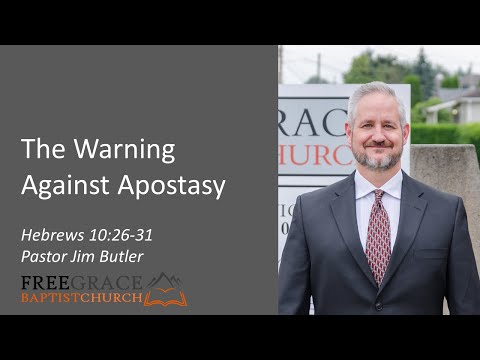
Hebrews 10:26–31 contains one of the New Testament's starkest warnings, and the question it raises is precise: who has committed the sin of willful apostasy, and can it be the believer who struggles with remaining corruption? This sermon works through the nature and judgment of apostasy, distinguishing between the sensitive saint who sorrows over indwelling sin and the apostate who openly tramples the Son of God underfoot, counts the blood of the covenant a common thing, and insults the Spirit of grace. Drawing on Calvin, Owen, Gill, and Ursinus, the sermon argues that the persons in view are not struggling believers but outright rejecters of the gospel — in the original context, Hebrew Christians who publicly renounced Christ to return to the Levitical system. The chief comfort the passage affords is precisely this: the believer who fears he has committed the unpardonable sin almost certainly has not, and is called to draw near, hold fast, and consider one another in the confidence of a once-for-all sacrifice that saves to the uttermost.

The Renewal of God's Covenant, Part 1
Exodus 34:1–9 records the renewal of the Mosaic covenant following Israel's catastrophic idolatry with the golden calf, and the chapter's theological heart is God's self-proclamation of His own glory to Moses on Sinai. The sermon works through three movements in verses 1–9: the command to cut new tablets as a covenant-renewal symbol, the descent of God in the cloud, and God's proclamation of His own name — a compendium of divine perfections stretching from mercy and grace through long-suffering, goodness, truth, and covenant faithfulness to justice and righteousness. These attributes are traced across the canon from the Psalms and the prophets to their fulfillment in the high-priestly work of Christ, who makes definite propitiation for the sins of His people. Moses' response — immediate worship followed by intercessory prayer grounded in the very perfections God had just declared — is held out as the model for the believer's own approach to God.
The Idolatry of Israel, Part III
Exodus 32:30–35 presents Moses interceding for Israel after the golden calf debacle, confessing their great sin and offering himself to be blotted out of God's book on their behalf. The sermon works through Moses's rebuke, his request, and God's response, giving particular attention to the theological question of whether God blots names from the Book of Life — resolving the tension by distinguishing the conditional Old Covenant (a covenant of works securing physical blessings) from the unconditional New Covenant, in which the elect are eternally secure in Christ. The Mosaic intercession is read typologically as pointing to Christ, who was, in effect, blotted out on behalf of his people. The sermon closes with application to the gravity of idolatry drawn from Romans 1 and a quote from John Stott.

The Idolatry of Israel, Part 2
Exodus 32:15–35 records the descent of Moses from Sinai and the immediate consequences of Israel's golden calf idolatry. This study covers four movements in the text: Moses' symbolic breaking of the covenant tablets, Aaron's evasive self-defense, the Levites' execution of three thousand offenders, and Moses' intercessory return to the Lord. The gravity of idolatry — as a direct assault on the being and honor of God — is traced from Sinai through Numbers 25 and Psalm 106, and pressed home with Calvin's warning that the human heart is a perpetual idol factory, turning even good gifts and the self into objects of ultimate devotion.

The Idolatry of Israel, Part 1
Exodus 32:1–14 records the catastrophic breach of Israel's covenant oath, sworn only weeks earlier in Exodus 24, as the people demand a visible god and Aaron fashions the golden calf. The passage exposes the persistent human tendency toward idolatry — rooted in total depravity and inflamed by impatience, carnality, and the craving for a manageable deity — and demonstrates that their sin was not a denial of Yahweh but a second-commandment violation: representing the true God by a forbidden image. The sermon then turns to Moses' masterful intercession, grounded in appeals to God's power, his glory before the nations, and his covenant oath to the patriarchs, and concludes with extended treatment of divine immutability and anthropopathism to explain why Exodus 32:14 ('the Lord relented') cannot be made to teach flux or change in God.