
Theological term
Inscripturation
14 sermons · All terms
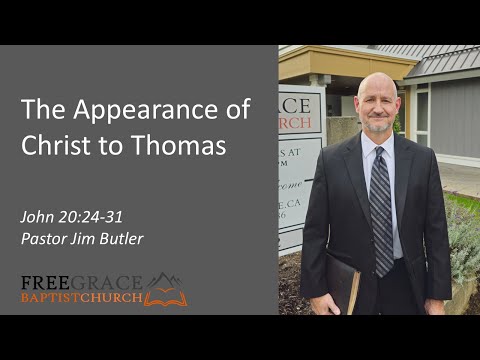
The Appearance of Christ to Thomas

John 20:24–31 presents Thomas not merely as a doubter but as an obstinate man who refuses to believe the resurrection unless his own conditions are met — rejecting the Old Testament prophets, the repeated predictions of Christ, and the apostolic testimony of ten eyewitnesses. Christ responds not with rebuke but with sovereign grace, appearing again on the Lord's Day and inviting Thomas to examine the wounds that sealed a finished atonement. The confession that follows — 'My Lord and my God' — is the theological and experiential crown of the fourth gospel, answering John's own stated purpose in verses 30–31: that through the written word, those who have not seen may nevertheless believe and have life in Christ's name.
Deuteronomy 1
Deuteronomy 1 opens Moses' first address to the second generation of Israel on the plains of Moab, a historical review designed to prepare the people for the conquest of the promised land. Moses rehearses four episodes: God's command to advance from Horeb, the appointment of judges, the rebellion at Kadesh Barnea rooted in unbelief, and the punishment that fell on the first generation. The central diagnostic is verse 32 — 'you did not believe the Lord your God' — which exposes unbelief as the taproot of Israel's grumbling, refusal, and covenant faithlessness. The sermon calls the New Covenant congregation to dwell on this history so as to be steadfast in the future, trusting the same God whose promises are yes and amen in Christ.

The Rebellion in the Wilderness
Numbers 14:1–12 records the congregation of Israel responding to the faithless report of the ten spies with weeping, complaint against Moses and Aaron, blasphemy against God, and a proposal to appoint a new leader and return to Egypt. The passage exposes the idolatry underlying Israel's rebellion — not merely a preference for Egyptian food, but a wholesale rejection of Yahweh in favor of the gods they had left behind. God's response in verses 11–12, spoken in what theologians call the 'manner of men,' underscores the gravity of Israel's sin, the holiness of God's judgment, and sets the stage for Moses' remarkable intercession on behalf of a people who had just sought to stone him.

The Cessation of Revelatory Gifts

First Corinthians 13:8–13 declares that tongues, prophecy, and words of knowledge have a designed and determined end, giving way to the completed New Testament canon. This sermon argues from Acts 2, 1 Corinthians 13–14, Hebrews 1–2, Ephesians 2, and Daniel 9 that the revelatory gifts were temporary, apostolic, and tied to the first advent of Christ and the foundational era of the church. The 'perfect' of 1 Corinthians 13:10 refers not to the eschatological consummation but to the inscripturated fullness of divine revelation in the New Testament scriptures. Christians today are called to glory in the completed Word of God and in the abiding work of the Holy Spirit in regeneration and illumination, rather than seeking gifts that have ceased.
Free Grace Baptist Church - June 9, 2019 AM
The Christological unity of Scripture — the truth that the Old Testament prophets testified to Christ by the Spirit of Christ — grounds the believer's hope under suffering and shapes a properly Christocentric hermeneutic. Drawing from 1 Peter 1:10–12, this sermon argues that the Spirit of Christ was personally present in and through the prophets, disclosing the sufferings of Christ and the glories that follow, so that the Old Testament is not Israel-centric but Christ-centric in its ultimate focus. The sermon calls believers to read Scripture not merely for cognitive information but as a supernatural encounter with Christ himself, whose revealed glory transforms the reader into his likeness and sustains eschatological hope in the face of suffering and persecution.

The Divine Provision of Eternal Life
Isaiah 55 presents God's gracious and urgent invitation to sinners to receive the fullness of salvation — the refreshment, gladness, and nourishment of the gospel — entirely without cost, because the suffering servant of Isaiah 53 has already satisfied the purchase price. The sermon expounds the chapter in two movements: the invitation to come (vv. 1–5), grounded in the new covenant and secured by the Davidic king, and the call to faith and repentance (vv. 6–13), sustained by the sovereign power of God's Word. Believers are urged to treasure the abundance of every spiritual blessing already given in Christ, and unbelievers are warned not to squander their lives on what cannot satisfy while the Lord may yet be found.
2LCF Chapter 1 - Of the Holy Scriptures, Part 2
What gives the Bible its authority, and how did the church come to recognise which books belong in it? Working through paragraphs 2–4 of the Second London Confession of Faith (1689 LBCF chapter 1), this study examines the canon of Scripture — its 66 books, the exclusion of the Apocrypha, and the ground of scriptural authority. Three factors explain the origins of canon: the eschatological expectations of early Christianity, the covenantal framework that always paired redemptive acts with written covenant documents, and the unique apostolic authority Christ invested in his designated spokesmen. Against both the community-determined and historically-determined models, the confession's self-authenticating model is defended: Scripture's authority rests wholly on God as its author, confirmed inwardly by the testimony of the Holy Spirit, and evidenced by the divine qualities of the text itself, its providential spread across the churches, and its corporate reception among believers of every age.
2 Samuel 14
Second Samuel 14 records Joab's scheme to engineer Absalom's return from exile through the parable-like appeal of a wise woman from Tekoa, David's capitulation, and the uneasy non-reconciliation that follows. The chapter exposes David's chronic inactivity as a father and king — his refusal either to punish or fully forgive Absalom producing the very bitterness that will fuel Absalom's usurpation in chapter 15. The narrator's portrait of Absalom's stunning appearance, his family, and his manipulative conduct warns that outward impressiveness without inward submission to God is a recipe for leadership disaster, a theme that runs from Saul through Eliab to Absalom himself. Parents and leaders alike are called to deal decisively with sin rather than tolerate the "no man's land" between justice and mercy.

The Christocentric Gospel
John 20:30–31 gives the purpose statement for the entire Gospel of John: that readers would believe Jesus is the Christ, the Son of God, and that believing they would have life in His name. This sermon examines, first, the deliberate divine design behind gospel revelation — that God superintended the inscripturation of Scripture not to disclose all things, but to set forth with clarity the saving knowledge of Christ — and, second, the Christocentric character of that revelation, tracing how the whole of Scripture, from Moses through John, has Christ as its intended terminus. The sermon closes with a direct call to believe on Christ, warning that rejection of such a glorious Savior issues in eternal condemnation, while faith issues in spiritual life now and eternal life in the age to come.
2LCF Chapter 1 - Of the Holy Scriptures, Part 2
What gives the church the right to declare these 27 books—and no others—the Word of God? This session works through 1689 London Baptist Confession of Faith chapter 1, paragraphs 2 and 3, to answer that question by examining the origins of the New Testament canon and the three attributes by which canonical books are recognized: divine qualities, corporate reception, and apostolic origin. Drawing extensively on Michael Kruger's scholarship, the lesson demonstrates that the canon was neither a fourth-century political invention nor a community preference, but a self-authenticating body of Scripture whose recognition by the church was providentially prepared for from within the structure of redemptive history itself. The closing application presses the hearer to see that no argument for canonicity finally persuades apart from the inward testimony of the Holy Spirit.
2LCF Chapter 1 - Of the Holy Scriptures
The doctrine of Scripture (1689 LBCF Chapter 1) is examined through twenty aspects drawn from paragraphs 1–10, arguing that the Holy Scriptures alone are the sufficient, certain, and infallible rule of all saving knowledge, faith, and obedience. Beginning with the principium cognoscendi — Scripture as the epistemological foundation of all theology — the study moves through the limits of general revelation, the cessation of special revelation, the canon, the self-attesting authority of Scripture, and the role of the Spirit in producing genuine belief. The session closes with the Reformation axiom that Scripture is its own infallible interpreter and the supreme judge of all religious controversy, against Rome's claim that the magisterium validates the canon.
A Brief Survey of Covenant Theology, Part 1

What is a divine covenant, and why does 'covenant theology' accurately describe the Bible's own architecture? This lecture — the first in a three-part survey — defines divine covenants as relational arrangements sovereignly initiated by God for man's benefit, with ways and means established by God alone to obtain the designated blessings. Drawing on Nehemiah Cox, 2 Samuel 7, Exodus 19, and Hebrews 10, the speaker demonstrates that both Testaments are covenantally structured documents: the Old Testament is the covenantal record for old covenant Israel, and the New Testament is the covenantal record for the new covenant church, both centering on Christ in his sufferings and glory. The lecture concludes that covenant theology is not an alien grid imposed on Scripture but the organic, Christocentric shape of biblical revelation itself, best interpreted by allowing the New Testament to illuminate the Old.
John, Brother and Companion of the Persecuted
Revelation 1:9–11 introduces John not as a remote visionary but as a brother and companion sharing in the tribulation, kingdom, and patience of Jesus Christ — writing from Patmos, where he was banished for the word of God and the testimony of Jesus Christ. The sermon examines three dimensions of John's identity as author: his solidarity with persecuted believers, his present experience of exile, and the divine commission he receives from the Alpha and the Omega, whose self-identification as the First and the Last establishes the explicit deity of Christ. Christians are called to embrace a joyful rather than merely resigned response to affliction, to reclaim a robust confidence in the present reign of Christ over all things, and to be devoted to the word of God and the testimony of Jesus Christ regardless of whether they face first-century intensity of persecution or the subtler trials of the modern West.
The Prayer of Habakkuk
Habakkuk 3 moves from prophetic complaint to confident worship through prayer and the deliberate rehearsal of God's mighty acts in redemptive history. This expository treatment traces three movements in the chapter: the prophet's prayer (vv. 1–2), his contemplative collage of God's historical deeds (vv. 3–15), and his response of reverential awe and joyful devotion despite impending calamity (vv. 16–19). The sermon presses home that the justified by faith must live by steadfast trust in God — not because He supplies health, wealth, and prosperity, but because He is Lord, and in having Christ the believer has everything.