
Theological term
Incarnation
167 sermons · All terms

The Feeding of the Five Thousand

John 6:1–15 presents the feeding of the five thousand as a sign — a theological event designed to reveal who Jesus is, not merely a remarkable act of provision. The miracle is set against the backdrop of the Passover and the Mosaic exodus, inviting comparison between the manna in the wilderness and Jesus as the living bread come down from heaven. The crowd's response — declaring him the prophet of Deuteronomy 18 and then attempting to seize him as a political king — exposes the persistent confusion between a physical, temporal messianic expectation and the spiritual, eternal salvation Christ actually came to accomplish. The sermon calls hearers to see in the bread and fish the One who supplies all things abundantly, who has both the compassion and the omnipotence to save every sinner who comes to him in faith.

The Rejection of the Son
John 5:41–47 records Christ's closing rebuke to the Jewish religious leaders who rejected Him despite the testimony of John the Baptist, His works, the Father, and the Scriptures. The sermon expounds two principal charges Jesus levels against His opponents: their refusal to receive the honor that comes from God alone, and their complete absence of love for God — demonstrated precisely by their rejection of the One the Father sent. Working through the accusation by Moses in verses 45–47, the exposition shows that to reject Christ is simultaneously to reject Moses, to reject the Father, and to worship an idol in place of the living God. The sermon closes with a call to receive Christ by faith, in whom alone eternal life is found.

The Promise of the Coming King
Isaiah 9:6–7 presents the promised Messianic King in language that exceeds any earthly monarch — a child born yet mighty God, a son given yet everlasting Father, the Prince of Peace who secures shalom through conquest. This exposition sets the passage in its historical context of Assyrian devastation and prophetic hope, then works through the fourfold identification of the King and the fourfold character of His kingdom. The central application is that this King presently reigns at the right hand of the Father, and entrance into His eternal, covenantal, just, and secure kingdom is by grace through faith alone in the Lord Jesus Christ.

The Riches of Christ
How can the eternal, omnipotent Son of God be said to have 'become poor'? Expounding 2 Corinthians 8:9, this sermon traces the riches of Christ to His divine nature and works as the second person of the Trinity, and His poverty to the Incarnation, His lowly life, and His sufferings and death. The hypostatic union — two whole natures inseparably joined in one person — is shown to be not merely a speculative doctrine but the theological ground on which the Apostle Paul appeals to the Corinthians for generous giving. The riches believers receive through Christ's poverty are spiritual: justification, sanctification, glorification, and adoption, purchased by His obedience, suffering, and resurrection.

The Discourse on God's Salvation, Part 3
John 3:17–21 declares that the Son of Man's incarnation was a redemptive, not a condemnatory, mission — yet the world He entered was already under condemnation by virtue of Adam's sin and its own actual transgressions. The passage moves from the declaration of man's condemned state (vv. 17–18) to the demonstration of it (vv. 19–21): fallen humanity resists the light of Christ, loves moral darkness, and avoids exposure — the classic scriptural portrait of total depravity confirmed across Genesis, the Psalms, the Prophets, and the New Testament. The necessity of regeneration by the Holy Spirit follows directly: because sinners are constitutionally hostile to the light, they cannot come to Christ unless the Spirit first makes them alive and grants the graces of faith and repentance.

The Discourse on God's Salvation, Part 1
Jesus answers Nicodemus's question — 'How can these things be?' — by pointing to three realities: his own incarnation as the one who descended from heaven, the Old Testament typology of the bronze serpent in Numbers 21, and the necessity of his crucifixion as the antitype to whom sinners must look in faith. The sermon works through John 3:11–15, examining Christ's authority to speak of heavenly things, the doctrine of the hypostatic union and the communication of idioms, and the parallel between Israel's look-and-live prescription in the wilderness and saving faith in the crucified Son of Man. The application is direct: the antidote to sin is not moral reformation but faith in the lifted-up Christ, who alone secures justification and eternal life for believing sinners.

The Wedding at Cana of Galilee
John 2:1–12 recounts the wedding at Cana, where Jesus turns water into wine as the first of his public signs. The sermon traces three movements in the passage — the setting, the sign, and the summary — and argues that the miracle is not merely a display of power over nature but a prophetically charged inauguration of new covenant abundance, anticipated by Isaiah, Jeremiah, Joel, Amos, and Zechariah. The water pots of Jewish purification give way to wine that surpasses what came before, signifying that the grace and truth that came through Jesus Christ exceeds the law given through Moses. The closing application presses hearers to heed the one command Mary gives in all of Scripture: whatever Jesus says, do it.

The Incarnation of the Word, Part 2
John 1:15–17 presents the preeminence of the incarnate Word and the fullness of grace and truth that flows from Him to needy sinners. The testimony of John the Baptist — that Christ ranks before him because He was before him — is an affirmation of Christ's co-eternity, distinctness, and consubstantiality with the Father, in accord with the Nicene Creed. Verse 17 is not a sharp antithesis between Moses and Jesus but a contrast in the mode of divine revelation: the law was mediated through Moses, while grace and truth came through the mediator Himself, who is the very embodiment of God's glory. The sermon calls hearers to stand in awe of the preeminent Redeemer, to find every spiritual need met in His inexhaustible fullness, and to close with Christ without delay.

The Incarnation of the Word, Part 1
John 1:14 — 'the Word became flesh and dwelt among us' — is the hinge on which all Christian theology turns. This exposition works through the identification, the incarnation proper, and the indwelling presence of the Word, establishing that the eternal Son assumed a true human nature (body and soul) without ceasing to be the second person of the Trinity — the doctrine the church confesses as the hypostatic union. The sermon draws on the active and passive obedience of Christ to show that the incarnation was not primarily exemplary but redemptive: the Word took flesh to render the perfect obedience sinners owe and to shed the blood that purchases their forgiveness. Hearers are pressed to see Christ not only as Redeemer but as reigning King, and the unbeliever is called to receive, by faith alone, that righteousness which comes from God.

The Mission of the Word, Part 2
John 1:10–13 presents two contrasting responses to the mission of the incarnate Word: the rejection of the world and of Israel, and the reception of those upon whom Christ confers the right to become children of God. The sermon works through the threefold use of 'world' in verse 10, the parallel between Israel's ancient rebellion and their rejection of the Messiah, and the sovereign grace underlying faith and new birth in verses 12–13. Central to the exposition is the Reformed insistence that regeneration precedes faith — those who receive Christ by believing do so because they have first been born of God — against both Pelagian and Arminian construals of conversion.

The Mission of the Word, Part 1
John 1:6–9 introduces John the Baptist not as an independent figure but as a divinely commissioned witness whose entire ministry exists to point to the Word made flesh. This sermon examines the origin, nature, and function of that witness ministry, demonstrating that the Baptist's testimony belongs to a network of overlapping witnesses — Father, Son, Holy Spirit, Scripture, and signs — that ground saving faith in historical reality rather than a blind existential leap. The function of John's witness is inseparable from its purpose: that sinners would believe on Christ as the Lamb of God who takes away the sin of the world, not merely imitate him as a moral example. The sermon closes with a call to keep law and gospel in their proper places, so that sinners driven by the law's killing power may look by grace to the one who is both the true light and the only hope of the world.
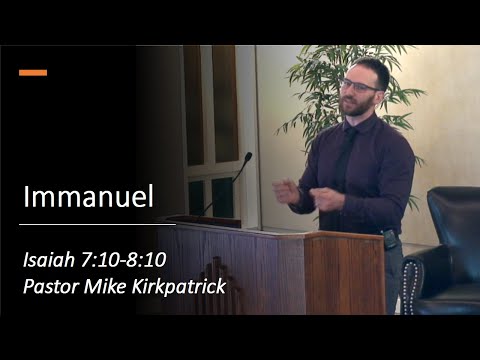
Immanuel

Isaiah 7:10–8:10 presents the Immanuel prophecy not as a comfortable seasonal text but as a word of judgment against Ahaz's faithless trust in Assyria and a word of hope for the covenant remnant. The sermon traces two contrasting realities: 'Assyria with us,' the consequence of royal unbelief, and 'God with us,' the promise that anchors the remnant through exile and desolation. The Immanuel sign finds its definitive fulfillment in Matthew 1, where the virgin-born Son saves his people from sin rather than merely political oppression — a truth that remains the ground of steadfastness for the church in every era of suffering and exile.

The Bible and Abortion
Abortion is not a political issue but a theological and ethical one — a violation of the Sixth Commandment against murder and a direct assault on the image of God borne by every human being from conception. This sermon works through Exodus 21:22–25 to demonstrate that the Mosaic case law governing accidental injury to a pregnant woman treats the pre-born child as a full person, applying the lex talionis — life for life — when the child is killed. Supporting passages from Genesis, Job, Psalms, Jeremiah, Luke, and Paul establish the biblical case for the personhood and sanctity of the pre-born. The sermon closes by calling the church to preach the whole counsel of God on this subject, to pursue sexual fidelity, to pray for the end of abortion, and to proclaim the gospel's mercy to all who have sinned in this way.

The Incarnation of the Word
John 1:14 declares that the eternal Word — the second person of the Trinity, who was in the beginning with God and was God — became flesh and dwelt among men. This sermon expounds the incarnation under two heads: first, the identity and reality of the Word taking on true humanity (the hypostatic union of two complete natures in one person), and second, the glory of that Word as the only begotten of the Father, full of grace and truth. The incarnation is shown to be the indispensable ground of redemption — whatever is not assumed is not redeemed — and sinners are urged to flee to a mediator who is full, not miserly, in grace and truth.

The Covenant with David
The Davidic Covenant in 2 Samuel 7:1–17 is a sovereign promise by God to David that a seed from his line will establish an eternal kingdom — a promise that cannot be annulled by death, destroyed by sin, or exhausted by time. The sermon traces the historical background of the covenant (the ark's wandering, God's presence with his pilgrim people, David's own rise from the sheepfold), then unfolds the triple meaning of 'house' — physical dwelling, dynastic succession, and temple — showing that God's answer to David's desire to build for him is instead to build a dynasty for David. Covenant theology frames the whole: the Davidic covenant is not a new or separate covenant of grace but a further discovery of the one covenant purpose moving from Genesis 3:15 through Abraham and David to its full realization in the Lord Jesus Christ, the son of David who now reigns over a kingdom without end. The sermon closes with Jeremiah 23:5–6 — the Lord our righteousness — pressing hearers to rest in Christ's imputed righteousness as the ground of their entry into that everlasting kingdom.
The New and Living Way
Hebrews 10:19–25 presents two encouragements and three exhortations for the covenant people of God. The two encouragements — bold access into the holy of holies by the blood of Jesus, and the possession of a great high priest — ground the three commands that follow: draw near with a true heart in full assurance of faith, hold fast the confession of hope without wavering, and consider one another so as to stir up love and good works. Neglect of these exhortations is the path by which professing believers drift toward the apostasy warned against in verses 26–31, making faithful corporate worship, steadfast confession, and mutual encouragement indispensable means of perseverance.

From Alienation to Reconciliation
Colossians 1:21–23 sets the condition of fallen humanity — alienated from God, hostile in mind, and characterised by wicked works — against the sovereign act of divine reconciliation accomplished through the incarnation and substitutionary death of Christ. This sermon works through Paul's three-part description of man's former state before turning to the means and goal of reconciliation: the bodily death of Christ to present his people holy, blameless, and above reproach. The exposition closes with a call to perseverance grounded not in the believer's resolve but in the completed work of the one who reconciles, redeems, and saves to the uttermost.

The Good Soldier's Incentives
What motivates a Christian to endure suffering rather than abandon the faith? Expounding 2 Timothy 2:8–13, this sermon identifies three incentives Paul sets before Timothy: the contemplation of Christ in his incarnation and resurrection, the conduct of the Apostle Paul who endured chains as a self-described evildoer for the sake of the elect, and the believer's present and future communion with Christ — dying with him, living with him, and ultimately reigning with him. The sermon closes with a sober examination of the faithful saying in verses 11–13, distinguishing the warning against apostasy from the assurance belonging to the wavering but genuine believer, and connects the Lord's Supper as a divinely appointed means of grace for sustaining the good soldier's contemplation of Christ.

The Mission of the Son of Man
Matthew 20:20–28 confronts the persistent problem of pride and the inverted logic of kingdom greatness. Against the backdrop of Christ's third passion prediction, the ambitious request of James and John exposes a desire common to all God's people: the crown without the cross. The sermon works through Christ's twofold instruction — rejecting the Gentile model of top-down authority and embracing servant-greatness — before landing on the theological heart of verse 28: the Son of Man gave his life as a ransom for many, a payment securing the definite salvation of his people and providing the interpretive key to the entire passion narrative of Matthew 21–27.

The Male Child and the Dragon
Revelation 12 presents Christ as the decisive victor over Satan, tracing the dragon's fourfold defeat from the incarnation through the casting out of heaven to his continuing failed campaigns against the church. The chapter is read through the lens of Genesis 3:15 and its fulfillment in Christ's crosswork: the male child escapes the serpent's grasp, is caught up to God's throne, and the accuser is cast down by virtue of Calvary. Satan's ongoing rage against the church is not a sign of his power but of his desperation — a conquered enemy making war against those he cannot ultimately destroy. The people of God are called to understand that suffering under satanic opposition identifies them with Christ's own suffering and conforms them to his image, not to despair but to faith in the one who has already overcome.

The Royal Purpose in the Incarnation
John 18:37 records Jesus declaring before Pontius Pilate, 'For this cause I was born,' identifying the incarnation with a royal purpose — he entered the world as king. This sermon expounds John 18:33–40, tracing the nature of Christ's kingdom (not originating from this world, yet encompassing it), the method by which that kingdom advances (through truth, not military force), and the prophecy of Isaiah 9:6–7 that illuminates both the king and his everlasting dominion. The listener is called to receive the truth Christ embodies rather than dismiss it as Pilate did.

The Riches and the Poverty of Christ
Second Corinthians 8:9 packs a vast Christology into a single verse: the eternal Son, rich as the second person of the Trinity and agent of creation and providence, became poor through incarnation, a life of rejection, and death on the cross — not by divesting himself of deity (kenosis is rejected), but by addition, taking on humanity while remaining fully God. The hypostatic union — one person, two natures — is shown to be not academic abstraction but the doctrinal foundation that motivates Christian liberality and sustains joy. Believers are called to count their spiritual riches: justification, sanctification, and glorification secured by Christ's poverty, all received by grace through faith.

The Importance of the Knowledge of Christ

The most important question ever asked — 'Who do you say that I am?' — exposes a crisis in the contemporary church: a Ligonier survey found that 78% of polled evangelical Christians answered that Jesus Christ is the highest creature of God, effectively the ancient Arian heresy. This sermon works through Matthew 16:13–20 as a launching point, pressing seven reasons why the knowledge of Christ is of supreme importance: He is the scope of Scripture, eternal life hinges on a right knowledge of His person, the gospel is about Him, He is the exclusive way of salvation, all redemptive benefits are found in Him, the church's commission is given by and about Him, and our present and future hope rests in Him alone. The practical import of Christology — rightly defined as the dignity of Christ's person and the virtue of His office — is shown to bear on worship, humility, beneficence, good works, and steadfast confession.

The Majestic Name
Psalm 8 frames the majestic name of God as the beginning and end of all true praise, confronting the reader with the infinite distance between Creator and creature while simultaneously revealing the astonishing condescension of God in both creation and redemption. The sermon works through three movements: God's majestic name proclaimed in creation and defended through weakness (vv. 1–2), God's mindfulness of an infinitesimal humanity (vv. 3–5), and God's appointment of man to vice-regential dominion (vv. 6–9). Each movement is shown to find its ultimate fulfilment in the Lord Jesus Christ — the one who, as the last Adam, was made a little lower than the angels to purchase new creation for his people. The sermon closes with a call to study the attributes of God as the antidote to idolatry, and with a direct appeal to unbelievers to look to Christ, in whom Psalm 8 is fully realised.

The Glory of the Lamb of God
John 1:29 — 'Behold, the Lamb of God who takes away the sin of the world' — cannot be rightly understood apart from the Prologue that precedes it. The eternal Word who was with God and was God became flesh, was eternally begotten of the Father, and stands as the covenantal head of the new covenant before he is identified as the Lamb whose violent, substitutionary death takes away the sin of the world. The scope of that sin-bearing is not every individual without exception but persons without distinction — Jews and Gentiles alike — as the consistent use of 'world' in John's Gospel and the song of the redeemed in Revelation 5 make clear. The proper response is to place the cross in its full Trinitarian, Christological, and covenantal context and to worship the one who left the eternal life of God to enter our flesh and save us from our sins.

Free Grace Baptist Church - December 24, 2017 PM
Hebrews 10:24–25 sets before Christians a third and final exhortation completing the threefold pattern of corporate Christian duty: a thoughtful diligence in communion with one another that stirs up love and good works. Against the background of Hebrew Christians tempted to abandon gathered worship for the obsolete ceremonies of temple religion, the text demands mutual, outward-directed consideration of fellow believers — not a mere proximity of individuals, but a genuine fellowship that provokes charity and joyful obedience. The sermon draws on John Owen's commentary and Philippians 2:1–4 to show that this corporate ethic requires the active mortification of selfish ambition and the deliberate cultivation of lowliness of mind toward one another.
OF Christ the Mediator (2LCF 8)
The doctrine of the Incarnation — that the eternal Son of God took to himself a full human nature, body and soul, yet without sin — is one of the two great mysteries of the Christian faith alongside the Trinity. This confession study works through 1689 London Baptist Confession of Faith Chapter 8, Paragraph 2, establishing first what the Incarnation does not mean (mutation of the divine nature, mere appearance, assumption of body only, full humanity without exception, addition to divine being) before drawing out five positive theological entailments: it is the Son alone who became incarnate through the undivided work of the triune God; it is the divine Son who assumed flesh; the assumed humanity is full and complete; Christ is sinless in that humanity; and the two natures are united in one person without conversion, composition, or confusion. The whole doctrine is shown to be the necessary foundation of the Christian gospel, since only a mediator who is truly and fully God, truly and fully man, and wholly without sin can accomplish the redemption of fallen humanity.

The Angelic Word & Song
What did the angels announce to the shepherds on the night of Christ's birth, and why does it matter for sinners today? Expounding Luke 2:10–14, this sermon traces the angelic word and the angelic song under two headings, showing that the announcement is one of greatest significance, greatest joy, universal scope, and divine salvation — a Savior who is Christ the Lord, born in fulfillment of Old Testament promise (2 Samuel 7, Isaiah 9:6, Micah 5:2) and condescending from infinite glory to a feed trough. The sermon calls hearers to hasten their gaze upon this Christ, to hitch the joy of their lives to the triune God and His gospel alone, and to believe on the Lord Jesus Christ for everlasting life.
A Thoughtful Diligence in Fellowship
Hebrews 10:24–25 contains the third of three apostolic exhortations grounded in Christ's blood and high-priestly office: a thoughtful diligence in corporate fellowship that stirs one another to love and good works. The sermon traces the call to mutual consideration — looking away from self and toward brothers and sisters in Christ — and grounds its motivation in the incarnate humility of the Son of God, who made himself of no reputation to serve sinners. Forsaking the assembly is not a private failure but a breach of the covenantal reciprocity that belongs to those who rest on so great a salvation.

Free Grace Baptist Church - December 17, 2017 AM
John 9:1–12 presents Christ's healing of a man born blind as the occasion for understanding what it means that Jesus is 'the light of the world' — not merely a physical healer, but the fullness of divine revelation entering a world of spiritual darkness. The sermon traces the Old Testament roots of this claim through Isaiah's Servant Songs, the messianic oracle of Genesis 49, and the typology of Naaman's cleansing in 2 Kings 5, showing that restoring sight to the blind is a distinctly messianic activity. The Pharisees' rejection exposes the deepest irony of the text: those who claimed to see were blind, while a beggar born sightless came to confess and worship the Son of God. The sermon closes with a call both to personal confidence in Christ as the sole light in a darkened world and to gospel proclamation modeled on the once-blind man who could not help but speak of what he had seen.