
Theological term
Good Works
15 sermons · All terms

2LCF Chapter 16 - Of Good Works

Good works, as defined in chapter 16 of the 1689 London Baptist Confession of Faith, are only those things God has commanded in his holy word — not deeds devised by men from blind zeal or good intentions. They are not the ground or cause of justification, which is by faith alone through Christ alone; rather, they are the fruits and evidences of a true and lively faith, flowing from hearts purified by that faith and enabled wholly by the Spirit of Christ. The confession targets both the Roman Catholic doctrine of supererogation and any merit-based soteriology, insisting that even the believer's best works, mingled with weakness and imperfection, are acceptable before God only through the mediation of Christ. Believers are therefore called to freely and cheerfully perform good works — including proper worship — not to secure salvation but as the grateful and Spirit-enabled response of those already justified by Christ's perfect obedience imputed to them.

Ask FGBC #30: What does a holy walk look like in a Christian?

What does a holy walk look like for the Christian? This Q&A response argues that holiness is neither mystical nor monastic but is concretely shaped by three coordinates: conformity to Christ, regulation by the law of God, and the practice of ordinary good works in every sphere of life. The discussion draws on Romans 8, Romans 12–13, 1 Peter 1–2, and Galatians 5 to show that holy living begins with the renewal of the mind and expresses itself in the dignity of daily work, household relationships, and engagement with the world as pilgrims and sojourners.
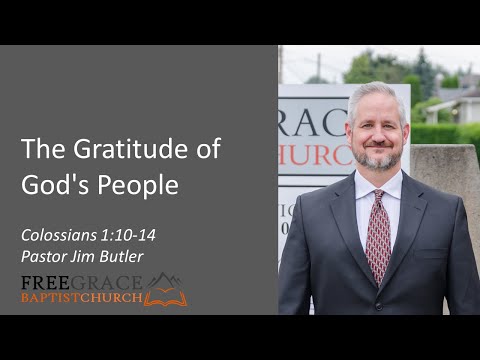
The Gratitude of God's People
Colossians 1:10–14 presents Paul's apostolic prayer as a template for Christian growth, identifying four marks of a walk worthy of the Lord: fruitfulness in good works, increase in the knowledge of God, divine strengthening for patience and longsuffering, and giving thanks to the Father. The sermon argues that justification by faith alone issues necessarily in sanctification, and that gratitude is not an optional emotional response but the fitting conclusion of a life shaped by the gospel. Believers are called to thankfulness on the basis of three specific gospel realities Paul enumerates: qualification for a heavenly inheritance, deliverance from the dominion of darkness, and transfer into the kingdom of the Son of God's love — all grounded in the redemption accomplished by Christ's blood.

The Judgment Seat of Christ
Matthew 7:21–23 confronts the reader with Christ's own words at the final judgment: 'I never knew you. Depart from me, you who practice lawlessness.' The sermon argues that this passage is not a call to more good works but a stark exposition of the doctrine of justification by faith alone — the false professors are condemned not for lack of works but for resting upon their works as the ground of their acceptance with God. Self-righteousness is identified as a species of lawlessness, as damning as any gross immorality. The believer's only refuge is the doing, dying, and rising of Christ, received by faith alone, and it is to Christ — not to personal performance — that all assurance must be anchored.
2LCF Chapter 16 - Of Good Works, Part 1
Good works in the Christian life must be carefully defined, grounded, and distinguished from every meritorious scheme if the glory of Christ is to be preserved. This study of 2nd London Baptist Confession chapter 16 works through the definition of good works (their substance, manner, and definitive character as fruits and evidences of a lively faith), the necessary foundation of good works in the enabling power of the Holy Spirit, and the non-meritorious nature of good works as plainly asserted in Romans 3 and Galatians 2. The central burden is that no work of the creature — however sincere, however commanded — can merit pardon of sin or eternal life before God, because the only works that avail with divine justice are the active and passive obedience of Christ alone imputed to the believer by faith.

The Rejection of Heretics
Titus 3:9–15 closes Paul's letter to Titus with a sharp command to avoid unprofitable disputes and to reject the divisive man — a command the broader pastoral epistles and the apostolic witness consistently reinforce. The sermon distinguishes heresy from damnable heresy, identifying denial of the Trinity, the hypostatic union, and justification by faith alone as the errors that condemn, while pressing the church not to confuse the struggling saint with the proud, self-serving false teacher. Church discipline for doctrinal error is treated with the same gravity as discipline for moral sin, and the concluding emphasis on good works is grounded in the confession that such works are the fruits and evidences of a true and lively faith, not the grounds of justification.

The Prologue and Commission
Acts 1:1–8 opens with a prologue establishing that the book of Acts is not merely the acts of the apostles but the continuing acts of the risen, enthroned Christ — carried out by the Spirit, through the Word, and by means of the apostles he himself commissioned. The sermon examines what Luke signals by the phrase 'Jesus began both to do and teach,' arguing that faithful Christianity holds doctrine and good works together as an inseparable knot, neither collapsing into social-gospel activism nor retreating into a purely intellectual faith. The apostolic commission is shown to be authoritative and externally given, grounding the church's mission in Christ's own mandate rather than human initiative.

The Nature of Saving Faith, 2
James 2:18–26 presents an apparent conflict with Paul's doctrine of justification by faith alone, a tension that has troubled interpreters from Martin Luther onward. This sermon resolves the tension exegetically by demonstrating that James and Paul use the word 'justification' in different senses: Paul addresses the sinner's standing before God by grace alone through faith alone, while James addresses the public demonstration and evidential confirmation of that faith before men. The controlling principle throughout is that saving faith is never alone — it is ever accompanied with all other saving graces and necessarily produces good works — while a faith that produces no works is the dead, demonic, counterfeit profession James condemns. The sermon calls hearers to examine whether their profession of faith in Christ is accompanied by the fruit that distinguishes genuine saving faith from empty confessionalism.
The Necessity of Pure and Undefiled Religion
James 1:27 presents a 'succinct threefold characterization of authentic religion': measured speech, care for the needy, and separation from the world. This sermon expounds the final two marks — visiting orphans and widows in their distress, and keeping oneself unspotted from the world — grounding both in the Old Testament witness to God as defender of the fatherless and in the New Testament pattern of the apostolic church. True religion is neither merely external social action nor merely internal piety, but both together, flowing as the necessary consequence of justifying faith rather than as a condition of it. Those who have believed the gospel are called to a Godward orientation in every good work, resisting the temptation to perform religion before men rather than before God and the Father.
The Olivet Discourse, Part 14
The Parable of the Talents (Matthew 25:14–30) is Christ's definition of watchfulness: not passive waiting for the Son of Man's return, but diligent, faithful stewardship of whatever the Master has entrusted. The sermon expounds the three servants in turn, establishing that talents are distributed according to God's sovereign wisdom rather than merit, that faithfulness rather than quantity of output determines commendation, and that the one-talent servant's condemnation flows directly from a defective doctrine of God. The central application is that justification by faith alone is never a license for inactivity — those truly justified will evidence it by serving the Master's interests in light of His coming.
The Lord's Concern for Widows, Part 1
The fifth commandment's requirement to honor parents grounds the Apostle Paul's instruction in 1 Timothy 5:3–8 that widows who are 'really widows' — left alone, without family, trusting in God — be financially supported first by their believing children and grandchildren, and only then by the church. The word 'honor' in verse 3 carries the same material force it bears in verse 17, meaning tangible provision of food, clothing, and shelter, not mere esteem. God's covenantal concern for the defenseless widow runs from Deuteronomy through the Gospels, establishing that care for widows is an expression of genuine piety, not an optional act of charity. The sermon presses the sobering warning of verse 8: to neglect one's widowed mother or grandmother is not merely a lapse in duty but a denial of the Christian faith itself, placing the professing believer below the standard even pagans maintain.
Colossians 1:9-14
Paul's intercessory prayer in Colossians 1:9–14 sets the pattern for how believers ought to pray for one another: not merely for temporal relief, but for a life that walks worthy of the Lord and fully pleases Him. The sermon works through four participles that Paul uses to describe that worthy walk — fruitfulness in good works, growth in the knowledge of God, strength for patient endurance, and thankfulness — showing these as a unified package rather than a menu of options. The closing verses of the passage (vv. 12–14) then ground that thankfulness in three cosmic realities: qualification for the inheritance of the saints, deliverance from the dominion of darkness, and transfer into the kingdom of Christ, all secured by redemption through His blood.
Modesty and Good Works
Paul's instructions to women in 1 Timothy 2:9–10 are grounded in one controlling concern: corporate worship is about God, not the worshipper. This sermon works through the passage under three headings — the general principles of adornment, the specific applications Paul names (braided hair, gold, pearls, costly clothing), and the reorientation Paul commands toward good works. A biblical theology of jewelry demonstrates that Scripture nowhere condemns adornment as such; the prohibition targets ostentatiousness — the deliberate drawing of attention to oneself, whether through sexuality or the display of wealth — that distracts men from worship and provokes covetousness in sisters. The sermon closes by calling the Christian woman to pursue modesty, self-control, and good works as the true adornment of a gospel profession.
Questions to Live By
Matthew 22:34–40 records a lawyer's question to Jesus — which commandment is the greatest? — and Jesus answers by binding together love for God and love for neighbour as the sum of all the law and the prophets. The sermon traces the theme of questioning throughout the Gospels to show that Christ himself answers every fundamental question about who he is and what he requires. From that foundation, two implicit questions are drawn from the text and pressed upon hearers: who are you living for (vertical love toward God), and how are you living (horizontal love toward neighbour)? The conclusion calls those outside Christ to submit to him and those within to pursue him with wholehearted passion.
The Church at Thyatira
Revelation 2:18–29 records the longest of the seven letters to the churches of Asia Minor, addressed to the smallest city — Thyatira. Christ presents himself to this church as the Son of God with eyes like flame and feet like burnished bronze: omniscient judge and certain executioner of his threats. The church is commended for real growth in works, love, service, faith, and patient endurance, yet condemned for tolerating a false prophetess called Jezebel who seduced believers into sexual immorality and idol-food — the precise sins forbidden by the Jerusalem Council. The letter closes with a call to hold fast until Christ comes and a promise that overcomers will share in his royal rule over the nations, receiving Christ himself as the Morning Star.