
Theological term
Federal Vision
34 sermons · All terms
Ask FGBC #63: What is Baxterianism?

Baxterianism, drawn from the teaching of 17th-century minister Richard Baxter, replaces the Reformed doctrine of justification by faith alone with a scheme in which God justifies the believer on the ground of evangelical obedience to a relaxed 'law of the gospel.' This Q&A exposition identifies Baxterianism as a conflation of justification and sanctification, a departure from the imputation of Christ's active and passive obedience, and an implicit relaxation of the moral law — errors addressed directly by 1689 LBCF chapters 11, 13, and 19. The discussion grounds its critique in Galatians 2:16 and the consistent witness of Paul that sinners are justified by faith alone, not by any human obedience, through the sole and finished work of Christ.

Ask FGBC #62: What is Federal Vision?
Federal Vision theology, originating largely within Presbyterian and broader Reformed circles, conflates the covenant of works with the covenant of grace into a mono-covenantalism that mingles works and grace. The result is a doctrine of justification dependent on grace-assisted covenantal faithfulness rather than the imputed righteousness of Christ alone. This Q&A response argues that Federal Vision constitutes not a subtle revision but an outright rejection of the historic doctrine of justification by faith alone, grounded in both Christ's active obedience imputed to the believer and his passive obedience bearing the wrath of God in the sinner's stead.

What Is Faith? When Should I Be Baptized? & more| Ask FGBC Batch 6
This Q&A episode from a confessional Reformed Baptist church addresses twelve questions spanning baptism, faith, church membership, Scripture interpretation, seminary training, and the heresies of Federal Vision and Baxterianism. Particular attention is given to the definition of saving faith — distinguishing the objective content of the faith from the act of believing, warning against loading faith with feelings, faithfulness, or love as its ground, and insisting that faith is the empty instrument through which God-given grace lays hold of Christ alone. The episode closes with treatments of conviction of sin, catechetical instruction of children, and the importance of an educated ministry.
Intro/Teaser - CTF 2026 - Understanding God's Decree
This introductory segment promotes the 2026 Confessing the Faith conference hosted by Free Grace Baptist Church in Chilliwack, BC, which will address 1689 London Baptist Confession Chapter 3 on the decree of God. The conference follows a sequential exposition of the confession, having previously covered the doctrine of Scripture (Chapter 1) and the doctrine of God and the Holy Trinity (Chapter 2). Featured speakers include Dr. Jim Renahan and Dr. Richard Barcelos of the International Reformed Baptist Seminary, alongside Pastor David Charles, who will offer a pastoral reflection on how the doctrine of divine decree is to be taught, embraced, and preached. The segment frames the doctrine of God's decree as foundational to Christian stability, peace, and worship, contending that what believers face in this world is governed by the sovereign God who has ordained whatsoever comes to pass for His glory and the good of His people.

2LCF Chapter 13 - Of Sanctification

Sanctification is a work of God's free grace — not of human effort — wrought in the elect by the Word and Spirit through the virtue of Christ's death and resurrection. The 1689 London Baptist Confession, Chapter 13, sets out the nature and cause of sanctification: its undeserving recipients (the effectually called and regenerated), the initial definitive act of sanctifying grace at conversion, the progressive ongoing work of the Spirit, and the instruments God employs (Word and Spirit). The confession guards this doctrine on two fronts simultaneously: against moral-improvement schemes that reduce sanctification to human effort, and against sinless perfectionism that denies remaining corruption in the believer.

The Conversion of Paul, Part 4
Philippians 3:10–11 presents sanctification and glorification as necessary and inseparable consequences of justification by faith alone (v.9). The knowledge of Christ described in verse 10 is experiential, practical, theologically correct, and constitutes the very essence of eternal life — but it includes not only the power of Christ's resurrection (newness of life, union with Christ, definitive breach with sin) but also the fellowship of His sufferings and conformity to His death, which are not redemptive but inevitable for all who side with a crucified Savior in a hostile world. Verse 11 then sets forth glorification — the resurrection of the righteous — as the confident hope that sustains perseverance through the difficulties of sanctification. The sermon draws on 1689 LBCF 11.2 and Westminster Larger Catechism 77 to show that faith which justifies is alone as an instrument, yet never alone in the person justified, being ever accompanied by all other saving graces.

The Warning Against Judaizers
Philippians 3:1–3 contains the only sustained polemical section in the epistle, and the apostle Paul deploys it as a warning against Judaizers — those who insisted that faith in Christ must be supplemented by Mosaic ceremonies such as circumcision for acceptance with God. Working through Paul's strategy in verse 1, his three-fold warning in verse 2, and his corrective in verse 3, the sermon demonstrates that the Judaizing error — whether in its first-century form, in Roman Catholicism, or in modern movements such as the New Perspective on Paul and Federal Vision — nullifies the grace of God by refusing to let Christ be a whole Savior. The church's only boast, identity, and worship are grounded in Christ alone, received through faith alone, apart from any confidence in the flesh.

The Vine, the Vinedresser, and the Branches
John 15:1–8 presents Christ as the true vine, his Father as the vinedresser, and his people as the branches — a passage that answers the question of who constitutes the true Israel of God. The sermon argues from Jeremiah 31 and the New Covenant's own terms that the New Covenant knows no externally connected members, and that the unfruitful branches of verse 2 refer to apostate Old Covenant Israel and to those who counterfeit saving faith, not to baptized infants as some paedo-baptist readings propose. The pruning of living branches is shown to be the Father's gracious work of conforming his people to the image of his Son through affliction and discipline. The sermon closes with a double application: unbelievers are called to look to Christ in faith, and believers are urged to receive God's chastening as the evidence of his love and the means of their growth in grace.

The Blessing of Gospel Rest
Matthew 11:25–30 grounds the gospel invitation — 'Come to me, all you who labor and are heavy laden' — in the sovereign will of the Father and the mediatorial office of the Son, so that the call to rest is inseparable from the doctrines of election and definite atonement. Jesus thanks the Father for hiding these things from the self-wise and revealing them to babes, declaring that all sovereign authority over salvation belongs to Him as the God-man and mediator. The 'rest' He offers is not relief from physical toil but deliverance from the crushing burden of sin and the impossible demands of pharisaical religion, received through faith alone. Those who come to Christ in faith are also exhorted to take His yoke — the life of sanctification — which is not oppressive bondage but the glad obedience of those justified freely by grace.
The Gratitude of God's People
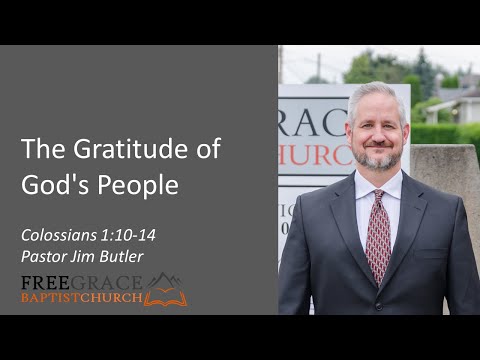
Colossians 1:10–14 presents Paul's apostolic prayer as a template for Christian growth, identifying four marks of a walk worthy of the Lord: fruitfulness in good works, increase in the knowledge of God, divine strengthening for patience and longsuffering, and giving thanks to the Father. The sermon argues that justification by faith alone issues necessarily in sanctification, and that gratitude is not an optional emotional response but the fitting conclusion of a life shaped by the gospel. Believers are called to thankfulness on the basis of three specific gospel realities Paul enumerates: qualification for a heavenly inheritance, deliverance from the dominion of darkness, and transfer into the kingdom of the Son of God's love — all grounded in the redemption accomplished by Christ's blood.

The Glorious Exchange
Zechariah 3 presents a courtroom scene in which the high priest Joshua stands before the angel of the Lord clothed in filth while Satan waits to bring his accusation — and God silences the devil not by appealing to Israel's performance but by sovereignly removing the filthy garments and clothing Joshua in rich robes. This fourth night vision of Zechariah illustrates what Luther called the glorious exchange: the sinner's guilt imputed to Christ and Christ's righteousness imputed to the believer, received by faith alone. The sermon traces this double imputation through Romans 5, 1 Corinthians 1, 2 Corinthians 5, Galatians 2, and Philippians 3, and refutes the New Perspective on Paul's rejection of forensic imputation. The exhortation is plain: when the adversary accuses, the Christian's only answer is not performance but the gospel of sovereign grace in Christ the Branch.
2LCF Chapter 13 - Of Sanctification
The 1689 London Baptist Confession of Faith, Chapter 13, sets forth sanctification as a real and personal moral transformation wrought by the Holy Spirit through the Word, inseparably joined to justification yet categorically distinct from it. The confession distinguishes the dominion of sin — broken decisively at regeneration — from the remnants of corruption that remain in every part of the believer throughout this life, producing an irreconcilable war between flesh and Spirit. Against both perfectionism and antinomianism, the chapter insists that sanctification is neither a checklist of religious performance nor a license for presumption, but a progressive, Spirit-empowered conformity to Christ that never constitutes the ground of acceptance before God. Hearers are urged to reject the conflation of justification and sanctification — whether in Roman Catholic merit theology, the New Perspective on Paul, or Federal Vision — and to rest acceptance with God solely on the imputed righteousness of Christ.

2LCF Chapter 7 - Of God's Covenant, Part 2
1689 London Baptist Confession of Faith, Chapter 7, paragraph 3 sets out three theological covenants — the covenant of grace, the covenant of redemption (pactum salutis), and the covenant of works — as the structural architecture of all Scripture. This sermon expounds each in turn, demonstrating from texts in Genesis, Isaiah, Hosea, Galatians, and Romans that the covenant of grace is founded on an eternal transaction between the Father and the Son, and that it is God's provision for sinners rendered incapable of acceptance with God since Adam's fall. The covenant of works is shown to be indispensable to a right understanding of justification: without it, the imputed righteousness of Christ collapses into either moralism or antinomianism, and the distinction between forgiveness and imputation is lost. Covenant theology is pressed not as academic machinery but as the very ground of the believer's comfort, assurance, and stability before God.
The Second Missionary Journey, Part 3
Acts 16:16–34 traces two episodes in Philippi: the exorcism of a slave girl's python spirit and the midnight conversion of the Philippian jailer. The passage confronts the reader with the hostility that faithful gospel ministry provokes — illegal imprisonment, beating without due process, and the solidarity of civil and commercial interests against the missionaries — while demonstrating that neither chains nor stocks can suppress the prayer and praise of those conquered by grace. The climax turns on the jailer's question, 'What must I do to be saved?', and the apostolic answer cuts through every form of salvation-by-works or salvation-by-experience: believe on the Lord Jesus Christ, and you will be saved. The sermon presses hearers to distinguish justification from sanctification, to receive the gospel offer without complicating it, and to rejoice as those delivered from sin, damnation, and the righteous wrath of God.

The Council at Jerusalem, Part 4
Acts 15:22–35 records the Jerusalem Council's formal response to the Judaizing heresy: the drafting of a letter, the commissioning of Judas Barsabbas and Silas, and the delivery of that letter to the churches of Antioch, Syria, and Cilicia. The passage is expounded to show that the council's decree condemning the addition of circumcision and Mosaic ceremony to faith in Christ constitutes a decisive affirmation of justification by faith alone — not by infusing righteousness, but by pardoning sin and imputing Christ's active and passive obedience. The sermon draws out the unity achieved through doctrinal deliberation, the guidance of the Holy Spirit through ordinary means, and the courage of those who risk their lives for the name of Christ, closing with a call to look to Christ alone for salvation.

The Council at Jerusalem, Part 1
Acts 15:1–5 introduces the Jerusalem Council by presenting the Judaizing heresy in its starkest form: certain men from Judea taught that circumcision must be added to faith in Christ for salvation, striking simultaneously at the law's proper use and at the sufficiency of Christ's finished work. The passage is set in its chronological context, distinguishing the events of Galatians 2 from the council itself, and showing that the problem was not merely one of Jewish-Gentile social relations but a soteriological crisis with eternal consequences. Paul and Barnabas respond with uncompromising confrontation, the church at Antioch sends delegates to Jerusalem, and the passage closes with the same Judaizing demand surfacing within the Jerusalem church — demonstrating the universality and perpetuity of the tendency to add human merit to sovereign grace. The exhortation is to resist every form of works-righteousness and to preach the law and gospel in their proper distinction, so that sinners are directed to Christ alone.
The Conversion of Cornelius, Part 4
Acts 10:44–11:18 records the outpouring of the Holy Spirit upon Cornelius and his Gentile household and the controversy that erupted among Jewish believers in Jerusalem when Peter reported what had happened. The sermon examines the divine initiative behind Gentile inclusion in the covenant of grace, the cessationist significance of the tongue-speaking at this 'Gentile Pentecost,' the apostolic command of water baptism following credible conversion, and the collapse of Jewish objections before Peter's ordered defense. The passage's closing doxology — 'God has also granted to the Gentiles repentance to life' — presses home that faith, repentance, and the Spirit himself are gifts of sovereign grace, received through the preaching of Christ crucified and risen, apart from any work of the law.

The Inclusion of Wretches in God's Covenant
Ephesians 2:1–10 presents the full arc of redemption — from the total deadness of sinners to their gracious vivification in Christ — and this exposition traces that arc through the origin, objects, and execution of salvation. The sermon grounds the covenant of grace in the prior covenant of redemption (Ephesians 1:3–14), showing that the Father's election, the Son's redemption, and the Spirit's sealing together exclude every contribution of the sinner. Salvation is by grace alone through faith alone, with faith itself a gift conveyed by God to the spiritually dead — not a human instrument brought to the table that God then rewards. The exposition closes by distinguishing justification from sanctification and warning against both Roman Catholic and Federal Vision distortions of grace, anchoring the believer's final acceptance before God solely in the active and passive obedience of Christ.
The Prohibition Against Partiality
James 2:1–4 issues a direct prohibition against partiality — the sin of showing favoritism based on economic status, ethnicity, or social rank within the gathered assembly of Christ's body. The sermon works through the command of verse 1 and its illustrative example in verses 2–4, while devoting substantial attention to demonstrating that James's soteriology is fully consistent with Paul's: salvation is by sovereign grace alone, through faith alone, in Christ alone, with works serving as the necessary evidence of genuine saving faith rather than its ground. The persistent tendency to judge by externals and to divide the body of Christ into cliques and factions is exposed as a form of sinful judgmentalism that usurps God's own prerogative as judge.

The Reformation of the Church
What does it mean for the church to be 'the pillar and ground of the truth'? Expounding 1 Timothy 3:14–16, this sermon examines the identity and confession of the church through three descriptions Paul gives in verse 15 — the house of God, the church of the living God, and the pillar and ground of the truth — before applying the doctrinal legacy of the sixteenth-century Reformation to the contemporary church. The great Christological confession of verse 16 is shown to be the theological center around which all church conduct, worship, and proclamation must orbit. The sermon calls the church to guard sola scriptura, justification by faith alone, the regulative principle of worship, and a proper Christology against the perpetual drift toward pragmatism, experientialism, and Romanizing errors.

The Pharisee and the Publican
Luke 18:9–14 presents two men at prayer whose contrasting postures before God expose the heart of the doctrine of justification. The Pharisee's self-congratulatory prayer — cataloguing what he is not and what he does — illustrates the fatal error of self-righteousness: banking one's standing with God upon personal merit, which inevitably produces contempt for others. The tax collector's wordless self-renunciation — 'God be propitious to me, the sinner' — is the only posture that receives the verdict 'justified,' because justification is an act of God's free grace wherein the righteousness of Christ alone, received by faith, is the ground of the sinner's acceptance. The parable calls every hearer to kill pride, renounce all self-congratulatory religion, and cast himself entirely upon the mercy of God in Christ.

The Astonishment of Paul
Paul's opening salvo in Galatians 1:6–9 is a study in holy alarm: the apostle marvels not with wonder but with grief that the Galatian churches are so quickly defecting from the gospel of grace to a Judaizing corruption that mingles law-keeping with faith. The Judaizing heresy — like Roman Catholicism, the New Perspective on Paul, and the Federal Vision after it — does not abolish Christ but supplements him, which Paul declares is no gospel at all, because justification is either entirely by grace alone through faith alone in Christ alone, or it is not justification at all. The sermon traces three movements in the passage: Paul's astonishment at the defection, the nature of the false gospel as something that is 'not another,' and the double anathema pronounced on all who pervert the gospel regardless of their authority. The application calls hearers to a 'blessed intolerance' toward gospel corruption, to precision in doctrine, and to the personal embrace of Christ's doing and dying as the sole ground of acceptance with God.
2LCF Chapter 13 - Of Sanctification
Sanctification belongs to the unbreakable chain of redemption: all whom God effectually calls and regenerates will be sanctified and glorified. This study of 1689 LBCF Chapter 13 traces both a divine and a human chronology of sanctification, distinguishing definitive sanctification — the once-for-all decisive break with sin's dominion accomplished in Christ's crosswork — from progressive sanctification, the ongoing renewal of the whole man by the indwelling Spirit through the Word, prayer, and the sacraments. The sermon insists that conflating sanctification with justification corrupts the gospel no less than denying sanctification's necessity, and calls believers to pursue holiness through joyful, evangelical obedience to the law of Christ.
2LCF Chapter 11 - Of Justification, Part 2
The forensic doctrine of justification — God's one-time legal declaration that the sinner is righteous on the sole ground of Christ's imputed righteousness — faces persistent assault in every era. This session surveys three modern deviations: Arminian evangelicalism (which collapses faith into a meritorious work or relocates righteousness within the believer), the New Perspective on Paul (which reframes Paul's argument as a corrective for ethnic exclusivity rather than a remedy for the condemnation of sin), and the Federal Vision (which renders righteousness relational, conflates Christ's faithfulness with the believer's, and anticipates a future eschatological justification grounded in covenantal obedience). Against all three, Scripture and the confession insist that justification is a completed legal verdict, not a process, and that its ground is exclusively the active and passive obedience of Christ credited to the elect.
2LCF Chapter 7 - Of God's Covenant, Part 3
Covenant theology is not abstract speculation but the architectural blueprint of all Scripture, and a faulty grasp of it distorts both law and gospel. This session works through 1689 London Baptist Confession chapter 7, paragraph 3, tracing the covenant of grace from its first announcement in Genesis 3:15 through the Noahic, Abrahamic, Mosaic, and Davidic covenants as progressive, concentric revelations of the same redemptive promise, culminating in the new covenant ratified by Christ's blood. The eternal covenant of redemption between the Father and the Son grounds the covenant of grace, so that for sinners, grace is free and unconditional, while for Christ, it was a covenant of works demanding exact, entire, and personal obedience. The session closes with the axiom that 'the covenant of grace is the covenant of works kept for us,' and applies this structure to the necessity of sola fide against Federal Vision, Baxterian, and Roman Catholic distortions.
Galatians 1:6-10
Galatians 1:6–10 confronts the Galatian churches' rapid defection from the gospel of grace to a Judaizing heresy that added circumcision and law-keeping to faith as a condition of justification. The sermon argues that any addition of human merit to the work of Christ — however small — destroys the gospel entirely, because salvation is either by grace alone through faith alone in Christ alone, or it is by the law, and the two cannot be mixed. The Apostle Paul's double pronouncement of anathema on false gospel teachers is examined in its Old Testament background (the herem principle) and applied as a call to doctrinal precision, vigilance against indifference, and refusal to supplement the finished work of Christ.
The God Who Justifies the Ungodly
Romans 4:5 declares that God justifies the ungodly — a statement that stands in apparent tension with Proverbs 17:15, which calls the one who justifies the wicked an abomination. This communion meditation resolves that tension by tracing the doctrine of imputation through three movements: Adam's sin imputed to his posterity, the sin of God's elect imputed to Christ, and Christ's righteousness imputed to believers. Far from promoting moral laxity, this forensic reality — that sinners are declared righteous on the sole ground of another's obedience and atoning death — is shown to be the very foundation of genuine sanctification and the most powerful incentive to holy living.
The Example of Abraham
Galatians 3:6–9 presents Abraham as Paul's decisive scriptural witness against the Judaizing demand for circumcision alongside faith. Drawing from Genesis 15:6, Paul demonstrates that Abraham's justification was by faith alone — faith as the instrument, not the ground, by which righteousness was reckoned to his account — and that this same faith-righteousness is the only basis on which anyone, Jew or Gentile, stands as a son of Abraham. The sermon works through four theological implications: imputed righteousness comes through faith alone, sonship to Abraham belongs only to the believing, Scripture itself preached the gospel to Abraham in advance, and the blessing of God falls exclusively on those who share Abraham's faith. Hearers are called to rest in the peace, gratitude, and humility that flow from justification by grace alone through faith alone in Christ alone, and to guard against every system — ancient or modern — that supplements faith with human merit.
An Appeal to the Galatians' Experience
Galatians 3:1–5 records Paul's appeal to the Galatians' own conversion experience as evidence that justification is by faith alone, apart from works of the law. Paul's six rhetorical questions expose the folly of supplementing or completing the finished work of Christ with law-keeping, circumcision, or any covenantal faithfulness — a bewitchment the Judaizers were actively promoting. The sermon works through five observations on the passage: the Galatians were being led astray doctrinally, they had received the Gospel through apostolic preaching, they received the Spirit by the hearing of faith, they must resist the heresy of seeking perfection by works, and they must hold fast to the exclusivity of faith alone. The application is direct: justification is a complete, once-for-all legal declaration, never supplemented by works, and to depart from it — whether toward Rome, the new perspective on Paul, or the federal vision — is to fall under a wicked spell.
The Defense of Justification by Faith Alone
Galatians 2:17–21 presents one of Paul's sharpest defenses of justification by faith alone, and this exposition works through three movements in the text: the proper and improper uses of the law (vv. 17–19), the personal experience of crucifixion with Christ as the ground of the justified life (v. 20), and the exclusivity of grace that renders any supplementation of the gospel a nullification of Christ's death (v. 21). The sermon exposes the logic of the objection that justification by faith makes Christ a 'minister of sin,' refutes it from the text, and shows that legalism — not antinomianism — is the true transgression of God's law. The central application is that any 'Christ-plus' system, whether formal theology or informal churchly shibboleths, empties Calvary of its meaning and must be resisted.