
Theological term
Federal Headship
929 sermons · All terms

The Third Missionary Journey, Part 3

Acts 19:21–41 records Paul's final days in Ephesus, culminating in a riot instigated by the silversmith Demetrius, whose financial interests were threatened by the gospel's advance against idolatry. The passage is examined under four headings: Paul's strategic plans for further ministry, the anger of the silversmiths rooted in profit dressed as piety and patriotism, the confused uproar in the theater, and the intervention of the city clerk whose cool legal reasoning protected the church. The exposition draws out the apologetic purpose of Luke's account — demonstrating that Roman civil authority found no legal fault with Christianity — and closes with an urgent call to forsake every idol and trust the righteousness of Christ alone.

The Messiah, The Baptist, And The Kingdom
Matthew 11:2–15 presents three interlocking questions: who is Jesus the Messiah, who is John the Baptist, and what is the nature of the kingdom of heaven? The sermon works through John's imprisoned inquiry — not as rank unbelief but as a struggle with the shape of the messianic agenda — and Christ's answer, which grounds assurance in fulfilled Old Testament prophecy rather than in political deliverance. John is then assessed by Christ himself as more than a prophet, the very subject of Malachi's covenant-messenger prophecy, a man of unflinching courage who stands as a model for preachers and all believers. The enigmatic kingdom-violence saying of verse 12 is read as a positive-negative pairing: the kingdom forcefully advances through proclamation and regeneration, but violent men persist in opposing and plundering it until Christ's enemies are made his footstool.
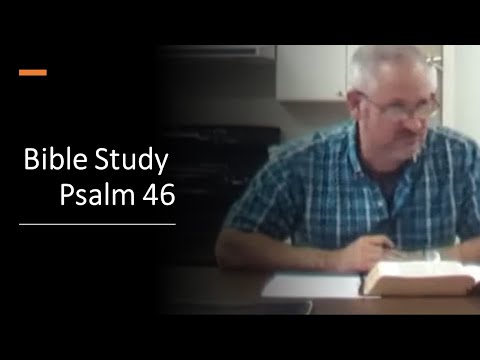
Psalm 46
Psalm 46 presents God as the impenetrable refuge and omnipotent strength of His people in the midst of natural catastrophe, national upheaval, and personal affliction. The study works through four heads: the assurance of God's presence (vv. 1, 7, 11), the demonstration of God's power (vv. 2–6), the invitation to behold God's works (vv. 8–9), and the command to rest in God's sovereignty (v. 10). Covenant theology is not merely a theoretical construct but the very ground of the believer's comfort — the God of Jacob is a covenant-keeping God whose purposes cannot be frustrated by any earthly power. The congregation is called to the practical discipline of theology proper: to know God deeply so that the soul is stabilized, not paralyzed, in times of trouble.

Man's Responsibility and Rejection of Christ
Human responsibility before God stands alongside divine sovereignty — neither cancels the other. Drawing on Ezekiel 33, Psalm 2, Isaiah 45 and 55, and the gospel invitations of Christ, this address confronts the perennial tendency of sinners to evade accountability by deflecting blame onto circumstances, other people, or divine predestination itself. The hearer is called to abandon every such evasion, acknowledge personal guilt before the moral Governor of the universe, and flee to King Jesus Christ for mercy, grace, and peace with God.

Introduction to the Book of Exodus
The book of Exodus is not a standalone document but the second movement of the Pentateuch, continuing the story of the covenant people from Genesis through to their deliverance from Egypt, the giving of the law at Sinai, and the construction of the tabernacle. This introductory study surveys the book's structure through three themes — deliverance, demand, and dwelling — and traces how each anticipates Christ: Moses as covenant mediator prefiguring the greater Mediator, the Passover lamb pointing to the sacrifice of Christ, and the tabernacle foreshadowing the incarnation. The threefold division of God's law (moral, judicial, ceremonial) is explained with reference to the 1689 London Baptist Confession of Faith, with particular attention to why the moral law remains perpetually binding while the judicial and ceremonial laws have expired. The study closes by applying the Immanuel principle — that God redeems his people in order to commune with them — to the corporate worship of the New Covenant church.

The Christian's Duty toward Non-Christians
Titus 3:1–3 sets out the Christian's duty toward both civil government and all people outside the church. The sermon traces the divine origin of civil government from Genesis 9 through Romans 13 and 1 Peter 2, arguing from Francis Turretin's two-kingdom framework that Christ rules both the civil and spiritual spheres, and that the civil state therefore has no authority to command the church as church. Verse 3's catalogue of pre-conversion vices — foolishness, disobedience, malice, hatred — is read as a theological reason for patient, peaceable, and humble conduct toward non-Christians: believers were once exactly what they now struggle to bear in others, and those others may yet become objects of the same sovereign grace.

The Manifestation of God's Grace
Titus 2:11–15 presents God's grace not merely as the ground of salvation but as the very teacher of holy living. This exposition traces four aspects of grace in the passage: its appearance in the incarnation and atoning work of Christ, its instruction toward denial of ungodliness and worldly lusts and pursuit of sober, righteous, and godly life, its demonstration in the deity of the returning Christ and the definite redemption he accomplished, and its proclamation through authoritative gospel ministry. The controlling hermeneutical key is the grammatical and theological priority of the indicative over the imperative: believers obey not in order to be saved but because they have been saved, and inverting that order collapses the gospel into moralism.

Genesis 48:1-22
Genesis 48 records Jacob's adoption of Joseph's two sons, Ephraim and Manasseh, as tribal heads within Israel, and his deliberate bestowal of the greater blessing on the younger Ephraim — a pattern running throughout Genesis that the covenant blessings are dispensed not by birth order but by sovereign divine election. The chapter's vocabulary of "firstborn" is examined in light of Colossians 1:15, demonstrating that the term denotes preeminence rather than creaturely origin, directly refuting the Arian Christology of Jehovah's Witnesses. Jacob's deathbed testimony — praising God who fed him all his life and whose Angel redeemed him from all evil — is held up as a model for how the people of God should rehearse divine faithfulness at the close of life.

The Instruction of the Church, Part 1
Titus 2:1–5 instructs specific people groups within the church to live in a manner consistent with sound doctrine — not as a means of salvation, but as the fruit of it. This exposition works through the virtues required of older men (sobriety, reverence, temperance, soundness in faith, love, and patience), the conduct and teaching role of older women, and the domestic calling of younger women. The complementarian ordering of church and home is grounded not in culture but in the creation and fall account of Genesis 1–3, with particular attention to 1 Timothy 2 as a cross-reference. The governing purpose of all these exhortations is stated in verse 10: that the conduct of God's people would adorn, rather than blaspheme, the doctrine of God our Savior.

The Second Missionary Journey, Part 2
Acts 16:6–15 traces the divine hand behind the second missionary journey's westward turn into Macedonia and the conversion of Lydia in Philippi. The Spirit's successive prohibitions of ministry in Asia and Bithynia are not judgments on those regions but demonstrations that God actively directs the missionary enterprise according to his sovereign purpose. The conversion of Lydia — a woman whose heart was dead in trespasses until God opened it to receive Paul's preaching — illustrates that the efficient cause of every conversion is divine grace, not human ingenuity, while the instrumentality of gospel proclamation and the responsibility of hearers to believe remain fully intact. The sermon calls the church to define missionary work precisely as the Spirit-sent, church-commissioned preaching of Christ crucified, rejecting both Arminian confidence in the sinner's free will and hyper-Calvinist reluctance to call sinners to faith.
The Resurrection and Justification
Romans 4:25 declares that Christ 'was delivered up because of our offenses and was raised because of our justification' — a verse Charles Hodge called a comprehensive statement of the gospel and Matthew Poole called an abridgment of the whole. The sermon works through two inseparable redemptive realities: the substitutionary, particular atonement accomplished in Christ's death, and the five-fold testimony of the resurrection to the validity of that work. The central application is that a robust grasp of justification by faith alone — the imputation of Christ's righteousness received through faith — is the irreplaceable foundation for Christian stability, comfort, and peace with God.

The Empty Tomb and the Risen Lord
The resurrection of Jesus Christ from the dead is not a cunningly devised fable but a historically attested and theologically necessary event that vindicates Christ's person and work. Expounding Matthew 28:1–10, this sermon examines the discovery of the empty tomb — the descent of the angel, the commission to the women, and the flight of the guards — and then the appearance of the risen Lord to the women, who held him by the feet and worshipped him. The hypostatic union underlies that act of worship: they touch his human feet while adoring the second person of the Trinity. Because Christ is risen, believers need not fear, have an advocate with the Father when they sin, and possess a hope that is grounded in historical reality and not mere sentiment.

The Council at Jerusalem, Part 2
The Jerusalem Council of Acts 15 confronts the Judaizing error that Gentile salvation requires circumcision and law-keeping in addition to faith in Christ. Drawing on Peter's testimony in Acts 15:6–12 and its grounding in the Cornelius episode of Acts 10, the sermon argues that God himself made no distinction between Jew and Gentile, purifying hearts by faith alone — making any human addition to the gospel a direct testing of God. Faith is shown to be the empty hand that receives Christ's righteousness, not a virtue that earns it, and the church is called to guard the law-free gospel against every cultural or ecclesiastical supplement that would corrupt it.

The Qualifications for Elders, Part 2
What does Scripture require of a man before a church installs him as an elder? Expounding 1 Timothy 3:1–7 alongside Titus 1:5–9, this sermon completes a two-part treatment of the biblical qualifications for elders, focusing on the elder's maturity in the faith, his good testimony before outsiders, and his indispensable ability to teach. The danger of rushing a novice into office is pressed from multiple angles — pride, the church's welfare, and the man's own protection — before the sermon closes with practical exhortations to the congregation on praying for, identifying, examining, and where necessary excluding candidates for eldership.
The Qualifications for Elders (Part 1)
What qualifies a man to serve as an elder in the church of Jesus Christ? Expounding 1 Timothy 3:1–7 as an excursus from a series through Acts, this sermon establishes that the New Testament uses 'elder,' 'overseer,' and 'pastor' as synonymous titles for one office, and then works through five of the six qualifications Paul sets out for that office: the man's desire, his personal holiness, and his domestic faithfulness. The sermon is equally concerned with what these qualifications are not — they are not a standard of sinless perfection, nor a popularity contest, nor a direct transfer of worldly competence — and applies the passage by urging the church to vet candidates by Scripture alone, not by affection or likability.
Genesis 44-45
Genesis 44–45 presents the arrest of Joseph's brothers, Judah's substitutionary intercession for Benjamin, and Joseph's dramatic self-disclosure — all framed by a fourfold emphasis on the providence of God. The separation between chapters 44 and 45 artificially interrupts what is one of the most theologically dense scenes in the entire Pentateuch: Judah, the man who once sold Joseph into slavery, now offers himself as a slave in Benjamin's place, functioning as a type of Christ. Joseph's forgiveness of his brothers flows directly from his theological grasp of divine sovereignty, demonstrating that a right understanding of providence is the engine of genuine forgiveness. The sermon closes with the typological significance of both Judah and Joseph as portraits of the Lord Jesus Christ embedded in the redemptive narrative of Scripture.

The Family of Christ

Mark 3:31–35 presents Christ distinguishing his earthly family from his spiritual family, using the arrival of his mother and brothers as a teaching moment about the nature of true belonging to God. The sermon works through two headings — Jesus's earthly family (vv. 31–32) and Jesus's spiritual family (vv. 33–35) — showing that physical descent and bloodlines carry no weight in determining who belongs to Christ. Membership in the family of God is defined by doing the will of God, which is unpacked as faith in Christ — repentance and belief in the gospel — not moral effort or ethnic identity. The hearer is pressed to consider whether they are an insider or an outsider, with the call to draw near to the elder brother through the means of grace.
The First Missionary Journey, Part 10
Acts 14:8–18 presents Paul and Barnabas in Lystra, where a miraculous healing of a congenitally lame man provokes the crowd to mistake the apostles for Zeus and Hermes. The sermon moves through three movements: the healing and its spiritual significance, the apostles' repudiation of pagan worship, and Paul's proclamation of the living God to a purely pagan audience. Particular attention is given to the doctrine of divine impassibility — the classical confession that God is without passions — as the necessary corollary of divine immutability, with pastoral argument that this doctrine secures rather than undermines the believer's confidence in God's unchanging love and justice. The sermon closes with an appeal to repent of all idolatry and trust in the Lord Jesus Christ as the only Savior for sinners.

The Incarnation of the Word
John 1:14 declares that the eternal Word — the second person of the Trinity, who was in the beginning with God and was God — became flesh and dwelt among men. This sermon expounds the incarnation under two heads: first, the identity and reality of the Word taking on true humanity (the hypostatic union of two complete natures in one person), and second, the glory of that Word as the only begotten of the Father, full of grace and truth. The incarnation is shown to be the indispensable ground of redemption — whatever is not assumed is not redeemed — and sinners are urged to flee to a mediator who is full, not miserly, in grace and truth.

The First Missionary Journey, Part 6
Paul's sermon in the synagogue at Pisidian Antioch reaches its practical climax in Acts 13:38–43, where he preaches forgiveness of sins and justification by faith alone — two distinct yet inseparable blessings secured by Christ's active and passive obedience. The law of Moses cannot justify; it can only expose the sinner's inability and drive him to Christ, in whom every believer is declared righteous by the imputation of Christ's righteousness received through faith alone. Paul's warning from Habakkuk 1:5 presses the point home: to despise this gospel is to invite a judgment more severe than the Babylonian captivity. The sermon closes by tracing the same doctrine of justification through the vision of Joshua the high priest in Zechariah 3, and exhorts believers to continue in the grace of God as the only ground of perseverance.
The First Missionary Journey, Part 4
Acts 13:26–37 records Paul's synagogue sermon in Pisidian Antioch, in which he explains the two pivotal events of Israel's Messiah: the crucifixion and the resurrection. The Jerusalem rulers condemned Jesus without cause, yet in doing so they fulfilled the very prophetic scriptures they heard read every Sabbath, demonstrating the sovereign providence of God working through the wickedness of men. Paul marshals Psalm 2:7 to establish the eternal generation of the Son and his fitness as mediator, then Psalm 16:10 to prove that David's body saw corruption while Christ's did not, and Isaiah 55 to ground the sure mercies of the Davidic covenant in the risen servant of Isaiah 53. The sermon drives toward justification by faith alone in Christ alone, urging hearers not to repeat Jerusalem's fatal error of rejecting the one through whom alone there is forgiveness of sins.
The Only Redeemer of God's Elect
Galatians 3:10–14 sets law and gospel in sharp contrast, demonstrating that justification before God is entirely excluded from the domain of law-keeping. Paul's threefold appeal to Deuteronomy 27, Habakkuk 2:4, and Leviticus 18:5 establishes that the law demands perfect, perpetual, and entire obedience — an impossibility for sinners in Adam. The only hope lies in Christ's substitutionary, curse-bearing work: he bore the imputed sin of his people, exhausted the wrath of God in their place, and secured for them both the blessing of Abraham and the gift of the Holy Spirit. The sermon calls hearers to abandon every form of faith-plus-works supplementation and to rest wholly in the particular redemption accomplished by Christ alone.

The First Missionary Journey, Part 2
Paul's sermon in the synagogue at Pisidian Antioch (Acts 13:13–41) opens with a sweeping sketch of Israel's redemptive history — election, deliverance from Egypt, wilderness forbearance, the land promise, the judges, the monarchy, and the Davidic covenant — all converging on one point: the law and the prophets inevitably lead to Jesus Christ. The sermon examines why Paul structures his argument this way, showing that a correct hermeneutic always produces a Christocentric reading of Scripture and that God's faithfulness in the lesser promises guarantees his faithfulness in the greater seed promise. Along the way, the exposition confronts the temptation to doubt God's sustaining care in hard seasons, insisting that God never abandons his people and that every believer can rest on his unwavering covenant faithfulness. The sermon closes with a direct appeal drawn from verse 38: forgiveness of sins — which the law of Moses could never provide — is freely available through this man, Jesus Christ.

The Third Commandment
The Third Commandment — 'You shall not take the name of the Lord your God in vain' (Deuteronomy 5:11) — grounds its prohibition and its positive demands in the theological weight of the divine name itself: God's name is the vehicle by which He reveals His nature, being, and attributes to His creatures, so every misuse is a direct offense against God. The sermon works through five concrete violations (blasphemy, false oaths, magic and sorcery, misapplication of providence, and misinterpretation of Scripture) before turning to the positive duties of reverent use, worshipful fear, and a sincere profession of faith matched by answerable conduct. Throughout, the law-gospel distinction is maintained: no sinner is accepted by God on the basis of keeping this commandment, but on the basis of Christ's perfect obedience rendered in the sinner's place; those united to Christ by grace through faith are then pointed back to the law as a rule of grateful living.

The First Missionary Journey, Part 1
Acts 12:25–13:3 marks the launch of the first missionary journey and the pivotal moment when the church at Antioch, directed by the Holy Spirit, formally separates Barnabas and Saul for organised gospel mission to the Gentiles. The sermon traces this appointment back to the divine plan announced in Acts 9:15–16, showing that Paul's calling, suffering, and relentless preaching were purposed by Christ from the moment of his conversion on the road to Damascus. A sustained application argues that the local church — not parachurch agencies, mission boards operating independently, or individual self-appointment — is the proper centre for identifying, qualifying, and sending missionaries. The sermon closes with an appeal grounded in covenant theology: God's promise to Abraham that all nations would be blessed through his seed is the very engine driving the missionary enterprise recorded in Acts.

The Second Commandment
The second commandment forbids both the manufacture of idols and the worship of the true God by means of visible representations — a distinction the first commandment does not address. Working through Deuteronomy 5:8–10, this sermon grounds the regulative principle of worship in the doctrine of God: because God is incorporeal, incomprehensible, and infinite, any attempt to represent Him in image or statue is a theological assault on His nature, not merely a liturgical irregularity. The sermon applies this principle to Roman Catholic image-veneration, depictions of the Lord Jesus Christ (including the 'Jesus film' and similar media), and the broader failure of evangelical worship to ask what God has actually commanded.

The Baptisms of Jesus Christ
What is the theological basis for believers' baptism? This sermon argues that Christians are baptized because of the two baptisms of Jesus Christ: his water baptism in Matthew 3, which inaugurated his life of active obedience by fulfilling all righteousness on behalf of his people, and his metaphorical baptism of suffering in Matthew 20, which points to his passive obedience in drinking the cup of divine wrath on the cross. Sinners possess no righteousness of their own sufficient to stand before a holy God; they are clothed entirely in Christ's alien righteousness, imputed to them through faith. The practical exhortation to those who have believed is to follow Christ in believer's baptism as an act of public obedience, not as a means of salvation but as its public confession.
The First Commandment, Part 2
The First Commandment — 'You shall have no other gods before me' (Deuteronomy 5:7) — carries not only a prohibition but a cluster of positive obligations that define the redeemed creature's relationship to the Creator. This sermon works through five such positive aspects: the love of God, the fear of God, obedience to God, trust in God, and the proper worship of God, showing how each flows necessarily from the sovereign grace by which God conquers the sinner. The sermon concludes with a call to reject idolatry in all its forms — including mental idolatry constructed by false doctrine — and to cultivate a growing, confessional knowledge of the triune God.

Free Grace Baptist Church - October 6, 2019 PM
What does it mean that the Father has 'bestowed' his love on sinners so that they should be called children of God? Expounding 1 John 3:1 in the context of a Lord's Supper service, this sermon examines the divine love under four headings: the call to consider it, the object in view, the blessed result of adoption, and the attendant conflict with the world. The love of God is grounded in his impassibility and immutability — he is 'most loving' not as an emotional fluctuation but as an unchanging perfection — and the doctrine of adoption is carefully distinguished from and harmonized with John's language of new birth, following B.B. Warfield's analysis. The sermon closes by directing communicants to fix their minds on Christ rather than on themselves as they receive the bread and cup.

Genesis 27
Genesis 27 presents the deception of Isaac by Rebekah and Jacob to secure the patriarchal blessing, and a careful reading reveals that every member of the family acts in an unprincipled manner — yet God's covenantal promise advances without interruption. The blessing conveyed upon Jacob is the Abrahamic covenant itself being passed to the son of promise, a line that runs through Israel and terminates in the Lord Jesus Christ as the seed of Genesis 3:15. Ambrose's allegory, endorsed by Calvin, illuminates the typological force of the episode: as Jacob entered the presence of his father clothed in borrowed garments carrying their distinctive odor, so believers enter the presence of the heavenly Father clothed in the imputed righteousness of Christ. The chapter is a sustained argument for the sovereignty of divine election and the grace of God, which operates not because of human virtue but in spite of its spectacular absence.