
Theological term
Federal Headship
929 sermons · All terms

The Healing of a Blind Man, Part 3

John 9:35–41 records the climax of the healing of the man born blind: not the restoration of his physical sight, but his salvation through faith in the Son of God. This sermon argues that providence and miracles do not save — only grace through faith in Christ does — and that Christ's coming pronounces both salvation on the spiritually blind who see their need and judgment on the self-righteous who claim to see but remain in their sin. The exposition closes with a direct appeal: the self-righteous require both the law, to expose the bankruptcy of their works-confidence, and the gospel, to offer the righteousness of Christ received by faith alone.
The Idolatry of Israel, Part III
Exodus 32:30–35 presents Moses interceding for Israel after the golden calf debacle, confessing their great sin and offering himself to be blotted out of God's book on their behalf. The sermon works through Moses's rebuke, his request, and God's response, giving particular attention to the theological question of whether God blots names from the Book of Life — resolving the tension by distinguishing the conditional Old Covenant (a covenant of works securing physical blessings) from the unconditional New Covenant, in which the elect are eternally secure in Christ. The Mosaic intercession is read typologically as pointing to Christ, who was, in effect, blotted out on behalf of his people. The sermon closes with application to the gravity of idolatry drawn from Romans 1 and a quote from John Stott.

2LCF Chapter 27 - Of the Communion of Saints

The 1689 London Baptist Confession chapter 27 grounds the communion of saints in the prior doctrine of union with Christ and union with one another in love, then draws out the obligations that follow for both local church life and the wider household of faith. The chapter carefully rules out any ontological or hypostatic union between Christ and his saints while affirming that believers genuinely share in his graces, sufferings, death, resurrection, and glory through the indwelling Spirit and the gift of faith. Three constituent elements of that communion are identified — complementary profiting through gifts and graces, spiritual encouragement in gathered worship, and physical provision for those in need — before a closing qualification defends personal property rights against any collectivist or communistic reading of the text.

The Gifts Given by the Ascended Christ, Part 1
Ephesians 4:7–11 presents Christ the ascended Lord as the giver of gifts to His church. This sermon expounds the provision of God's grace in verse 7, the Christological argument drawn from Psalm 68 in verses 8–10, and the specific gifted men named in verse 11 — apostles, prophets, evangelists, and pastor-teachers. The preacher argues that Paul's appeal to Psalm 68 is typological: as Yahweh conquered Israel's enemies, received tribute, and distributed it to his people, so Christ conquered sin and death, ascended to the right hand of the Father, and now distributes gifts to His church through the Spirit. The practical weight of the sermon falls on killing pride, praying for elders and deacons, and recognising that the teaching ministry — not celebrity — is the bond that produces the love and unity Paul commands in verses 2–3.

Livestream - The Basis for Love and Unity
Ephesians 4:4–6 presents seven 'ones' — one body, one Spirit, one hope, one Lord, one faith, one baptism, and one God and Father — as the objective, Spirit-wrought basis for the love and unity to which Paul exhorts believers in verses 1–3. The sermon argues that these seven unities are not aspirational ideals but present realities constituted by the Holy Spirit in the production of the church, and that believers are therefore called to steward, not generate, the unity already given. The practical weight falls on bearing with one another in love, contending for the faith once delivered to the saints, and recognising that the Triune God — not social trinitarianism — is the foundation of all communion and the basis for genuine ecumenism among confessional Christians.

The Healing of the Blind Man
John 9:1–12 presents the healing of a man born blind as a sign that Jesus is the light of the world — not merely a title (John 8:12) but a function he enacts in restoring both physical and spiritual sight. The sermon addresses the disciples' question about the cause of the man's blindness by distinguishing between suffering that is a direct consequence of particular sin and suffering that is ordained by God's sovereign providence to display his works. God's absolute sovereignty over all creatures and all their actions — including congenital affliction — is defended from Scripture and the 1689 LBCF chapter on providence, with Job, Paul, and the man born blind as converging witnesses that God's people walk by faith in Romans 8:28 when affliction comes. The sermon closes with an evangelistic appeal drawn from John's stated purpose: that readers believe Jesus is the Christ, the Son of God, and have everlasting life.

The Joy of Abraham in the Day of Christ
John 8:54–59 presents the most concentrated claim to divine identity in this chapter: Jesus asserts unity with the Father, declares that Abraham rejoiced to see His messianic day, and finally identifies Himself as the eternal 'I Am' of Exodus 3:14. The sermon traces Abraham's anticipatory faith through the protoevangelium of Genesis 3:15, the Abrahamic covenant promises, and their fulfilment in Christ alone, demonstrating that old covenant saints were justified by grace alone through faith alone in Christ alone. The response of the religious leaders — picking up stones for blasphemy — confirms what they rightly understood Jesus to be claiming: equality with the Father. The sermon closes with a direct call to faith, contrasting the animosity of unbelieving Jerusalem with the joy of Abraham, and urging hearers not to harden themselves against the one who promises that whoever keeps His word shall never see death.

The Sanctuary and Ark of the Testimony
Exodus 25:1–22 opens the third major division of Exodus — the dwelling of God among his redeemed people — which the sermon argues is the climax of the entire book. Working through the offerings for the tabernacle, the purpose of the sanctuary, and the construction and function of the ark, the exposition traces how God's intent to dwell with Israel typologically anticipates the new covenant reality secured by Christ, the great high priest and true mercy seat. The regulative principle of worship is grounded exegetically in God's precise prescriptions for the tabernacle and applied to New Covenant church practice. Hearers are called to count corporate worship a privilege and to approach God only in the manner he has commanded in Holy Scripture.
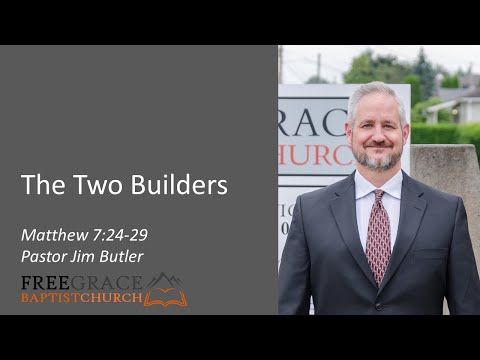
The Two Builders
Matthew 7:24–29 concludes the Sermon on the Mount with a parable of two builders whose contrasting foundations — rock and sand — expose the decisive difference between saving faith and mere hearing. The sermon argues that true faith, sovereignly granted and resting on Christ alone, produces a life of obedience to his word, while the mere hearer — however impressed by the teaching — builds on shifting ground and faces a great and final ruin. The devil, the world, and remaining indwelling corruption all beat against both houses, but only the house founded on Christ stands. Hearers are urged to close with Christ now, trusting not in works or false religion but in his righteousness alone.

Better Things in Christ
Hebrews 1:1–4 presents Jesus Christ as the apex of divine revelation, the eternal Son who bears the undiminished nature of the Father, and the perfect High Priest whose finished work secures salvation for all His people. The sermon moves through three considerations: the singular greatness of Christ's revelation over all prior prophetic speech, the infinite excellency of His person as the brightness of the Father's glory and the exact imprint of His nature, and the perfection of His redemptive regency demonstrated in His expiatory sacrifice and His session at the right hand of the Majesty on high. Against any drift toward lesser things — whether Old Covenant shadows, Roman Catholic purgatory, or the kenotic diminishment of Christ's deity — the congregation is called to hold fast their Christ, rejoice in the revelation God has given, and fear the consequences of neglecting so great a salvation.

The Champion of the Howling Wilderness
Matthew 4:1–11 presents the temptation of Christ not primarily as a model for personal resistance to sin, but as the decisive act of single combat in which the Lord Jesus Christ, as the second Adam and the true Israel, vicariously perfects obedience for his elect people. Where Adam fell in the garden amid every provision and where Israel failed in the wilderness under divine care, the Son of God enters a howling wilderness—hungry, alone, and unarmed—and vanquishes the devil point for point through resolute dependence on the word of God. The rich typological connections to Adam's expulsion, Israel's forty years of wandering, Moses' fast on Sinai, and David's unarmed single combat against Goliath converge on the one claim the passage presses: Christ alone is the covenantally faithful champion, and salvation belongs exclusively to those who trust in his doing, dying, and rising. Christians are therefore called to rejoice in their champion rather than to reduce this episode to a moral technique for fighting temptation.

Live Stream - January 08, 2023
Colossians 2:11–15 teaches that believers are spiritually circumcised and made alive in Christ, finding their complete identity in union with him rather than in law-keeping, philosophy, or any other system. The circumcision made without hands — a heart-circumcision accomplished by Christ's death and resurrection — strips away the old man and brings the new man to life through faith in God who raised Christ from the dead. Christ's cross work simultaneously cancels the record of debt owed to God, removes the dominion of sin, and publicly triumphs over principalities and powers. Because the already-not-yet tension of inaugurated eschatology means remaining sin persists, believers are called to live as those who have died, been buried, and been raised with Christ — clinging to their identity in him rather than despairing under the weight of ongoing struggle.

The Triumph of the Lamb
Revelation 12 presents a cosmic drama in three acts — the incarnation of the Son, the defeat of the dragon in heaven, and the persecution of the woman — that together constitute a behind-the-scenes theological account of what Christ accomplished at His first advent. The serpent of old, identified as the devil and Satan of Genesis 3:15, suffers four successive and total failures: he cannot stop the birth of the male child, he is cast from heaven, he cannot destroy the woman in the wilderness, and his rage against the rest of her offspring only confirms that the decisive battle has already been lost. Christ's ascension to God's throne, not His second coming, marks the moment Satan is ejected from heaven and universal kingship is secured. The church, still militant on earth, overcomes not by health, wealth, or worldly ease but by the blood of the Lamb and the word of its testimony, persevering under persecution as the sign of Satan's defeat rather than his victory.

2LCF Chapter 25 - Of Marriage
The confession's chapter on marriage (2LCF 25) rests on the foundation of Genesis 2 and Matthew 19, defining marriage as an exclusive covenant between one man and one woman, ordained by God before the fall and therefore neither a social construct nor a second-rate reality beneath celibacy. The chapter serves four structural functions: establishing the monogamous design of marriage, grounding its divine origin and pre-fall holiness, articulating its threefold providential purpose (companionship, procreation toward the inhabitation of creation, and a hedge against sexual immorality), and setting its regulative bounds with respect to both consanguinity and the Christian obligation to marry in the Lord. The placement of this chapter immediately before the chapter on the church (2LCF 26) is deliberate: God's use of marriage to populate the earth is the providential means by which He gathers the elect from every tribe, tongue, people, and nation unto Christ.

The Ratification of the Covenant, Part II
Exodus 24:9–18 concludes the ratification of the Mosaic covenant and introduces Moses' solitary ascent to receive the Decalogue inscribed by God. The passage raises the theological question of how sinful, finite creatures can see the invisible God — answered through the category of theophany, a creaturely manifestation of divine glory that does not expose God's essential being. The covenant meal of verse 11 seals the bond between God and Israel, while Moses' charge to Aaron and Hur underscores the necessity of law and legal structure given the persistent sinfulness of man. The passage closes the 'demand' section of Exodus and opens toward the 'dwelling' section, whose pinnacle is God's desire to tabernacle in the midst of his people.

The Promise of God's Provision
Genesis 22:1–19 presents the binding of Isaac as far more than a biographical account of Abraham's obedience — it is a typological promise of God's provision of the Messiah. The sermon works through the test presented to Abraham, his obedience in the three-day journey to Moriah, and God's approval through the substitutionary ram, showing how Abraham, Isaac, and the ram each function as types of the Father, the Son, and the Lamb of God respectively. Abraham's declaration in verse 8 — 'God will provide for himself the lamb for a burnt offering' — is read as genuine messianic anticipation, confirmed by Christ's own words in John 8:56. The passage calls believers to the kind of covenant-anchored faith that perseveres under affliction, catechizes their children in the great truths of God, and rests on the substitutionary atonement accomplished at Calvary.

The Ratification of the Covenant, Part I
Exodus 24:1–8 records the formal ratification of the old covenant at Sinai, and this expository study examines three elements the text presents: God's instructions structuring nearness and distance on the mountain, Moses' compliance in writing the covenant words and erecting the altar and twelve pillars, and the blood-sprinkling ceremony that sealed the covenant between Yahweh and Israel. The sermon argues that the old covenant, far from being a mere administration of the covenant of grace, is a republication of the covenant of works — a position the 1689 LBCF reflects in distinction from the Westminster Confession. The blood of the ratification ceremony finds its antitype in the blood of Christ, whose once-for-all sacrifice inaugurates the new covenant in which believers stand accepted not by their own obedience but by that of their covenant head.

The Children of the Devil, Part 3
John 8:44–47 records Christ's unflinching indictment of the unbelieving Jewish religious leaders as children of the devil, a verdict he confirms by exposing three marks of their paternity: they reject the truth he speaks precisely because it is truth, they cannot convict him of a single sin, and they do not hear God's words because they are not of God. The sermon draws out the theological weight of each mark — the devil as murderer and father of lies in contrast to Christ as life and truth — and applies these diagnostic tests to the question of assurance: those who are of God love Christ and love the Word. The exposition closes with a call to both the congregation and the unconverted to rest in the imputed righteousness of Christ, received by faith alone, as the only ground of a right relationship with God the Father.

The Promise of the Conquest
Exodus 23:20–33 records God's promises and warnings to Israel on the eve of the conquest of Canaan. The passage presents God as the divine initiator of the conquest — sending the Angel of the Lord (identified as the pre-incarnate Christ) to guide and fight for Israel — and then enumerates blessings contingent on covenant obedience: provision, health, fruitfulness, and the gradual dispossession of the Canaanites. The sermon exposes the Mosaic covenant as a covenant of works in which blessings follow obedience and curses follow infidelity, and closes by contrasting Israel's inevitable failure under that arrangement with the covenant of grace secured by Christ on behalf of his people.

The Children of the Devil, Part 2
John 8:42–47 presents one of the most confrontational moments in Christ's public ministry: his declaration that the religious leaders who claimed God as their Father were in fact children of the devil. This sermon works through three elements of that indictment — the rejection of their claim to divine sonship (v. 42), the affirmation of their total inability to receive Christ's word (v. 43), and the opening of his identification of their true father (v. 44). The doctrine of eternal generation grounds the argument: because the Son is consubstantial with the Father, rejection of the Son is conclusive proof that God is not their father. The sermon extends the application to warn the church against those who, like these leaders, do the desires of the devil — whether as false teachers within or persecuting powers without — and calls believers to the one antidote: love for Christ as the fruit of regeneration and sovereign grace.

The Children of the Devil, Part 1
John 8:37–41 records Jesus systematically dismantling the religious establishment's claim that physical descent from Abraham constitutes spiritual standing before God. Working through the Jews' twofold assertion — that Abraham is their father and, in verse 41, that God is their father — Jesus marshals three evidences that expose the claim as groundless: their murderous intent toward him, their refusal to receive his word, and their rejection of the one he came from. The sermon drives toward the conclusion that membership in the family of God is secured not by race but by grace through faith in Jesus Christ, the promised seed of Genesis 3:15, and calls every hearer to examine whether they have received or rejected that word.

November 19, 2022 - Wedding Stream
A wedding homily grounding the institution of marriage in the creation account of Genesis 2 and the redemptive promise of Genesis 3:15. The sermon traces God's good gift of companionship in creation, the disruption of the fall, and the protoevangelium as the first announcement of the gospel — that Christ, born of a woman, would crush the serpent's head through substitutionary suffering and resurrection. The couple is charged to embody in their Christian marriage the relationship between Christ and his church as depicted in Ephesians 5, and all hearers are called to trust in Christ's righteousness received by faith alone.

The Freedom in Receiving the Son, Part 2
John 8:33–36 sets two irreconcilable conditions before every person: slavery to sin or freedom in the Son. Working through Jesus' response to the objecting Jews — His declaration of spiritual slavery in verse 34, His illustration from the household in verse 35, and His promise of true liberty in verse 36 — this sermon argues that sin's bondage is total, that the sinner is constitutionally blind to his own condition, and that freedom comes exclusively through the only-begotten Son who abides in the Father's house forever. The law of God must be pressed upon the conscience so that sinners know their malady before they can receive the remedy: the Son who makes men free indeed.

The Mystery and God's Eternal Purpose
Ephesians 3:8–13 presents Paul's apostolic ministry and God's eternal purpose as two inseparable realities: Paul's grace-given charge to preach the unsearchable riches of Christ to the Gentiles flows directly from God's comprehensive plan to display His manifold wisdom through the church. The mystery once hidden in ages past — that Jew and Gentile stand as one new man in Christ — is now made known not only to humanity but to the principalities and powers in the heavenly places, as the church serves as a living trophy case of divine wisdom. God's eternal purpose, accomplished in Christ's incarnation, death, and resurrection, secures for believers boldness and access with confidence to the Father. The sermon calls saints to resist despondency, to use the access purchased by Christ's blood, and to find stability in the sovereign God who governs creation, providence, and redemption.
The Laws Concerning Homicide and Bodily Injury, Part 3
Exodus 21:33–22:15 sets out Israel's case laws governing property damage, animal theft, and home defense — laws designed not as an exhaustive legal code but as representative principles equipping judges to adjudicate equitably. Three features of biblical law emerge with force: the pervasive principle of restitution (the offender must make the victim whole, not merely 'pay a debt to society'), the absence of a prison system in the Mosaic economy, and the explicit legitimacy of lethal self-defense when a thief breaks in under cover of darkness. The sermon calls hearers to appreciate the pro-victim orientation of God's law and to think biblically about criminal justice, property rights, and self-defense in the present civil order.

The Truthful Testimony of the Lord
John 8:13–20 records the Pharisees' flat rejection of Christ's self-testimony — 'your witness is not true' — and his threefold response: the intrinsic truthfulness of his witness grounded in his divine origin and destination, the confirming unity he shares with the Father, and the law of two witnesses satisfied by Father and Son together. The passage closes with the Pharisees demanding to see the Father, only to be told that their ignorance of the Son proves their ignorance of the God they claim to worship. The sermon presses upon the hearer that to receive or reject Christ is to receive or reject the Father, and calls unbelievers to look in faith to the one mediator between God and men.

The Gentiles and the Covenant of Grace, Part 3
Ephesians 2:19–22 closes Paul's argument about the equal standing of Gentile believers within the covenant people of God. This sermon works through three aspects of the temple Paul constructs in these verses — its foundation (apostles and prophets), its cornerstone (Christ himself), and its materials (believers united to him) — showing that Gentile inclusion is not second-tier membership but full citizenship in the kingdom and full membership in the household of God. The sermon presses hard on the corporate nature of these privileges, arguing from David's anguish in 1 Samuel 26 that to be cut off from public worship is to be cut off from the inheritance of the Lord, and that Christians who treat gathered worship as optional have surpassed David in privileges while falling far short of him in appetite.

Live Stream - September 25, 2022
Ephesians 2:14–18 presents Christ as the one who is our peace, who makes peace, and who preaches peace — accomplishing the reconciliation of both Jews and Gentiles to God through the blood of his cross. The abolition of the ceremonial law removes the middle wall of separation between the two peoples, creating one new man in Christ without distinction of privilege or standing before God. Access to the Father through the Son by one Spirit is inherently trinitarian, and the corporate assembly of God's people is the apex of that New Covenant blessing — making unexplained absence from gathered worship a forfeiture of the very Redemptive benefits Christ secured.

The Light of the World
In John 8:12, Jesus declares 'I am the light of the world,' a claim that situates him within the great 'I Am' tradition of Exodus 3:14 and the Isaianic servant songs, asserting both his full deity as the eternal Son and the universal scope of his messianic mission to Jew and Gentile alike. The sermon traces the 'I Am' statements across John's Gospel, showing that Jesus consciously identifies himself with Yahweh and that the light-imagery of the Old Testament finds its fulfillment in his person and work. Darkness in John is not physical but ethical — the guilt, depravity, and rebellion of a world that hates the light — and the follower of Christ, by grace through faith, passes from that darkness into the light of life. The church is therefore called to hold forth the word of the gospel as light in a morally darkened age, trusting that God is able to transfer sinners from the kingdom of darkness into the kingdom of his Son.

The Gentiles and the Covenant of Grace, Part 1
Ephesians 2:11–13 presents the former covenantal destitution of Gentile believers and the transforming power of Christ's blood that brought them near to God. The passage shows that Gentiles suffered two compounding liabilities: individual deadness in sin and corporate exclusion from the commonwealth of Israel and the covenants of promise. Against this bleak background, the apostle's 'but now' in verse 13 declares that union with Christ — secured through his atoning blood — has abolished the alienation and incorporated believing Gentiles into the one new humanity. The sermon argues that this covenantal reversal should evoke perpetual humility and gratitude in every believer, and calls the unbeliever to come to the Father through the Son in the Spirit.