
Theological term
Evangelical Obedience
10 sermons · All terms
Ask FGBC #63: What is Baxterianism?

Baxterianism, drawn from the teaching of 17th-century minister Richard Baxter, replaces the Reformed doctrine of justification by faith alone with a scheme in which God justifies the believer on the ground of evangelical obedience to a relaxed 'law of the gospel.' This Q&A exposition identifies Baxterianism as a conflation of justification and sanctification, a departure from the imputation of Christ's active and passive obedience, and an implicit relaxation of the moral law — errors addressed directly by 1689 LBCF chapters 11, 13, and 19. The discussion grounds its critique in Galatians 2:16 and the consistent witness of Paul that sinners are justified by faith alone, not by any human obedience, through the sole and finished work of Christ.

Ask FGBC #59: What is Faith?
Faith is defined in two senses in Scripture: as the objective content of the Christian religion (the propositions of the gospel to be believed) and as the subjective act of believing. In its saving sense, faith is the Spirit-given, empty-handed instrument by which a sinner rests upon and receives the Lord Jesus Christ and all the redemptive benefits secured by His obedient life, atoning death, and resurrection. Because regeneration precedes faith and faith itself is a divine gift, the strength of one's faith — or the feelings accompanying it — is never the ground of salvation; Christ alone is that ground. The discussion warns against distortions that load faith with feelings, smuggle faithfulness or love into its definition, or ground justification in evangelical obedience rather than in Christ received through faith alone.

What Is Faith? When Should I Be Baptized? & more| Ask FGBC Batch 6
This Q&A episode from a confessional Reformed Baptist church addresses twelve questions spanning baptism, faith, church membership, Scripture interpretation, seminary training, and the heresies of Federal Vision and Baxterianism. Particular attention is given to the definition of saving faith — distinguishing the objective content of the faith from the act of believing, warning against loading faith with feelings, faithfulness, or love as its ground, and insisting that faith is the empty instrument through which God-given grace lays hold of Christ alone. The episode closes with treatments of conviction of sin, catechetical instruction of children, and the importance of an educated ministry.
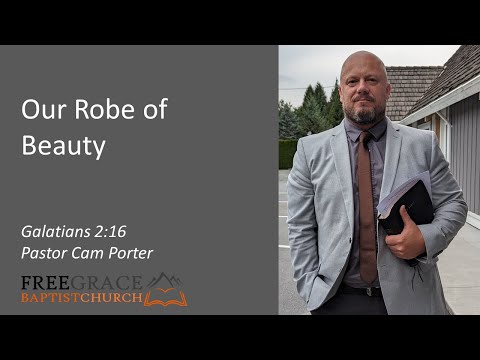
Our Robe of Beauty

Galatians 2:16 presents a five-fold declaration that justification is by faith alone and not by the works of the law — a doctrine that stands at the very heart of the Christian gospel. This sermon works through four categories: a definition of justification as a forensic declaration set in opposition to condemnation, its foundation in the obedience and satisfaction of Christ alone (not infused righteousness, works, the act of faith, or evangelical obedience), the transaction of imputation by which sin is credited to Christ and his righteousness credited to the believer, and faith as the empty instrument that receives rather than earns that righteousness. The pastoral application presses the believer's assurance away from inward evidences toward the finished work of Christ, and calls the unconverted to look to Christ in faith as their only standing before a holy God.

2LCF Chapter 13 - Of Sanctification
Second London Confession of Faith Chapter 13 examines sanctification as an inseparable fruit of justification, rooted entirely in the sovereign grace of God rather than human merit or striving. The confession teaches that sanctification is real and personal moral transformation wrought by the Holy Spirit through the Word, yet remains imperfect in this life — a continual war between flesh and Spirit in which remaining corruption may at times prevail. The critical distinction between justification (Christ's forensic work for us) and sanctification (the Spirit's transforming work in us) guards against both Roman Catholic conflation and Protestant antinomianism, keeping Christ's righteousness alone as the ground of acceptance before God.

2LCF Chapter 11 - Of Justification
How is a guilty sinner declared righteous before a holy God? This study of 1689 London Baptist Confession chapter 11 works through the six paragraphs on justification, giving careful attention to the three pairs of denials and affirmations in paragraph one. The confession is set against the Roman Catholic conflation of justification and sanctification, Socinian and Arminian errors regarding faith and evangelical obedience as the ground of justification, and the doctrine of eternal personal justification. The sole ground of the sinner's acceptance before God is the imputed active and passive obedience of Christ, received through faith alone — itself a gift of God — so that God is glorified as both perfectly just and richly gracious in the justification of sinners.
2LCF Chapter 13 - Of Sanctification
The 1689 London Baptist Confession of Faith, Chapter 13, sets forth sanctification as a real and personal moral transformation wrought by the Holy Spirit through the Word, inseparably joined to justification yet categorically distinct from it. The confession distinguishes the dominion of sin — broken decisively at regeneration — from the remnants of corruption that remain in every part of the believer throughout this life, producing an irreconcilable war between flesh and Spirit. Against both perfectionism and antinomianism, the chapter insists that sanctification is neither a checklist of religious performance nor a license for presumption, but a progressive, Spirit-empowered conformity to Christ that never constitutes the ground of acceptance before God. Hearers are urged to reject the conflation of justification and sanctification — whether in Roman Catholic merit theology, the New Perspective on Paul, or Federal Vision — and to rest acceptance with God solely on the imputed righteousness of Christ.

The Joy of Keeping God's Law
Proverbs 29:18 sets before us two contrasting conditions: the lawlessness that follows the absence of God's revealed word, and the happiness that accompanies obedience to that word. This sermon works through the classic Reformed threefold use of the law — civil/political, pedagogical, and normative — applying the first two uses to the unbeliever and the third to the justified believer. The practical conclusion is that keeping God's law is simultaneously a consequence of justifying faith, a means of promoting assurance of salvation, and an expression of gratitude to God for sovereign grace.
Of Sanctification (2LCF 13)
What does it mean to be sanctified, and how does that work itself out in the Christian life? Working from 2LCF Chapter 13 and Ephesians 4:17–24 as a core text, this teaching distinguishes definitive sanctification — the once-for-all, irreversible breach with the dominion of sin that occurs at union with Christ — from the progressive sanctification that follows as the Spirit applies Christ's death and resurrection to the believer's daily conflict with the flesh, the world, and the devil. The confession's three paragraphs frame the exposition: the inception and source of sanctification in Christ's virtue, the imperfect yet real struggle with indwelling sin, and the certain progress of grace toward evangelical obedience. Believers are called to reckon themselves dead to sin, take up the means of grace daily, and press on toward holiness as those who are already God's special possession.
The Lord's Concern for Widows, Part 1
The fifth commandment's requirement to honor parents grounds the Apostle Paul's instruction in 1 Timothy 5:3–8 that widows who are 'really widows' — left alone, without family, trusting in God — be financially supported first by their believing children and grandchildren, and only then by the church. The word 'honor' in verse 3 carries the same material force it bears in verse 17, meaning tangible provision of food, clothing, and shelter, not mere esteem. God's covenantal concern for the defenseless widow runs from Deuteronomy through the Gospels, establishing that care for widows is an expression of genuine piety, not an optional act of charity. The sermon presses the sobering warning of verse 8: to neglect one's widowed mother or grandmother is not merely a lapse in duty but a denial of the Christian faith itself, placing the professing believer below the standard even pagans maintain.