
Theological term
Divine Providence
45 sermons · All terms

The Qualifications for Elders, Part 1

What qualifies a man to lead Christ's church as an elder, and how is a genuine call to ministry recognized? Expounding 1 Timothy 3:1, this sermon works through four elements of a man's call to eldership drawn from Albert N. Martin's Pastoral Theology: the desire of the man, the graces of the man, the gifts of the man, and the opportunity for the man. The internal, subjective desire for ministry must be checked by external, objective criteria — the qualifications of verses 2–7 and the common suffrage of the local church as confessed in the Second London Baptist Confession, chapter 26. The sermon closes with exhortations to the congregation to pray for gospel laborers and to take the qualification process seriously, and with a call to unbelievers to trust the Christ whom these ambassadors proclaim.

The Resurrection-Hope of the Righteous One
Psalm 16 is expounded as a Messianic psalm concerning the mind and experience of Christ in his earthly ministry — his earnest petition for divine preservation, his joyful contentment amid sorrow, and his sufficiency rooted in the Father alone. The apostolic witness of Peter in Acts 2 and Paul in Acts 13 establishes that David speaks in this psalm concerning the Lord Jesus Christ, and only secondarily of David and the saints in union with him. The sermon calls believers to follow the pattern of their Savior: praying for preservation, finding sufficiency in God rather than earthly blessings, meditating on Scripture in the night seasons, and navigating trial through a settled confidence in divine providence.

Life in the Wilderness and Canaan
Deuteronomy 8 sets the wilderness generation of Israel before the land of Canaan with a threefold movement: a reminder of God's providential humbling in the wilderness (vv. 1–5), a promise of abundant blessing in the land (vv. 6–10), and a solemn warning against the pride and forgetfulness that prosperity tends to generate (vv. 11–20). The wilderness was not divine cruelty but divine chastening — designed to produce dependence on God rather than self-sufficiency — a pattern the New Testament applies both to the believer's ongoing trials and to the person of Christ, who as the true Israel recapitulates the exodus, wilderness, and restoration that old covenant Israel failed to embody faithfully. The sermon closes by calling hearers to combat forgetfulness of God through regular remembrance of his word, his covenant, and his redemptive acts, recognising that the danger is never prosperity itself but the pride that severs gratitude from grace.

The Believer's Contentment
Philippians 4:10–13 presents the contentment of the Apostle Paul not as an innate virtue but as a learned conviction forged through diverse and often severe circumstances. Working through Paul's expression of gratitude to the Philippians, his present situation, his learned conviction, his diverse circumstances, and his source of strength, this sermon argues that Christian contentment is utterly independent of circumstances because it is grounded in union with Christ — in justification, sanctification, and promised glorification. The practical exhortation confronts the common error of tying contentment to circumstances ('when I get married, then I will be content') and calls believers instead to submit sweetly to divine providence, rejoice in God's sovereign ownership of all things, and find their settled rest in Christ alone.

Fearfully and Wonderfully Made

Psalm 139:13–16 declares that the formation of every human being in the womb is an act of God's immediate, intimate providence — the divine Weaver knitting together image-bearers for His own glory. The sermon argues that human dignity is grounded not in sentiment or politics but in divine authorship: God knows each person's substance before conception, fashions every inward part, and has decreed their days in His eternal book. The Incarnation deepens rather than evacuates this ethical claim, for the Son of God assumed embryonic and fetal life, passing through every stage of human existence to redeem a multitude of sinners. The congregation is called to tremble before the God who sees in secret, to defend the sanctity of life from conception to death, and to rest in the omnipotent providence of the One who has numbered both our members and our days.

The Believer and Trials
James 1:1–8 confronts believers with a counterintuitive command: count trials as pure joy. This exposition works through the believer's required response to trials (vv. 2–4) and the believer's required request during trials (vv. 5–8), grounding both in the theological truth that the testing of faith produces endurance and conformity to Christ. The sermon argues that ignorance of God's remedial purposes in affliction is the root cause of disordered responses — panic, complaint, and double-mindedness — and calls believers to ask God for wisdom to navigate suffering in faith, confidence resting on the character of a God who gives liberally and without reproach.

Late in Time Behold Him Come
The incarnation of the Son of God is not one event among many in redemptive history but the appointed climax toward which every Old Covenant type, ceremony, and providence was directing the people of God. Expounding Galatians 4:1–5, this sermon argues that the Old Covenant was temporary, preparatory, and anticipatory — never designed to convey everlasting covenantal blessing — and that Paul deploys the incarnation as a decisive argument against the Judaizing error of faith plus works. The 'but when' of verse 4 marks the arrival of the fullness of the times: the Father's eternally decreed appointment, the fulfillment of prophetic announcement, the termination of types and shadows, and the perfection of all providences. The sermon closes with a call to set the confidence of the soul entirely on the Son of God who descended from glory to redeem lawbreakers and bring many sons and daughters to everlasting glory.

The Commendation of His Spirit
Psalm 31 is a prophetic psalm of Christ, providing the scriptural background to the seventh saying of the Savior from the cross: 'Father, into your hands I commit my spirit' (Luke 23:46). The psalm moves through five sections — petition for deliverance, description of suffering, condemnation of enemies, admiration of the Father, and exhortation to the people — each finding its fullest meaning in the crucified and triumphant Messiah. The sermon draws out three contextual observations from the cross: the sovereign control exercised by the Son in laying down his life willingly, the contrast between the hand of God receiving Christ's spirit and the hand of men seeking to destroy him, and the restoration of communion between the Son and the Father after the cry of dereliction. God's people are called to the same trust and courage that marked the Savior — committing their times and their souls to a faithful Creator in the midst of trial, persecution, and adversity.
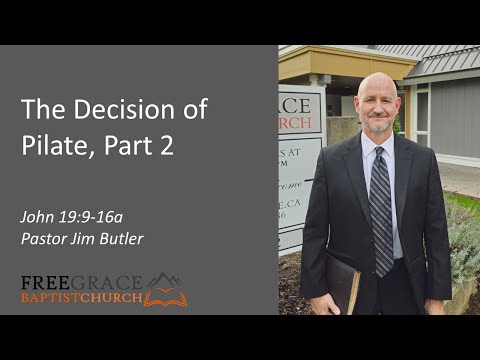
The Decision of Pilate, Part 2
John 19:9–16 records the exchange between Jesus and Pontius Pilate that culminates in the verdict of crucifixion. This sermon works through Pilate's confusion and arrogant assertion of authority, Christ's counter-declaration that all governing power derives from God Most High, and the theological weight of the greater sin belonging to those who delivered Christ up. The death of the Lamb of God at the hour of Passover preparation is no accident — it is the predetermined plan of the Father, the fulfillment of every Passover sacrifice, and the ground of forgiveness for wretched sinners who look to Christ in faith.

2LCF Chapter 5 - Of Divine Providence
Divine providence — God's upholding, directing, disposing, and governing of all creatures and all their actions — is the subject of 2LCF Chapter 5. The chapter moves from a general statement of providence in paragraph 1 through the relationship of first and second causes, the use of means, and the hardest pastoral question: how God's sovereign decree relates to sin in general, in believers, and in unbelievers. The session closes by grounding the doctrine in the particular care God exercises over his church, whose history is the key to all human history.
The Glory of God in the Valley of Elah
Standing in the Valley of Elah, the armies of Israel cower before Goliath for forty days — not merely from want of courage, but from failure to rest upon the covenant promises of God. Against this backdrop of faithless fear, David's response exposes what true faith looks like: a jealous zeal for the honor of Yahweh, grounded in historical retrospect upon God's past deliverances, expressed in bold confidence that the Lord of hosts will act. The narrative drives toward a climax in which Goliath falls on his face to the earth — mirroring the fall of his god Dagon before the ark — as a forced worship of the very God he defied, and the whole account points forward to Christ, the greater Shepherd-King who crushes the head of that ultimate enemy at the cross.

Sunday School Confession Study - Oct 15, 2023
The 1689 London Baptist Confession of Faith, chapter 5, 'Of Divine Providence,' paragraphs 2–7 sets the agenda for this study. After reviewing paragraph 1's foundational statement that God upholds, directs, and governs all creatures by his most wise and holy Providence, the study works through the confession's treatment of second causes, the ordinary use of means, the relation of Providence to sin (both in its general scope and in the specific cases of believers and unbelievers), and the special providential care God exercises over his church. The central concern throughout is theodicy properly grounded: that God's absolute sovereignty over first and second causes does not make him the author or approver of sin, while also refusing the weak refuge of 'bare permission.' The study closes with the encouragement that whatever befalls the elect is by God's appointment for his glory and their good, and that Providence's ultimate telos is the perfecting of the church as the bride of the Lamb.

The Cross of Christ in the Book of Acts
The cross of Christ is not a threshold event left behind at conversion but the perpetual heartbeat of Christian life and worship. Working through the theme of the cross as it appears across the Book of Acts, this sermon traces six dimensions of the cross under six headings — divine purpose, divine promise, divine providence, divine power, divine proclamation, and divine proficiency — demonstrating that the crucifixion was planned in eternity, foretold throughout redemptive history, carried out through providential means, accomplished by the God-man himself, heralded by apostolic messengers, and effectually applied to all whom the Father gave the Son. The central application is a call to restore the art of marveling in the cross daily, not only on the Lord's Day, as the only fitting response to the reality that the God of heaven and earth took human flesh to bring many sons to glory.

The Champion of the Howling Wilderness
Matthew 4:1–11 presents the temptation of Christ not primarily as a model for personal resistance to sin, but as the decisive act of single combat in which the Lord Jesus Christ, as the second Adam and the true Israel, vicariously perfects obedience for his elect people. Where Adam fell in the garden amid every provision and where Israel failed in the wilderness under divine care, the Son of God enters a howling wilderness—hungry, alone, and unarmed—and vanquishes the devil point for point through resolute dependence on the word of God. The rich typological connections to Adam's expulsion, Israel's forty years of wandering, Moses' fast on Sinai, and David's unarmed single combat against Goliath converge on the one claim the passage presses: Christ alone is the covenantally faithful champion, and salvation belongs exclusively to those who trust in his doing, dying, and rising. Christians are therefore called to rejoice in their champion rather than to reduce this episode to a moral technique for fighting temptation.

A Psalm of Thanksgiving
Psalm 103 calls the redeemed to bless God with the totality of their being — not passively, but by deliberately rehearsing his mercies against the ever-present tendency to forgetfulness. The psalm moves from the forgiveness of sins as the chief and foundational benefit, through temporal preservation and physical provision, to the perfections of God himself — his mercy, his patience, his covenant faithfulness — as the inexhaustible ground of praise. The sermon presses the congregation to fight spiritual amnesia privately in prayer and publicly in corporate worship, and to understand that gratitude is not an optional ornament but a defining mark of those who walk worthily before God.

The Truthful Testimony of the Lord
John 8:13–20 records the Pharisees' flat rejection of Christ's self-testimony — 'your witness is not true' — and his threefold response: the intrinsic truthfulness of his witness grounded in his divine origin and destination, the confirming unity he shares with the Father, and the law of two witnesses satisfied by Father and Son together. The passage closes with the Pharisees demanding to see the Father, only to be told that their ignorance of the Son proves their ignorance of the God they claim to worship. The sermon presses upon the hearer that to receive or reject Christ is to receive or reject the Father, and calls unbelievers to look in faith to the one mediator between God and men.

The Problem of Israel's Apostasy
Israel's apostasy in Judges 2:7–3:6 follows a pattern rooted not in ignorance but in a failure to know the Lord experientially — a failure that produced syncretism, Baal worship, and divine chastisement. The sermon traces the root, description, and divine response to Israel's apostasy, showing that God's repeated raising up of judges was not provoked by Israel's repentance but by his own covenant faithfulness and mercy. Samson is presented as a type of Christ, each of the twelve judges pointing typologically to the Savior who would definitively deliver his people from their sins. The church is exhorted to keep herself unspotted from the world, resisting the toleration that leads by degrees to full apostasy.

Clip: God isn't crippled, hindered, silent, or absent
The sovereignty of God over creation and providence is the proper ground of confident, bold prayer. Drawing on Acts 4 and Psalm 2, this excerpt shows how the apostolic church prayed not to a God diminished by circumstance but to the God who made and governs all things — including the threats of the Sanhedrin against the early church. The vantage point of God's absolute sovereignty is what makes petition coherent and emboldening rather than desperate.

2LCF Chapter 5 - Of Divine Providence
The 1689 London Baptist Confession of Faith, Chapter 5, on Divine Providence, teaches that God upholds, directs, disposes, and governs all creatures and all their actions from the greatest to the least — not by blind fate or fortune, but according to his infinite power and wisdom, his infallible foreknowledge, and the free and immutable counsel of his will. The chapter unfolds in seven paragraphs, moving from the general definition of providence (paragraph 1) through its relation to second causes, ordinary means, miracles, the fall, remaining sin in believers, the hardening of unbelievers, and finally the special care God exercises over his church. God's sovereignty does not make him the author of sin nor does it remove human responsibility; first causality establishes rather than annuls second causality. The doctrine is a source of deep comfort: whatever befalls the elect is by God's appointment for his glory and their good.

The Governing Principle of Kingdom Life
Anxiety is not a private struggle but a theological failure — a contradiction of the sovereignty of God confessed in the pew but abandoned in the heart. Expounding Matthew 6:25–34, this sermon works through Christ's fourfold structure in the Sermon on the Mount: the command not to worry, the indictment of those who do, the contrast between Gentile anxiety and covenant-child confidence, and the governing principle that kingdom life is regulated by seeking first God's kingdom and righteousness. The sermon closes with eight dangerous fruits of worry and a call to trust that the God who is absolutely sovereign in salvation is equally sovereign over food, clothing, and every daily crisis.

Genesis 29:31 - 30:24
Genesis 29:31–30:24 records the birth of the twelve tribal patriarchs of Israel through a household marked by rivalry, deception, polygamy, and heartbreak — a far cry from the paradise setting one might expect for redemptive history's foundations. The sermon traces four movements: the opening of Leah's womb, Rachel's envious frustration and her recourse to surrogacy, Leah's counter-response through her own maid and the mandrake episode, and finally the long-awaited opening of Rachel's womb. The governing theological lesson is that the purely gracious character of Israel's election is on full display: the twelve tribes emerged not from human merit, virtue, or domestic harmony, but from God's sovereign purpose working through and despite profound human dysfunction. The passage calls believers to contentment in their circumstances, trust in divine providence, and wonder at a grace that accomplishes its ends in spite of fallen instruments.

Free Grace Baptist Church - October 2, 2019 Bible Study
Genesis 28 records God's sovereign confirmation of the Abrahamic covenant blessing to Jacob at Bethel — a man fleeing for his life after his own deception, yet met by Yahweh in a dream of angels ascending and descending a ladder between heaven and earth. The passage is expounded under three movements: Jacob's relocation to Padanaram, Esau's futile attempt to secure parental blessing through marriage, and Jacob's vow at Bethel. The dream is interpreted on two complementary levels — as a declaration of divine providence over Jacob's solitary journey, and as a messianic anticipation of Christ as the one mediator between heaven and earth, the interpretation Christ himself provides in John 1:51. The chapter marks a turning point in Jacob's life, from grasping deceiver to worshipping covenant-keeper, and sets a paradigm for all Israel of worship, tithing, and trust in Yahweh's faithfulness.

Genesis 27
Genesis 27 presents the deception of Isaac by Rebekah and Jacob to secure the patriarchal blessing, and a careful reading reveals that every member of the family acts in an unprincipled manner — yet God's covenantal promise advances without interruption. The blessing conveyed upon Jacob is the Abrahamic covenant itself being passed to the son of promise, a line that runs through Israel and terminates in the Lord Jesus Christ as the seed of Genesis 3:15. Ambrose's allegory, endorsed by Calvin, illuminates the typological force of the episode: as Jacob entered the presence of his father clothed in borrowed garments carrying their distinctive odor, so believers enter the presence of the heavenly Father clothed in the imputed righteousness of Christ. The chapter is a sustained argument for the sovereignty of divine election and the grace of God, which operates not because of human virtue but in spite of its spectacular absence.
The Sovereignty of God
Proverbs 3:19–20 grounds God's sovereignty not merely in creation but in every sphere of existence — the world was founded by divine wisdom, and that same sovereign wisdom governs all of history and secures the redemption of His people. Drawing widely from Proverbs alongside Genesis, the Psalms, Daniel, and Romans, this sermon traces three distinct expressions of God's sovereignty: His free, unconstrained creation of all things; His comprehensive providence over human affairs including civil government; and His eternal purpose in redemption, centred in the pre-existent Christ of Proverbs 8. The practical force of the message is that divine sovereignty — rightly understood — produces neither fatalism nor hyper-Calvinist passivity, but rather deep comfort, stable faith, and the use of appointed means, all to the glory of God.

Genesis 20:1-18
Genesis 20 records Abraham's deceptive half-truth to Abimelech, king of Gerar — a relapse into the same sin committed in Egypt — and God's sovereign intervention to protect both Sarah's honor and the line of promised seed. The passage reveals that not every pagan city is a Sodom: God's common grace produces genuine integrity in Abimelech, whom the Lord acknowledges and restrains, while Abraham's fear exposes a distrust of divine providence that God graciously overcomes. The birth of Isaac in chapter 21 is secured not by human faithfulness but by the sovereign God who closes and opens wombs, curses those who threaten His covenant people, and blesses those who bless them. The sermon calls believers to rest in the past faithfulness of God as a present argument against fear and self-protective deception.

The Death of Ahab
The death of Ahab in 1 Kings 22:29–53 is the culmination of multiple prophetic pronouncements — by Elijah, the unnamed prophet of chapter 20, and Micaiah — all of which converge on a single 'random' arrow on the field of Ramoth Gilead, demonstrating that no disguise, no strategy, and no human ingenuity can deflect the sovereign judgment of God. The narrative also exposes the folly of Jehoshaphat, a genuinely godly king whose piety was unaccompanied by good sense, yet who was graciously preserved by the God he served despite the consequences he deserved. The criterion by which every king in 1 Kings is finally measured is not his administrative accomplishments but his fidelity to the Word of God. The sermon calls believers to combine true piety with godly wisdom, to flee from the wrath of God to the cross of Christ as the only refuge, and to take sober warning as parents against training children in wickedness.
Genesis 29:1-30
Genesis 29:1–30 narrates Jacob's arrival in Haran, his meeting with Rachel, and his marriages to both Leah and Rachel through the fraud of Laban. The passage is examined in three movements — arrival, meeting, and marriage — with particular attention to the irony that Jacob the deceiver is himself deceived by his father-in-law. The overarching application is the doctrine of divine providence: God works sovereignly through morally disordered and even perverse circumstances — the switched brides, Leah's unexpected marriage, the messianic line through Judah — to accomplish his redemptive purpose in Christ.

The Sermon in Solomon's Porch, Part 2
Peter's sermon in Solomon's Porch confronts Jerusalem sinners with the necessity of repentance, pressing three realities upon them: their ignorance was willful, not innocent; God's sovereign providence overruled even their wickedness in crucifying Christ to fulfill all that the prophets foretold; and the call to repent and turn carries with it the promised blessings of sins blotted out, times of refreshing from the Lord's presence, and the indwelling presence of Christ by Spirit and Word until the restoration of all things. The exposition of Acts 3:17–21 drives toward a direct appeal: those burdened with sin must repent and turn to Christ, the only one in whom those blessings are found.

The Sacrifice Remembered
What does it mean to remember the death of Christ at the Lord's Supper? Examining 1 Peter 1:18–20, this sermon traces three dimensions of that remembrance: the incomparable value of Christ's precious blood over all corruptible earthly things, the eternal and love-driven divine purpose behind the atonement foreordained before the foundation of the world, and the singular historical reality of the incarnation and sacrifice. The congregation is called to prize Christ above every earthly attachment and to observe the Lord's Supper with the gravity and joy befitting so great a Savior.

2 Kings 9
Second Kings 9 records the anointing of Jehu and his swift execution of God's long-deferred judgment upon the house of Ahab — a judgment decreed in 1 Kings 19 and pronounced by Elijah in 1 Kings 21. This sermon works through the chapter in two movements: the instrument of that judgment (the anointing of Jehu, vv. 1–13) and the execution of it (the deaths of Joram, Ahaziah, and Jezebel, vv. 14–37). The exposition draws out the comprehensive sovereignty of God over history, politics, and retribution, tracing how every detail — the location of Naboth's field, the presence of both kings in Jezreel, the dogs and the chariot — fulfills specific prophetic promises decades in the making. Listeners are called to take seriously both the justice of God against the wicked and the legitimate rejoicing of the righteous when that justice is displayed.