
Theological term
Dispensationalism
47 sermons · All terms
2LCF Chapter 32 - Of the Last Judgment

The biblical doctrine of the Last Judgment—its nature, purpose, and practical relevance—is examined through 1689 LBCF Chapter 32. God has appointed a day on which He will judge the world in righteousness through Jesus Christ as covenant mediator, to manifest both His mercy in the eternal salvation of the elect and His justice in the eternal damnation of the reprobate. Romans 9 grounds the theocentric purpose of judgment in God's sovereign disposition of mercy and wrath, while 2 Thessalonians 1 supplies the apostolic warrant for the believer's rejoicing in divine justice. The session concludes with an overview of the major millennial positions and their hermeneutical foundations, urging the church to let eschatology produce holiness, consolation, and gospel urgency rather than pride or speculation.
Ask FGBC 67: Are Piper and MacArthur Reformed Baptists?
What separates a confessional Reformed Baptist church from a Calvinistic Baptist church associated with figures like John Piper or John MacArthur? This conversation argues that Calvinism, properly understood, is not reducible to the five points of Dort but entails a whole confessional heritage — covenant theology (including the covenant of works), cessationism, the regulative principle of worship, and adherence to one of the great Protestant confessions. The Second London Baptist Confession of 1689 is presented as the most mature expression of that heritage, providing a theological anchor that protects congregations from pastoral personality-driven ministry and binds them to the cumulative wisdom Christ has given his church through the ages.

2LCF Chapter 32 - Of the Last Judgement
2 London Baptist Confession of Faith Chapter 32 examines the doctrine of the Last Judgment under three heads: the concept of the Day of Judgment (its divine appointment, its agent in Christ, and its comprehensive scope over angels and all humanity), the goal of that day (the manifestation of God's mercy in the eternal salvation of the elect and his justice in the eternal damnation of the reprobate), and its practical relevance (deterring sin, consoling the afflicted people of God, and keeping believers watchful). The session concludes with a survey of the three millennial positions and four interpretive approaches to the book of Revelation, explaining why the Confession deliberately avoids resolving those disputes in order to function as a broad consensus document. The consistent ethical burden throughout is that contemplation of the coming judgment should shape present conduct: purifying the elect, driving evangelism, and giving the suffering saints confidence that divine justice will prevail.

Ask FGBC #22: What is the New Covenant in the Reformed Baptist view?
The New Covenant in Reformed Baptist theology is identified as the historical expression of the covenant of grace, ratified in the blood of Christ and offering salvation to God's elect through faith in Jesus Christ. Unlike many Paedo-Baptist positions that locate the covenant of grace in the Abrahamic or Mosaic covenants, the Reformed Baptist view holds that only the New Covenant is that historical expression, with the earlier covenants serving as types and shadows pointing forward to it. Dispensationalism, by contrast, structures redemptive history around distinct divine dealings with Jews and Gentiles, tends to resist the theological covenant framework of redemption, works, and grace as extra-biblical categories, and anchors its New Covenant reading in a literalistic hermeneutic. Jeremiah 31, Hebrews 8 and 10, and the institution of the Lord's Supper together ground the Reformed Baptist insistence that the New Covenant begins with Christ's death and resurrection.

The Martyrdom of Stephen
Acts 7:54–8:1 records the martyrdom of Stephen, the first Christian martyr, whose death exposes the murderous hatred that unbelieving Israel bore toward the Messiah and those who bore witness to Him. Standing alone before the Sanhedrin, Stephen receives a vision of the glory of God and the Son of Man standing at the right hand of the Father — confirming his theology of temple, rebuking his executioners, and manifesting the presence of the triune God with His servant in extremity. His dying words, mirroring Christ's own prayers from the cross, demonstrate that true temple worship — the meeting of God and sinners in prayer and forgiveness — is found not in any physical structure but in the Lord Jesus Christ. The passage calls believers to theological preparedness, courageous witness, and dependence on the triune God in the face of opposition, however severe.

Ask FGBC #14: How do we connect modern day Israel to Old & New Covenant Promises?
How should Christians understand the modern state of Israel, the Abrahamic and Davidic covenants, and the land promises in light of the New Testament? This Q&A exchange argues that the church is not a replacement for Israel but is the eschatological Israel of Old Testament prophecy — one people of God, Jew and Gentile together, united in Christ. Dispensationalism's two-peoples-of-God framework is evaluated and rejected on hermeneutical grounds, with Romans 11, the Davidic covenant, and the land promise examined in turn. The conversation broadens into the necessity of reading Scripture canonically and horizontally, the value of confessionalism, and the danger of allowing political rhetoric to distort biblical interpretation.

2LCF Chapter 22 - Of Religious Worship and the Sabbath Day
The regulative principle of worship — the claim that God alone determines the acceptable manner of approaching Him — is the organising doctrine of 2nd London Confession of Faith Chapter 22. This session works through all eight paragraphs, distinguishing between the divinely commanded elements of worship (prayer, Scripture reading, preaching, singing, the sacraments) and the circumstantial matters left to Christian prudence, while also setting out the confession's Sabbatarian position: a creation-grounded, morally perpetual fourth commandment whose appointed day shifts from the seventh to the first day of the week at Christ's resurrection. Hearers are pressed to submit their worship preferences to divine prescription rather than personal taste, and to pursue Sabbath observance in its full rigour while resting in Christ's atonement when they fall short.

The Vine, the Vinedresser, and the Branches
John 15:1–8 presents Christ as the true vine, his Father as the vinedresser, and his people as the branches — a passage that answers the question of who constitutes the true Israel of God. The sermon argues from Jeremiah 31 and the New Covenant's own terms that the New Covenant knows no externally connected members, and that the unfruitful branches of verse 2 refer to apostate Old Covenant Israel and to those who counterfeit saving faith, not to baptized infants as some paedo-baptist readings propose. The pruning of living branches is shown to be the Father's gracious work of conforming his people to the image of his Son through affliction and discipline. The sermon closes with a double application: unbelievers are called to look to Christ in faith, and believers are urged to receive God's chastening as the evidence of his love and the means of their growth in grace.
The True Vine, Part 2
Jesus' declaration 'I am the true vine' (John 15:1) is not a free-standing metaphor but the culmination of a redemptive-historical pattern running from Adam through Old Covenant Israel to the Last Adam. The sermon traces the vine imagery through the Psalter and the Prophets — Psalm 80, Isaiah 5, Jeremiah 2, Ezekiel 15 and 17 — to show that Israel was the vine God tended, judged, and finally condemned for covenant unfaithfulness. Christ as the true vine fulfills what both Adam and ethnic Israel forfeited, and those united to him by faith are therefore identified by the apostles as the Israel of God, the new covenant people who inherit all the promises. The sermon closes with a direct application: ethnic Jews today are to be called to repent and believe on Jesus Christ, not treated as a covenant people apart from faith in Him.
The Covenantal Status of Israel in the Parable of the Vineyard
Matthew 21:33–46 presents the Parable of the Wicked Vinedressers as a compressed history of Old Covenant Israel — a nation privileged with God's presence, prophets, and promises, yet persistently covenant-breaking and finally guilty of rejecting the Messiah himself. The parable is read against Isaiah 5 and fulfilled in the AD 70 destruction of Jerusalem, which is the covenantal judgment pronounced in verse 43: the kingdom of God is taken from ethnic Israel and given to the church, the true Israel of God. The New Covenant people — constituted by faith in Christ, not ethnic descent — are that nation bearing fruit, identified as such in 1 Peter 2 and Galatians 6:16. The sermon argues that any future geopolitical restoration of Old Covenant Israel with a rebuilt temple and renewed sacrificial system would be a reversal of redemptive history, and that ethnic Jews today stand in need of the gospel like every other nation.

The Promise of Blessings and Curses (Part 1)
Leviticus 26:1–13 opens with a promise of blessing conditioned on Israel's obedience — a structure that raises the question of how the Old Covenant relates to the New. This study expounds the covenantal framework underlying Leviticus 26, arguing that the Old Covenant operated as a covenant of works at the national level, distinct from the covenant of grace realized in Christ. The blessings of rain, peace, and God's presence promised to Israel find their fulfillment in the New Covenant, where the obedience that secures blessing is Christ's own, imputed to his people by faith alone.
The Stewardship of the Mystery of Christ
Ephesians 3:1–7 presents Paul simultaneously as prisoner and steward — his imprisonment for preaching Gentile inclusion in the covenant of grace is inseparable from the divine commission that caused it. The sermon traces the apostolic stewardship of the mystery of Christ: a truth partially disclosed in the Old Testament through types and promises, but fully unveiled in the New Testament through the Spirit's revelation to the apostles and prophets. The content of the mystery is that Gentiles are fellow heirs of the same body, not a parenthetical people of God, but full partakers of the covenant promise in Christ through the gospel — a reality that demolishes any two-peoples-of-God framework. The power enabling that ministry is God's alone, not the orator's persuasion, so that faith rests in divine power rather than human wisdom.
2LCF Chapter 20 - Of the Gospel and of the Extent of the Grace Thereof

2 London Baptist Confession of Faith Chapter 20, 'Of the Gospel and of the Extent of the Grace Thereof,' addresses a chapter absent from the Westminster Confession but added by the Congregationalists in the Savoy Declaration and retained by the Particular Baptists to combat incipient deism and the General Baptist doctrine that sinners may be saved through general revelation alone. The sermon traces the chapter's four paragraphs through Romans 10, Luke 24, John 5, and Psalm 19 to demonstrate that the gospel of Christ has been the sole substance of special revelation since the protevangelium of Genesis 3:15, that general revelation is categorically insufficient to make Christ known, that God distributes gospel light with absolute sovereignty, and that effectual grace is indispensable alongside that revelation for the conversion of dead sinners. The double theme of the chapter — the necessity of special gospel revelation and the necessity of the Spirit's insuperable work — magnifies divine grace, grounds the missionary enterprise, and exposes the doctrine-of-sin deficiencies latent in every scheme that allows salvation apart from hearing Christ proclaimed.

Live Stream - September 25, 2022
Ephesians 2:14–18 presents Christ as the one who is our peace, who makes peace, and who preaches peace — accomplishing the reconciliation of both Jews and Gentiles to God through the blood of his cross. The abolition of the ceremonial law removes the middle wall of separation between the two peoples, creating one new man in Christ without distinction of privilege or standing before God. Access to the Father through the Son by one Spirit is inherently trinitarian, and the corporate assembly of God's people is the apex of that New Covenant blessing — making unexplained absence from gathered worship a forfeiture of the very Redemptive benefits Christ secured.

2LCF Chapter 19 - Of the Law of God, Part II
The moral law of God — given to Adam at creation, codified at Sinai in the Ten Commandments, and written on the hearts of New Covenant believers — perpetually binds all people everywhere, justified and unjustified alike, by virtue of God's authority as Creator. This study of 2LCF Chapter 19, paragraphs 5–7, works through 1 Timothy 1:8–10 to distinguish the three uses of the law (civil, pedagogical, and normative) and expounds Jeremiah 31, Matthew 5, Romans 3, Romans 6, Galatians 3, Romans 13, and Ephesians 6 to demonstrate that Christ and the gospel do not dissolve but rather strengthen the law's obligation. The session exposes the errors of dispensationalism and antinomianism, showing that the Spirit of Christ enables believers to obey freely and cheerfully the very law that condemns the unbeliever. The application presses Christians to declare God's law publicly — to believers for sanctification and to unbelievers for conviction — never separating law from gospel in proclamation.

The Gentiles and the Covenant of Grace, Part 1
Ephesians 2:11–13 presents the former covenantal destitution of Gentile believers and the transforming power of Christ's blood that brought them near to God. The passage shows that Gentiles suffered two compounding liabilities: individual deadness in sin and corporate exclusion from the commonwealth of Israel and the covenants of promise. Against this bleak background, the apostle's 'but now' in verse 13 declares that union with Christ — secured through his atoning blood — has abolished the alienation and incorporated believing Gentiles into the one new humanity. The sermon argues that this covenantal reversal should evoke perpetual humility and gratitude in every believer, and calls the unbeliever to come to the Father through the Son in the Spirit.

The New People of God: Part 2

The titles given to the church in 1 Peter 2:9–10 — chosen generation, royal priesthood, holy nation, and his own special people — are drawn directly from Old Testament Israel typology and applied to all who believe in Christ. Working through Deuteronomy 32, Exodus 19, 2 Samuel 7, and the Abrahamic covenant, the sermon traces how God's act of separating Israel from the nations at Babel prefigures his rescue of the spiritual Israel — the church — from the dominion of darkness into the marvelous light of Christ. The sermon argues that the new covenant fulfils what the old covenant typified: believers now constitute the household of God, the spiritual temple, and a royal priesthood whose commission is to proclaim the excellencies of the one who called them out of darkness. This demands that the church pursue its prophet-priest-king calling not through military or political dominion but through the proclamation of the gospel of King Jesus to every tribe, tongue, people, and nation.

The New People of God, Part 1
What does it mean for the church to be built on Christ as a living cornerstone, and how does the Old Testament ground that identity? Expounding 1 Peter 2:6–8, this sermon traces the biblical-theological arc from Adam's failed dominion mandate in Genesis through Israel's typological history—law-giving, exile, and restoration—to the fulfilment of Isaiah's cornerstone prophecy in the Lord Jesus Christ. Israel's covenant history is shown to be a historical type of the cosmic reality: the broken covenant of works and its restoration by the Messiah, who is now building a global kingdom of redeemed image-bearers out of every tribe and tongue. Believers are called to marvel at God's sovereignty over history, over the kingdom of darkness, and over the unified message of Scripture that runs from Genesis 3:15 to the church as the true Israel of God.

2LCF Chapter 7 - Of God's Covenant, Part 2
1689 London Baptist Confession of Faith, Chapter 7, paragraph 3 sets out three theological covenants — the covenant of grace, the covenant of redemption (pactum salutis), and the covenant of works — as the structural architecture of all Scripture. This sermon expounds each in turn, demonstrating from texts in Genesis, Isaiah, Hosea, Galatians, and Romans that the covenant of grace is founded on an eternal transaction between the Father and the Son, and that it is God's provision for sinners rendered incapable of acceptance with God since Adam's fall. The covenant of works is shown to be indispensable to a right understanding of justification: without it, the imputed righteousness of Christ collapses into either moralism or antinomianism, and the distinction between forgiveness and imputation is lost. Covenant theology is pressed not as academic machinery but as the very ground of the believer's comfort, assurance, and stability before God.
Clip: Flyover of Covenant Theology (2LCF Chapter 7 - Of God's Covenant)
Covenant theology serves as the central hermeneutical architecture of Scripture, and this introductory flyover situates it against competing systems — dispensationalism and New Covenant theology — before tracing its practical consequences for continuity between the Testaments, the role of ethnic Israel, the subjects of baptism, and the law of God in the new covenant. Two key distinctions between the 1689 London Baptist Confession and the Westminster Confession are noted: the particular Baptists' omission of an explicit covenant of works statement in Chapter 7, and their refusal to identify the Old Covenant as an administration of the covenant of grace. The sermon locates covenant theology not merely in academic method but in pastoral comfort, grounding the blood-bought people of God in the assurance that God is in Christ reconciling the world to himself.
Chapter 7 - Of God's Covenant
1689 London Baptist Confession chapter 7 traces the biblical and theological architecture of God's covenant: from the necessity of divine condescension (paragraph 1), through the gracious character of the covenant of grace (paragraph 2), to the three theological covenants — grace, redemption, and works — and their progressive historical unfolding (paragraph 3). The session contrasts covenant theology with dispensationalism and New Covenant theology as competing hermeneutical frameworks, argues that the Old (Mosaic) Covenant functioned as a republication of the covenant of works rather than an administration of the covenant of grace, and demonstrates from Genesis 3:15 through Jeremiah 31 and Matthew 26 that all historical covenants advance a single promise of redemption finally and fully disclosed in the new covenant inaugurated by Christ. The practical payoff is a robustly confessional case for believers-only baptism: the new covenant community is defined by inward regeneration, universal knowledge of the Lord, and definitive forgiveness — marks that exclude the external-and-internal covenant structure required to justify paedobaptism.

Exodus 19
Exodus 19 records Israel's arrival at Sinai and God's formal entry into covenant with the nation — a covenant that functions as a republication of the covenant of works, in which Israel, like Adam before them, is called to obedience and fails, thereby pointing forward to the last Adam, Jesus Christ. The chapter unfolds in three movements: the exhortation to faithfulness through the covenant terms (vv. 1–8), the consecration of the people for readiness (vv. 9–15), and the theophanic demonstration of divine glory (vv. 16–25). The Sinai theophany, with its thunder, fire, and death-boundary around the mountain, teaches that God's people require a mediator — a lesson that finds its fulfillment in Christ, the Mediator of the New Covenant. The church, as the true Israel of God, inherits the vocation of Exodus 19:6 — a royal priesthood, a holy nation — and is therefore called to proclaim the praises of God with reverence befitting the consuming fire she approaches in worship.

The Earthly Temple in Stephen's Defense
Stephen's defense before the Sanhedrin in Acts 7:44–50 is not an attack on the temple but a demonstration that the Sanhedrin itself has misunderstood it. Working through the tabernacle, David's desire, Solomon's building, and Isaiah's oracle, Stephen shows that Israel's entire sacrificial and dwelling-place theology was typological — pointing forward to the Lord Jesus Christ as the true temple in whom God dwells with his people. The sermon argues that the dispensational expectation of a rebuilt physical temple in Jerusalem represents a retreat from fulfilled typology, and calls hearers to receive Christ as the antitype of all that the earthly sanctuary signified.
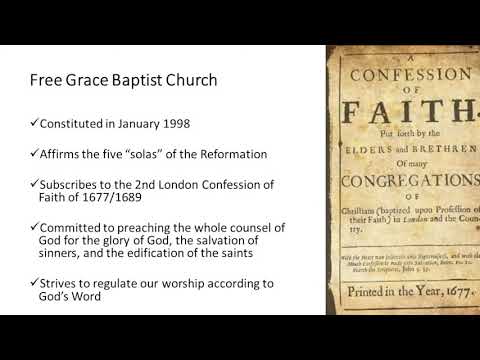
Introduction to the 1689 Second London Baptist Confession of Faith
Why should a church bind itself to a confession of faith? This introductory lesson on the Second London Baptist Confession of 1677/1689 grounds the answer exegetically in Ephesians 4 — where Christ gives gifted men to the church so that the body attains doctrinal unity and is no longer tossed about by every wind of teaching — and then traces the historical origins of the 1689 among the Particular Baptists, distinguishing them from Anabaptists, Presbyterians, and Congregationalists. Four functions of a confession are developed: defining, defending, discriminating, and disciplining with reference to the doctrine of the church. The lesson closes by distinguishing Reformed theology (Calvinism plus covenant theology plus the regulative principle) from mere five-point Calvinism, and by defending the confession's silence on matters of Christian liberty as a feature, not a defect.

The Hearing before the Sanhedrin, Part 1
The trial of Jesus before the Sanhedrin (Matthew 26:57–64) was no honest hearing but a predetermined execution by the highest religious court in Israel, assembled in violation of their own law and Scripture. This sermon examines the setting of the hearing, the fraudulent witness testimony regarding the temple, and the high priest's sworn examination of Jesus — in which Christ openly affirms that He is the Messiah, the Son of God, and Daniel's Son of Man. The temple charge against Jesus is shown to be a deliberate misquotation and misinterpretation of John 2:19, where Christ spoke not of the physical structure but of His own death and resurrection. The Sanhedrin's wickedness is set in sharp contrast to the resolve of Christ, who endures this sham trial in silence and then under oath, fulfilling Isaiah 53 and Daniel 7, in order to accomplish the salvation of His people.

The Second Missionary Journey, Part 6
Acts 17:16–21 presents the Apostle Paul in Athens, a city saturated with idolatry and celebrated for its philosophical culture. The sermon traces three movements in this brief passage: Paul's provocation of spirit at the sight of rampant idolatry, his deliberate response of preaching Christ in both the synagogue and the public marketplace, and his engagement with Epicurean and Stoic philosophers who summon him to the Areopagus. Paul's example establishes that righteous anger at the transgression of the First and Second Commandments, mingled with grief and compassion, is a mark of God's people — and that the fitting response to such provocation is not silence but the proclamation of Jesus and the resurrection.

The Council at Jerusalem, Part 3
James closes the Jerusalem Council (Acts 15:13–21) by grounding the inclusion of Gentiles in the covenant people of God not in human experience alone but in the prophetic word of Amos 9:11–12 and in the eternal decree of God. The rebuilding of David's tabernacle is the spiritual kingdom of Christ, which was purposed in eternity, announced through the prophets, and executed in the crosswork and exaltation of the Son. From this doctrinal foundation James renders a definitive verdict against Judaizing — that justification is by faith alone, apart from circumcision or the ceremonies of Moses — and then offers practical accommodations to facilitate communion between Jewish and Gentile believers in the one new humanity Christ has made.
Stephen's Defense, Part 3
Stephen's defense before the Sanhedrin, as recorded in Acts 7:9–16, turns on the narrative of Joseph: a man chosen by God, sent to his people, and rejected by his own brothers. The sermon traces two movements in Stephen's argument — the patriarchs' envious rejection of Joseph, and God's sovereign providence overruling that evil for the preservation of Israel — and shows how each element constitutes a deliberate typological indictment of the council that condemned Jesus. The controlling hermeneutical claim is that Christ is the proper key to the Old Testament, and that the ceremonial law and the temple were always types pointing forward to him, not ends in themselves.

Gentile Inclusion in God's Covenant
Ephesians 2:11–22 presents Gentile inclusion in the covenant promises of God as a third demonstration of divine power, alongside the resurrection of Christ and the salvation of individual sinners. Gentile believers were once Christless, churchless, hopeless, godless, and homeless — aliens from the commonwealth of Israel and strangers to the covenants of promise — but now, through the blood of Christ, they have been brought near and made one new man together with believing Jews. The sermon refutes dispensationalism's two-peoples framework, explains the threefold division of the law (moral, judicial, ceremonial) to clarify what Christ abolished at the cross, and calls the church to a high corporate esteem of the household of God as the dwelling place of the Spirit.

Genesis 12:1-9
Genesis 12:1–9 presents the call of Abram as a programmatic text establishing God's covenantal plan of redemption, standing alongside Genesis 3:15 and Genesis 9:25–27 as a divinely initiated response to the human disaster of the fall and its aftermath. The sermon works through three movements: the grace of God in the call itself, the threefold promise of land, seed, and blessing in verses 2–3, and Abram's faith-driven obedience and worship in verses 4–9. Against dispensationalist readings, the land promise is shown to find its fulfillment not in a reconstituted geopolitical Israel but in Christ as heir of the world, with the seed promise identified in Galatians 3 as Christ himself and all who are united to him by faith. The listener is called to see in Abram's departure from country, family, and father's house a typological pattern for what occurs in every genuine conversion — the forsaking of former allegiances in the embrace of the living God.