
Theological term
Covenant of Redemption
282 sermons · All terms

2LCF Chapter 3 - Of God's Decree

God's decree — His eternal, immutable purpose to foreordain whatsoever comes to pass — is the subject of 2 London Baptist Confession of Faith Chapter 3. This study works through paragraphs 1–7, establishing that the decree is absolute and unconditional, covers all events including the free and sinful actions of creatures without making God the author of sin, and that election unto life is grounded solely in God's free grace rather than any foreseen condition in the creature. The session addresses the distinction between preterition and double predestination, the infralapsarian and supralapsarian debate, and closes with the confession's insistence that this high doctrine is to be handled with prudence, producing praise, humility, diligence, and abundant consolation in those who sincerely obey the gospel.

The Trial Before the Jews
John 18:13–27 presents the trial of Jesus before the Jewish authorities alongside Simon Peter's three denials, and John's deliberate interweaving of the two scenes forces the reader to measure Peter's cowardice against his Master's composed, unflinching faithfulness. Jesus, the true high priest, stands before the illegitimate proceedings of Annas and Caiaphas — proceedings marked by false witnesses, unprovoked violence, and a verdict predetermined by envy — and yet he defends his disciples, demands lawful evidence, and maintains his identity without wavering. Peter, by contrast, cannot acknowledge his Lord to a servant girl, illustrating the fickleness that characterises even redeemed sinners. The sermon closes by calling believers to remember both the rooster's rebuke of unfaithfulness and the grace of a Saviour who restores the very disciples who forsook him.

Light Prevails Over Darkness
Ephesians 5:13–14 sets before the hearer a decisive confrontation: the light of Christ exposes the darkness of sin, spiritual blindness, and death, and effectually calls sinners to life. The sermon traces the contextual contrast between spiritual darkness and light, the two components by which Christ's light operates (the external word and the internal work of the Spirit), and the gospel call to awake and arise. Justification by faith alone — faith as the sole instrument by which the sinner receives and rests on Christ's imputed righteousness — is the doctrinal center from which applications to the unbeliever, the backslidden, and the walking believer are drawn.

CTF 2025 - Session 8 – Q&A Panel

A Q&A panel from a theology conference on the doctrine of God addresses questions arising from the preceding lectures on classical theism. Three theologians field questions on divine impassibility (including whether God can be grieved), the eternal decree and the covenant of redemption, divine aseity and the Son's relationship to the Father, the nature of time in the eternal state, the role of philosophy and natural theology in arriving at the classical doctrine of God, and whether genuine evil exists within God's sovereign economy. The discussion throughout presses for formulations of doctrine that protect divine simplicity, immutability, and impassibility while preserving the integrity of biblical language and confessional categories.

The High Priestly Prayer, Part 9
John 17:24–26 records the final petition of Christ's high priestly prayer: that those given to him by the Father would be with him in glory and behold his mediatorial splendor. The sermon traces the theological logic from election and effectual calling through justification to glorification, grounding the certainty of the believer's future glory in the Father's eternal love for the Son and the irreversible decree of God. Along the way, the sermon addresses the relationship between sovereign election and the free offer of the gospel, arguing that the doctrines of sovereign grace are the very foundation of evangelism, not a barrier to it. The practical exhortation is twofold: let the hope of future glory fuel present sanctification, and let the love and presence of God sustain patient endurance through affliction.
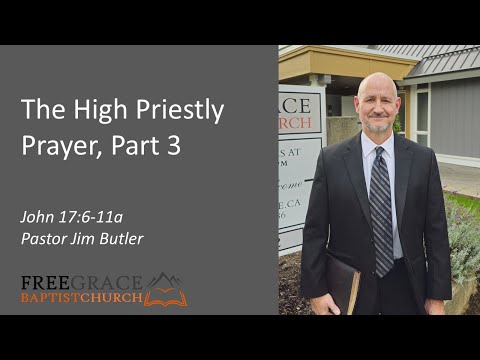
The High Priestly Prayer, Part 3
Jesus intercedes for his apostles in John 17:6–11a, and this sermon examines who those men are, what qualifies them as objects of his high priestly prayer, and why he prays for them rather than for the world. The exposition grounds the disciples' identity in the Father's sovereign, electing gift of them to the Son within the eternal covenant of redemption, their reception of the words the Father gave to the Son, and their growing recognition that the Son is one in being with the Father. The preacher draws out the implication that faithful gospel ministry, like the ministry of Christ himself, must declare only what has been received from God, without accommodation to cultural pressure or the demand for entertainment.

The High Priestly Prayer, Part 2
John 17:4–5 records Christ's proleptic and covenantal claim to have glorified the Father and finished the work given him — a claim that opens into the full theology of active obedience and its indispensable place in justification by faith alone. The sermon demonstrates that Jesus was not merely an ethical example but the obedient substitute whose 33 years of perfect law-keeping is imputed to the elect alongside the forgiveness secured by his blood. Verse 5 is examined against the kenosis error: Christ does not pray to recover a lost glory but to be manifested as the glorified God-man and mediator who has accomplished the covenant of redemption. Believers are exhorted to pursue the knowledge of God and Christ as the essence of eternal life; unbelievers are called to look to the only Savior in whom alone there is both forgiveness and a righteousness that avails before God.

2LCF Chapter 29 - Of Baptism, Part 3 - Paedobaptist Arguments
Believers' baptism rests on the covenant distinction between Israel after the flesh and the spiritual seed of Abraham, and no paedobaptist argument survives the scrutiny of those covenantal boundaries. This third study in the confession's chapter on baptism works through six major paedobaptist arguments — from the Abrahamic covenant, household baptisms, federal holiness, and more — and answers each from Scripture, the 1689 confession, and Nehemiah Cox's seventeenth-century Baptist covenant theology. A question-and-answer period then addresses practical matters: rebaptism after sprinkling or infant immersion, communicating credo-baptist convictions to paedobaptist family and elders, prerequisites for baptism, minimum age, and the necessity of immersion as the sign that answers the thing signified.

Ask FGBC - July 2024 Podcast with Pastors Butler and Kirkpatrick
Two pastors work through a wide-ranging set of questions submitted by listeners, covering the Reformed doctrine of the will, repentance and faith, holy days, Christian political engagement, believers' baptism, the New Covenant, forgiveness of unrepentant offenders, ongoing confession of sin, witnessing to homosexual neighbors, the Sabbath shift from Saturday to Sunday, the day of the Lord, the beatific vision, common grace, saving versus temporary faith, and the holy walk. Throughout, the answers are grounded in the 1689 London Baptist Confession and exposit the relevant biblical texts, consistently distinguishing the Reformed Baptist position from Arminian, dispensationalist, and paedobaptist alternatives. The session serves as accessible catechetical instruction for believers at all stages while modeling how confessional Reformed Baptist theology addresses both doctrinal and practical questions.

The Enthronement of the King-Priest
Psalm 110 is the most frequently quoted Old Testament text in the New Testament, and for good reason: it presents the Lord Jesus Christ in his twofold office as enthroned King and eternal Priest. This exposition works through all seven verses under three headings — the enthronement of Christ at the Father's right hand (vv. 1–3), the Melchizedekan priesthood sworn by God's oath (v. 4), and the triumph of Christ over all his enemies (vv. 5–7). The sermon calls believers entering a new year to fix their minds on the reigning King-Priest rather than on the hostility of the present evil age, and urges the unconverted to come to Christ in faith on the grounds that God's saving purpose is irreversible.

Late in Time Behold Him Come
Galatians 4:4–5 declares that the Son of God entered history at the precise moment determined in the eternal covenant of redemption — not a moment early or late, but at the fullness of the times. The sermon works through four heads: the moment of Christ's coming as the convergence of eternal decree, prophetic anticipation, typological terminus, and Old Covenant tutelage's completion; the mission of the sent Son as the assumption of humanity by the omnipresent divine Word; the mystery of His humiliation in being born of a woman and born under the law as last Adam, obedient servant, and satisfier of the law's penal demands; and the meaning of the Incarnation as the redemption of law-breakers and their adoption as sons of God. The sermon calls believers to daily joy in so great a salvation and urges unbelievers to repent and believe before the day of forced submission.

CTF 2025 - Why Attend the Conference?
Two pastors offer reasons to attend a confessional Reformed Baptist conference centred on the knowledge of God. Drawing on John 17:3 and Jeremiah 9, they argue that knowing the triune God — his being, his perfections, and his works in redemption — is the supreme good, surpassing riches, strength, and worldly wisdom. The conference is commended not as an academic exercise but as a gathering for instruction, corporate worship, and the mutual encouragement of the saints.

2LCF Chapter 29 - Of Baptism, Part 1
Reformed Baptists administer baptism only to professing believers — but why? This confession study works through 2LCF Chapter 29 on baptism by examining the two foundational theological arguments that undergird credobaptism: covenant theology and federal headship. The covenant of grace and the new covenant are shown to be identical in substance, not merely different administrations of one covenant, meaning that only regenerate, believing covenant members are proper recipients of the covenant sign. The argument from federal headship reinforces this conclusion: since baptism signifies union with Christ as covenant head, it cannot rightly be administered to those still under the federal headship of Adam.

The Joy Associated with Christ's Departure
John 16:16–24 records Jesus preparing his disciples for the grief of his death and the joy of his resurrection, framing both under the single announcement 'a little while.' This exposition works through two movements: the announcement of Christ's departure and the disciples' confusion (vv. 16–18), and then the benefits of that departure — lasting joy grounded in the resurrection, and direct access to the Father through prayer in Christ's name (vv. 19–24). The sermon argues that the joy promised here is not the absence of suffering or temporal prosperity, but an indestructible joy rooted in Christ's finished work of life, death, resurrection, and ascension, a joy no adversary can strip from the believer.

Ask FGBC #22: What is the New Covenant in the Reformed Baptist view?
The New Covenant in Reformed Baptist theology is identified as the historical expression of the covenant of grace, ratified in the blood of Christ and offering salvation to God's elect through faith in Jesus Christ. Unlike many Paedo-Baptist positions that locate the covenant of grace in the Abrahamic or Mosaic covenants, the Reformed Baptist view holds that only the New Covenant is that historical expression, with the earlier covenants serving as types and shadows pointing forward to it. Dispensationalism, by contrast, structures redemptive history around distinct divine dealings with Jews and Gentiles, tends to resist the theological covenant framework of redemption, works, and grace as extra-biblical categories, and anchors its New Covenant reading in a literalistic hermeneutic. Jeremiah 31, Hebrews 8 and 10, and the institution of the Lord's Supper together ground the Reformed Baptist insistence that the New Covenant begins with Christ's death and resurrection.

2LCF Chapter 27 – Of the Communion of Saints
The communion of saints, as confessed in 2LCF Chapter 27, is grounded in the believer's union with Christ by the Spirit and through faith — a union that conveys participation in His graces, sufferings, death, resurrection, and glory without any divinization of the creature or diminishment of Christ's divinity. From that vertical union flows a horizontal obligation: holy fellowship in corporate worship, mutual edification through rightly ordered spiritual gifts, and material relief distributed according to ability and necessity. A necessary qualification guards the confession against both spiritual individualism and collectivist error: the communion of saints neither licenses neglect of public worship nor grants any person a right to another's private property, placing both socialism and communism in direct conflict with the Eighth and Tenth Commandments.

The Love of Christ and Love to One Another
John 15:9–11 presents the love of Christ for his disciples as the pattern, precept, and purpose of the Christian life. The Father's love for the Son — infinite, eternal, and unchangeable — is the very measure of Christ's love for his people, a love that is not conditional upon the disciples' obedience but is rather the ground from which obedience springs. Keeping Christ's commandments is not the cause of the disciple's acceptance before God but the consequence of justification freely received: the blood and righteousness of Christ alone secure standing with the Father. The sermon closes with an urgent call to unbelievers to cease searching for joy in creatures and to come to Christ, in whom fullness of joy is found both now and in glory.
The Anatomy of a Benediction
The closing verses of Hebrews unfold one of the most theologically dense benedictions in the New Testament, packed with titles, covenantal language, and christological weight. This exposition works through six elements of the apostolic blessing in Hebrews 13:20–21: the divine title 'God of peace,' the mediatorial title 'great shepherd of the sheep,' the covenantal foundation of Christ's blood, the petition for completeness in obedience, the doxology rendered to Christ, and the necessity of divine enabling for every good work. The sermon draws together the covenant of grace, the resurrection as the divine vindication of Christ's atoning work, and the believer's dependence on God's working in them both to will and to do — all to the end that glory be given to Christ forever.

The Believer's Race, Part 2
Hebrews 12:2 presents Jesus as the supreme object of faith for the believer running the Christian race. This sermon examines five dimensions of Christ to which the runner is directed: His person, His work as author and finisher of the faith, His mission under the covenant of redemption, His suffering and shame on the cross, and His exaltation to the right hand of God. The central pastoral application is that the believer neither enters nor sustains the race by personal effort, but by faith in Christ alone — and that the pattern of the cross preceding the crown should brace believers for mounting opposition to their identification with Jesus.

2LCF Chapter 20 - Of the Gospel and of the Extent of the Grace Thereof
The gospel was not discovered by human reason but revealed by divine initiative — beginning with the protoevangelium of Genesis 3:15 and unfolding through progressive special revelation. This session works through Chapter 20 of the Second London Confession of Faith (1689 LBCF), examining the promise of the gospel, the insufficiency of general revelation for salvation, the sovereign freedom of God in spreading the gospel, and the absolute necessity of the Holy Spirit's effectual work upon sinners dead in trespasses. The doctrinal stakes are practical: a right understanding of general and special revelation is the indispensable foundation for evangelical and missionary enterprise.

The Departure of Christ, Part 2
John 14:29–31 grounds the disciples' faith in Christ's predictive prophecy, his victory over the devil, and his loving obedience to the Father. Jesus announces his departure in advance so that when it comes to pass the disciples will believe — both that he is the object of saving faith and that he is the second person of the triune God. The cross simultaneously displays the Father's love for the world and the Son's love for the Father, and the resurrection and ascension secure every blessing the departing Christ promises his people. The sermon closes with a call to find stability not in practical strategies but in the knowledge of the triune God and the peace Christ himself gives by the Spirit.

The Departure of Christ
John 14:28–31 presents Christ's departure not as cause for sorrow but as grounds for rejoicing, because it leads through the cross to his exaltation at the right hand of the Father. The sermon gives sustained attention to the clause 'my Father is greater than I,' defending Trinitarian orthodoxy against Arian misreading by deploying two hermeneutical guardrails: the consubstantiality of the divine persons (each having the whole divine essence undivided) and partitive exegesis (predicating statements of Christ according to whichever nature is in view). The Father is not greater than the Son in respect of the divine nature, but is greater with respect to the Son's assumed humanity and mediatorial office in the covenant of redemption. Believers are called to rejoice in Christ's departure, to stand in awe that the Spirit has been sent so they are not left as orphans, and to receive the peace Christ bequeaths as their stable foundation for mission.

The Blessing of Gospel Rest
Matthew 11:25–30 grounds the gospel invitation — 'Come to me, all you who labor and are heavy laden' — in the sovereign will of the Father and the mediatorial office of the Son, so that the call to rest is inseparable from the doctrines of election and definite atonement. Jesus thanks the Father for hiding these things from the self-wise and revealing them to babes, declaring that all sovereign authority over salvation belongs to Him as the God-man and mediator. The 'rest' He offers is not relief from physical toil but deliverance from the crushing burden of sin and the impossible demands of pharisaical religion, received through faith alone. Those who come to Christ in faith are also exhorted to take His yoke — the life of sanctification — which is not oppressive bondage but the glad obedience of those justified freely by grace.

The Exceeding Greatness of God's Almighty Power
Paul's prayer in Ephesians 1:19–23 that believers would know the exceeding greatness of God's almighty power raises the question of what that power actually is and what it has accomplished. This sermon works through three interlocking realities: the supremacy of God's omnipotence as a timeless, self-existent, and inexhaustible divine attribute; its decisive demonstration in the resurrection and exaltation of Christ; and the immensity of that exaltation, whereby Christ reigns as head over all creation and over his church. The practical weight falls on believers — the same power that raised Christ from the dead is the power that calls, regenerates, preserves, and will finally resurrect all who are united to him.

CTF 2024 Session 1: An Engaging Overview of the Second London Confession of Faith

The Second London Confession of Faith (1689) did not arise in a vacuum but was forged in response to specific doctrinal crises and pastoral needs within the 17th-century particular Baptist churches. This address traces the historical circumstances behind the Confession's 1677 publication — including the Christological heresies of Thomas Collier and Matthew Caffin, the threat of Quaker mysticism, fear of Roman Catholic resurgence, and the pastoral concern for family catechesis. The speaker then surveys the Confession's 32 chapters as a coherent theological architecture, showing how its structure reflects the covenant of grace viewed from both divine and human perspectives. Listeners are urged to recover the Confession as a living instrument of orthodoxy, protection, instruction, and proclamation for the church today.

The Nature of the Holy Spirit, Part 2
Jesus' promise in John 14:17–18 — that the Spirit of truth cannot be received by the world, yet dwells with and will be in his disciples — grounds the church's dependence on sovereign grace for all gospel ministry. The sermon works through the doctrine of inseparable operations and appropriations to protect both the unity of the Godhead and the distinction of persons, before applying the Spirit's indwelling to the perseverance of the saints and the sufficiency of the gospel. The closing exhortation presses both believers and unbelievers: the Spirit abides forever, justification is by faith alone, and the righteousness of Christ is imputed — not merely forgiveness extended — to all who come to him.

The Whole Armor of God, Part 1
Ephesians 6:10–17 calls the believer to armed, active resistance against a spiritual enemy whose power and cunning exceed any merely human opposition. The sermon works through three movements in the passage: the necessity of the armor (vv. 10–11a), the reason for it in the reality of demonic spiritual warfare (vv. 11b–12), and the meaning of each defensive piece — truth, righteousness, the gospel of peace, faith, and salvation — drawn from both Old Testament background and Paul's wider corpus. Against the tendency toward either passive Christianity or an obsessive preoccupation with demonic activity, the text calls every believer to stand, hold ground, and advance, doing so entirely in dependence on the power of the risen and ascended Christ who reigns over all principalities and powers.

The Promise of Blessings and Cursing, Part 2
Leviticus 26:14–46 sets forth the covenant curses God threatened against Israel for breaking the Mosaic Covenant — a covenant of works — escalating through drought, wild animals, war, cannibalism, wholesale destruction, and exile. These curses came to historical fulfillment in the fall of the Northern Kingdom to Assyria in 722 BC, the fall of the Southern Kingdom to Babylon in 586 BC, and the destruction of Jerusalem by Rome in AD 70 — events prophesied in the Olivet Discourse and confirmed by Paul in 1 Thessalonians 2. The chapter closes with a promise of restoration conditioned on Israel's humble repentance and God's fidelity to the Abrahamic covenant. Believers under the New Covenant are freed from these covenant curses because Christ bore them fully, fulfilling the demands of the law and standing as the surety of a better covenant.

The Promise of Blessings and Curses (Part 1)
Leviticus 26:1–13 opens with a promise of blessing conditioned on Israel's obedience — a structure that raises the question of how the Old Covenant relates to the New. This study expounds the covenantal framework underlying Leviticus 26, arguing that the Old Covenant operated as a covenant of works at the national level, distinct from the covenant of grace realized in Christ. The blessings of rain, peace, and God's presence promised to Israel find their fulfillment in the New Covenant, where the obedience that secures blessing is Christ's own, imputed to his people by faith alone.

The Introduction to the Upper Room Discourse
John 13:1–3 functions as the theological introduction to the entire Upper Room Discourse (John 13–16), establishing three controlling realities: the arrival of Christ's appointed hour, the opposition of the devil through Judas, and the resolute authority and mission of the Son of God. The love of Christ for his own — unchanging, constant, and infinite — is the motivating force behind everything he teaches his disciples in those chapters. Those whom the Father gave to the Son are not a morally superior class but guilty sinners chosen in sovereign grace, loved to the uttermost through the cross, resurrection, intercession, and into eternity. Sound Trinitarian doctrine, far from being merely academic, is the very fuel that moves the church to worship, witness, and perseverance.