
Theological term
Confession of Faith
13 sermons · All terms
2LCF - Introduction to the 1689 London Confession of Faith

The 1689 London Baptist Confession of Faith (properly the 1677 Confession) did not arise in a vacuum: it was a deliberate act of theological stewardship by particular Baptists who stood inside the Reformed Protestant consensus, followed the Westminster Assembly and the Savoy Declaration in structure and wording, and published their confession to correct heterodoxy, serve a new generation, and demonstrate solidarity with fellow persecuted Protestants. This introductory session reads the original epistolary preface to the confession in full and then surveys its argument under five headings — continuity, catholicity, candor, confirmation, and conversation — showing how the confessors understood creeds and confessions as the church's Berean effort to articulate what the Bible says, not to add to it. The session closes with a call to receive the confession in the same spirit in which it was written: not contention, but a whole-souled, humble, and Spirit-dependent owning of the faith once for all delivered to the saints.

Ask FGBC #57: What Are the Requirements for Church Membership?

Church membership is not named by a single proof-text, yet the New Testament data — the numbered and joinable Jerusalem church, the bounded authority of pastors, the mutual accountability of members, and the discipline procedure of Matthew 18 — together demand a formal, local church membership. The prerequisites a confessional Reformed Baptist church may rightly require are a credible profession of faith, baptism by immersion, a general understanding of the confession of faith, a willingness to submit to the church's doctrine and government, and familiarity with its constitution and bylaws. A published confession of faith protects both the church and prospective members by ensuring honest communication of what the church believes before anyone commits to join. The question of young believers and membership is handled on a case-by-case basis, with no principled bar to admitting a child who has professed faith and been baptized.
Intro/Teaser - CTF 2026 - Understanding God's Decree
This introductory segment promotes the 2026 Confessing the Faith conference hosted by Free Grace Baptist Church in Chilliwack, BC, which will address 1689 London Baptist Confession Chapter 3 on the decree of God. The conference follows a sequential exposition of the confession, having previously covered the doctrine of Scripture (Chapter 1) and the doctrine of God and the Holy Trinity (Chapter 2). Featured speakers include Dr. Jim Renahan and Dr. Richard Barcelos of the International Reformed Baptist Seminary, alongside Pastor David Charles, who will offer a pastoral reflection on how the doctrine of divine decree is to be taught, embraced, and preached. The segment frames the doctrine of God's decree as foundational to Christian stability, peace, and worship, contending that what believers face in this world is governed by the sovereign God who has ordained whatsoever comes to pass for His glory and the good of His people.
The Use of the 2nd London Confession
A confession of faith is not a human addition to Scripture but a tool the church uses to define, defend, discriminate, discipline, and delimit its doctrine. Drawing on passages from the Pastoral Epistles, Jude, and Ephesians 4, this Sunday School address argues that the Second London Baptist Confession of 1689 serves the local church in six concrete ways: it establishes doctrinal boundaries, equips members for apologetics, vets candidates for ministry, grounds church discipline, protects Christian liberty by identifying what lies outside its purview, and anchors the church in the catholicity of the Reformed tradition. The session closes with a call to reject autonomous biblicism in favour of confessional theology understood as the fruit of the Spirit's ongoing work in the teaching ministry of Christ's church.

CTF 2025: Why This Conference?
This recorded conversation introduces a Reformed Baptist theological conference structured around a chapter-by-chapter study of the 1689 London Baptist Confession of Faith. The speakers explain that the conference was conceived to promote edification among pastors and laypeople alike by gathering around the central doctrines summarized in the confession. The format draws on the pattern of a long-running Southern California Reformed Baptist conference that worked through confession chapters progressively over successive years. The vision is explicitly confessional: to equip God's people to know what Scripture teaches and to receive faithfully the theological heritage passed down through the Reformed Baptist tradition.

Ask FGBC #32: Are there different types of faith? Ie. temporary, historical, saving
Scripture distinguishes several types of faith, and only saving faith — the kind that receives and rests upon Jesus Christ — differs qualitatively, not merely in degree, from historical or temporary faith. Historical faith acknowledges the facts about Christ without personal trust; temporary faith produces an apparent profession that does not endure. Saving faith, even in its weakest form, is united to Christ as its object and is accompanied by all other saving graces, working through love. The 1689 London Baptist Confession of Faith chapter 14 paragraph 3 grounds the distinction: even weak saving faith is different in kind from the faith of temporary believers, and it will ultimately attain full assurance through Christ, the author and finisher of our faith.
CTF 2025 - Why another conference?
This preview conversation introduces a confessional Reformed Baptist conference designed to walk through the 1689 Second London Baptist Confession of Faith one chapter per year, gathering pastors, elders, and laypeople around the doctrines most surely believed among Reformed Christians. The 2025 conference focuses on Chapter 2 of the confession, a chapter with significant overlap with the Westminster Confession, the Savoy Declaration, and the Belgic Confession. The stated purpose is the edification of the saints through theological instruction, fellowship, and fidelity to the received biblical and confessional heritage.

CTF 2024 Session 3: A Robust Defense of the Scriptures

Creeds and confessions are not supplements to Scripture but summaries of its central propositional content, necessary for intelligent faith, faithful evangelism, and the defense of orthodoxy. Drawing on Romans 12:1-2, James Renihan argues that right living always flows from right believing, and that the theological, ethical, and redemptive-historical dimensions of Scripture all demand that Christians be able to articulate the facts of the faith. Confessions function positively to state the contents of the faith and connect believers across time and place, and negatively to identify error and mark the boundaries of true Christianity. The session closes with a survey of confessional language embedded in the New Testament itself — from the Shema to the apostolic christological summaries — demonstrating that creeds are not a human invention imposed on Scripture but a distillation of what Scripture already teaches.

Introduction to the 1677/1789 2nd London Baptist Confession of Faith
The 1689 London Baptist Confession of Faith — formally composed in 1677 and adopted by particular Baptist churches in 1689 — stands in deliberate continuity with the Westminster Confession and the Savoy Declaration, adapting their language to reflect distinctively Baptist convictions while maintaining solidarity with the broader Reformed tradition. This introductory session traces the Confession's historical origins, its relationship to the First London Confession of 1644–46, and the legal and ecclesiastical context in which particular Baptists operated under the Act of Toleration. Six reasons are then advanced for why a 21st-century church should subscribe to a 17th-century confession: to define, defend, discriminate, discipline, distinguish matters of Christian liberty, and develop an appreciation for the history of the church. The session closes by urging that confessionalism, rightly understood, is not proud biblicism but the humble reception of gifts Christ has given to his church across the ages.
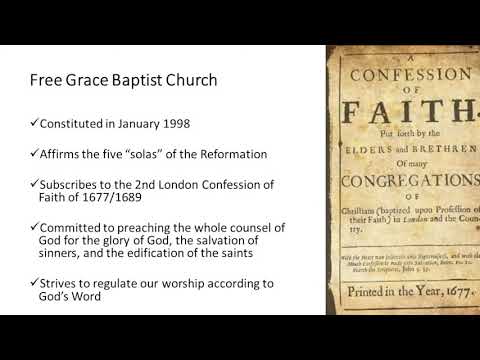
Introduction to the 1689 Second London Baptist Confession of Faith
Why should a church bind itself to a confession of faith? This introductory lesson on the Second London Baptist Confession of 1677/1689 grounds the answer exegetically in Ephesians 4 — where Christ gives gifted men to the church so that the body attains doctrinal unity and is no longer tossed about by every wind of teaching — and then traces the historical origins of the 1689 among the Particular Baptists, distinguishing them from Anabaptists, Presbyterians, and Congregationalists. Four functions of a confession are developed: defining, defending, discriminating, and disciplining with reference to the doctrine of the church. The lesson closes by distinguishing Reformed theology (Calvinism plus covenant theology plus the regulative principle) from mere five-point Calvinism, and by defending the confession's silence on matters of Christian liberty as a feature, not a defect.

The Utility of Confessions and Introduction to the Second London Baptist Confession
Confessions of faith are not competitors to Scripture but are faithful summaries of biblical doctrine, and the church has historically depended on them for good reason. This address introduces the Second London Baptist Confession of 1689, tracing its historical origins among the Particular Baptists of the 17th century and its relationship to the Westminster Confession and the Savoy Declaration. Five interlocking uses of a confession are then examined: defining church doctrine, defending it against error, discriminating between members and officers on doctrinal grounds, disciplining departures from orthodoxy, and distinguishing confessed doctrine from matters of Christian liberty. The goal is not confessional enslavement but confessional clarity — guardrails that protect the church and free her members to worship and grow in the grace and knowledge of Christ.

The Church at Antioch
Acts 11:19–30 presents the founding and early life of the church at Antioch as a model for faithful ecclesiology. The sermon traces three features of that church's first days: the gospel preaching that gathered a diverse congregation, the apostolic oversight exercised through Barnabas, and the year-long teaching ministry of Barnabas and Saul that catechised those converts in Christian doctrine. The passage is read through the lens of divine sovereignty — it was the hand of Yahweh that produced the conversions, working through the ordinary means of preaching — and closes with an application of six characteristics that every church should emulate: evangelism, converted membership, doctrinal instruction, Christ-centredness, charity, and dependence on the grace of God alone.
Joshua 2
Joshua 2 presents Rahab the harlot as an unexpected trophy of divine grace — a Canaanite prostitute whose confession of Yahweh's sovereignty stands as one of the most remarkable declarations of faith in the entire Hebrew Bible. Working through the chapter in three movements — the reconnaissance mission (vv. 1–7), Rahab's confession of God's sovereignty (vv. 8–14), and the covenant agreement with the spies (vv. 14–24) — the study shows that the ethical question of Rahab's lie is a distraction from the text's true center: her recognition of Yahweh as the one God over heaven and earth. The concluding application presses the Abrahamic promise that all nations will be blessed through Israel, and reminds hearers that the church is not a club for the respectable but a refuge for sinners redeemed by grace.