
Theological term
Condescension
16 sermons · All terms

The Glorious Proverb

The Gospel can be stated with stunning brevity: Christ Jesus came into the world to save sinners. Expounding the 'faithful saying' of 1 Timothy 1:15, this sermon examines why the apostolic proverb is trustworthy and deserving of universal acceptance — rooting its reliability in the character of the God who speaks it and the Christ who performs it. The condescension of the eternal Son is explored with care, guarding against any notion that the omnipresent God vacated heaven to visit earth, while insisting that he genuinely assumed human nature for the redemption of sinners. The sermon closes with three applications: the sinner may rest on this saying because its foundation is the faithfulness of the triune God, the Incarnation should produce deep humility, and no degree of personal sin places a soul beyond the reach of Christ's saving power.
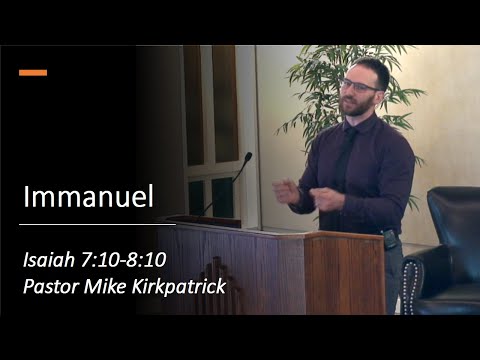
Immanuel

Isaiah 7:10–8:10 presents the Immanuel prophecy not as a comfortable seasonal text but as a word of judgment against Ahaz's faithless trust in Assyria and a word of hope for the covenant remnant. The sermon traces two contrasting realities: 'Assyria with us,' the consequence of royal unbelief, and 'God with us,' the promise that anchors the remnant through exile and desolation. The Immanuel sign finds its definitive fulfillment in Matthew 1, where the virgin-born Son saves his people from sin rather than merely political oppression — a truth that remains the ground of steadfastness for the church in every era of suffering and exile.

The Majestic Name
Psalm 8 frames the majestic name of God as the beginning and end of all true praise, confronting the reader with the infinite distance between Creator and creature while simultaneously revealing the astonishing condescension of God in both creation and redemption. The sermon works through three movements: God's majestic name proclaimed in creation and defended through weakness (vv. 1–2), God's mindfulness of an infinitesimal humanity (vv. 3–5), and God's appointment of man to vice-regential dominion (vv. 6–9). Each movement is shown to find its ultimate fulfilment in the Lord Jesus Christ — the one who, as the last Adam, was made a little lower than the angels to purchase new creation for his people. The sermon closes with a call to study the attributes of God as the antidote to idolatry, and with a direct appeal to unbelievers to look to Christ, in whom Psalm 8 is fully realised.
A Thoughtful Diligence in Fellowship
Hebrews 10:24–25 contains the third of three apostolic exhortations grounded in Christ's blood and high-priestly office: a thoughtful diligence in corporate fellowship that stirs one another to love and good works. The sermon traces the call to mutual consideration — looking away from self and toward brothers and sisters in Christ — and grounds its motivation in the incarnate humility of the Son of God, who made himself of no reputation to serve sinners. Forsaking the assembly is not a private failure but a breach of the covenantal reciprocity that belongs to those who rest on so great a salvation.

Free Grace Baptist Church - September 17, 2017 PM
How do we know the gospel is true? First John 1:1–4 opens with John's answer: the apostolic witness to Jesus Christ is grounded in direct sensory experience — hearing, seeing, and handling the Word of life. This sermon works through the introduction to First John under three headings: the messenger, his message, and the benefits of that message. The exposition confronts early docetism (the denial that Christ came in the flesh), insists that eternal life is found only in the incarnate, crucified, and risen Son of God, and calls hearers to hold fast to the apostolic gospel as the only ground of true fellowship with the Father and the Son and of lasting joy.

The Hymn to Christ as to God
Philippians 2:5–11, known in scholarly and devotional tradition as a hymn to Christ as to God, opens a series of expository studies through one of the most concentrated christological passages in the New Testament. This sermon establishes the exhortation's context within the letter to the Philippians — a message of thanksgiving and rejoicing addressed to a church facing external persecution but inward temptation toward pride and disunity — and then examines the exordium of verse 5: 'Let this mind be in you, which was also in Christ Jesus.' Three qualifications govern the use of Christ as example: He is not only nor primarily an example, Christians are called to imitate His disposition rather than duplicate His saving work, and this lowliness of mind is not the pathway to salvation but the characteristic mark of those already saved by grace through faith. The sermon closes with a direct call to humility modeled on Christ's condescension and an evangelistic summons to believe on the Lord Jesus Christ before that day when every knee shall bow in judgment.

A Sure and Proven Creed
First Timothy 1:15 presents what Charles Spurgeon called 'the whole gospel in one verse' — a faithful saying worthy of all acceptance. This sermon expounds the verse under three headings: the introduction to the creed (its truthfulness and trustworthiness), the creed itself (Christ Jesus as champion, his incarnational coming, and his consummate saving work), and the demonstrable confirmation of the creed in the conversion of the Apostle Paul, the self-declared chief of sinners. Believers are exhorted to ground assurance not in inward experience but solely in the person and finished work of Christ Jesus, the Lord.
The Incarnation and True Humanity of Christ
Philippians 2:5–11 anchors a study of the incarnation and true humanity of the Lord Jesus Christ. Drawing on the Nicene, Constantinopolitan, Chalcedonian, and Athanasian creeds together with the 1689 London Baptist Confession of Faith, the study traces three aspects of the incarnation — assumption of human nature, the virgin birth, and the union of two natures in one person — before marshalling seven biblical proofs of Christ's full humanity. The central argument throughout is soteriological: the Son of God must be truly and perfectly man, body and soul, yet without sin, because only such a mediator can make propitiation for guilty sinners and be their faithful high priest.

John's Incarnation Theology
John 1:1–18 presents the most concentrated incarnation theology in the New Testament, and this sermon works through that prologue under four headings: the eternality of the Word, his personal distinction from the Father, his full and essential deity, and his true humanity. The Word who has always existed as God, distinct from the Father yet of one undivided substance with him, took to himself man's nature — not by casting off deity, nor by confusion of the two natures, but by a condescension in which he remained what he always was while becoming what he was not. The sermon guards each heading by naming and refuting the classical heresies that have distorted each truth, drawing on John 8, John 18, John 20, Philippians 2, and 1689 LBCF 8.2. The application calls believers to deepen their knowledge of this Christ and urges the unconverted to believe on the Lord Jesus Christ before that same Christ comes as the sovereign judge of Revelation 19.
The Manger's Heavenly Guest
Luke 2:1–14 presents the incarnation of the Lord Jesus Christ not as myth or allegory but as verifiable, prophecy-fulfilling history. The sermon works through four headings: the fact of the incarnation (its straightforward, openly disclosed, prophetically saturated character), the humility of the incarnation (God taking on humanity in an inglorious condition, pointing toward the cross), the message of the incarnation (good tidings of a Savior delivered to unpolished shepherds by divine kindness), and the hymn of the incarnation (the angelic doxology ascribing all glory to God and proclaiming peace to those who receive Christ). Hearers are pressed to follow the trajectory of Christmas not to a sentimental infant but to a crucified, risen, and ascended Savior, and those who reject Him are warned of judgment to come.
The Birth of Jesus Christ
Luke 2:1–14 presents the birth of the Lord Jesus Christ not as pious legend but as historically anchored, geopolitically situated, and theologically loaded narrative. This Bible study works through five aspects of Christ's incarnation — its timing in the fullness of the times (Galatians 4:4), its place in fulfillment of Micah 5:2 and the Davidic covenant, its purpose in the salvation of sinners, the proper angelic-and-human response of praise to God alone, and the manner of Christ's humiliation: born, born in a low condition, born under the law, subjected to the miseries of this life, and destined for the wrath of God and the cursed death of the cross. The Spurgeon quotation that closes the study drives home the Calvinistic logic of the angels' song: 'Glory to God in the highest' belongs to a salvation that puts God first, last, and without end — leaving no crown for the creature.
God in a Feed Trough
Luke 2:1–14 presents the incarnation of the Son of God not as myth or legend but as a historically verifiable, prophetically grounded event. The sermon traces four features of the nativity narrative: its veracity, its condescension, its proclamation, and the angels' hymn of praise. The central burden is that 'God in a feed trough' — the Word made flesh, born in Bethlehem, lying in a manger — is not a sentimental image at which thought terminates, but the inaugurating moment of the redemptive mission that ends at the cross and empty tomb, and therefore the proper object of unceasing wonder, proclamation, and praise.
The Gospel in the Graveyard
Mark 5:1–20 presents a man utterly beyond human remedy — demon-possessed, dwelling among tombs, breaking every chain — as a vivid picture of the sinner in his natural condition before grace. The sermon works through four movements: the sovereign, condescending Christ who seeks out individuals; the absolute bondage that characterises fallen humanity; the peace with God that Christ alone effects through the blood of His cross; and the commission to proclaim His excellencies wherever one is planted. The application presses both believer and unbeliever to see themselves in the demoniac, to glory in the depth of the pit from which they were drawn, and to tell others of the compassionate Christ who saves to the uttermost.
A Little Sinner and a Big Savior

Luke 19:1–10 presents the conversion of Zacchaeus as a concentrated display of sovereign, covenant-keeping grace. The sermon works through Zacchaeus's identity as a chief tax collector, a rich man, and above all a lost sinner, before turning to the mission of Christ: he condescends, calls by name, and saves by grace alone through faith alone, with repentance and good works following as inevitable fruit. The closing application presses both the unconverted to make haste to Christ and the converted to receive him joyfully as they come to the Lord's Supper.
The Davidic Covenant
The Davidic Covenant of 2 Samuel 7 represents the climactic stage of Old Testament redemptive revelation, in which God formally establishes a dynasty — not merely a building — for his servant David, promising an eternal throne and a coming king whose reign sin, death, and time cannot annul. The sermon traces three particulars: the historical setting of the covenant, the design of God within it, and the testimony of the prophets who anticipate its fulfillment. These threads converge in the Lord Jesus Christ, who — as Peter argues in Acts 2 — ascended to David's throne at his resurrection and currently rules and reigns over all things for the sake of his church. Hearers are called to trust in David's greater Son and not to leave neglecting so great a salvation.
The Glory of Christ in His State of Humiliation
What does the eternal Son of God's descent from infinite glory to a cattle trough reveal about the nature of his saving work? This sermon on Luke 2:1–14 traces five aspects of Christ's state of humiliation — the timing, place, purpose, manner, and cost of the incarnation — showing that each detail, from the manger to the mocking soldiers to Gethsemane, is not an occasion for embarrassment but for worship. The incarnation was not a sentimental seasonal event but the arrival of the eternal Son, veiled in flesh, to bear the wrath of God and the curse of the cross as the active and passive obedient substitute for guilty sinners. Hearers are called to centre their daily praise on this Christ, to learn humility from his condescension, and to believe on the Lord Jesus Christ and be saved.