
Theological term
Christian Liberty
30 sermons · All terms

2LCF Chapter 21 - Of Christian Liberty and Liberty of Conscience

Christian liberty, as defined in chapter 21 of the Second London Confession of Faith (1689), consists in deliverance from the guilt, power, and punishment of sin — purchased by Christ and applied by the Spirit to every believer in every age. The chapter further distinguishes Old Covenant from New Covenant worship, affirming that while salvation blessings were shared across both covenants, New Testament believers enjoy freedom from the ceremonial law, greater boldness of access to God, and fuller communication of the Holy Spirit. Liberty of conscience means God alone is Lord of the conscience, freeing believers from ecclesiastical tyranny, civil totalitarianism, and the moral impositions of men — whether popes, parliaments, or fellow professors. Christian liberty is not license to sin but the freedom to serve God in holiness and righteousness, delivered unto righteous obedience rather than from obligation to it.

Who Are the Heirs of the Promise?
Galatians 3:29 and 4:6–7 together answer the question of who truly inherits the promises made to Abraham: not those physically descended from him, nor those who observe Mosaic ceremonies, but those who are united to Christ by saving faith. The sermon traces the covenant-theological distinction between Abraham's physical seed and his spiritual seed, showing that membership in the covenant of grace is coextensive with those who receive the definite atonement of Christ. The Trinitarian shape of redemption — the Father sending the Spirit of the Son into the hearts of adopted sons — seals the argument, and the sermon draws out implications for believer's baptism and the enlarged liberty of the new covenant age.

The Warning Against Judaizers

Philippians 3:1–3 contains the only sustained polemical section in the epistle, and the apostle Paul deploys it as a warning against Judaizers — those who insisted that faith in Christ must be supplemented by Mosaic ceremonies such as circumcision for acceptance with God. Working through Paul's strategy in verse 1, his three-fold warning in verse 2, and his corrective in verse 3, the sermon demonstrates that the Judaizing error — whether in its first-century form, in Roman Catholicism, or in modern movements such as the New Perspective on Paul and Federal Vision — nullifies the grace of God by refusing to let Christ be a whole Savior. The church's only boast, identity, and worship are grounded in Christ alone, received through faith alone, apart from any confidence in the flesh.
The Use of the 2nd London Confession
A confession of faith is not a human addition to Scripture but a tool the church uses to define, defend, discriminate, discipline, and delimit its doctrine. Drawing on passages from the Pastoral Epistles, Jude, and Ephesians 4, this Sunday School address argues that the Second London Baptist Confession of 1689 serves the local church in six concrete ways: it establishes doctrinal boundaries, equips members for apologetics, vets candidates for ministry, grounds church discipline, protects Christian liberty by identifying what lies outside its purview, and anchors the church in the catholicity of the Reformed tradition. The session closes with a call to reject autonomous biblicism in favour of confessional theology understood as the fruit of the Spirit's ongoing work in the teaching ministry of Christ's church.

2LCF Chapter 25 - Of Marriage
Marriage as a divine institution is examined through the four paragraphs of 2LCF Chapter 25, with Matthew 19:5–6 as the anchor text where Christ grounds marriage in the creation of male and female. The sermon argues that marriage is not a social construct or ecclesiastical sacrament but a creation ordinance ordained by God before the fall, designed for the union of one man and one woman in monogamous covenant. A threefold providential purpose is unfolded — companionship, the inhabitation of creation, and a hedge against sexual immorality — and the regulative bounds of marriage regarding consanguinity, affinity, and Christian marital duty are applied against both contemporary sexual confusion and Roman Catholic sacerdotalism.

2LCF Chapter 24 - Of the Civil Magistrate
What does the Bible teach about civil government, and how should Christians relate to governing authorities? Working through 2 London Baptist Confession of Faith Chapter 24, this study expounds the divine origin and limited purpose of civil magistracy, the lawfulness of Christian participation in government, and the qualified obedience owed to rulers who govern within God-ordained bounds. The particular Baptists are shown to occupy a distinct position between the Anabaptist rejection of civil authority and the Erastian tendencies of their Presbyterian contemporaries, grounding Christian submission not in the authority of the magistrate but in the sovereign ordination of God over all nations.

CTF 2024 Session 1: An Engaging Overview of the Second London Confession of Faith

The Second London Confession of Faith (1689) did not arise in a vacuum but was forged in response to specific doctrinal crises and pastoral needs within the 17th-century particular Baptist churches. This address traces the historical circumstances behind the Confession's 1677 publication — including the Christological heresies of Thomas Collier and Matthew Caffin, the threat of Quaker mysticism, fear of Roman Catholic resurgence, and the pastoral concern for family catechesis. The speaker then surveys the Confession's 32 chapters as a coherent theological architecture, showing how its structure reflects the covenant of grace viewed from both divine and human perspectives. Listeners are urged to recover the Confession as a living instrument of orthodoxy, protection, instruction, and proclamation for the church today.
2LCF Chapter 21 - Of Christian Liberty and Liberty of Conscience
Christian liberty, properly understood, is not primarily about matters of lifestyle preference but about the freedom Christ has purchased for believers: freedom from the guilt, power, and punishment of sin, and freedom for joyful, childlike access to and obedience toward God. The 1689 London Baptist Confession chapter 21 unfolds this in three movements — the definition of Christian liberty (paragraph 1), the protection of liberty of conscience (paragraph 2), and the qualification that Christian liberty is never a license to sin (paragraph 3). Central to paragraph 2 is the confession's axiomatic claim that God alone is Lord of the conscience, which means neither civil authority nor ecclesiastical authority may bind the conscience beyond or against the Word of God. The practical application presses believers to distinguish between God's explicit commands and their own preferences, and to resist the near-universal temptation to elevate personal opinion to the status of thus saith the Lord.

2LCF Chapter 21 - Of Christian Liberty and Liberty of Conscience
This exposition of 2nd London Baptist Confession chapter 21 (Of Christian Liberty and Liberty of Conscience) examines what freedom Christ secures for his people and what that freedom does not permit. The sermon works through three liberties from sin's bondage — from its guilt, its power, and its punishment — before turning to freedom in worship and obedience, distinguishing what Old and New Testament believers share and what New Testament believers enjoy in greater measure: freedom from the ceremonial law, greater boldness of access to the throne of grace, and fuller communication of the Spirit. A substantial section treats liberty of conscience — freedom from ecclesiastical tyranny, civil totalitarianism, and moral impositions of men — and the sermon closes by warning against the perversion of Christian liberty into licentiousness.

The 4th Commandment (Part 3)
The Christian Sabbath is grounded in both creation and redemption, and the New Testament establishes Sunday — the Lord's Day — as the day of corporate worship by precedent and pattern rather than by bare precept. This third installment in a study of the Fourth Commandment examines three apostolic texts (Acts 20:7, 1 Corinthians 16:1–2, Revelation 1:10) that demonstrate the early church's practice of gathering on the first day of the week, then turns to two alleged anti-Sabbatarian passages (Romans 14 and Galatians 5) to show that neither addresses the weekly Sabbath but rather deals with Jewish calendar observances and the question of justification by works. The moral principle of one day in seven set apart for God remains binding on New Covenant believers, while the positive law has lawfully shifted the day from Saturday to Sunday in light of Christ's resurrection.
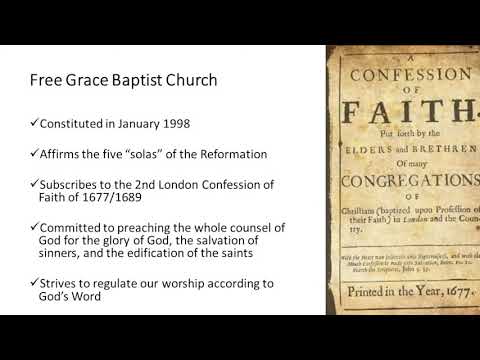
Introduction to the 1689 Second London Baptist Confession of Faith
Why should a church bind itself to a confession of faith? This introductory lesson on the Second London Baptist Confession of 1677/1689 grounds the answer exegetically in Ephesians 4 — where Christ gives gifted men to the church so that the body attains doctrinal unity and is no longer tossed about by every wind of teaching — and then traces the historical origins of the 1689 among the Particular Baptists, distinguishing them from Anabaptists, Presbyterians, and Congregationalists. Four functions of a confession are developed: defining, defending, discriminating, and disciplining with reference to the doctrine of the church. The lesson closes by distinguishing Reformed theology (Calvinism plus covenant theology plus the regulative principle) from mere five-point Calvinism, and by defending the confession's silence on matters of Christian liberty as a feature, not a defect.

The Christian Sabbath, Part 3
Three passages in the New Testament — Romans 14, Galatians 4, and Colossians 2 — are commonly marshalled against the abiding validity of the Fourth Commandment, but careful exegesis reveals that none of them address the weekly Lord's Day Sabbath. Romans 14 concerns Christian liberty over matters indifferent, principally Jewish dietary laws and Israel's feast calendar; Galatians 4 rebukes the Judaizers' demand that calendar observance supplement faith in Christ for justification; and Colossians 2 warns against a syncretistic heresy that mingled Christ, Judaism, and angel worship. In each case Paul is dealing with Israel's ceremonial calendar, not the moral Sabbath commandment rooted in creation and redemption, which remains binding on the new covenant people of God and is observed on the first day of the week in light of Christ's resurrection.

The Utility of Confessions and Introduction to the Second London Baptist Confession
Confessions of faith are not competitors to Scripture but are faithful summaries of biblical doctrine, and the church has historically depended on them for good reason. This address introduces the Second London Baptist Confession of 1689, tracing its historical origins among the Particular Baptists of the 17th century and its relationship to the Westminster Confession and the Savoy Declaration. Five interlocking uses of a confession are then examined: defining church doctrine, defending it against error, discriminating between members and officers on doctrinal grounds, disciplining departures from orthodoxy, and distinguishing confessed doctrine from matters of Christian liberty. The goal is not confessional enslavement but confessional clarity — guardrails that protect the church and free her members to worship and grow in the grace and knowledge of Christ.

The Meeting with James in Jerusalem
Acts 21:17–40 narrates Paul's final recorded visit to Jerusalem, where he meets with James and the elders before being seized by a mob in the temple. The sermon works through four aspects of the meeting — reception, report, response, and recommendation — to demonstrate that James and Paul were in full theological harmony, both preaching justification by grace alone through faith alone in Christ alone. The arrest that follows illustrates both the rage of unbelieving Israel and the sovereign providence of God, who uses Roman civil authority to preserve his apostle. Hearers are urged to imitate Paul's spirit of conciliation on secondary matters, insist on the gospel above all else, and trust the God who receives sinners.

The Fourth Commandment, Part 3
Romans 14, Galatians 4, and Colossians 2 are frequently cited as evidence that no special day of worship remains for the people of God, but a careful exegesis of each passage shows they address Jewish ceremonial observances and food laws — not the moral, Decalogical Sabbath. The argument of Romans 14 concerns Christian liberty in matters of diet and ethnic calendar practices, not the abrogation of the Lord's Day; Galatians 4 condemns the Judaizing of salvation by attaching religious merit to ceremonial observances; and Colossians 2:16-17 targets the 'sabbaths' that functioned as shadows alongside new moons and festivals — a grouping the Old Testament itself consistently distinguishes from the weekly Sabbath. The Christian Sabbath, grounded in creation, codified at Sinai, prophesied for the new covenant era, and transposed by Christ's resurrection to the first day of the week, remains binding on the people of God — kept not as a means of justification but as a fruit of it.

Free Grace Baptist Church - September 22, 2019 AM
Acts 10:9–16 presents Peter's vision of the great sheet as more than a curiosity about dietary law — it is a decisive turning point in redemptive history, signaling the formal inclusion of the Gentiles in the covenant promises of God. The sermon works through three particulars of the vision: its occasion (Peter's noon prayer on the housetop), the vision proper (the sheet with clean and unclean animals), and God's explanation ('What God has cleansed you must not call common'), tracing the contrast with Ezekiel 4 to show that where Ezekiel's unclean diet symbolized Israel's defilement among the Gentiles, Peter's vision announces the Gentiles' purification alongside Israel. The exposition addresses the threefold division of the law — moral, ceremonial, and judicial — demonstrating that the food laws were ceremonial and always purposed by God to be abrogated by Christ's fulfillment, with implications for how new covenant Christians navigate Christian liberty, avoid judgmentalism toward one another, and proclaim a gospel that comes to helpless sinners without additions or conditions.

The Purity of God's Word
Proverbs 30:5–6 presents two inseparable claims: every word of God is pure, and God is a shield to those who trust him. This sermon expounds the purity of Scripture as an attribute derived from the character of God himself, extends it across every genre and testament, and anchors it in the New Testament's own witness to its inspiration and authority. The warning of verse 6 — that adding to God's words brings divine rebuke and the verdict of liar — is applied not only to unbelieving Judaism, Roman Catholic tradition, and Charismatic continuationism, but to the Reformed believer's own temptation to bind consciences where God has not legislated. Hearers are called to read the whole counsel of God daily, to rest in its sufficiency, and to resist every impulse to place human words on a level with or in competition with divine revelation.

Liberty and Law

Galatians 5:1–15 presents the Pauline application of justification by faith alone: those whom Christ has liberated from the law's curse must stand fast in that freedom rather than entangle themselves again in the yoke of legal works-righteousness. The sermon works through two headings — the liberty of Christ (vv. 1–6) and the law of love (vv. 7–15) — showing that true Christian liberty is neither license for sin nor grounds for adding human merit to Christ's finished work. Justified believers are called to a gospel holiness expressed through love of God and neighbor, lived out by the Spirit in dependence on Christ's imputed righteousness alone.

Of Religious Worship and the Sabath Day (Part 3) (2LCF 22)
Romans 14, Galatians 4, and Colossians 2 are frequently cited to argue that the New Testament abolishes the Christian Sabbath, but each passage, read in context, is addressing something else entirely. Romans 14 concerns Christian liberty and mutual forbearance between stronger and weaker brethren over food and culturally retained Jewish observances; Galatians 4 condemns the Judaizers' insistence that legal observances can supplement faith and commend a sinner to God; and Colossians 2 targets the ceremonial, typological Sabbaths of Israel's calendar — festivals, new moons, and occasional sabbaths — not the weekly moral Sabbath rooted in creation and carried forward into the Lord's Day. The fourth commandment's moral obligation to set apart one day in seven for worship is a positive, perpetual, and binding ordinance, and Sabbath-keeping is the fruit of justification by grace through faith in Christ, not a means of obtaining it.

2LCF Chapter 21 - Of Christian Liberty and Liberty of Conscience
Christian liberty is grounded not primarily in political or personal freedoms but in the perfect saving work of Christ, who has purchased freedom from the guilt, power, and punishment of sin for all his elect. This study works through 1689 London Baptist Confession of Faith chapter 21, paragraphs 1–3, tracing the biblical foundations of liberty of conscience against both Roman Catholic ecclesiastical imposition and antinomian abuse of grace. The New Testament enlarges the freedom already held by Old Testament believers by releasing them from the ceremonial law's yoke, granting bolder access to the throne of grace, and communicating the Spirit more fully. True Christian liberty issues not in licentiousness but in cheerful, childlike obedience to God, freed from slavish fear and self-imposed religious scrupulosity alike.

Free Grace Baptist Church - October 23, 2016 PM
What does it look like for a justified sinner to walk in the Spirit? Working through Galatians 5:22-26, this exposition of the fruit of the Spirit demonstrates that love, joy, peace, long-suffering, kindness, goodness, faithfulness, gentleness, and self-control are not optional extras but the necessary outflow of justification by grace alone through faith alone in Christ alone. The sermon argues that because those who belong to Christ have crucified the flesh with its passions and desires at regeneration, the absence of these fruits is not an excuse but a call to repentance, and the presence of the Spirit provides the very power by which they are cultivated.
Spiritual Discernment and the Limits of Judgment
Matthew 7:6 — 'Do not give what is holy to the dogs, nor cast your pearls before swine' — is not a withdrawal from gospel witness but a call to Spirit-given discrimination between brothers in Christ and hardened enemies of the gospel. The sermon works through the contrast between Matthew 7:1–5 (censorious judgment toward brothers) and 7:6 (the prohibition against treating dogs and pigs as brothers, and vice versa), showing that the same Jesus who forbids a judgmental spirit also forbids a naive one. Drawing on Calvin, Spurgeon, and the apostolic precedents in Acts and the Pauline epistles, the exposition applies the text in three directions: guard against judgmentalism toward brethren, remove your own plank before correcting others, and seek wisdom to identify genuine enemies of the gospel without lazily writing off ordinary sinners.
2LCF Chapter 21 - Of Christian Liberty and Liberty of Conscience, Part 1
Christian liberty, as defined in 2LCF Chapter 21, is not primarily about what believers are permitted to do but about what Christ has accomplished for them — freedom from the guilt, power, and punishment of sin, as well as freedom from the ceremonial yoke of the Old Covenant. The chapter also guards the conscience from two opposing errors: the tyranny of ecclesiastical or civil impositions that bind the conscience beyond God's Word, and the antinomian perversion that treats liberty as license for sin. The sermon calls believers to live under God's Word alone as the Lord of the conscience, neither adding to it nor subtracting from it, walking in holiness and righteousness without fear.

The Warning Against Despising Believers
Jesus' warning in Matthew 18:10–14 against despising fellow believers is neither a peripheral concern nor a suggestion for pleasant church life — it is a binding command addressed to the very tendency toward pride and contempt that lurks in regenerate hearts. The sermon works through three movements: the prohibition itself with its two supporting reasons (the ministry of angels and the redemptive mission of the Son of Man), the parable of the straying sheep (read in its Matthean context as pastoral recovery rather than evangelistic proclamation), and the Father's stated will that none of these little ones should perish. The congregation is pressed to see that when the Father, the Son, and the angels all esteem the little ones, any contempt shown by one believer toward another is an affront to the entire Trinitarian economy of redemption. The exhortation is concrete: kill pride at the root, receive rather than reject fellow believers, and willingly surrender Christian liberties rather than scandalize a brother for whom Christ died.

The Warning Against Causing Offense
Matthew 18:5–9 confronts the damning danger of causing offense — the Greek scandalon — to Christ's 'little ones,' those who believe in him. The passage divides the threat into two categories: offenses arising from a godless world that inevitably opposes the people of God, and offenses that arise from within the covenant community through moral corruption and intellectual perversion. Jesus' language is extreme by design — a millstone pulled by a donkey hung around one's neck and cast into the depths of the sea is declared preferable to the eternal consequences awaiting those who ensnare a brother or sister in sin. The sermon calls believers to receive one another with genuine humility, to deal radically with whatever personal sin or liberty causes another to stumble, and to take seriously the eternal weight of their influence within the church.

The Payment of the Temple Tax
Matthew 17:24–27 records a miracle found only in Matthew's Gospel, in which Jesus instructs Peter to pay the temple tax from a coin found in a fish's mouth. The passage is not incidental: it is anchored between Jesus's second passion announcement (vv. 22–23) and the teaching on offense in chapter 18, connecting the temple tax — rooted in the ransom and atonement language of Exodus 30 — to the atoning work Christ will accomplish at the cross. Jesus's exemption from the tax declares his unique divine sonship ('the sons are free'), while his willingness to pay nonetheless teaches a principle of self-denying deference that Paul draws on explicitly in 1 Corinthians 8–9. The sermon calls hearers to behold Christ as sovereign Lord over nature, as the fulfillment of every Old Testament ransom-type, and as the one who paid a debt he did not owe for sinners who could not pay it.
The Prevention of Judgmentalism
Matthew 7:1–5 forbids not all judicial discernment but the petty, fault-finding, hypocritical spirit that condemns the speck in a brother's eye while ignoring the plank in one's own. This sermon, the evening complement to a morning exposition of the same passage, turns from diagnosis to remedy, working through seven biblical means by which Christians may actively resist a censorious spirit. The prevention runs from the internal (Spirit-filling, humility, a sober doctrine of sin) to the relational (charity, esteem for the brethren, continual recourse to Christ and his gospel), and the whole is anchored in the recognition that perfection in this duty awaits glory.
Gospel Liberty and the Law of Love
Gospel liberty, rightly understood, is not freedom from responsibility but freedom for the service of God and neighbour. Expounding Galatians 5:13–15, this sermon argues that Paul is no antinomian: believers called to liberty are simultaneously called to fulfil the moral law through love, and the gospel of free justification is the very source of genuine sanctification, not its enemy. Four theological implications of Paul's appeal to Leviticus 19:18 are drawn out — Paul's rejection of antinomianism, the threefold distinction in the law, the continuity of the moral law from creation through Sinai into the new covenant, and the complementary rather than antithetical relationship of Spirit and law — before the sermon closes with a sober warning that biting and devouring within the church betrays a failure of gospel-wrought love. The congregation is exhorted to pursue loving service of one another as the God-appointed antidote to both legalism and licentiousness.
Conflict in Antioch
Galatians 2:11–14 records the Apostle Paul's public confrontation of Peter at Antioch, where Peter's withdrawal from Gentile table fellowship — motivated by fear of Jewish persecution of the Jerusalem church — functionally communicated a faith-plus gospel to Gentile believers. The sermon expounds three elements of the passage: Paul's action toward Peter, the reason for that action, and the real issue at stake, namely the compromise of justification by faith alone. The central application is that no consideration — social harmony, fear of persecution, or the standing of the one in error — can justify softening the gospel of sovereign grace, and that every Christian, not only pastors, must be able to articulate and defend justification by faith alone.
The Description of the Heresy
Colossians 2:16–23 exposes a syncretistic heresy threatening the church at Colossae — a blend of Jewish legalism, pagan mysticism, and bodily asceticism — and Paul's response is to anchor the believer's complete standing in Christ alone. The sermon works through three facets of this false teaching: the imposition of dietary laws and calendar observances as religious requirements, the pursuit of angelic visions and experiential 'higher planes' above Scripture, and the self-imposed bodily regulations that, despite their appearance of wisdom, fuel rather than subdue the flesh. The governing principle throughout is that Christ plus anything — legalism, mysticism, or asceticism — is heresy; Christ plus nothing is the gospel.