
Theological term
Calvinism
7 sermons · All terms

Ask FGBC #1 - What is a Reformed Baptist?

What distinguishes a Reformed Baptist from a generic Calvinist or a generic Baptist? This question-and-answer exchange works through the defining marks of the Reformed Baptist tradition: the supreme authority of Scripture, covenant theology, the regulative principle of worship, the centrality of preaching, believers' baptism by immersion, and congregational church polity. The 1689 Second London Baptist Confession is identified as the clearest doctrinal touchstone, held not loosely but in full subscription — not as an authority alongside Scripture, but because it faithfully summarises Scripture's teaching. The historical designation 'Particular Baptist' is also commended as an accurate and less confusing alternative label for the same tradition.
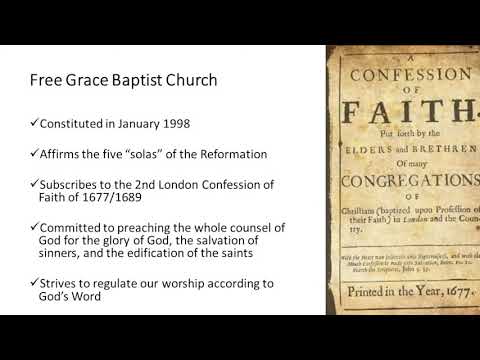
Introduction to the 1689 Second London Baptist Confession of Faith
Why should a church bind itself to a confession of faith? This introductory lesson on the Second London Baptist Confession of 1677/1689 grounds the answer exegetically in Ephesians 4 — where Christ gives gifted men to the church so that the body attains doctrinal unity and is no longer tossed about by every wind of teaching — and then traces the historical origins of the 1689 among the Particular Baptists, distinguishing them from Anabaptists, Presbyterians, and Congregationalists. Four functions of a confession are developed: defining, defending, discriminating, and disciplining with reference to the doctrine of the church. The lesson closes by distinguishing Reformed theology (Calvinism plus covenant theology plus the regulative principle) from mere five-point Calvinism, and by defending the confession's silence on matters of Christian liberty as a feature, not a defect.

The Extension of Christ's Kingdom
Christ's sovereignty over persecution is the controlling theme of Acts 8:1b–4, where the martyrdom of Stephen triggers a great dispersion that advances the very mission Christ commissioned in Acts 1:8. The sermon traces the programmatic geography of Acts — Jerusalem, Judea, Samaria, the ends of the earth — and shows that the scattering of the disciples, far from being a setback, was the means by which Christ extended his kingdom. Particular attention is given to Saul of Tarsus as the chief persecutor whose subsequent conversion illustrates that no human opposition can thwart the sovereign purposes of Christ. Hearers are called to pray earnestly for gospel preachers to be raised up, to commit to biblical churchmanship with perseverance, and to hold fast to the confidence that Christ must reign until all his enemies are made his footstool.
1 Samuel 30:9-31
God's providence, power, and provision converge in 1 Samuel 30:9–31 as David pursues the Amalekites who have raided Ziklag, burned it, and carried off the families of his men. An abandoned Egyptian servant, left to die by his Amalekite master, becomes the instrument of divine providence by leading David to the enemy camp — illustrating that God governs all things, including the cruelties of the wicked, for the good of his people. The sermon draws out David's messianic character in his care for the weak and his theology of grace as the ground for generosity, calling God's people to strengthen themselves in God through his promises and appointed means when trial strikes, trusting that the God who brought David from tragedy to triumph will bring all his people to final glory.
The Governing Principle of Kingdom Life
Matthew 6:31–34 sets out the governing principle of kingdom life: the disciple of Christ is to seek first the kingdom of God and his righteousness, and not to be paralyzed by the carnal anxiety that marks Gentile existence. The sermon draws a sharp contrast between those who have no doctrine of a sovereign Father and those who confess one, arguing that a Reformed understanding of God's sovereignty must extend beyond soteriology into the daily trials of earthly life. To worry about food, drink, and clothing is to live as a Gentile; to rest in the Father's knowledge of our needs, pray as Christ taught, and pursue the kingdom first is to live as a loyal subject of God's reign.
A Faithful Saying
The phrase 'Christ Jesus came into the world to save sinners' (1 Timothy 1:15) is not rhetorical decoration but a precise theological claim about the nature and scope of redemption. This exposition works through Paul's self-description as 'chief of sinners' — blasphemer, persecutor, and insolent man — to show that the depth of his depravity magnifies rather than diminishes the glory of sovereign, particular grace. The sermon argues that Calvinistic soteriology reduces to one confession: God saves sinners, doing everything from election to glorification, leaving no share of the decisive act to man. Hearers are called to respond to this grace with informed, exhilarated worship and to press the invitation upon every sinner who imagines himself too wretched to be saved.
Five Observations on Christ's Doctrine of Salvation (Part 1)

The doctrines of grace are not cold dogmatism but the very substance of the gospel, and Christ himself is their foremost teacher. Working from John 6:35–51 and ranging through the Gospel of John, this sermon opens a five-observation series on Christ's own doctrine of salvation, examining first the comprehensiveness of sin — total inability, bondage to the devil, and the love of darkness — and second, the unmitigated and unsolicited divine prerogative in salvation, by which God alone is the alpha and omega of the rescue of sinners. The third observation treats the precision and impeccability of Christ's crosswork: the Father's will that nothing given to the Son be lost, and the Son's answering cry of victory, 'It is finished,' as the ground of particular redemption. The unconverted are urged to see themselves as the Gadarene maniac — untamed, chained, and in need of the Christ who alone can bring a sinner to be clothed and in his right mind.