
Theological term
Biblicism
5 sermons · All terms
Ask FGBC 70: Is Progressive Covenantalism Compatible with the 1689?

Progressive Covenantalism and New Covenant theology are examined against the standard of the 1689 London Baptist Confession of Faith, with particular attention to whether either system can consistently affirm the covenant of works, the covenant of redemption, and the law/Sabbath chapters of the Confession. The discussion traces the hermeneutical root of these systems — a tendency toward biblicism that resists theological vocabulary not found verbatim in Scripture — and argues that their own best instincts, illustrated by Gary Long's late work on the Adamic covenant and the creation rest, point toward the fuller confessional expression of covenant theology. The conversation closes by considering the covenant of redemption and whether collapsing it into the eternal decree is adequate, finding devotional and doxological value in the anthropomorphic language of the pactum salutis even where precise metaphysics must be qualified.

Ask FGBC #6 - Why is historical confessional Christianity important?
The question of why historical confessional Christianity matters is addressed by examining what Scripture itself says about the gifts Christ gives to his church. Drawing on Ephesians 4 and Matthew 28, the argument is made that creeds and confessions are the accumulated fruit of those gifts — the best doctrinal articulation the church has produced across centuries of theological controversy, from Nicaea and Chalcedon through the Second London Confession. To reject them in favor of a 'no creed but the Bible' posture is not humility but a subtle repudiation of the very ecclesiology the Bible commands, and it leaves individuals without the guardrails that preserve orthodox Christianity.
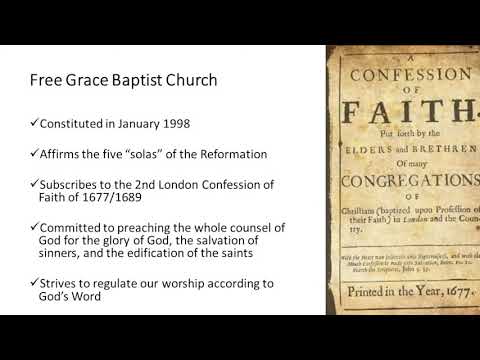
Introduction to the 1689 Second London Baptist Confession of Faith
Why should a church bind itself to a confession of faith? This introductory lesson on the Second London Baptist Confession of 1677/1689 grounds the answer exegetically in Ephesians 4 — where Christ gives gifted men to the church so that the body attains doctrinal unity and is no longer tossed about by every wind of teaching — and then traces the historical origins of the 1689 among the Particular Baptists, distinguishing them from Anabaptists, Presbyterians, and Congregationalists. Four functions of a confession are developed: defining, defending, discriminating, and disciplining with reference to the doctrine of the church. The lesson closes by distinguishing Reformed theology (Calvinism plus covenant theology plus the regulative principle) from mere five-point Calvinism, and by defending the confession's silence on matters of Christian liberty as a feature, not a defect.

The Utility of Confessions and Introduction to the Second London Baptist Confession
Confessions of faith are not competitors to Scripture but are faithful summaries of biblical doctrine, and the church has historically depended on them for good reason. This address introduces the Second London Baptist Confession of 1689, tracing its historical origins among the Particular Baptists of the 17th century and its relationship to the Westminster Confession and the Savoy Declaration. Five interlocking uses of a confession are then examined: defining church doctrine, defending it against error, discriminating between members and officers on doctrinal grounds, disciplining departures from orthodoxy, and distinguishing confessed doctrine from matters of Christian liberty. The goal is not confessional enslavement but confessional clarity — guardrails that protect the church and free her members to worship and grow in the grace and knowledge of Christ.

Sola Scriptura: The Bible Alone

Hebrews 1:1–3 opens with the declaration that God has spoken — a claim the author of Hebrews treats not as background noise but as the controlling fact of redemptive history. This sermon works through six attributes of Scripture drawn from those opening verses: its divine source, its authority, its finality in the Son, its intended beneficiaries, its perspicuity, and its sufficiency for faith and life in the new covenant community. The Reformation's sola scriptura is shown to be not a negative protest but a positive testimony: Scripture alone is God's last, best, and sufficient word, complete in Christ, requiring no supplement from tradition, continuing prophecy, or moralistic self-help.