
Theological term
Baptismal Regeneration
9 sermons · All terms

The Baptism of Saul of Tarsus

The baptism of Saul of Tarsus in Acts 9:17–25 demonstrates the proper order of Christian baptism: conversion precedes the ordinance, which then publicly marks the believer as a disciple of Christ. The passage is treated as a direct answer to Stephen's dying prayer in Acts 7:60, with Saul's transformation from chief persecutor to chief preacher serving as a vivid display of sovereign, redeeming grace. The sermon draws out three observations from Saul's early ministry — the immediacy, the effects, and the hostility of his preaching — and closes with the baptism of three new believers, each of whom gives a brief testimony of their own conversion.

The Appearance of the Love of God
Though mankind stands condemned under the description of Titus 3:3 — foolish, disobedient, enslaved to lusts and malice — the kindness and love of God the Father appeared supremely in the incarnation of the Son to rescue dead sinners by sovereign mercy alone. This sermon expounds Titus 3:4–8 under three headings: the appearance of the love of God, the application of the grace of God in regeneration and justification, and the affirmation of the gospel as the faithful saying ministers must constantly proclaim. The ordered sequence of the text is decisive: justification by grace through faith is the condition; good works are the consequent fruit, never the ground.

The Meeting with Nicodemus, Part 2
John 3:4–10 confronts every hearer with the absolute necessity of regeneration before any entrance into the kingdom of God. Working through Nicodemus's proud misunderstanding and Christ's patient explanation, this exposition argues that the new birth is entirely God's sovereign work — initiated by the Holy Spirit, prefigured in Ezekiel 36 and Deuteronomy 30, and entirely prior to saving faith. The sermon also draws out the Trinitarian theology embedded in Christ's wind analogy, showing that the Spirit's sovereign, effectual work in regeneration reveals who God is, not merely what He does.

The Apostle Peter and Simon Magus
Acts 8:18–25 presents one of Scripture's most debated conversion accounts: Simon Magus, a former sorcerer who professed faith and was baptized, then attempted to purchase apostolic power with money. This exposition traces Peter's sharp rebuke — 'your money perish with you' — through its Old Testament resonances in Deuteronomy 29 and Proverbs 5, while weighing the evidence on both sides of the question of Simon's genuine conversion. The sermon concludes that the deeper question Acts 8 presses is not Simon's eternal state but the hearer's own: whether they have come to know the Christ who forgives wickedness, grants repentance, and receives every sinner who comes to him.

The Great Commission
Christ's Great Commission in Matthew 28:18–20 provides the church with her complete marching orders: go, make disciples, baptize those disciples, and teach them to observe all that Christ commanded. The authority behind the commission belongs to the risen and exalted Christ, who possesses all authority in heaven and earth; the assurance sustaining it is His promise of perpetual presence to the end of the age. The sermon treats the specific focus of the commission in sequence, defending believers' baptism by immersion as the pattern demanded by the text and the order it establishes — make disciples first, then baptize — against both baptismal regeneration and paedobaptism. The Trinitarian formula of baptism occasions an extended treatment of theology proper, including divine simplicity, impassibility, and the unity of essence in three persons, with warnings against tritheism, modalism, and subordinationism.
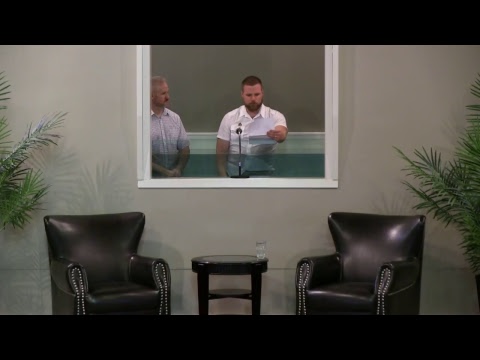
Livestream - Baptism: Wim Kerkhoff
Acts 8:26–40 records the conversion and baptism of the Ethiopian eunuch, and this exposition sets that account against its Old Testament backdrop in Isaiah 53 and Isaiah 56 to show that what is happening is not merely one man's conversion but the fulfillment of covenant promises: the inclusion of those doubly excluded from the assembly of Israel. The sermon works through three movements — the divine appointment of the contact, the gospel communication beginning from Isaiah 53, and the conversion issuing in immediate baptism upon confession of faith. The central application is that God is characteristically and eagerly a saving God, that believers' baptism follows faith as its ordained external sign, and that no sinner — whether powerful or poor, crisis-converted or quietly brought to faith — is beyond the reach of sovereign grace.

The Response to Peter's Sermon
Acts 2:41–47 records the immediate fruit of Peter's Pentecost sermon: three thousand souls baptized and a church marked by steadfast doctrine, fellowship, the Lord's Supper, and prayer. This exposition argues that the passage is both descriptive and prescriptive — what the early church did defines what the church in every age must be. Along the way, believers' baptism is defended against paedo-baptist readings of verse 39, and the growth of the church is traced not to programs or techniques but to the sovereign calling of God through the faithful preaching of Christ crucified.
2LCF Chapter 28 - Of Baptism and the Lord's Supper

The two ordinances of baptism and the Lord's Supper are positive and sovereign institutions of the Lord Jesus Christ, the only lawgiver, to be administered in His church until He returns. This study of 2LCF Chapter 28 traces the confessional and biblical foundations of these ordinances across multiple chapters of the 1689 London Baptist Confession, demonstrating how doctrines of Scripture, Christology, sanctification, saving faith, and ecclesiology together undergird their proper observance. The sermon distinguishes the Baptist use of 'ordinance' from both Roman Catholic sacramentalism and the Paedo-Baptist covenantal framework, while insisting that these are not optional ceremonies but dominical injunctions binding the conscience of every believer. Christians are called not merely to be informed about baptism and the Lord's Supper, but to obey and rejoice in them as holy appointments given for the strengthening of faith and the glory of Christ.
The Great Commission
Matthew 28:18–20, the Great Commission, grounds the church's evangelistic and discipleship mandate not in human strategy but in the universal authority of the enthroned Christ. The sermon traces three interlocking realities: the authority behind the commission (Christ's sovereign rule over all things), the activity the commission requires (making, baptizing, and teaching disciples), and the active agent who sustains it (Christ himself present with his people to the end of the age). Believers' baptism is expounded as a visible sign of union with Christ, remission of sins, and public covenant commitment — an ordinance reserved for disciples, not infants — and the entire commission is set within a robustly Calvinist framework in which God alone adds to his church by sovereign grace.