
Theological term
Anathema
35 sermons · All terms

Of Troublers and the Truth

Galatians 5:7–12 confronts the churches of Galatia with a rhetorical question of reproach — who hindered you from obeying the truth? — and Paul's answer exposes the errorists who were smuggling human obedience into the scheme of salvation. The sermon works through five movements in the passage: the question asked, the assessment given, the verdict rendered, the offense retained, and the imprecation pronounced. Central to the exposition is the conviction that any gospel attaching the works of the individual to the finished work of Christ brings confusion, distress, and fear, while the gospel of grace alone through faith alone in Christ alone brings true and solid peace. Hearers are called to run the race well, to reject doctrinal error with the discernment that distinguishes not only right from wrong but right from almost right, and to be jealous for the purity of the church's doctrine.

Ask FGBC Batch 8: Church Planting, Creation, Imprecatory Psalms & More | Reformed Baptist Theology
This Q&A episode addresses ten questions spanning ecclesiology, pneumatology, soteriology, and worship, drawing on confessional Reformed Baptist commitments throughout. Topics range from church planting and confessional subscription to the nature of saving faith versus assurance, the love of God for the non-elect, literal six-day creation, the theology of imprecatory psalms, and the regulative principle of worship as it applies to musical instruments and the offering. The consistent thread is that Scripture and the 1689 London Baptist Confession provide the sufficient framework for answering practical and doctrinal questions facing Reformed Baptist churches today.

The Solicitation to Apostasy

Deuteronomy 13 confronts Israel with three escalating scenarios of solicitation to apostasy: the false prophet, the intimate family member or friend, and the corrupt city given over to idolatry. In each case the text demands not tolerance but purging, because defection from the living and true God constitutes treason against the theocratic covenant order. The chapter's severity is inseparable from its mercy: faithful execution of justice removes the cause of divine wrath and secures the covenant blessings sworn to the fathers. The passage presses the hearer to examine whether fidelity to God holds firm against both miraculous signs that lead astray and the subtler pull of intimate relationships.

The Apostle's Charge to Timothy
Paul's charge to Timothy in 1 Timothy 1:3–7 commands the silencing of false teachers in Ephesus who taught other doctrine, devoted themselves to fables and endless genealogies, and generated disputes rather than godly edification. The charge is not motivated by power or animosity but by love flowing from a pure heart, a good conscience, and sincere faith — the fruit of regeneration. The false teachers compounded their error by combining ignorance of the law with arrogant confidence in their own assertions, a combination the apostle deems disqualifying. Churches today must hold the same line: qualifying teachers rigorously, refusing platforms to the heterodox, and measuring all teaching against the truth as it is in Jesus.

The Command for the Conquest
Deuteronomy 7:1–11 sets out the divine policy for Israel's conquest of Canaan, commanding total destruction of the seven Canaanite nations and prohibiting political, social, and religious alliances with them. The passage answers the modern objection that God commanded genocide of innocent peoples by demonstrating from Leviticus 18 that the Canaanites were under divine judgment for extreme wickedness, and that God applied the same standard of judgment to Israel when Israel imitated their conduct. The distinction between Israel and Canaan rests entirely on sovereign, unconditional election — not Israel's numbers or righteousness — and finds its New Covenant fulfillment in the church as the true people of God united to Christ. The passage's prohibitions carry direct application to contemporary alliances: believers are to marry only in the Lord, avoid religious compromise on cardinal doctrines, and understand civil government's proper and limited role.

The Vindication of the Righteous One
Psalm 7 unfolds as a courtroom drama in which the psalmist — and, typologically, the Lord Jesus Christ — appeals to God for vindication against false accusers, refusing personal retaliation and casting the entire matter upon the justice of God. The sermon moves through three phases: the supplication of the righteous one, the assertion of innocence, and the extended vindication that grounds confidence in God's decreed judgment against the wicked. David functions as a type of Christ, whose spotless innocence alone fully satisfies the conditions of verses 3–4, and whose imputed righteousness is the sole ground on which the church may echo his plea. The practical summons is to resist paralysis or retaliation in the face of false accusation and social hostility, and instead to take refuge in the just God who is angry with the wicked every day and who has appointed a day of final judgment.

The Citizenship of the Believer
The enemies of the cross of Christ are not merely mistaken but are heading toward eternal destruction — and the Apostle Paul warns of them with tears. Expounding Philippians 3:18–21, this sermon identifies the Judaizers as those enemies: their god is their belly, their glory is in their shame, and their minds are set on earthly things. Against that dark backdrop, the believer's citizenship in heaven is a present legal possession that demands an eager anticipation of Christ's return, a purifying of life in light of that coming, and a deliberate seeking out of godly examples to follow rather than the many who walk the broad road to destruction.

The Authenticity of Paul's Gospel, Part 2
Galatians 1:18–2:10 records Paul's autobiographical defense of justification by faith alone against Judaizers who insisted that circumcision and adherence to Mosaic precepts were necessary for salvation. The sermon traces Paul's independence from the Jerusalem apostles, the uncompromising refusal to circumcise Titus, and the apostolic unity between Paul and the Jerusalem pillars — all marshaled to prove that Paul's gospel came by divine revelation, not human tradition, and that it stands as the only true gospel. The application presses both the vital importance of the doctrine of justification and the necessity of an uncompromising ministry: Christian peace rests solely in Christ's perfect obedience and atoning death, not in the ebbing and flowing of personal works or church attendance.

The Authenticity of Paul's Gospel
Paul's vigorous autobiographical defense in Galatians 1:11–24 establishes that his gospel did not originate from any human source but came by direct revelation of Jesus Christ — a claim with profound implications for the doctrine of justification. The sermon works through three arguments for gospel authenticity: the nature of the gospel itself as something no man would invent, Paul's pre-conversion conduct as a violent persecutor of the church, and his post-conversion movements that deliberately bypassed human instruction. The application presses the congregation to hold with confidence to a gospel that rests on the triune God's sovereign grace alone, not on human tradition or legal observance, and to hope for the conversion of even the most hardened opponents of the truth.

The Gospel's Irreplaceable Value
Galatians 1:6–10 confronts every generation with the irreplaceable value of the gospel by exposing three responses to its perversion: astonishment, abhorrence, and anathema. The Judaizers who troubled the Galatian churches were not offering a different gospel but no gospel at all — a metastrophe that renders God less holy than he is, man less sinful than he is, and Christ inglorious and his work useless. Justification is by grace alone, through faith alone, in Christ alone, or there is no justification before the God of heaven and earth. The sermon closes with a call to Pauline vigilance in protecting gospel purity and to seek God's approval rather than man's.

The Gospel's Liberty
Galatians 1:1–5 introduces an epistle written in urgent opposition to the Judaizing error that was perverting the gospel of justification by faith alone among the southern Galatian churches. Working from the historical setting of Paul's first missionary journey and the impending Jerusalem Council of Acts 15, this exposition traces how Paul's apostolic greeting — his assertion of divine authority, his benediction of grace and peace, and his compressed account of Christ's self-giving — is deliberately shaped to lay the theological foundation for the entire letter. The sermon argues that every element of Paul's opening salutation serves the polemic purpose of the epistle: to cast down the error that adds Mosaic ceremony to faith in Christ and to anchor the believer's peace and joy exclusively in the finished work of Jesus Christ.
Departure from Sinai
Numbers 10:11–36 records Israel's long-awaited departure from Sinai, the first movement of a covenant community organized around the visible presence of God. The passage is examined under three headings: the ordered departure of the tribes, Moses' invitation to Hobab as an exercise of providential wisdom, and the petitionary prayers at departure and rest that frame the entire march. The sermon draws out a sustained tension between the ideal covenant life depicted in the legislation of Exodus and Leviticus and the realistic failure narrated immediately in Numbers 11–12, pressing the parallel to New Covenant believers who are fickle yet sustained by a faithful God and the advocacy of Jesus Christ.

The Lawful Use of Vows in Israel
Leviticus 27 addresses the Israelite practice of making vows to God — acts of religious zeal, often rash or imprudent, by which persons consecrated people, animals, houses, or land to the Lord. The chapter does not license vow-breaking but rather underscores the gravity of vowing by legislating a costly redemption mechanism, warning the would-be vower to count the cost before speaking. The sermon situates the passage within the 1689 LBCF chapter 23 framework distinguishing oaths from vows, then draws three applications against popish monastical vows, Protestant legalistic vows, and pietistic circumventions of God's law — all forms of man-made religion condemned repeatedly in Scripture.
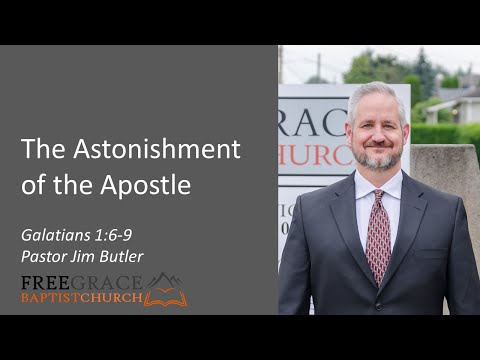
The Astonishment of the Apostle
Paul's opening salvo in Galatians 1:6–9 registers apostolic astonishment at the speed with which the Galatian churches were deserting the gospel of free grace for a Judaizing supplement of circumcision and Mosaic law-keeping. The sermon expounds why any addition to the finished work of Christ — however small — is not a variation of the gospel but its outright denial, because a man must choose either perfect law-keeping or the wholly sufficient righteousness of Christ received by faith alone. The anathema Paul pronounces in verses 8–9, drawn out through the Hebrew concept of ḥērem and its New Testament cognate anathema, exposes the perverter of the gospel not merely to church discipline but to the judicial wrath of God. The sermon closes with an urgent call to doctrinal vigilance: to resist indifference, imprecision, compromise, and novelty, and to hold fast to justification by faith alone as the very heart of the Christian religion.

The Freedom in Receiving the Son
John 8:30–36 sets before the reader a sharp contrast between the blessedness of spiritual liberty and the wretchedness of spiritual slavery. This sermon expounds the theological order of salvation — justification by grace alone through faith alone precedes and produces the disciple's abiding in Christ's word, not the reverse — and then traces what that freedom means: deliverance from the curse of the law, the condemnation of sin, the wrath of God, and the tyranny of the devil. The church's calling to be the pillar and ground of the truth (1 Timothy 3:15) demands that she identify, propagate, contend for, and protect that truth in every generation.

The Defense in Jerusalem
Acts 22 records Paul's defense before the Jerusalem mob and his invocation of Roman citizenship before the commander, and this exposition traces both movements as a pattern for how believers engage hostile civil and religious authorities. Paul's account of his conversion — his Jewish upbringing under Gamaliel, his confrontation with the risen Christ on the Damascus road, his instruction through Ananias, and his temple vision — demonstrates that he is not an enemy of Israel but rather the fulfillment of what a faithful reading of the Old Testament demands. The crowd's fury erupts not over Paul's biography but over Christ's commission to the Gentiles, exposing their rejection of covenant promises made to Abraham and repeated through the Psalms and prophets. The sermon closes by pressing Paul's gospel — blood atonement, imputed righteousness, and salvation by grace through faith — upon every hearer, including the worst of sinners.

The Council at Jerusalem, Part 1
Acts 15:1–5 introduces the Jerusalem Council by presenting the Judaizing heresy in its starkest form: certain men from Judea taught that circumcision must be added to faith in Christ for salvation, striking simultaneously at the law's proper use and at the sufficiency of Christ's finished work. The passage is set in its chronological context, distinguishing the events of Galatians 2 from the council itself, and showing that the problem was not merely one of Jewish-Gentile social relations but a soteriological crisis with eternal consequences. Paul and Barnabas respond with uncompromising confrontation, the church at Antioch sends delegates to Jerusalem, and the passage closes with the same Judaizing demand surfacing within the Jerusalem church — demonstrating the universality and perpetuity of the tendency to add human merit to sovereign grace. The exhortation is to resist every form of works-righteousness and to preach the law and gospel in their proper distinction, so that sinners are directed to Christ alone.

Paul's "Jesus and the Resurrection"
What does Paul mean when he proclaims 'Jesus and the resurrection,' and why does the denial of bodily resurrection destroy the entire Christian faith? Drawing on 1 Corinthians 15:1–20, this exposition works through four interlocking realities: the gospel is comprehensive for all of Christian life, the events of the gospel are certain on the testimony of Scripture and eyewitnesses, the grace of God is foundational to both the delivery and reception of the gospel, and the resurrection of Christ secures an unconquerable hope for all who believe. The sermon presses toward a pointed application: Christian hope is not wishful thinking but the certain expectation that God's promises in the risen Christ will most surely come to pass.

The Astonishment of Paul
Paul's opening salvo in Galatians 1:6–9 is a study in holy alarm: the apostle marvels not with wonder but with grief that the Galatian churches are so quickly defecting from the gospel of grace to a Judaizing corruption that mingles law-keeping with faith. The Judaizing heresy — like Roman Catholicism, the New Perspective on Paul, and the Federal Vision after it — does not abolish Christ but supplements him, which Paul declares is no gospel at all, because justification is either entirely by grace alone through faith alone in Christ alone, or it is not justification at all. The sermon traces three movements in the passage: Paul's astonishment at the defection, the nature of the false gospel as something that is 'not another,' and the double anathema pronounced on all who pervert the gospel regardless of their authority. The application calls hearers to a 'blessed intolerance' toward gospel corruption, to precision in doctrine, and to the personal embrace of Christ's doing and dying as the sole ground of acceptance with God.

The Galatian Benediction
The opening three verses of Galatians are not mere epistolary formality but carry concentrated theological weight: Paul's identity as a divinely commissioned apostle, the significance of the audience designation, and the rich pastoral benediction of grace and peace. The sermon argues that Paul's apostolic authority is grounded in divine rather than human commissioning, that the absence of the customary commendatory address to the Galatian churches signals a subtle rebuke, and that the benediction of grace and peace is a Trinitarian gift addressing the precise spiritual need created by the Judaizing perversion of justification by faith alone. Hearers are called to seek growth in grace and peace through faithful attendance upon the means of grace, and those outside of Christ are pressed to believe on the one who lived, died, and rose to save sinners.
The Warning and Report
Paul closes his final letter by warning Timothy against Alexander the coppersmith, whose opposition was directed not against Paul personally but against the Word of God, and by giving a theologically ordered account of his own imprisonment. The sermon traces how Paul's confidence in God's retributive justice, his experience of the Lord's present strengthening, and his certainty of future heavenly preservation together produce doxology rather than complaint. Seven marks of Paul's apostolic character — vigilance for God's Word, concern for the church, dependence on the Lord, worship, care for friends, hope for glory, and faithful ministry to the end — are set before the congregation as a pattern for gospel ministers and the church alike. The primary application is that faithful proclamation of God's truth, not celebrity or popularity, is what God requires of his ministers.

The Final Charge to Timothy, Part 1
Paul's final formal charge to the church, delivered through Timothy in 2 Timothy 4:1–2, consists of a solemn charge and a specific command: preach the Word. The solemnity of the charge is grounded in the presence of the triune God as divine audience and in the coming judgment of Christ over the living and the dead, which simultaneously weighs on the minister who handles the Word and on the people who will one day stand before God. The command itself, rooted in the image of the herald (Greek kēryx), demands faithful proclamation of the Word — not creative substitutes, not life-coaching, not entertainment — through conviction, rebuke, exhortation, longsuffering, and teaching. The sermon closes with a call for biblical preachers, biblical preaching, and biblical hearers, arguing that the church's abandonment of the pulpit is the root of her contemporary crisis.
The Ninth Commandment
The ninth commandment, 'You shall not bear false witness against your neighbor' (Deuteronomy 5:20), governs far more than courtroom testimony — it encompasses every form of lying, slander, backbiting, gossip, hypocrisy, and doctrinal heresy. Three grounds obligate God's people to truth-telling: God himself is truth, man bears God's image and his reputation is inviolable, and the stability of every social order depends on trust. The positive demand of the commandment calls believers to speak truth in all spheres of life, to discourage slander, and to resist the co-opting of humanist language that obscures biblical categories.
Deuteronomy 23
Deuteronomy 23 addresses the holiness of the covenant community through laws governing exclusion from the assembly of the Lord, ritual cleanliness in the military camp, and miscellaneous regulations for community life. The chapter's detailed and seemingly mundane stipulations — covering the castrated, the illegitimate, hostile ethnic groups, bodily waste, escaped slaves, cult prostitution, usury, vows, and gleaning rights — all flow from one unifying concern: Israel was a sanctified, set-apart people who were to reflect the character of the God who dwelt in their midst. These Old Covenant regulations, grounded in God's love for his covenant community, point toward the New Covenant expansion in which eunuchs, Gentiles, and all nations are called without restriction to enter the assembly of the Lord through the proclamation of the gospel.
Galatians 1:6-10
Galatians 1:6–10 confronts the Galatian churches' rapid defection from the gospel of grace to a Judaizing heresy that added circumcision and law-keeping to faith as a condition of justification. The sermon argues that any addition of human merit to the work of Christ — however small — destroys the gospel entirely, because salvation is either by grace alone through faith alone in Christ alone, or it is by the law, and the two cannot be mixed. The Apostle Paul's double pronouncement of anathema on false gospel teachers is examined in its Old Testament background (the herem principle) and applied as a call to doctrinal precision, vigilance against indifference, and refusal to supplement the finished work of Christ.
Seduction to Idolatry
Deuteronomy 13 confronts Israel — and the church — with three escalating scenarios of seduction to idolatry: the false prophet who performs genuine signs and wonders, the intimate family member who whispers in private, and the city that has given itself wholly over to apostasy. The sermon argues that the severity of the prescribed penalties is not barbarism but proportionate justice rooted in the holiness, jealousy, and justice of the God who redeemed Israel by sovereign grace — and that the New Testament, far from softening this standard, intensifies it in passages such as Galatians 1:8-9 and 1 Corinthians 16:22. Throughout, the preacher insists that the church today does not wield the civil sword, but must nonetheless take with utmost seriousness the danger of idolatry in all its forms — including the subtlest idol of self — and find refuge from it only in the cross of Christ.
Deuteronomy 13
Deuteronomy 13 exposes three escalating threats to covenant fidelity in Israel: the false prophet who performs genuine signs but leads toward idolatry, the family member or close friend who privately solicits apostasy, and the urban revolutionary movement that corrupts an entire city. The chapter shows that God tests his people through such enticements to reveal whether their love for him is genuine, and that the severity of the prescribed penalties is proportionate to the gravity of the crime — which was not merely religious sin but constitutional treason against the covenant Lord. The same principles carry into the new covenant: gospel perverters are anathematized, family loyalty must never outrank loyalty to Christ, and the first and second commandments still demand undivided allegiance.
The Motivation Behind False Religion
Galatians 6:11–13 exposes the threefold motivation driving those who distort the gospel by adding law-keeping to faith as a condition of justification. The Judaizers pursued circumcision adherents to make a good showing in the flesh, to escape the persecution that the exclusive claims of the cross inevitably provoke, and to boast in the numbers of their converts — all motivations rooted in the externals of religion rather than in the finished work of Christ. Paul's polemic against this Judaizing tendency applies equally to Rome and to any system that mingles law and grace, for to mingle them is to end with neither. The sermon calls believers to boast in the cross of Christ alone and confronts the unconverted with the impossibility of rendering the personal, entire, exact, and perpetual obedience God demands.
The Law of Love
Matthew 5:43–48 contains the sixth and final antithesis of the Sermon on the Mount, in which Christ corrects the Pharisaic addition 'hate your enemy' — a phrase found nowhere in Scripture — and restores the full demand of the moral law: love your enemies, bless those who curse you, do good to those who hate you, and pray for those who persecute you. Christ is not introducing new legislation but faithfully expounding the eternal righteousness of the Father, whose law always required love even toward enemies, as texts from Exodus, Leviticus, Proverbs, and Job demonstrate. The sermon traces the contrast between true law and scribal distortion, the three positive duties of love, the theological ground of sonship in reflecting the Father's common grace, and the summary call to perfection — which ultimately drives the believer to the cross and to the imputed righteousness of Christ who alone satisfied these demands perfectly. Kingdom citizens are not bare-minimum disciples but are called, by the Spirit's enabling, to embody an ethic that distinguishes them entirely from tax collectors and pagans.
A Real Savior for Real Sinners
What does it mean that 'such were some of you' — fornicators, idolaters, adulterers, thieves, drunkards, revilers? Expounding 1 Corinthians 6:9–11, this sermon makes six observations: the kingdom of God is real; self-deception about one's standing before God is pervasive; God has established an objective ethical standard in his moral law; all men without exception stand guilty before that standard; sin is not genetic and therefore not beyond redemption; and Christ is a real Savior who truly washes, sanctifies, and justifies real sinners. The closing application calls believers to live a cross-centered life, letting the memory of what they once were fuel ongoing worship and praise.