
Theological term
Active Obedience
420 sermons · All terms

The Faithful Christian Mother

Proverbs 31:28–30 presents the faithful Christian mother not merely as a moral exemplar but as a woman whose fear of the Lord is itself the fruit of sovereign grace — a grace Jeremiah 32 promises God will plant in the hearts of his covenant people. The sermon works through four aspects of the Christian mother's calling: her condition before God, her influence over her children, her God-given authority over them (rooted in the fifth commandment), and her fourfold responsibility to instruct, to set an example, to discipline, and to love. Mothers are urged to press law and gospel upon their children tirelessly, to embrace corporal and verbal discipline without apology, and to find their ultimate confidence not in their own faithfulness but in Christ, the stellar Savior, whose life, death, and resurrection is the only ground of acceptance before God.

2LCF Chapter 11 - Of Justification, Part 2
The 1689 London Baptist Confession of Faith, Chapter 11 (Of Justification), paragraphs 3–6 are expounded in this Sunday school session, building on an earlier treatment of paragraphs 1–2. The study examines the basis of justification in Christ's penal substitutionary atonement and the satisfaction of divine justice (paragraph 3); the ordering of justification in time against the error of eternal justification (paragraph 4); the ongoing forgiveness of post-conversion sin in light of remaining corruption, with David's Psalm 51 as a case study (paragraph 5); and the uniformity of justification across both testaments, showing that Old and New Covenant saints are saved by grace alone through faith alone in Christ alone (paragraph 6). The Westminster Larger Catechism's distinctions between justification and sanctification are brought in to guard against both antinomianism and perfectionism, and the session closes urging justified sinners to run to their Advocate rather than wallow in guilt.

The Prophecy Concerning the Resurrection
Peter's Pentecost sermon in Acts 2:24–32 anchors the resurrection of Jesus Christ not in apostolic invention but in the prophetic word of Psalm 16, written by David nearly a millennium before the event. Working through Peter's appeal to and interpretation of that psalm, this exposition traces four aspects of the Messiah's disposition before His death — His focus, joy, confidence, and dependence upon the Father — and demonstrates that David, writing as a prophet under the Davidic covenant of 2 Samuel 7, could not have been describing his own resurrection since his tomb remained occupied. The resurrection is therefore the Father's public vindication that divine justice has been fully satisfied by Christ, the ground of the believer's justification, and the fulfillment of the Davidic covenant promise that one from David's line would build an eternal house for God. The sermon closes by calling sinners — however guilty — to call upon the risen Lord Jesus, the one on the middle cross who alone can grant everlasting life.
2LCF Chapter 11 - Of Justification, Part 1
What does it mean to be justified before a holy God, and on what basis does that standing rest? This confession study works through paragraphs one and two of Chapter 11 of the 1689 London Baptist Confession of Faith, examining the forensic nature of justification against both Roman Catholic infused righteousness and Baxterian neonomianism. The twin foundations of justification are established: the pardon of sins through Christ's passive obedience and the imputation of righteousness through his active obedience, both received by faith alone as a gift of God. The lecture closes by showing that justifying faith, though the sole instrument of justification, is never alone in the person justified but is always accompanied by sanctification.

The Great Commission
The Great Commission in Matthew 28:16–20 is grounded in the absolute authority of the risen Christ, who possesses all power in heaven and on earth and commissions His church to make disciples of all nations. The passage contains four grammatically imperatival commands — going, making disciples, baptizing, and teaching — each examined for its precise theological and ecclesiological force. Believers' baptism by immersion follows upon credible profession of faith, not the reverse, and the Trinitarian formula of baptism grounds the church's confession of one divine essence in three persons. The sermon closes by situating the Great Commission within the full passion narrative: the life, death, and resurrection of Christ are themselves the content the church is sent to proclaim, and Christ's omnipotence and omnipresence are the twin assurances that the commission will not fail.
Wednesday Night Bible Study (Feb 23, 2022) - 4th Commandment, Part V
This concluding session on the Fourth Commandment (Exodus 20:8-11) surveys the entire biblical-theological arc from creation through the new covenant, demonstrating that the weekly sabbath is a perpetual moral obligation rooted in creation and redemption, not a ceremonial shadow abolished at the cross. The lecture reviews the progression from Genesis 2, Exodus 16, and Sinai through the prophets, the ministry of Christ, apostolic practice, and Hebrews 4, before working through the 1689 LBCF chapter 22, paragraphs 7 and 8, on the Christian sabbath. Application addresses the threefold use of the law with respect to sabbath, answers objections from alleged anti-sabbatarian texts in Romans 14, Galatians 4, and Colossians 2, and closes by grounding sabbath keeping in the active obedience of Christ imputed to believers.

The Consubstantiality of the Son, Part 3
John 5:27–30 presents the Son of God claiming the divine prerogatives of life-giving and universal judgment as proof of His consubstantiality with the Father — the same divine nature, not a derivative or lesser deity. The sermon works through the distinction between the present spiritual resurrection of verse 25 and the future general resurrection of all mankind in verses 28–29, establishing that the 'good' who rise to life are those justified by faith alone, whose works are the fruit and evidence of that faith rather than its ground. Christ's declaration in verse 30 — 'I can of myself do nothing' — is shown to be not a confession of subordination but an assertion of the unity of the divine will across the three persons. Hearers are called either to take refuge in Christ's blood and righteousness before the day of judgment, or, if already believing, to long with biblical legitimacy for the coming of the just Judge who will vindicate His church and right every wrong.

2LCF Chapter 8 - Of Christ the Mediator, Part 2
Christ the Mediator, as confessed in chapter 8 of the 1689 London Baptist Confession of Faith, is examined through Hebrews 10 and supporting Scripture, tracing the pre-temporal appointment of the Son in the covenant of redemption, his hypostatic union, his anointing for the mediatorial office, and the execution of his saving work. The confession's account of Christ's perfect obedience, sacrificial death, and resurrection is shown to satisfy divine justice, procure reconciliation, and secure an everlasting inheritance for all the Father has given him. Particular attention is given to the retrospective communication of Christ's redemptive benefit to elect saints under the old covenant, demonstrating that salvation has always been by grace through faith in Christ alone. The study exhorts believers to find stability, comfort, and assurance in a precise knowledge of who Christ is and what he has accomplished.
The 4th Commandment (Part 2)
The fourth commandment's demand for Sabbath observance does not dissolve at the close of the Old Covenant; it runs through redemptive history and finds its New Covenant expression in the Lord's Day. Working through Matthew 5, Matthew 12, and Hebrews 4, this sermon argues that Christ upheld the moral law in both doctrine and practice, that his resurrection on the first day of the week grounds the shift from Saturday to Sunday, and that Hebrews 4:9's use of 'sabbatismos' constitutes a positive, unequivocal New Testament Sabbath ordinance for the people of God. The moral principle — one day in seven set apart for worship — is trans-covenantal; only its ceremonial aspect, the specific day, is conditioned by the covenant one inhabits. Believers are called to approach the Lord's Day not as a burden but as a gift that functions as a weekly foretaste and down payment of the eternal rest secured by Christ's finished work.

2LCF Chapter 8 - Of Christ the Mediator, Part 1
Chapter 8 of the 1689 London Baptist Confession opens with the pre-temporal appointment of Christ as mediator in the covenant of redemption, then moves to the historical stages of that mediatorial work, beginning with the incarnation. The confession affirms that the Son of God, consubstantial and co-eternal with the Father, took on true human nature — with all its essential properties and common infirmities, yet without sin — so that two whole and distinct natures are inseparably united in one person: the hypostatic union. Drawing on John 1, Hebrews 2, 4, and 7, Galatians 4, and the Chalcedonian Definition of 451, the study traces the biblical and creedal foundations of Reformed Christology, and shows how the confession's language connects the Reformed Baptist tradition to the settled Christological consensus of the ancient church.

The Healing at Bethesda
John 5:1–15 presents the healing of a paralyzed man at Bethesda as a display of Christ's sovereign initiative, mercy, and power. The man's 38-year infirmity — physical, helpless, and rooted in personal sin — mirrors the spiritual condition of every sinner apart from grace: unable to save himself and without recourse. Christ seeks the man out from a great multitude, issues a word of command that effects immediate and complete healing, and then addresses the deeper need by calling him to repentance. Against this glory, the opposition of the Jewish leaders — fixating on Sabbath casuistry while ignoring a manifest work of God — warns against a religion so narrowly fastidious that it cannot acknowledge divine mercy.

Redeemed by the Precious Blood of Christ

God is an impartial judge who will call every person to account for every transgression of his law, and no corruptible thing — no silver, gold, religious ritual, or moral effort — can satisfy the demands of that justice. Redemption comes exclusively through the precious blood of Christ, the spotless Lamb foreordained before the foundation of the world, whose death made propitiation for sin and whose perfect obedience is imputed to the believer's account. Drawing from 1 Peter 1:17–21, this sermon expounds the condition, command, reason, and result of the Christian's call to conduct life in reverent fear: not a slavish terror born of misunderstanding God's character, but a reverent awe that flows from knowing the God who is both perfectly just and perfectly merciful. The believer's ongoing faith and hope are to rest continually in God — grounded in Christ's resurrection, confirmed by his ascension to glory, and oriented toward the certain hope of the new heaven and new earth.

2LCF Chapter 7 - Of God's Covenant, Part 2
1689 London Baptist Confession of Faith, Chapter 7, paragraph 3 sets out three theological covenants — the covenant of grace, the covenant of redemption (pactum salutis), and the covenant of works — as the structural architecture of all Scripture. This sermon expounds each in turn, demonstrating from texts in Genesis, Isaiah, Hosea, Galatians, and Romans that the covenant of grace is founded on an eternal transaction between the Father and the Son, and that it is God's provision for sinners rendered incapable of acceptance with God since Adam's fall. The covenant of works is shown to be indispensable to a right understanding of justification: without it, the imputed righteousness of Christ collapses into either moralism or antinomianism, and the distinction between forgiveness and imputation is lost. Covenant theology is pressed not as academic machinery but as the very ground of the believer's comfort, assurance, and stability before God.

The Healing of the Nobleman's Son
John 4:43–54 records the second sign Jesus performed in Galilee: the healing of a royal official's son from a distance of sixteen miles. The passage exposes both the deficient faith that demands visible proof before believing and the sufficient power of Christ's spoken word, which heals without physical presence. The nobleman's earnest intercession for his dying son becomes a pointed application for parents to implore God persistently for their children's spiritual wellbeing. The sign itself points beyond physical healing to the life given to all who believe the word of Christ.
Exhortations in Light of So Great a Salvation
Peter's exhortations in 1 Peter 1:13–16 are grounded in the prior theological indicatives of the epistle: the elect have been saved by the triune God, unto an incorruptible inheritance, and must now respond with corresponding imperatives. Two commands govern this passage — set your hope fully on the grace to be revealed at Christ's return, and live a holy life in all your conduct — each requiring mental intentionality, self-control, and an understanding of the regenerate nature as 'children of obedience.' The sermon argues that sanctification involves both mortification of former lusts and vivification of the new nature of obedience, while insisting that this holiness contributes nothing to justification, which rests wholly on Christ's perfect active obedience and atoning death.

The Riches of Christ
How can the eternal, omnipotent Son of God be said to have 'become poor'? Expounding 2 Corinthians 8:9, this sermon traces the riches of Christ to His divine nature and works as the second person of the Trinity, and His poverty to the Incarnation, His lowly life, and His sufferings and death. The hypostatic union — two whole natures inseparably joined in one person — is shown to be not merely a speculative doctrine but the theological ground on which the Apostle Paul appeals to the Corinthians for generous giving. The riches believers receive through Christ's poverty are spiritual: justification, sanctification, glorification, and adoption, purchased by His obedience, suffering, and resurrection.

The Savior of the World
John 4:27–42 traces three interlocking movements — the Samaritan woman's testimony, Christ's teaching on the harvest, and the Samaritans' confession that He is the Savior of the world — to argue that Christ's saving work crosses every ethnic and religious boundary without exception. The passage exposes the active and passive obedience of Christ as the twin grounds of justification: His perfect compliance with the law of God and His atoning death together constitute the righteousness sinners receive by faith alone. The Samaritans' declaration in verse 42 is not merely a first-century curiosity but a standing gospel call — Christ is the Savior of the world, and all who hear are summoned to come and see Him.

The Testimony Concerning Christ's Supremacy
John 3:31–36 contains John the Baptist's climactic testimony concerning the supremacy and authority of the Lord Jesus Christ. The passage presses two inseparable realities: Christ's origin from above establishes his absolute supremacy over every earthly voice, and the Father's gift of all things into the Son's hand grounds his authority to bestow everlasting life on believers and to execute wrath on those who remain in unbelief. The sermon traces how the Baptist's testimony in these verses is of one piece with the prologue of John's Gospel, the high-priestly prayer of John 17, and the whole drift of Scripture concerning the triune God. Hearers are called to look in faith to Christ, the Lamb of God, understanding that regeneration by the Spirit is the necessary precondition for that faith, and that to reject the Son is not neutrality but the tacit accusation that God is a liar.
The Discourse on God's Salvation, Part 2
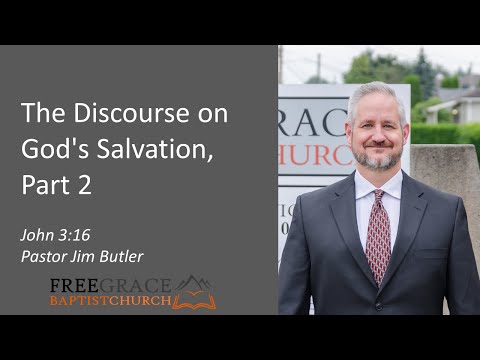
John 3:16 — Luther called it 'the Bible in miniature,' and this exposition treats it as precisely that: a compressed statement of the whole Christian gospel. The sermon moves through three divisions of the verse — the declaration of God's love, the demonstration of that love in the gift of the only begotten Son, and the description of those who receive God's redemptive love through faith. Central to the argument is the insistence that God's love is the source, not the consequence, of the atonement, and that 'the world' in John's vocabulary denotes persons from every tribe and tongue without ethnic distinction, not every individual without exception — a conclusion that grounds particular redemption in the wider theology of John's writings. The sermon closes with a direct appeal to unbelievers: the one way of salvation is to believe on Jesus Christ alone, whose active obedience supplies the righteousness that sinners need and whose substitutionary death removes the condemnation they deserve.

The Antitype of the Temple
John 2:18–25 presents Jesus as the antitype of the Old Testament temple — the reality to which the type pointed and in which it finds its fulfillment and realization. The Jews' demand for a sign of his authority after the temple cleansing is answered by the one definitive sign: the death and resurrection of Christ, which the apostle John interprets for the reader in verses 21–22. The sermon also treats the omniscience of Christ as evidence of his divinity, demonstrated in his refusal to entrust himself to those whose belief was superficial and temporary. Hearers are called to flee to Christ in genuine faith and repentance, receiving both forgiveness of sin and the imputed righteousness of Christ that avails before the Father.

The Cleansing of the Temple
Jesus' cleansing of the temple in John 2:13–17 is not an aberration from his character but a direct expression of his identity as the Son of God and the antitype of the temple itself. The passage reveals two inseparable realities: the apostasy of first-century Israel's worship and the messianic zeal prophesied in Psalm 69, Malachi 3, and the post-exilic prophets. Christ's authority to purge the temple rests on his sonship by nature, not adoption, and his action announces that the entire Old Covenant sacrificial system finds its fulfillment in him. The sermon calls the church to recover zeal for the purity of God's worship, to identify and resist the defections of contemporary Christendom, and to look in faith to the Lamb who has displaced every animal sacrifice.

The Testimony of John the Baptist, Part 3
John 1:30–34 records the Baptist's testimony concerning the dignity of Christ's person — his preeminence as the eternal Word who was before John, his anointing with the Spirit without measure for the work of mediation, and his identity as the natural, essential, and eternal Son of God. The sermon traces the Old Testament prophetic background of the Spirit's descent (Isaiah 11, 42, and 61), the active and passive obedience of Christ as the ground of the believer's acceptance before God, and the Baptist's final declaration that this Jesus is the Son of God. From this foundation the preacher draws an urgent gospel application: the same Lamb who takes away sin will visit unbelief with wrath, and the only fitting response is faith in him now.

The Testimony of John the Baptist, Part 1
John 1:19–28 records the official interrogation of John the Baptist by a delegation sent from Jerusalem to establish his identity and authority. The Baptist's threefold denial — he is not the Christ, not Elijah bodily returned, not the prophet of Deuteronomy 18 — is matched by his positive confession as the voice of Isaiah 40, the forerunner who prepares the way of Yahweh and thereby implicitly confesses the deity of Jesus. The sermon traces the Baptist's testimony through Luke 1's prophecy of Zacharias, the Transfiguration account in Matthew 17, and the prologue of John 1, showing that the Baptist preached not only repentance but the remission of sins through the coming Messiah — that is, justification by faith alone. The governing application is that Christ's people exist to proclaim His preeminence, following the Baptist's model of humble, courageous, light-and-heat ministry that makes nothing of self and everything of Jesus.

The Conversion of Cornelius
Acts 10:34–48 records the official inclusion of Gentiles in the covenant promises of God — a watershed moment in redemptive history. Peter's sermon before Cornelius and his household sets forth the peace, person, work, and prophetic witness of Jesus Christ, culminating in the declaration that through His name, whoever believes will receive remission of sins. The sovereign Holy Spirit falls upon the hearers before Peter has even finished speaking, confirming that salvation is of the Lord and that divine initiative — not human free will — drives the conversion of sinners. The passage concludes with the baptism of the entire household, a commanded public identification with the Triune God that pictures, but does not accomplish, the inward work already wrought by grace through faith.

Psalm 24
Psalm 24 asks who may ascend into the hill of the Lord and stand in his holy place — a question that exposes the impossibility of any sinner approaching a holy God on the basis of personal merit. The psalm is expounded in three movements: the sovereign lordship of Yahweh the Creator over all the earth, the covenant conditions of holy hands and a pure heart that no creature can meet in himself, and the triumphal ascension of the King of Glory who alone meets those conditions and leads his redeemed captives into the presence of God. The righteousness required to enter God's presence is not achieved but received by faith, given freely by the God of salvation through the obedient life, atoning death, and victorious resurrection of the Lord Jesus Christ.

The Incarnation of the Word, Part 1
John 1:14 — 'the Word became flesh and dwelt among us' — is the hinge on which all Christian theology turns. This exposition works through the identification, the incarnation proper, and the indwelling presence of the Word, establishing that the eternal Son assumed a true human nature (body and soul) without ceasing to be the second person of the Trinity — the doctrine the church confesses as the hypostatic union. The sermon draws on the active and passive obedience of Christ to show that the incarnation was not primarily exemplary but redemptive: the Word took flesh to render the perfect obedience sinners owe and to shed the blood that purchases their forgiveness. Hearers are pressed to see Christ not only as Redeemer but as reigning King, and the unbeliever is called to receive, by faith alone, that righteousness which comes from God.

The Trial Before Pilate, Part 3
Matthew 27:24–26 records the sentencing of Jesus by Pontius Pilate — the culmination of a trial in which the governor thrice declared the accused innocent yet delivered him to crucifixion anyway. The sermon examines Pilate's hypocritical self-absolution by the washing of hands, the crowd's willing acceptance of blood-guilt and its ominous extension to their children, and the formal scourging and condemnation of Christ. Throughout, the exposition presses the double benefit of the gospel: the forgiveness of sins and the imputation of Christ's righteousness received by faith alone, both grounded in the penal substitutionary atonement symbolised by Barabbas going free while the just one goes to the cross.

The Royal Wedding
Psalm 45 presents a royal wedding between the divine-human Messiah and his church, and the sons of Korah compose it as a song of love that the New Testament apostles and the entirety of the Old Testament prophetic witness sustain. The sermon works through the psalm's four sections — the psalmist's intention, the perfections and person of King Messiah, the instruction to the bride, and the closing declaration — demonstrating that a divine Messiah was not a novelty invented by John or Paul but was anticipated in the Hebrew Scriptures. Christ is celebrated as fairer than the sons of men, committed to truth and righteousness, triumphant over his enemies, fully God and fully man in the hypostatic union, and the one who clothes his bride in imputed righteousness received through faith alone. The appropriate response of the church is repentance, exclusive allegiance, worship, and gladness before her great King.

The Trial before Pilate, Part 2
Matthew 27:15–23 records Pilate's attempt to grant amnesty to Jesus through the Passover prisoner-release custom, a device that exposes the cowardice of the Roman governor, the envious malice of the Jewish religious leaders, and the terrifying moral bankruptcy of mob rule. The passage is expounded under five heads — the custom of amnesty, the leaders' motivation of envy, the warning of Pilate's wife, the demand of the multitudes, and Pilate's cross-examination — each of which illuminates the comprehensive reach of human depravity. The substitution of Barabbas for Jesus is treated as emblematic of definite atonement: the just going to the cross in the place of the unjust, securing both the forgiveness of sins and the imputed righteousness of Christ received by faith alone. Hearers are urged not to be carried along by ungodly leaders, to flee to Christ without delay, and to eat the Lord's Supper as a memorial of the blood atonement and active obedience of the Second Person of the Trinity wrought entirely on behalf of his people.

The Problem of Sin and the Mercy of God
Proverbs 28:13 sets the problem of sin and its remedy in sharp relief: the one who covers his sin will not prosper, but whoever confesses and forsakes sin will have mercy. The sermon works through the anatomy of sin-covering — denial, minimization, blame-shifting, and self-righteousness — with biblical examples ranging from Adam and Eve to Ananias and Sapphira, demonstrating the futility of every human attempt at self-atonement. Confession is shown to be not merely verbal acknowledgment but a saving act of faith in Christ, inseparably joined to repentance, whereby the sinner lays the hand of faith upon the surety of the new covenant and receives imputed righteousness. The closing application calls both unbeliever and believer to stop covering sin and look in faith to Christ, the only authorized covering for guilt before a holy God.