

2,065 sermons · All speakers

Wednesday PM - Sept 27, 2023
Leviticus 17 governs the sacrificial use of blood among the covenant people of Israel, and this exposition traces three interlocking regulations: the prohibition against slaughtering sacrificial animals outside the Tabernacle, the prohibition against ingesting blood, and the rules for handling game animals. The central rationale is penal substitution — the blood of the animal represents life given in the place of the worshiper's life, prefiguring the atoning work of Christ. The Holiness Code of Leviticus 17–26 functions as the ethical imperative that follows the indicative of sacrificial forgiveness, a pattern that anticipates the New Covenant movement from justification into sanctification.

Wednesday Night Bible Study - Leviticus 1-16
Leviticus 16, the Day of Atonement, stands at the theological center of both the book and the Pentateuch, answering the question Exodus leaves unresolved: how may sinful man enter the presence of a holy God. This session reviews the whole of Leviticus 1–16, tracing the book's structure from the sacrificial system and the institution of the priesthood through the laws of cleanness, showing that every element of the ceremonial apparatus — offering, priest, atonement — was divinely instituted, not humanly devised. The Nadab and Abihu incident demonstrates that unauthorized worship is mortal transgression, while the two-goat ritual of chapter 16 pictures both propitiation and expiation, all pointing forward to the once-for-all sacrifice of the Lord Jesus Christ.

The Glorious Exchange
Zechariah 3 presents a courtroom scene in which the high priest Joshua stands before the angel of the Lord clothed in filth while Satan waits to bring his accusation — and God silences the devil not by appealing to Israel's performance but by sovereignly removing the filthy garments and clothing Joshua in rich robes. This fourth night vision of Zechariah illustrates what Luther called the glorious exchange: the sinner's guilt imputed to Christ and Christ's righteousness imputed to the believer, received by faith alone. The sermon traces this double imputation through Romans 5, 1 Corinthians 1, 2 Corinthians 5, Galatians 2, and Philippians 3, and refutes the New Perspective on Paul's rejection of forensic imputation. The exhortation is plain: when the adversary accuses, the Christian's only answer is not performance but the gospel of sovereign grace in Christ the Branch.

The Triumph of the Church
Matthew 16:13–18 presents three interlocking realities about Christ and his church: the identity of Christ confessed by Simon Peter, the divine source of that confession, and the indestructible promise Christ appends to his church. The rock upon which the church is built is not Peter's person but the Christ Peter confessed — the second person of the triune God who assumed humanity, died, and rose for his people. Christ himself is the builder, foundation, and protector of the church, which means the gates of Hades assault the church not as a conquering force but as a defensive one being overrun by the church's gospel advance. The practical summons is for the church to fulfil her three marks — the preaching of the word, the administration of the sacraments, and the exercise of discipline — with the confidence that Christ's triumphant headship guarantees the church's survival into the eschaton.

Live Stream - August 13, 2023
The contest at Mount Carmel in 1 Kings 18 sets the living God of Israel against the false prophets of Baal and Asherah, exposing the utter futility of idolatry and demanding undivided allegiance to Yahweh. Elijah's brief, confident prayer stands in deliberate contrast to the frenzied, all-day invocations of Baal's prophets, demonstrating that God is not manipulable by human religious technique. The fire that falls from heaven is not merely a proof of Yahweh's power but a display of his grace, confirming that he receives sinners through the sacrifice he himself ordains. The sermon closes with a direct call: halt no longer between two opinions, but come to the Lord Jesus Christ, in whom alone there is justification, peace with God, and every spiritual blessing.
The Contest at Carmel
Elijah's confrontation with the prophets of Baal on Mount Carmel exposes the absolute futility of idolatry and the exclusive sovereignty of Yahweh. Set against the backdrop of Ahab's state-sponsored Baalism and a three-year drought, the passage drives a direct challenge: total allegiance belongs to the living God alone, with no syncretistic middle ground. The sermon traces the contest from Elijah's gauntlet through the false prophets' frenzied failure to God's decisive, fire-bearing answer, arguing that the same God who consumed the sacrifice at Carmel receives sinners today through the atoning blood of Christ. The application is direct: those who still halt between two opinions are called to repent and look to Christ in faith, while believers are charged to hold fast to God Most High without divided allegiance.

The Refuge for God's People
Psalm 46 sets the doctrine of God's sovereign presence as the only sufficient ground for courage in affliction. The psalm's threefold refrain — 'The Lord of hosts is with us; the God of Jacob is our refuge' — anchors the people of God against both natural catastrophe and the rage of hostile nations. Drawing on Job, the upper room discourse, Acts 14, and the letters to the seven churches in Revelation, this exposition argues that suffering is the normative texture of the Christian life, not an anomaly to be explained away. The command of verse 10 — 'Be still and know that I am God' — is not passive fatalism but a call to steady, covenant confidence in the God whose justice, power, and faithfulness guarantee the final exaltation of Christ among the nations.

The Binding of Isaac
Genesis 22, the binding of Isaac, presents Abraham's supreme test of faith as both a window into faithful perseverance under affliction and a richly typological passage pointing forward to the atoning work of Christ. The sermon traces three movements: the presentation of the test, the obedience of Abraham, and God's approval and confirmed promises. Central to the exposition is the typological reading — Abraham as a figure of the Father, Isaac as the only beloved son who bears the wood, and the ram caught in the thicket as a type of the substitutionary Lamb of God who takes away the sin of the world. The application calls believers to cultivate persevering faith through the ordinary means of grace, trusting that God furnishes sufficient grace for whatever trial he appoints.

The Rich Young Ruler
What must a man do to inherit eternal life? The rich young ruler's question exposes the deepest error of fallen religion: the assumption that man possesses the moral ability to commend himself to a holy God. This sermon expounds Matthew 19:16–22, tracing Christ's deliberate use of the law — particularly the tenth commandment — not as a path of salvation but as a hammer to shatter the young man's self-righteousness and drive him to seek grace outside himself. The central application is urgent: stop asking what you shall do and ask instead in whom you shall believe, for justification is by faith alone in Christ alone, whose righteousness becomes yours and whose cross bears your sin.

Live Stream - July 30, 2023
Second Samuel 22:21–25 presents David's claim that God rewarded him according to his righteousness — a claim that stands in apparent tension with his adultery, conspiracy to murder, and failure to act justly in the rape of Tamar. This sermon argues that David's righteousness is not a profession of sinlessness but a celebration of imputed righteousness: the perfect obedience of Christ credited to the believing sinner by faith alone, the same basis on which every saint in every covenant has ever stood before God. Drawing on Romans 4, 2 Corinthians 5:21, and Philippians 3:9, the sermon shows that David possessed a thorough theology of sin, atonement, and justification by faith alone — and calls both the unconverted and the believing congregation to rest in and pursue the God whose grace is capacious enough to cover even the most public and heinous failures.
The Arrival of the Hour
John 12:20–26 presents the arrival of the appointed 'hour' — the cross — through two interconnected scenes: Gentile Greeks seeking an audience with Jesus, and Christ's own declaration that the Son of Man must be glorified through death. The universal scope of redemption, foreshadowed throughout the Old Testament and confirmed in the Greeks' arrival, demonstrates that Israel's Messiah is the Savior of every tribe, tongue, people, and nation. Christ's death is not merely exemplary but substitutionary and necessary — the grain of wheat that must fall and die to produce much fruit — grounding both the imputation of His righteousness to believers and the certainty of their eternal union with Him. Genuine discipleship flows from this: those who by grace receive Christ are marked by a radical reorientation away from self-love and this present evil age toward willing service and following of the Lamb.

The Righteousness of David
David's declaration in 2 Samuel 22:21–25 that God rewarded him according to his righteousness stands in apparent tension with his gross sins of adultery, murder, and failure to act in the rape of Tamar. This sermon resolves that tension through the theology of justification by faith alone, demonstrating from Romans 4 that David, like Abraham, was accepted by God not on the basis of personal moral achievement but through the imputed righteousness of Christ received by faith — the same way any sinner in any covenant has ever entered the presence of God. David's own writings, particularly Psalm 32 and Psalm 51, confirm that he understood his standing before God to rest on atonement, forgiveness, and the crediting of another's righteousness, not sinless perfection. The sermon closes with a call to treasure public worship as David did, and to bring great sin to the great Savior who justifies the ungodly.

Live Stream - July 16, 2023
Second Samuel 12:1–15 records Nathan's confrontation of David following his adultery with Bathsheba and the murder of Uriah the Hittite. The sermon expounds three movements in the passage: the instruction of God's servant Nathan through the parable of the ewe lamb, the indictment of God's king through Nathan's direct accusation and rehearsal of divine grace, and the implementation of God's grace in David's brief but genuine confession and Nathan's declaration of pardon. The central argument is that David's recovery from grievous sin was initiated entirely by God's sovereign grace, not by David's own contrition, and that the pardon pronounced over David rests ultimately on the atoning work of Christ, the greater Son of David. Hearers are called to see in David a concrete illustration that God is a real Savior for real sinners, and to cast themselves on that same grace rather than on any supposed sufficiency of their own works or contrition.

The Riches of God's Grace
David's fall into adultery and murder in 2 Samuel 11 sets the stage for one of Scripture's most striking displays of divine grace in 2 Samuel 12:1–15. Nathan's parable exposes David's sin through the unstoppable initiative of God, and the prophet's indictment demonstrates that David's wickedness was aggravated, not mitigated, by the abundant grace God had already shown him. David's two-word confession — 'I have sinned against the Lord' — is met immediately with pardon, not because the confession was elaborate, but because forgiveness rests entirely on the atoning work of Christ, to whom David looked in faith through the promises of the Davidic covenant. The sermon calls both believer and unbeliever to receive the same grace: real forgiveness for real sinners, grounded in the righteousness of Christ imputed through faith alone.

Sunday School Confession Study - 2LCF 2.2
God's external relations to the created order — his independence, omniscience, holiness, and the creature's obligation to him — are the subject of 2LCF Chapter 2, Paragraph 2. The confession's insistence that God is entirely self-sufficient and derives no glory from creatures corrects any notion that God created the world out of need or incompleteness. The omniscience of God is infinite, infallible, and independent of the creature, so that nothing is contingent or uncertain to him. The study closes by grounding the creature's obligation of worship, service, and obedience in what God is — holy in all his counsels, works, and commands.
The Triumphal Entry
The triumphal entry of Christ into Jerusalem, recorded in John 12:12–19, is a dense convergence of Old Testament expectation and messianic fulfillment. The crowd's palm branches, their cry of Hosanna from Psalm 118, and Jesus' deliberate choice to ride a donkey in fulfillment of Zechariah 9:9 together constitute a public royal declaration — Christ confirming by his own action that he is the King of Israel, the opener of the gates of righteousness, who brings salvation not by overwhelming military force but by suffering and death. The disciples' initial incomprehension, resolved only after the glorification of Christ, illustrates how the resurrection supplies the hermeneutical key for reading the entire Old Testament. The Pharisees' admission of failure — 'the world has gone after him' — unwittingly echoes Zechariah 9:10 and testifies to the unstoppable advance of God's kingdom through Christ.

The Triumph of Samson at Gaza
Judges 16 records the final chapter of the Samson cycle, moving from the removal of Gaza's city gates through Samson's betrayal by Delilah to his death in the destruction of the temple of Dagon. Against readings that reduce Samson to a figure of ungoverned sexual appetite, this exposition argues that Samson is a faithful judge of Israel, Spirit-empowered and strategically purposeful, whose every encounter with the Philistines is ordered by divine providence toward the deliverance of God's people. The departure of Yahweh from Samson is traced not to moral degeneracy but to Samson's disclosure of the sign of his Nazirite vow, which jeopardized the mission for which he was set apart. Throughout, Samson is presented as a type of the Lord Jesus Christ, whose greater deliverance through death saves more than his life alone could accomplish.

The One Thing Needful
Luke 10:38–42 presents two sisters whose contrasting postures before Christ expose a perennial danger for the people of God: the distraction of much serving to the neglect of the one thing needful. The sermon works through Martha's fourfold complaint — impugning Christ's care, demanding he redirect Mary, mingling grumbling with service, and collapsing into self-pity — before turning to Christ's gentle double-named rebuke and his commendation of Mary's humble discipleship. The passage does not condemn service, family, work, or daily necessity, but it does condemn the disordering of priorities that allows lawful things to crowd out devotion to the word of Christ. The lasting and untakeable benefit Christ promises to those who sit at his feet is the governing application: seek first the kingdom, receive the word with a noble heart, and trust that all other things will be added.

The Anointing at Bethany
John 12:1–11 presents the anointing at Bethany as a window into the worthiness of Christ on the eve of His passion. Mary's extravagant gift of costly spikenard — lavished on the feet of Jesus six days before the Passover — is set in deliberate contrast with the sanctimonious theft of Judas Iscariot and the misguided indignation of the disciples. Christ receives the anointing, defends Mary from her critics, and interprets the act as preparation for His burial, underscoring that the one going to the cross is altogether lovely and chief among ten thousand. The sermon calls believers to a devotion that spares no expense in worship while also commending practical service to the poor — not as competing priorities, but as the inseparable fruit of a life oriented toward Christ.

The Judicial Decision to Murder Jesus
The Sanhedrin's formal decree to execute Jesus, recorded in John 11:47–57, is the most extreme miscarriage of justice in human history — a body constituted to administer God's law plotting the murder of the only innocent man who ever lived. The sermon expounds the irony that Caiaphas, driven entirely by political self-preservation, nevertheless prophesied accurately: one man would die for the nation, and not for that nation only, but to gather the scattered children of God from every tribe, tongue, people, and nation. John's theological commentary on the high priest's words (vv. 51–52) unpacks the doctrinal heart of penal substitutionary atonement — the just for the unjust, the holy and harmless for the thoroughly defiled. The passage calls believers to stand in awe that Christ willingly walked into this kangaroo court, refused self-defense, and bore the wrath of godless men so that sinners might be freed from the wrath of God.
2LCF Chapter 2 - Theology Proper, Part 2
What does it mean that God is one, infinite, simple, invisible, incorporeal, and without passions? This Sunday school session works through paragraph 1 of 2LCF Chapter 2, tracing the classical attributes — or perfections — of God through their biblical foundations and the theological vocabulary refined by the church across centuries. Divine simplicity, aseity, incomprehensibility, and impassibility are each examined with care, showing how these doctrines are not abstract curiosities but guard the God of Scripture from distortion and secure the stability of his love, justice, and grace toward his people. The session closes by connecting the doctrine of divine impassibility to the assurance of salvation: because God does not move from one state to another, his love for his people is always most.

The Triumph of Samson at Jawbone Height
Judges 15 presents Samson not as a man governed by lust but as a Spirit-empowered deliverer who typifies the Lord Jesus Christ. This exposition traces three movements: the betrayal by Samson's father-in-law, the treachery of the men of Judah who preferred Philistine subjection to covenantal freedom, and the triumph at Jawbone Height where the Spirit of the Lord shattered Samson's bonds and enabled him to slay a thousand men. The central application calls God's people away from the assimilation of godless culture toward uncompromising allegiance to the Word of God, grounded in dependence upon the God who furnishes His servants with every means of victory.
The Day of Atonement
Leviticus 16 stands at the structural center of the Pentateuch, and its legislation governing the Day of Atonement reveals both the absolute holiness of God and the total sinfulness of man. The two goats — one slaughtered as a sin offering and one driven into the wilderness as the scapegoat — together signify substitutionary atonement and the definite removal of guilt from a specific covenant people. The high priest's own need for sacrifice before he could minister for Israel exposes the inadequacy of the Levitical priesthood and anticipates the once-for-all, self-sufficient sacrifice of Christ, whose blood retroactively atoned for Old Covenant believers and finally accomplished what the annual rite could only shadow. Believers in the New Covenant era need no further Day of Atonement ceremony; every observance of the Lord's Supper recalls the same removal of guilt that the scapegoat ceremony made visible to Israel.
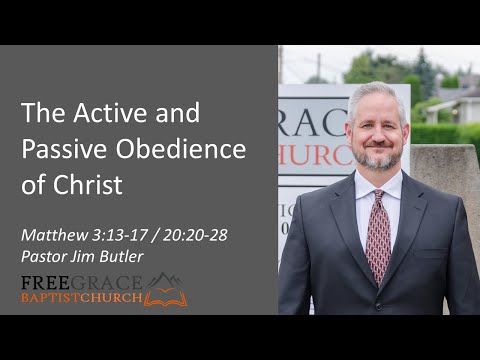
Live Stream - June 18, 2023
Justification by faith alone — grounded in both the active and passive obedience of Christ — is the doctrinal foundation on which three believers are publicly baptized. The sermon works through two passages in Matthew's Gospel: the water baptism of Jesus by John, which marks the beginning of his active obedience in fulfilling all righteousness on behalf of sinners, and his metaphorical 'baptism' of suffering and death, which satisfies the wrath of God and secures redemption for his people. The double imputation — of Christ's righteousness credited to the believer and of the believer's sin laid upon Christ — is the only ground on which a guilty sinner can stand before a holy God, and baptism is the public emblem of that inward, Spirit-wrought reality.

The Ministry of Paul in Ephesus
Acts 19:1–10 presents what appears to be a re-baptism of John's disciples by Paul, but a careful reading of the passage's punctuation and structure reveals that verses 4 and 5 record what Paul said — a summary of John's baptism — while verse 6 records what Paul did: lay hands on these men to confer the extraordinary gifts of the Holy Spirit. John's baptism was Christian baptism, requiring repentance and faith in Christ Jesus, and these disciples had already received it. The extraordinary sign gifts of tongues and prophecy that accompanied the Spirit's coming in Acts 2, 8, 10, and 19 were revelatory gifts suited to the first-century church's founding mission and are not normative patterns for all believers in subsequent ages.

The Active and Passive Obedience of Christ
The obedience of Christ — both active and passive — is the sole foundation of justification by faith alone. Working through two texts in Matthew's Gospel, this sermon expounds the theological distinction between Christ's active obedience, in which He fulfilled all righteousness on behalf of His people, and His passive obedience, in which He drank the cup of divine wrath and was overwhelmed by death as a ransom for many. Sinners cannot contribute a righteousness of their own; they need both the imputed righteousness of Christ's perfect life and the cleansing of His atoning blood. The occasion of three baptisms serves as the concrete illustration: the water publicly declares what God has accomplished inwardly through the finished work of the Savior.

The Problem of Uncleanness and Its Treatment
Leviticus 11–15 addresses a crisis of ritual uncleanness that threatens Israel's access to the holy God dwelling in the tabernacle. The death of Nadab and Abihu in Leviticus 10 creates a double tension — a defiled sanctuary and a compromised priesthood — and these five chapters lay out the categories of uncleanness (diet, childbirth, skin disease, bodily discharge) along with their remedies, all grounded in the repeated divine declaration, 'Be holy, for I am holy.' The laws of clean and unclean are not arbitrary ritual hygiene but theological instruction: to be unclean is to be excluded from the presence of Yahweh, and to be made clean is to be made fit for that presence, a pattern that finds its ultimate fulfilment in the Lamb of God who takes away the sin of the world.
Live Stream - June 11, 2023
Nahum 1:7–14 sets salvation and judgment side by side, insisting that God's goodness cannot be rightly understood if his righteous destruction of the wicked is separated from his mercy toward his people. The sermon traces two movements in the passage: first, the Lord's goodness displayed in being a stronghold for those who trust him and in making an utter end of the wicked oppressor Assyria; second, the comfort that flows from that goodness — the breaking of Judah's chains and the blotting out of Nineveh's name. The application presses believers to find in the coming day of judgment not terror but comfort, since end-time wrath fell upon Christ at the cross, and those found in him stand secure.

Live Stream - June 04, 2023
Leviticus 8–10 presents the ordination, ministry, and judgment of the Aaronic priesthood as the divinely prescribed way for sinful man to access a thrice-holy God — access that comes only through blood atonement, not human innovation. The fire that consumes the sacrifices at the close of Leviticus 9 and the fire that devours Nadab and Abihu at the opening of Leviticus 10 are the same fire, with obedience or disobedience to God's explicit commands as the only determining factor. The entire Levitical system is typological, pointing forward to the Lord Jesus Christ as the great high priest who satisfies divine justice on behalf of guilty sinners. New Covenant worshipers are called to approach the unchanging holy God with the same reverence that the Levitical system demanded, now through the finished work of Christ and mediated at the Lord's Table.

The Installation of the Priesthood
Leviticus 8–10 records the ordination, ministry, and judgment of Israel's priesthood, tracing the way sinful man may approach a thrice-holy God through divinely prescribed sacrifice. The death of Nadab and Abihu for offering that which the Lord had not commanded warns that worship is regulated by God alone, not by the worshiper's innovation. Christ fulfills every type embedded in this system — as the holy, harmless, and undefiled High Priest who satisfies divine justice once for all. The sermon calls new-covenant worshipers to approach the Lord's Supper with the same reverence and eager joy that the priestly fire of Leviticus 9 ought to have kindled.