
Cited in sermons
W. D. Davies
49 sermons · All people cited

The Signs and Wonders Following Jesus's Death

At the death of Jesus, Matthew records four signs: the tearing of the temple veil, an earthquake, split rocks, and the resurrection of Old Testament saints — phenomena unique or extended beyond what the other Synoptics report. This exposition works through Matthew 27:51–56, arguing that each sign carries distinct theological weight: the torn veil announces the abrogation of the old covenant by fulfillment and the opening of free access to God through Christ's flesh; the earthquake signals divine judgment and vindicates the Son; the resurrection of the saints demonstrates Christ's power over the grave, confirms the bodily resurrection hope, and shows the retrospective efficacy of his atoning work for old covenant believers. The sermon closes at the Lord's Supper table, where the confession of Gentile soldiers and faithful women together display that Christ's blood avails for every tribe, tongue, people, and nation.

The Trial Before Pilate, Part 3
John 18:39–40 records Pilate's offer to release Jesus under the Passover custom, and the crowd's choice of Barabbas instead — a transaction that serves as an emblem of substitutionary atonement: the just taking the place of the unjust, the holy bearing what the unholy deserves. Drawing on Matthew 27:15–26 to amplify the scene, the sermon traces the envy of the religious leaders, the warning of Pilate's wife, the manipulation of the multitudes, Pilate's cowardly self-absolution, and the crowd's terrible cry of blood-guilt. The central application is that the believer stands before God not on the ground of personal righteousness but solely on account of Christ's vicarious obedience and death — the glorious exchange in which our sin is laid on him and his righteousness is credited to us.

The Conversion of Matthew
Matthew 9:9-13 presents the sovereign call of Christ to Matthew, a tax collector despised in first-century Jewish society as a collaborator with Gentile oppressors and a companion of sinners. The sermon traces three movements in the passage: the authoritative call that produced immediate discipleship, the feast Matthew threw to honor Christ and evangelize his former associates, and Christ's threefold response to the Pharisees' complaint — identifying himself as a physician to the sick, appealing to Hosea 6:6 against mere external religion, and declaring his mission to call sinners to repentance. The central application is that no sinner is too notorious to be received by Christ, and Matthew's immediate rising and following is held up as the pattern for genuine repentance and faith.

The Blessing of Gospel Rest
Matthew 11:25–30 grounds the gospel invitation — 'Come to me, all you who labor and are heavy laden' — in the sovereign will of the Father and the mediatorial office of the Son, so that the call to rest is inseparable from the doctrines of election and definite atonement. Jesus thanks the Father for hiding these things from the self-wise and revealing them to babes, declaring that all sovereign authority over salvation belongs to Him as the God-man and mediator. The 'rest' He offers is not relief from physical toil but deliverance from the crushing burden of sin and the impossible demands of pharisaical religion, received through faith alone. Those who come to Christ in faith are also exhorted to take His yoke — the life of sanctification — which is not oppressive bondage but the glad obedience of those justified freely by grace.

The Necessity of Christ's Passion
Matthew 16:21–23 presents the first formal announcement of what Christ himself calls a divine necessity: he must go to Jerusalem, suffer at the hands of the elders and chief priests, be killed, and be raised on the third day. The sermon traces this necessity through the covenant of redemption, the Old Testament prophetic witness — Psalms 22, 69, and 110, Isaiah 52–53, Daniel 9, Zechariah 9–14 — and a series of informal anticipations across Matthew's Gospel. Peter's sharp rebuke is examined as a representative failure to grasp the messianic agenda of a suffering Servant, and Christ's equally sharp response — 'Get behind me, Satan' — is shown to be the definitive affirmation that substitutionary curse-bearing is non-negotiable: error here is not a skin disease but a disease at the heart. The congregation is urged to hold fast to the doctrine of Christ crucified and risen as the only stable ground of perseverance in the Christian life.

The Denial of the Resurrection
Matthew 28:11–15 records the fabrication of the lie that Christ's disciples stole his body — the original counter-narrative to the resurrection. This sermon exposes the willful unbelief of the Jewish religious leaders, tracing their conspiracy as one episode in a sustained, devil-driven war against the truth of the gospel. The implausibility of the theft narrative is examined on apologetic grounds, and the sermon closes by contrasting the Counter Great Commission of bribe-funded deception with the Great Commission of Christ's abiding-presence-powered truth.
The Burial of Jesus
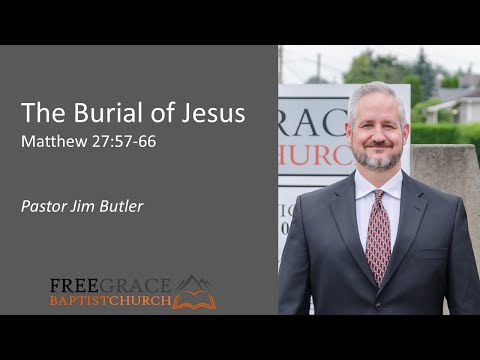
The burial of Jesus in Matthew 27:57–66 is examined across two movements: the burial proper (vv. 57–61) and the security measures taken at the tomb (vv. 62–66). Against both the swoon theory and ancient Jewish counter-testimony that the disciples stole the body, the sermon marshals the apologetic force of the sealed, guarded, newly-hewn tomb to demonstrate that the resurrection overcame every human precaution. The burial also carries weight in four theological categories: it confirms the reality of Christ's death, marks the final act of his humiliation as the last Adam, demonstrates his conquest of death, and strips the grave of its paralyzing power for all who belong to him.

The Crucifixion of Jesus, Part 5
The death of Christ on the cross was not a bare historical event but a theologically charged act that immediately reshaped the covenant order between God and man. This sermon expounds Matthew 27:51–56, examining the three signs that followed the crucifixion — the torn temple veil, the earthquake and split rocks, and the resurrection of the saints — as divine testimony to the efficacy of Christ's atoning work and the inauguration of the New Covenant. The witnesses to that death, both the confessing Roman soldiers and the faithful women who had followed Jesus from Galilee, confirm that the one crucified is truly the Son of God. Believers are called to rest in Christ's completed atonement, which has opened access to the Holy of Holies for all who come through him, and to look forward to the bodily resurrection he has secured for his people.

The Crucifixion of Jesus, Part 3
Matthew 27:45–46 records the fourth of Christ's seven words from the cross — the cry of dereliction, 'My God, my God, why have you forsaken me?' — and its interpretation demands both exegetical precision and doctrinal care. The darkness from the sixth to the ninth hour was not a solar eclipse but a supernatural sign of divine judgment, recapitulating the ninth plague pattern and marking the moment the Passover antitype was slain. The cry itself does not imply any ontological division within the Trinity, any dissolution of the hypostatic union, or the suffering of all three persons; rather, it expresses the withdrawal of divine consolation from the Son according to his true humanity as he bore, in our place as surety, the full weight of penal wrath. Believers are called to ground their assurance not in felt divine presence but in the covenant faithfulness of the God to whom Christ still cried 'my God' even in the depth of his substitutionary suffering.

The Neglect of Weighty Matters
Jesus condemns the scribes and Pharisees in Matthew 23:23–24 not for tithing mint, anise, and cumin, but for doing so while neglecting the weightier matters of the law: justice, mercy, and faith. The Pharisaic imbalance is neither ancient nor extinct — the same tendency to obsess over religious minutiae while bypassing the moral and covenantal substance of God's law persists in the church today. Drawing on Micah 6:8, Hosea 6:6, and the broader prophetic tradition, this exposition argues that genuine obedience to God is universal and balanced, not selective and performative.

The Soldiers Mock Jesus
The mockery of Jesus by the Roman soldiers in Matthew 27:27–31 is examined as a Lord's Supper meditation, tracing the psychological and physical brutality inflicted on the Son of God after Pilate's verdict. The scene is read through the lens of fulfilled prophecy — Isaiah 50:6 and Isaiah 53 — and the covenant of redemption, in which Christ willingly undertook every indignity as the surety and substitute for his people. The sermon closes by turning to the book of Revelation to show that what the soldiers performed in jest — robing, crowning, and hailing a king — Christ possesses in eternal reality, and calls believers to respond with the genuine homage these soldiers withheld.

The Trial Before Pilate, Part 3
Matthew 27:24–26 records the sentencing of Jesus by Pontius Pilate — the culmination of a trial in which the governor thrice declared the accused innocent yet delivered him to crucifixion anyway. The sermon examines Pilate's hypocritical self-absolution by the washing of hands, the crowd's willing acceptance of blood-guilt and its ominous extension to their children, and the formal scourging and condemnation of Christ. Throughout, the exposition presses the double benefit of the gospel: the forgiveness of sins and the imputation of Christ's righteousness received by faith alone, both grounded in the penal substitutionary atonement symbolised by Barabbas going free while the just one goes to the cross.

The Trial before Pilate, Part 1
Matthew 27:11–14 records the first stage of Jesus' trial before Pontius Pilate — his interrogation by the Roman governor. The passage unfolds in three movements: Pilate's opening question and Christ's guarded affirmation that he is indeed King of the Jews, the formal accusations brought by the chief priests and elders against which Jesus remains silent, and Pilate's astonished second question met again with silence. Christ's silence before Pilate is not passivity but purposeful obedience — fulfilling the fourth servant song of Isaiah 53 and accomplishing the active righteousness that is imputed to his people in justification. The sermon drives toward the twin realities of forgiveness and positive imputation: Christ's silence secured not only the remission of sins but the righteousness that avails with God, so that his people stand before the Father clothed in another's merit rather than their own.

The Empty Tomb and the Risen Lord
Matthew 28:1–10 narrates not the resurrection itself but the discovery of the empty tomb and Christ's first post-resurrection appearance — and the distinction matters theologically. This sermon works through the arrival of the women, the descent of the angel, the angelic announcement, and Christ's own greeting, demonstrating that the resurrection is attested historical fact whose denial collapses justification, undermines the prophetic witness, and renders the Christian hope pitiable. The risen Christ's address to the women — calling the disciples 'my brethren' despite their desertion — is shown to be a concentrated display of the grace and advocacy that sustains every believer who has sinned against the Lord he professes to love.

The Empty Tomb and the Risen Lord
The resurrection of Jesus Christ from the dead is not a cunningly devised fable but a historically attested and theologically necessary event that vindicates Christ's person and work. Expounding Matthew 28:1–10, this sermon examines the discovery of the empty tomb — the descent of the angel, the commission to the women, and the flight of the guards — and then the appearance of the risen Lord to the women, who held him by the feet and worshipped him. The hypostatic union underlies that act of worship: they touch his human feet while adoring the second person of the Trinity. Because Christ is risen, believers need not fear, have an advocate with the Father when they sin, and possess a hope that is grounded in historical reality and not mere sentiment.

The Anointing at Bethany
Sandwiched between the conspiracy of the religious leaders and the betrayal of Judas, the anointing at Bethany (Matthew 26:6–13) presents an act of extravagant devotion that Christ himself defends, interprets, and immortalizes. The sermon works through three movements: the act itself, the disciples' indignant complaint, and Christ's authoritative response, showing that what pragmatic men call a waste Christ calls a good work. Against the tendency toward either-or Christianity, the passage enforces both fervent worship of Christ and genuine care for the poor as inseparable obligations. The abiding lesson is that no expenditure of time, wealth, or devotion directed to the Lord of glory can ever constitute a waste, because he is chief among ten thousand and altogether lovely.

The Great Commission, Part 3
Matthew 28:19 commands that disciples be baptized into the singular name of the Father, Son, and Holy Spirit — a text that stands as one of Scripture's clearest witnesses to the doctrine of the Trinity. This sermon works through the baptismal formula to establish what the one name and three persons require the Christian to confess: one divine essence, three distinct subsistences, free from the errors of tritheism, modalism, and subordinationism. The active obedience of Christ is exposited as the ground of the righteousness imputed to sinners in justification, showing that the gospel itself is inseparable from a right doctrine of God. The congregation is urged to study the confession's chapters on theology proper and Christology, and to hold the doctrine of the Trinity as a white-knuckle conviction worth dying for.

Free Grace Baptist Church - October 8, 2017 AM
The mock enthronement of Jesus recorded in Matthew 27:27–31 simultaneously exposes the comprehensive guilt of every human participant — Pilate, the soldiers, the Jewish leaders, and the elect whose sins were heaped upon the Savior — and reveals the ironic glory of the King who would actually bear every emblem the soldiers placed on him in jest. The sermon argues that what the soldiers devised as dishonor — the robe, the crown of thorns, the reed — were unwitting foreshadowings of Christ's true royal majesty as depicted in the book of Revelation, where he reigns with golden crown, glorious robe, and iron scepter. The exposition closes with three applications under the gravity, the glory, and the gratitude of the scene, pressing both unbelievers to flee to the Savior from the coming wrath and believers to exceed the soldiers' inventiveness in devising honor for their King.

The Trial before Pontius Pilate, Part 3
Matthew 27:24–26 records Pontius Pilate's attempt to wash his hands of Christ's blood, the crowd's acceptance of blood-guilt upon themselves and their children, and the formal sentencing of Jesus to scourging and crucifixion. This sermon exposes Pilate's self-absolution as rank hypocrisy — he declares innocence while simultaneously ordering the execution — and traces the crowd's fearful cry ('His blood be on us and on our children') as an omen fulfilled in the destruction of Jerusalem in AD 70. The passage is set within the larger framework of substitutionary atonement: Christ, the only truly innocent man, willingly bore the penalty owed to guilty sinners, satisfying divine justice on behalf of His people. Hearers are called to see their own culpability in the cross and to repent and be converted, trusting in the sufficiency of Christ's shed blood for the remission of sins.

The Trial before Pontius Pilate, Part 1
Why does Jesus stand silent before Pontius Pilate, refusing to answer a single charge? Matthew 27:11–14 records the interrogation of Christ by the Roman governor, in which Jesus affirms his kingship with a qualified 'it is as you say' and then offers no defense against the accusations of the chief priests and elders. That silence is not weakness but resolute, covenantal determination — the fulfillment of Isaiah 53:7, the refusal to retard the death that alone can save sinners from the wrath of a holy God. The sermon calls both believer and unbeliever to marvel at the silence of Christ, recognizing in it the ground of every sinner's boldness before God on the day of judgment.
The Use of the Blood Money
Matthew 27:6–10 records the chief priests' disposal of the thirty pieces of silver used to betray Jesus — and Matthew's citation of this event as the fulfillment of prophecy attributed to Jeremiah. This sermon examines the rank hypocrisy of the religious leaders who scrupled over depositing blood money into the treasury while simultaneously orchestrating the judicial murder of an innocent man, exposing the self-condemning logic of ceremonial fastidiousness divorced from the weightier demands of the law. The sermon then defends the inerrancy of Matthew's composite citation of Zechariah 11 and Jeremiah 18–19, 32, showing how Matthew functions as a biblical theologian weaving together prophetic themes of rejection, judgment, exile, and restoration to demonstrate that the passion of Christ was the fulfillment of the entire prophetic witness. The application calls hearers to recognize their own guilt before a holy God and to flee to the imputed righteousness and atoning blood of the Lord Jesus Christ.

The Hearing before the Sanhedrin, Part 3
Matthew 26:65–68 records the formal charge of blasphemy leveled against Christ by the high priest Caiaphas and the Sanhedrin's unanimous verdict that he is deserving of death. This sermon, the third in a series on Christ before the Sanhedrin, examines three movements in the text: the high priest's indictment, the Sanhedrin's verdict, and the physical mistreatment of the Son of Man. The central irony running through the passage is that the one charged with blasphemy is the eternal Son of God, while those bringing the charge are themselves blaspheming — misrepresenting and condemning the Holy One of Israel in fulfillment of the very Scriptures they profess to uphold.

The Lord's Arrest in the Garden
Matthew 26:50-56 records the arrest of Christ in Gethsemane — an event the speaker expounds as the voluntary, scripturally determined surrender of the sinless Son of God, not a defeat. Working through four structural movements (betrayal, defense, assertion, and desertion), the sermon treats Peter's sword-stroke as a case study in zeal without knowledge, unpacks the legitimate and illegitimate uses of the sword in biblical ethics, and shows that Christ's willing submission to arrest was the necessary means by which He bore the wrath of God as the scapegoat for His people. The closing application summons hearers to the Psalm 2:12 command — 'Kiss the Son' — contrasting Judas's kiss of treachery with the saving trust that finds all shame removed in the One who went alone into the wilderness bearing sin.

The Institution of the Lord's Supper, Part 2
Matthew 26:26–30 records Christ's institution of the Lord's Supper in the context of the Passover, and this expository sermon works through the significance of the cup, the anticipation of the messianic banquet, and the concluding hymn sung before Gethsemane. The cup of the new covenant is unpacked under three headings: the covenantal background rooted in Exodus 24 and Jeremiah 31, the substitutionary and particular atonement it seals (Christ's blood shed for many, not for all without distinction), and the redemptive benefit of the remission of sins. The sermon closes by setting the Lord's Supper within its threefold orientation—backward to the cross, present in the church's communion, and forward to the consummated messianic banquet—and by pressing the gospel invitation upon the unconverted through John 6:40.
The Betrayal of Christ by Judas
Judas Iscariot's betrayal of Christ for thirty pieces of silver exposes the deadly convergence of unrepented sin, satanic opportunism, and the utter insufficiency of religious privilege as a ground of salvation. Working through Matthew 26:14–16 in its narrative context, this sermon examines both the identity of the betrayer — his position, character, and the devil's capitalizing on his covetousness — and the mechanics of his conspiracy with the chief priests. The central application is that unconverted hearts, however outwardly privileged, will be seized upon by Satan through their ruling sin; the only remedy is sovereign grace received through faith in Christ alone.
The Anointing at Bethany
Matthew 26:6–13 records the anointing of Jesus at Bethany by Mary, sister of Lazarus, who poured a flask of costly spikenard worth a year's wages upon his head. Matthew places this account between the conspiracy of the chief priests and the betrayal by Judas for deliberate theological reasons: where the cross is associated with treachery on every side, it must also be associated with wholehearted worship and adoration. The disciples' indignant charge of 'waste' is exposed as both a direct insult to Mary and an indirect slight upon the dignity of Christ himself, while Jesus' fourfold response vindicates her act as a beautiful thing, a prophetic preparation for his burial, and a deed to be proclaimed wherever the gospel is preached. The sermon calls believers to imitate Mary's extravagant, undivided devotion to Christ, resisting the tendency to reduce Christian faithfulness to either social concern or piety alone.

The Olivet Discourse, Part 7
Matthew 24:22–28 addresses the days of the great tribulation surrounding the destruction of Jerusalem in A.D. 70, and Jesus' warnings against false Christs who would arise during the siege. Taking a preterist hermeneutic, this exposition argues that the shortening of those days (v. 22) reflects God's sovereign limitation of covenant judgment for the elect's sake, and that the lightning metaphor of verse 27 describes not Christ's final physical return but a judgment-coming executed from His enthroned position at the Father's right hand. The carcass-and-eagles image of verse 28 is read against Deuteronomy 28 and Habakkuk 1 as a covenant-curse idiom for the Roman armies as instruments of divine vengeance. Throughout, the passage is applied evangelically: the only refuge from any coming judgment is flight to Christ alone, by grace alone, through faith alone.

The Olivet Discourse, Part 1
The Olivet Discourse opens with a decisive act: Jesus departs the temple he has just pronounced desolate, and his disciples — grasping the covenantal weight of that moment — point to its magnificence even as he foretells its total destruction. This sermon establishes the interpretive framework for Matthew 24–25, arguing from the immediate context of chapters 21–23, the parallel witness of the Old Testament prophets (Ezekiel, Micah, Jeremiah), and the time-texts of the discourse itself that Jesus addresses first-century Israel, not a distant eschatological future. The Preterist reading on offer holds that AD 70 was the exhaustion of the covenant curses of Deuteronomy 28 upon apostate Old Covenant Israel, that the church — not ethnic Israel — is now the covenant people of God, and that this understanding guards against both anti-Semitism and Christian Zionism.

The Lament Over Jerusalem
Matthew 23:37–39 records Christ's lament over Jerusalem — a cry of sorrow that follows directly upon the severest condemnations he has pronounced against the scribes and Pharisees. The sermon traces Jesus' prophetic lament through its Old Testament antecedents in Jeremiah, Ezekiel, and the Psalms, arguing that Christ speaks here according to his human nature, expressing genuine grief over a city that has killed the prophets and now rejects the Messiah himself. The declaration 'your house is left to you desolate' marks a decisive redemptive-historical shift: as in Ezekiel 8–11, the withdrawal of God's glory precedes the destruction of the temple, and that withdrawal is enacted when Christ departs to the Mount of Olives. The sermon closes by refuting the Arminian use of 'you were not willing' as a proof text for free will, showing instead that the text confirms total depravity and that the free and genuine offer of Christ to sinners is fully consistent with the Reformed doctrine of sovereign grace.

The Impending Judgment of Israel
Matthew 23:34–36 records Christ's announcement of impending divine judgment upon the generation of Israel that would reject him and murder his sent messengers. The sermon traces three interlocking movements: the rejection of the prophets Christ sends in the new covenant era, the accumulation of blood-guilt from Abel to Zechariah spanning the entire Hebrew canon, and the prophetic assurance — sealed with Christ's own 'amen' — that all these things would fall upon that first-century generation in the destruction of AD 70. The exposition situates Matthew 23 within a consistent covenantal pattern running from the Mosaic curses through the Assyrian and Babylonian captivities to AD 70, and closes with a direct call to flee to the Righteous One whose shed blood is the only escape from the condemnation of hell.