
Cited in sermons
Thomas Goodwin
9 sermons · All people cited
2LCF - Introduction to the 1689 London Confession of Faith

The 1689 London Baptist Confession of Faith (properly the 1677 Confession) did not arise in a vacuum: it was a deliberate act of theological stewardship by particular Baptists who stood inside the Reformed Protestant consensus, followed the Westminster Assembly and the Savoy Declaration in structure and wording, and published their confession to correct heterodoxy, serve a new generation, and demonstrate solidarity with fellow persecuted Protestants. This introductory session reads the original epistolary preface to the confession in full and then surveys its argument under five headings — continuity, catholicity, candor, confirmation, and conversation — showing how the confessors understood creeds and confessions as the church's Berean effort to articulate what the Bible says, not to add to it. The session closes with a call to receive the confession in the same spirit in which it was written: not contention, but a whole-souled, humble, and Spirit-dependent owning of the faith once for all delivered to the saints.

The Gospel's Indispensable Glory
What is the gospel? Paul's answer in 1 Corinthians 15:1–4 is not what we do or feel, but the objective, once-for-all work of the Lord Jesus Christ: his death for sins, his burial, and his bodily resurrection on the third day according to the Scriptures. This sermon works through two categories — the necessity of the gospel and its essential content — showing that the gospel is both the lifeblood of Christian existence and the only ground of justification and resurrection hope. The sermon closes with a direct summons: for the Christian, the risen Christ is blessed Savior and interceding High Priest; for the unbeliever, he is the coming Judge.
The Riches of God's Grace

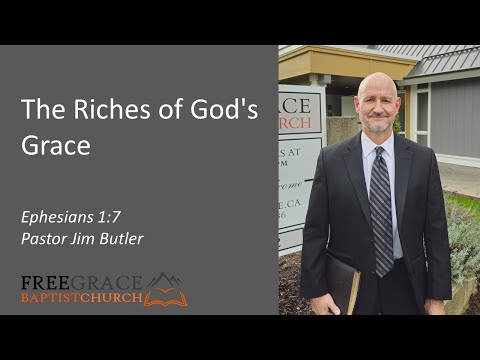
Ephesians 1:7 declares that believers possess redemption through Christ's blood and the forgiveness of sins according to the riches of God's grace. This sermon works through the triune shape of salvation in Ephesians 1:3–14, arguing that the redeemed are not a class of morally capable people who needed modest assistance, but guilty sinners who required blood atonement, divine election, and the sealing of the Holy Spirit. The cross is shown to satisfy divine justice as well as display divine love — God is both just and the justifier of the one who has faith in Jesus, as Paul argues in Romans 3:21–26. The sermon closes with a direct application to baptism, presenting the ordinance as an outward declaration of the inward forgiveness and righteousness received through union with Christ.

CTF 2024 Session 4: The Uniting Power of our Reformed Confessions

The ecumenical creeds of the first five centuries — the Apostles' Creed, the Nicene Creed, the Chalcedonian Definition, and the Athanasian Creed — form the doctrinal bedrock upon which the Reformation confessions, including the Westminster Confession, the Savoy Declaration, and the Second London Confession of Faith, were deliberately built. This address traces the historical controversies (Arianism, Eutychianism, Monophysitism, Monothelitism) that provoked each creed, demonstrates the precise linguistic dependence of the 1689 LBCF upon creedal formulations, and argues that this shared inheritance constitutes genuine theological unity among confessional Reformed and Reformed Baptist churches. The practical conclusion is that ministers must teach these creeds and their underlying doctrines — Trinitarian theology, the hypostatic union — as the bedrock of Christian comfort, not merely as academic curiosity.

Book introduction: The Mystery of Christ, His Covenant, and His Kingdom
Samuel Renihan introduces his book 'The Mystery of Christ, His Covenant, and His Kingdom,' explaining its origins in his seminary-era dissatisfaction with both pedobaptist and Baptist covenantal literature. He argues that historical particular Baptist covenant theology has been largely forgotten, and that modern Reformed Baptist literature has suffered from poor historical theology, excessive polemicism, and conclusions stated without premises. The book is structured by biblical theology rather than systematic theology, tracing three covenantal kingdoms — creation, Israel, and Christ — and contends that the concept of mystery in Paul is essential to a properly calibrated covenant theology that distinguishes the old covenants from the new covenant without collapsing the progressive development of divine revelation.

The Redemptive Work of the Son, Part 1
Ephesians 1:6–7 sets forth the redemptive work of the Son within the triune economy of salvation, moving from the Father's electing purpose in eternity past to Christ's historic accomplishment of redemption in time. The sermon expounds two interlocking realities: the Father's sovereign initiative in bestowing grace upon the elect in the Beloved, and the Son's purchase of redemption through the shedding of his blood. Redemption is shown to be not a mere exercise of divine power but the payment of a ransom price, with the forgiveness of sins as its primary blessing — all flowing from the inexhaustible riches of God's grace. Hearers are called to respond with worship, gratitude, and increasing love for Christ, the Beloved of both the Father and the redeemed.
2LCF Chapter 6 - Of the Fall of Man, of Sin, and of the Punishment Thereof

What is sin, where did it come from, and what has it done to us? This confession study works through 1689 London Baptist Confession chapter 6, paragraphs 1–5, examining the origin of sin in the covenantal breach of Adam, the universal solidarity of mankind in that guilt and corruption, and the abiding effects of sin in both the unregenerate and the regenerate. The remedy is shown to be twofold: justification to deal with the guilt of sin and sanctification to deal with its remaining corruption, both secured by Christ as the second Adam who fulfilled what the first Adam failed to keep.
2LCF Chapter 7 - Of God's Covenant, Part 3
The Covenant of Redemption (pactum salutis) is the pre-temporal, intra-Trinitarian agreement between the Father and the Son in which the Father gives a particular people to the Son and the Son willingly undertakes to be their mediator and surety. This teaching examines the definition, parties, stipulations, and promises of the pactum, traces its exegetical foundations across both Testaments, and shows how it grounds the Covenant of Grace and underwrites definite atonement. Understanding the Covenant of Redemption provides believers with firm assurance, because the immutable and impassible God has covenanted in eternity to save the elect in Christ, and that plan cannot fail.
The Parable of the Sower Stated
Matthew 13:1–17 presents the parable of the sower and Christ's explanation of why he teaches in parables. The sermon works through two sections: the parable itself (vv. 1–9), exposing four types of hearers — hardened, shallow, crowded, and fruitful — and the purpose of parabolic teaching (vv. 10–17), which is both to reveal kingdom mysteries to the converted and to conceal them from the unconverted by divine design. The two-fold purpose of parables is grounded in sovereign election, drawing on Isaiah 6:9–10 and the language of Matthew 11:25–27, pressing hearers to examine whether they are genuinely receptive soil and to submit to the Godhood of God rather than resist his sovereign purposes in grace.