
Cited in sermons
Samuel Pierce
6 sermons · All people cited

The Cross and the Crown of Christ, Part 1

Psalm 22 is the suffering Messiah speaking in his own voice — a depth of self-disclosure that the prophet Isaiah 53 approaches but does not match. This sermon works through the first two of three laments in verses 1–11: Christ's desolation under judicial desertion by the Father, and the reproach heaped upon him by his enemies. The cry of dereliction is neither a rupture in the Trinity nor a dissolution of the hypostatic union, but a penal desertion in which the Father withdraws his favorable countenance from the one who has been made sin as mediator. Throughout each lament Christ models the pattern of honest complaint before God followed by confident recourse to the Father's holiness, covenant faithfulness, and sovereign purpose — a pattern the church is called to imitate in its own far lesser sufferings.

The Psalmist's Cry in an Age of Deceit
Psalm 12 presses the question Psalm 11 leaves open: not what becomes of the wicked in the end, but how the people of God survive and remain faithful in the present evil age. The sermon traces two movements in the psalm — the destruction of foundations (vv. 1–4), marked by idle speech, flattery, and the proud autonomy of godless men, and the preservation of the righteous (vv. 5–8), grounded in God's arising to deliver the oppressed and in the utter purity of his Word. David's prayer is read through a Christological lens: the psalm is supremely the prayer of Christ in his earthly ministry, opposed at every step, yet sustained by the Father's Word and promise. The congregation is urged to respond to cultural and ecclesiastical decay not by retreat or despair but by theology, prayer, and dependent trust in the pure and preserving Word of God.
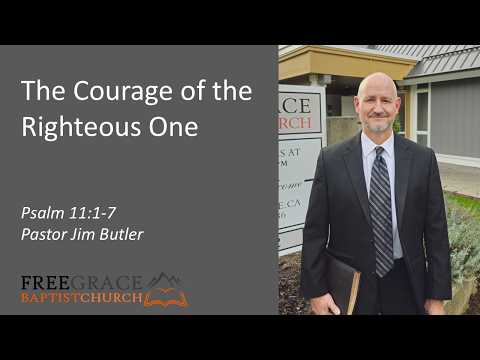
The Courage of the Righteous One
Psalm 11 presents the righteous man — supremely the Lord Jesus Christ — facing the temptation to abdicate his calling when wicked enemies ready their arrows and the foundations of moral order appear destroyed. The sermon expounds two movements: the temptation to flee (vv. 1–3) and the fortification found in contemplating God's sovereignty, omniscience, and justice (vv. 4–7). Because Christ steadfastly set his face toward Jerusalem and drank the cup of divine wrath to its dregs in the place of his people, believers have every reason to resist the same temptation to cowardice and unbelief, and to stand firm in the Lord.

The Challenge and Confidence of the Psalmist
Psalm 10 presents a twofold movement: the challenge of the psalmist in verses 1–11, and the confidence of the psalmist in verses 12–18. The sermon argues that this psalm is not primarily about David's historical circumstances but about the earthly ministry of the Lord Jesus Christ — his humanity, his experience of apparent divine withdrawal, and his witness to the wickedness of those who conspired against him. The church, as joined to Christ, prays these words as her own, setting the promises of God against the troubled testimony of sense and experience, and resting in the certain reign of the Lord who will one day cause the man of the earth to oppress no more.

The Vindication of the Righteous One
Psalm 7 unfolds as a courtroom drama in which the psalmist — and, typologically, the Lord Jesus Christ — appeals to God for vindication against false accusers, refusing personal retaliation and casting the entire matter upon the justice of God. The sermon moves through three phases: the supplication of the righteous one, the assertion of innocence, and the extended vindication that grounds confidence in God's decreed judgment against the wicked. David functions as a type of Christ, whose spotless innocence alone fully satisfies the conditions of verses 3–4, and whose imputed righteousness is the sole ground on which the church may echo his plea. The practical summons is to resist paralysis or retaliation in the face of false accusation and social hostility, and instead to take refuge in the just God who is angry with the wicked every day and who has appointed a day of final judgment.

The Salvation and Blessing of God
Psalm 3 presents David's threefold movement through affliction, conviction, and petition — not as private biography, but as a typological window onto the Lord Jesus Christ and, in union with him, the whole church. David's flight from Absalom prefigures Christ surrounded by enemies, crucified, raised, and exalted; the same enemies who said 'there is no help for him in God' echo across the centuries to Golgotha. The psalm teaches that affliction does not dissolve confidence in God but sharpens it: the shield, the glory, and the lifter of the head are unchanging realities that produce sleep in the midst of crisis and courage before ten thousands of adversaries. The closing declaration — 'salvation belongs to the LORD, your blessing is upon your people' — is the direct answer to every accusation that God has abandoned his own, and it is the ground on which the church is called to pray, to sing, and to stand without fear.