
Cited in sermons
Samuel Miller
14 sermons · All people cited
The Defense of the Faith

Jude 3 commands every believer — not merely church officers — to contend earnestly for the faith once for all delivered to the saints. This sermon works through the exhortation (v. 3), the motivation supplied by the reality of internal heresy (v. 4), and the disposition required of faithful contenders (vv. 17, 20–21). The defense of objective Christian truth is grounded not in combative temperament but in the knowledge that God loves his people, and is sustained through the study of Scripture, prayer, and a forward orientation toward the return of Christ.
The Use of the 2nd London Confession
A confession of faith is not a human addition to Scripture but a tool the church uses to define, defend, discriminate, discipline, and delimit its doctrine. Drawing on passages from the Pastoral Epistles, Jude, and Ephesians 4, this Sunday School address argues that the Second London Baptist Confession of 1689 serves the local church in six concrete ways: it establishes doctrinal boundaries, equips members for apologetics, vets candidates for ministry, grounds church discipline, protects Christian liberty by identifying what lies outside its purview, and anchors the church in the catholicity of the Reformed tradition. The session closes with a call to reject autonomous biblicism in favour of confessional theology understood as the fruit of the Spirit's ongoing work in the teaching ministry of Christ's church.

The Conduct of the Believer
Philippians 1:27–30 presents a twofold exhortation to the church: that believers conduct themselves in a manner worthy of the gospel, and that they do so with courage in the face of adversaries. The sermon expounds the Greek word for citizenship as the governing concept of verse 27, grounding the call to worthy conduct in the reality of justification by faith — the life of sanctification flows necessarily from what God has graciously accomplished in the believer. Corporate unity in striving together for the faith of the gospel, and undaunted boldness before enemies, are shown to be not optional virtues but demonstrable proofs of sovereign grace at work in God's people.

Ask FGBC #6 - Why is historical confessional Christianity important?
The question of why historical confessional Christianity matters is addressed by examining what Scripture itself says about the gifts Christ gives to his church. Drawing on Ephesians 4 and Matthew 28, the argument is made that creeds and confessions are the accumulated fruit of those gifts — the best doctrinal articulation the church has produced across centuries of theological controversy, from Nicaea and Chalcedon through the Second London Confession. To reject them in favor of a 'no creed but the Bible' posture is not humility but a subtle repudiation of the very ecclesiology the Bible commands, and it leaves individuals without the guardrails that preserve orthodox Christianity.

The Defense of the Faith
Jude 3 commands every believer — not merely clergy or scholars — to contend earnestly for the faith once for all delivered to the saints. This sermon expounds the exhortation, its rationale in the infiltration of ungodly men who pervert grace and deny Christ, and the practical readiness required: remembering apostolic warnings, building on Scripture, praying in the Spirit, and looking for the mercy of Christ at His return. The defence of the faith is not optional, not confined to specialists, and not finally dependent on human faithfulness — it is God's fight, and He keeps those who contend.

Introduction to the 1677/1789 2nd London Baptist Confession of Faith
The 1689 London Baptist Confession of Faith — formally composed in 1677 and adopted by particular Baptist churches in 1689 — stands in deliberate continuity with the Westminster Confession and the Savoy Declaration, adapting their language to reflect distinctively Baptist convictions while maintaining solidarity with the broader Reformed tradition. This introductory session traces the Confession's historical origins, its relationship to the First London Confession of 1644–46, and the legal and ecclesiastical context in which particular Baptists operated under the Act of Toleration. Six reasons are then advanced for why a 21st-century church should subscribe to a 17th-century confession: to define, defend, discriminate, discipline, distinguish matters of Christian liberty, and develop an appreciation for the history of the church. The session closes by urging that confessionalism, rightly understood, is not proud biblicism but the humble reception of gifts Christ has given to his church across the ages.
2LCF Chapter 1 - Of the Holy Scriptures, Part 2
Hermeneutics — the science of biblical interpretation — stands at the center of this study through paragraphs 5 to 10 of Chapter 1 of the 1689 London Baptist Confession of Faith. The session works through five principles: the scope of Scripture (Christ as its organizing center), the sufficiency of Scripture (including good and necessary consequences), the perspicuity of Scripture, the availability of Scripture through faithful translation, and the two classical interpretive rules — the analogy of Scripture and the analogy of faith. The study closes by defending the proper use of creeds, confessions, and the writings of faithful theologians as gifts Christ has given to his church, while insisting that Holy Scripture alone is the supreme and final judge in all controversies of religion.

The Defense of the Faith
Jude 3 commands every believer — not merely pastors or theologians — to contend earnestly for the faith once for all delivered to the saints. This sermon examines the exhortation itself, the internal threat posed by sneaky, ungodly apostates who pervert grace and deny Christ, and the practical preparedness Jude prescribes: remembering apostolic warning, building up on the most holy faith through Scripture and prayer, and resting in the assurance that God himself preserves his people. The defense of the faith is not pessimistic trench-holding but confident advance grounded in Christ's promise to build his church against which the gates of Hades shall not prevail.
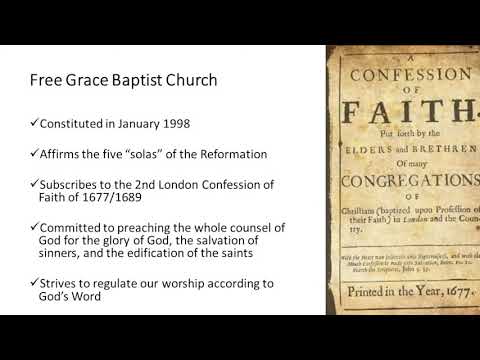
Introduction to the 1689 Second London Baptist Confession of Faith
Why should a church bind itself to a confession of faith? This introductory lesson on the Second London Baptist Confession of 1677/1689 grounds the answer exegetically in Ephesians 4 — where Christ gives gifted men to the church so that the body attains doctrinal unity and is no longer tossed about by every wind of teaching — and then traces the historical origins of the 1689 among the Particular Baptists, distinguishing them from Anabaptists, Presbyterians, and Congregationalists. Four functions of a confession are developed: defining, defending, discriminating, and disciplining with reference to the doctrine of the church. The lesson closes by distinguishing Reformed theology (Calvinism plus covenant theology plus the regulative principle) from mere five-point Calvinism, and by defending the confession's silence on matters of Christian liberty as a feature, not a defect.

The Problem of Sin and the Mercy of God
Proverbs 28:13 sets the problem of sin and its remedy in sharp relief: the one who covers his sin will not prosper, but whoever confesses and forsakes sin will have mercy. The sermon works through the anatomy of sin-covering — denial, minimization, blame-shifting, and self-righteousness — with biblical examples ranging from Adam and Eve to Ananias and Sapphira, demonstrating the futility of every human attempt at self-atonement. Confession is shown to be not merely verbal acknowledgment but a saving act of faith in Christ, inseparably joined to repentance, whereby the sinner lays the hand of faith upon the surety of the new covenant and receives imputed righteousness. The closing application calls both unbeliever and believer to stop covering sin and look in faith to Christ, the only authorized covering for guilt before a holy God.

The Utility of Confessions and Introduction to the Second London Baptist Confession
Confessions of faith are not competitors to Scripture but are faithful summaries of biblical doctrine, and the church has historically depended on them for good reason. This address introduces the Second London Baptist Confession of 1689, tracing its historical origins among the Particular Baptists of the 17th century and its relationship to the Westminster Confession and the Savoy Declaration. Five interlocking uses of a confession are then examined: defining church doctrine, defending it against error, discriminating between members and officers on doctrinal grounds, disciplining departures from orthodoxy, and distinguishing confessed doctrine from matters of Christian liberty. The goal is not confessional enslavement but confessional clarity — guardrails that protect the church and free her members to worship and grow in the grace and knowledge of Christ.

The Defense of the Faith
Jude 3 issues a universal call—addressed not to clergy alone but to every believer, the 'beloved'—to contend earnestly for the faith once for all delivered to the saints. The sermon works through three movements: the exhortation itself and its five implications, the reason for that exhortation in the apostates of verse 4, and the practical preparedness of the contender outlined in verses 20 and 21. Doctrinal fidelity is not optional maintenance for specialists; it is the privilege and duty of every member of the covenant community, sustained by Scripture reading, prayer, and a constant looking to Christ. The sermon closes with a direct call to the unconverted to flee to the Lord Jesus Christ, in whom alone forgiveness of sins and the imputation of his righteousness are received by faith alone.
Contending for the Faith
Jude's brief epistle opens with a thesis that reorients the entire letter: believers are to contend earnestly for the faith once for all delivered to the saints. This study of Jude 1 works through three movements — the command to contend (v. 3), the reason for it (v. 4), and the means of defense (vv. 17–21) — demonstrating that the obligation to guard and propagate Christian truth falls on every believer, not merely ordained officers or parachurch specialists. The apostates Jude describes are shown to be ungodly, secretive, and antinomian, but God's sovereign judgment over Egypt, the fallen angels, and Sodom and Gomorrah supplies the confidence the church needs to contend without fear. The practical strategy is simple: build yourselves up on the holy faith through Scripture, pray in the Holy Spirit, and look for the mercy of Christ — all while engaging opponents with earnestness and genuine Christ-like character.
The Necessity of Contending for the Faith
Jude 3 commands every believer — not merely theologians or specialists — to contend earnestly for the faith once for all delivered to the saints. This sermon expounds the command itself, the reason Jude gives (the covert infiltration of ungodly apostates who pervert grace and deny Christ), and the threefold means of defense in verses 20–21: building oneself up in the holy faith through Scripture, praying in the Holy Spirit, and living in hopeful expectation of Christ's return. The sermon closes by urging that contention be conducted with Christian charity, humility, and freedom from pride, in keeping with the pattern of the apostles and the Lord Jesus himself.