
Cited in sermons
Robert Paul Martin
4 sermons · All people cited
The Use of the 2nd London Confession

A confession of faith is not a human addition to Scripture but a tool the church uses to define, defend, discriminate, discipline, and delimit its doctrine. Drawing on passages from the Pastoral Epistles, Jude, and Ephesians 4, this Sunday School address argues that the Second London Baptist Confession of 1689 serves the local church in six concrete ways: it establishes doctrinal boundaries, equips members for apologetics, vets candidates for ministry, grounds church discipline, protects Christian liberty by identifying what lies outside its purview, and anchors the church in the catholicity of the Reformed tradition. The session closes with a call to reject autonomous biblicism in favour of confessional theology understood as the fruit of the Spirit's ongoing work in the teaching ministry of Christ's church.
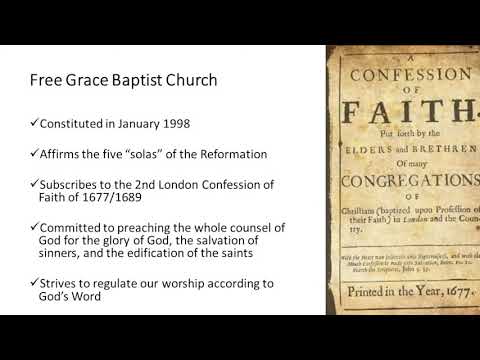
Introduction to the 1689 Second London Baptist Confession of Faith
Why should a church bind itself to a confession of faith? This introductory lesson on the Second London Baptist Confession of 1677/1689 grounds the answer exegetically in Ephesians 4 — where Christ gives gifted men to the church so that the body attains doctrinal unity and is no longer tossed about by every wind of teaching — and then traces the historical origins of the 1689 among the Particular Baptists, distinguishing them from Anabaptists, Presbyterians, and Congregationalists. Four functions of a confession are developed: defining, defending, discriminating, and disciplining with reference to the doctrine of the church. The lesson closes by distinguishing Reformed theology (Calvinism plus covenant theology plus the regulative principle) from mere five-point Calvinism, and by defending the confession's silence on matters of Christian liberty as a feature, not a defect.

The Utility of Confessions and Introduction to the Second London Baptist Confession
Confessions of faith are not competitors to Scripture but are faithful summaries of biblical doctrine, and the church has historically depended on them for good reason. This address introduces the Second London Baptist Confession of 1689, tracing its historical origins among the Particular Baptists of the 17th century and its relationship to the Westminster Confession and the Savoy Declaration. Five interlocking uses of a confession are then examined: defining church doctrine, defending it against error, discriminating between members and officers on doctrinal grounds, disciplining departures from orthodoxy, and distinguishing confessed doctrine from matters of Christian liberty. The goal is not confessional enslavement but confessional clarity — guardrails that protect the church and free her members to worship and grow in the grace and knowledge of Christ.
2LCF Chapter 22 - Of Religious Worship and the Sabbath Day, Part 4
The Fourth Commandment's perpetual and universal obligation — rooted in both natural law and the Word of God — binds new covenant believers to Sabbath observance no less than it bound old covenant saints. This session of a consecutive study through the 1689 London Baptist Confession (chapter 22, paragraphs 7–8) examines the twofold testimony to Sabbath necessity (general and special revelation), the positive-moral character of the Fourth Commandment, and the pre-Sinaitic origins of the Sabbath in Genesis 2. The change of the day from the seventh to the first is introduced and will be treated in full in the following session. The governing spirit of Christian Sabbath observance is not legal fear but cheerful compliance, strengthened by the risen Christ and the sweetness of the gospel.