
Cited in sermons
Richard Muller
35 sermons · All people cited

The Gospel Committed to the Apostle Paul

1 Timothy 1:15–17 contains one of five 'faithful sayings' in the Pastoral Epistles, and Paul deploys it here to contrast the life-giving gospel with the idle speculations of the false teachers troubling the church at Ephesus. The sermon works through three elements: the faithful saying as a standard confession received and guarded by the church; the glorious content of that saying — the incarnation of the Son and his effectual, definite work to save sinners; and the merciful application illustrated in Paul himself, who as the chief of sinners functions as a pattern of Christ's longsuffering for all who will believe. The doxology of verse 17 demonstrates that rightly understood soteriology issues in worship, and believers are called to keep this faithful saying at the centre of their hearts and to press it upon the unconverted.

The Goodness of God's Law
The law of God is good — but only when used lawfully. Expounding 1 Timothy 1:8–11, this sermon defends the goodness of the moral law against both antinomian dismissal and legalistic distortion, situating Paul's argument within the classical Reformed framework of the law's three uses: civil, pedagogical, and normative. The false teachers in Ephesus had neither understood the law nor handled it properly, and Paul's corrective is not to demote the law but to demonstrate its proper function — restraining lawlessness in society, exposing the sinner's need for Christ, and directing the justified believer in the path of sanctification.

CTF 2026 - Session 1: God's Decree in the Puritan Confessions

The doctrine of God's eternal decree, as confessed in the Westminster Confession of Faith, the Savoy Declaration, and the Second London Baptist Confession of 1677/1689, is not a single isolated chapter but a thread woven through the entire fabric of Reformed confessional theology. Drawing on Isaiah 46:8–11, this study traces the decree from its grounding in the doctrine of divine simplicity through creation, providence, the fall, covenant, redemption, the ordo salutis, perseverance, the spread of the gospel, and final judgment. The three Puritan-era confessions are shown to form a deliberate family — Westminster as parent, Savoy as child, and the Second London as grandchild — sharing common language and structure while registering careful Baptist and Congregationalist revisions. The study calls hearers not to speculative curiosity but to humble worship before the sovereign God whose decree is simply God decreeing.
Ask FGBC #65: Are Reformed Baptists Really Just Anabaptists?
The claim that Reformed Baptists (specifically, Particular Baptists) descended from the Anabaptists is examined historically and found to be without evidential basis. Drawing on primary-source scholarship by historians such as Matthew Bingham and James Renihan, the discussion establishes that the Particular Baptists emerged from English Reformation Congregationalism — not from the continental Anabaptist movement — and that no documentary connection exists between the two bodies in the extant 17th-century literature. The conversation also notes that the Anabaptists themselves were not a monolithic group, making the category 'Anabaptist' less precise than popular usage suggests.

Ask FGBC Batch 7: Anabaptists, Calvinism, Sincere Offer & More | Reformed Baptist Theology
This panel discussion brings together three Reformed Baptist pastors to address questions submitted to Free Grace Baptist Church on confessional identity, soteriology, covenant theology, and Lord's Day worship. The conversation distinguishes Particular Baptists from Anabaptists on historical-documentary grounds, examines the relationship between Calvinism and confessional Reformed Baptist identity, and evaluates the free and sincere offer of the gospel against what the panelists regard as the theological liabilities of well-meant-offer language. The discussion also treats the threefold division of the law, prosopological exegesis, and the scriptural rationale for two Lord's Day services, consistently grounding each answer in the 1689 Second London Baptist Confession and the exegetical tradition of the Particular Baptists.

CTF 2025 - Session 8 – Q&A Panel

A Q&A panel from a theology conference on the doctrine of God addresses questions arising from the preceding lectures on classical theism. Three theologians field questions on divine impassibility (including whether God can be grieved), the eternal decree and the covenant of redemption, divine aseity and the Son's relationship to the Father, the nature of time in the eternal state, the role of philosophy and natural theology in arriving at the classical doctrine of God, and whether genuine evil exists within God's sovereign economy. The discussion throughout presses for formulations of doctrine that protect divine simplicity, immutability, and impassibility while preserving the integrity of biblical language and confessional categories.
The Use of the 2nd London Confession
A confession of faith is not a human addition to Scripture but a tool the church uses to define, defend, discriminate, discipline, and delimit its doctrine. Drawing on passages from the Pastoral Epistles, Jude, and Ephesians 4, this Sunday School address argues that the Second London Baptist Confession of 1689 serves the local church in six concrete ways: it establishes doctrinal boundaries, equips members for apologetics, vets candidates for ministry, grounds church discipline, protects Christian liberty by identifying what lies outside its purview, and anchors the church in the catholicity of the Reformed tradition. The session closes with a call to reject autonomous biblicism in favour of confessional theology understood as the fruit of the Spirit's ongoing work in the teaching ministry of Christ's church.

The Revelation of the Father
John 14:7–11 presents Christ's claim that knowledge of the Son is knowledge of the Father, and that the Father dwells in the Son and the Son in the Father — a claim no mere creature could make. The sermon works through three confirmations of this unity: the nature of the Son (his consubstantiality with the Father), the words of the Son (which are the Father's words by virtue of shared essence, not mere instrumentality), and the works of the Son (which the Father performs through the Son as one divine operation). The Trinitarian theology at stake is not speculative — it is the doctrinal ground upon which the disciples, and all believers, stand when the world collapses in on them, because the Son who is God of God, light of light, very God of very God, is the one who came down 'for us and for our salvation.'

2LCF Chapter 1 - Of the Holy Scriptures, Part 2
What does it mean to interpret the Bible correctly, and how does the 1689 London Baptist Confession of Faith guide that task? Working through paragraphs 5 to 10 of Chapter 1, this study introduces the discipline of hermeneutics — the science of biblical interpretation — by tracing six principles the Confession sets forth: the scope of Scripture (the glory of God in the salvation of sinners through Christ), the sufficiency of Scripture (expressly stated and necessarily implied), the perspicuity of Scripture (clear enough for the unlearned on all saving matters), the translation of Scripture (grounded in divine inspiration and providential preservation), the interpretation of Scripture (the analogy of Scripture and the analogy of faith), and the finality of Scripture (Holy Scripture as the supreme judge over all councils, creeds, and private opinion). The practical burden is that a faulty hermeneutic produces bad doctrine, and that reading the Old Testament through the lens the New Testament apostles themselves provide is not optional but the pattern Christ himself commanded.

2LCF Chapter 8 - Of Christ the Mediator, Part 3
The incarnation of the Son of God — that the eternal, divine Son took to himself a true and complete human nature without ceasing to be God — stands at the centre of the Christian religion and is inseparable from the doctrine of salvation. This confession study works through 2LCF Chapter 8, paragraphs 2 and 7, first clearing away eight historical errors about what the incarnation is not (mutation, docetism, a heavenly body, a bodyless appearance, an animal soul without a human soul, a mixing of natures, a divestiture of divine attributes, and a Nestorian conjunction of persons), then positively establishing the language of assumption, union, and incarnation as the church's consistent witness from the apostolic era forward. The Son did not subtract from nor add to himself; he took to himself that which he was not while remaining fully what he eternally is, and the Trinity — Father, Son, and Spirit — acts undividedly in this work, though it terminates on the Son alone.

2LCF Chapter 2 - Of God and of the Holy Trinity
The doctrine of the Trinity is the capstone of the confession's treatment of God, asserting that the one divine and infinite being eternally exists as Father, Son, and Holy Spirit — three subsistences of one substance, power, and eternity, each possessing the whole divine essence undivided. This session works through six confessional affirmations: that Trinitarian monotheism excludes tritheism; that confessing one God in three persons is no contradiction; that the persons do not collectively comprise God in fractional parts; that the persons are distinguished solely by their eternal relations of origin; that Father, Son, and Holy Spirit are fully co-equal, co-eternal, and consubstantial; and that the doctrine of the Trinity is not a cold academic exercise but the very foundation of all communion with God and comfortable dependence on Him.
2LCF Chapter 2 - Of God and of the Holy Trinity, Part 2
What does it mean that God is one, infinite, simple, invisible, incorporeal, and without passions? This Sunday school session works through paragraph 1 of 2LCF Chapter 2, tracing the classical attributes — or perfections — of God through their biblical foundations and the theological vocabulary refined by the church across centuries. Divine simplicity, aseity, incomprehensibility, and impassibility are each examined with care, showing how these doctrines are not abstract curiosities but guard the God of Scripture from distortion and secure the stability of his love, justice, and grace toward his people. The session closes by connecting the doctrine of divine impassibility to the assurance of salvation: because God does not move from one state to another, his love for his people is always most.

Introduction to the 1677/1789 2nd London Baptist Confession of Faith
The 1689 London Baptist Confession of Faith — formally composed in 1677 and adopted by particular Baptist churches in 1689 — stands in deliberate continuity with the Westminster Confession and the Savoy Declaration, adapting their language to reflect distinctively Baptist convictions while maintaining solidarity with the broader Reformed tradition. This introductory session traces the Confession's historical origins, its relationship to the First London Confession of 1644–46, and the legal and ecclesiastical context in which particular Baptists operated under the Act of Toleration. Six reasons are then advanced for why a 21st-century church should subscribe to a 17th-century confession: to define, defend, discriminate, discipline, distinguish matters of Christian liberty, and develop an appreciation for the history of the church. The session closes by urging that confessionalism, rightly understood, is not proud biblicism but the humble reception of gifts Christ has given to his church across the ages.

2LCF Chapter 7 - Of God's Covenant, Part 2
1689 London Baptist Confession of Faith, Chapter 7, paragraph 3 sets out three theological covenants — the covenant of grace, the covenant of redemption (pactum salutis), and the covenant of works — as the structural architecture of all Scripture. This sermon expounds each in turn, demonstrating from texts in Genesis, Isaiah, Hosea, Galatians, and Romans that the covenant of grace is founded on an eternal transaction between the Father and the Son, and that it is God's provision for sinners rendered incapable of acceptance with God since Adam's fall. The covenant of works is shown to be indispensable to a right understanding of justification: without it, the imputed righteousness of Christ collapses into either moralism or antinomianism, and the distinction between forgiveness and imputation is lost. Covenant theology is pressed not as academic machinery but as the very ground of the believer's comfort, assurance, and stability before God.

Introduction to the Decalogue
Exodus 20:1–2, the preface to the Decalogue, reveals God as the sovereign Lawgiver who redeems before He commands — a pattern in which grace precedes obligation that runs from Sinai through the new covenant. The sermon examines three classical uses of the Ten Commandments (civil, pedagogical, and normative) and the threefold division of the law (moral, ceremonial, judicial), demonstrating that the moral law alone abides in its full binding force for all people and all ages. Believers are not justified by the law but are directed by it as the objective standard of sanctification, so that love for God and neighbor is never left undefined or sentimental.

2LCF Chapter 3 - Of God's Decree, Part II
God's decree, as confessed in 2LCF Chapter 3, encompasses both predestination unto life and the reprobation of the non-elect — a distinction the confession handles with care but which Scripture addresses with directness in passages such as Proverbs 16:4, Matthew 11:25-28, and Romans 9:17-23. The sermon distinguishes three theological frameworks integral to understanding the decree in salvation: the Pactum Salutis (the pre-temporal, intra-Trinitarian covenant of redemption), the Historia Salutis (the unfolding of redemption in space and time), and the Ordo Salutis (the application of redemptive benefit to the elect). God ordains not only the end — the salvation of a definite number — but also all the means, grounding the church's obligation to preach the gospel, make disciples, and pursue the lost. The doctrine, rightly received, produces praise, reverence, admiration, humility, diligence, and abundant consolation rather than either hyper-Calvinist passivity or Arminian nervousness.

2LCF Chapter 2 - Of God and of the Holy Trinity, Part 3
The doctrine of the Trinity is not a mathematical formula but a carefully defined confession of one divine being eternally subsisting as three distinct persons — Father, Son, and Holy Spirit. This session works through 1689 London Baptist Confession of Faith chapter 2, paragraph 3, examining the unity and equality of the persons, their distinction by eternal relations of origin, and the contemporary crisis caused by the abandonment of eternal generation. The denial of threeness is as heretical as the denial of oneness, and a recovery of Nicene Trinitarianism is essential not only for theological orthodoxy but for the health of the soul and the vitality of corporate worship.
2LCF Chapter 1 - Of the Holy Scriptures, Part 2
Hermeneutics — the science of biblical interpretation — stands at the center of this study through paragraphs 5 to 10 of Chapter 1 of the 1689 London Baptist Confession of Faith. The session works through five principles: the scope of Scripture (Christ as its organizing center), the sufficiency of Scripture (including good and necessary consequences), the perspicuity of Scripture, the availability of Scripture through faithful translation, and the two classical interpretive rules — the analogy of Scripture and the analogy of faith. The study closes by defending the proper use of creeds, confessions, and the writings of faithful theologians as gifts Christ has given to his church, while insisting that Holy Scripture alone is the supreme and final judge in all controversies of religion.
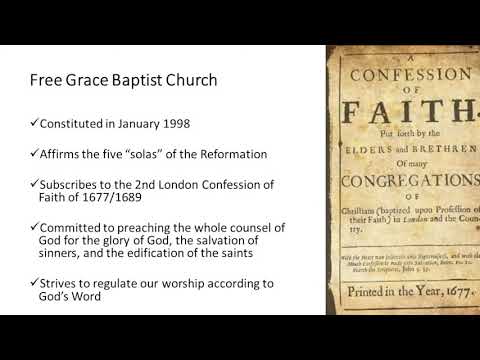
Introduction to the 1689 Second London Baptist Confession of Faith
Why should a church bind itself to a confession of faith? This introductory lesson on the Second London Baptist Confession of 1677/1689 grounds the answer exegetically in Ephesians 4 — where Christ gives gifted men to the church so that the body attains doctrinal unity and is no longer tossed about by every wind of teaching — and then traces the historical origins of the 1689 among the Particular Baptists, distinguishing them from Anabaptists, Presbyterians, and Congregationalists. Four functions of a confession are developed: defining, defending, discriminating, and disciplining with reference to the doctrine of the church. The lesson closes by distinguishing Reformed theology (Calvinism plus covenant theology plus the regulative principle) from mere five-point Calvinism, and by defending the confession's silence on matters of Christian liberty as a feature, not a defect.

The Utility of Confessions and Introduction to the Second London Baptist Confession
Confessions of faith are not competitors to Scripture but are faithful summaries of biblical doctrine, and the church has historically depended on them for good reason. This address introduces the Second London Baptist Confession of 1689, tracing its historical origins among the Particular Baptists of the 17th century and its relationship to the Westminster Confession and the Savoy Declaration. Five interlocking uses of a confession are then examined: defining church doctrine, defending it against error, discriminating between members and officers on doctrinal grounds, disciplining departures from orthodoxy, and distinguishing confessed doctrine from matters of Christian liberty. The goal is not confessional enslavement but confessional clarity — guardrails that protect the church and free her members to worship and grow in the grace and knowledge of Christ.

The Joy of Keeping God's Law
Proverbs 29:18 sets before us two contrasting conditions: the lawlessness that follows the absence of God's revealed word, and the happiness that accompanies obedience to that word. This sermon works through the classic Reformed threefold use of the law — civil/political, pedagogical, and normative — applying the first two uses to the unbeliever and the third to the justified believer. The practical conclusion is that keeping God's law is simultaneously a consequence of justifying faith, a means of promoting assurance of salvation, and an expression of gratitude to God for sovereign grace.

Genesis 9:1-17
The Noahic covenant establishes not only capital punishment but a comprehensive framework for criminal justice that the civil magistrate is bound to apply. Drawing from Genesis 9, Ecclesiastes 8, and the Mosaic civil law, this sermon traces three lesser forms of punishment — restitution, indentured servitude, and corporal punishment — demonstrating that each is governed by due process, proportionality, and a concern for the dignity of the offender as an image-bearer of God. The modern prison system is evaluated against these biblical categories and found to undermine restitution, rehabilitation, and human dignity alike. Hearers are called to think carefully about what Scripture actually teaches concerning crime and punishment rather than dismissing it as barbaric.
OF Christ the Mediator (2LCF 8)
The doctrine of the Incarnation — that the eternal Son of God took to himself a full human nature, body and soul, yet without sin — is one of the two great mysteries of the Christian faith alongside the Trinity. This confession study works through 1689 London Baptist Confession of Faith Chapter 8, Paragraph 2, establishing first what the Incarnation does not mean (mutation of the divine nature, mere appearance, assumption of body only, full humanity without exception, addition to divine being) before drawing out five positive theological entailments: it is the Son alone who became incarnate through the undivided work of the triune God; it is the divine Son who assumed flesh; the assumed humanity is full and complete; Christ is sinless in that humanity; and the two natures are united in one person without conversion, composition, or confusion. The whole doctrine is shown to be the necessary foundation of the Christian gospel, since only a mediator who is truly and fully God, truly and fully man, and wholly without sin can accomplish the redemption of fallen humanity.
The Use of the Blood Money
Matthew 27:6–10 records the chief priests' disposal of the thirty pieces of silver used to betray Jesus — and Matthew's citation of this event as the fulfillment of prophecy attributed to Jeremiah. This sermon examines the rank hypocrisy of the religious leaders who scrupled over depositing blood money into the treasury while simultaneously orchestrating the judicial murder of an innocent man, exposing the self-condemning logic of ceremonial fastidiousness divorced from the weightier demands of the law. The sermon then defends the inerrancy of Matthew's composite citation of Zechariah 11 and Jeremiah 18–19, 32, showing how Matthew functions as a biblical theologian weaving together prophetic themes of rejection, judgment, exile, and restoration to demonstrate that the passion of Christ was the fulfillment of the entire prophetic witness. The application calls hearers to recognize their own guilt before a holy God and to flee to the imputed righteousness and atoning blood of the Lord Jesus Christ.
Of Covenant (2LCF 7)
2 London Baptist Confession of Faith Chapter 7 traces the whole architecture of Scripture through the lens of covenant theology, demonstrating that God's dealings with humanity are covenantal from creation to consummation. The chapter distinguishes three interlocking covenants — the covenant of works, the covenant of redemption, and the covenant of grace — and shows how each is necessary for a right understanding of the others. Particular attention is given to the progressive revelation of the covenant of grace from Genesis 3:15 through the historical covenants (Noahic, Abrahamic, Mosaic, Davidic) to its full discovery in the new covenant inaugurated by Christ. The practical stakes are high: a faulty grasp of the covenant of works will inevitably distort one's understanding of Christ's mediatorial obedience, justification by faith alone, and the covenant of grace itself.
Of the Holy Scriptures (2LCF 1.5-10)
The 1689 London Baptist Confession of Faith, paragraphs 5–10, sets out a comprehensive doctrine of Holy Scripture, and this study draws out the hermeneutical principles embedded in each paragraph. The scope of Scripture is theocentric and Christocentric — all of it tends toward the glory of God through the mission of Christ — and every other interpretive concern flows from that governing conviction. The sufficiency of Scripture encompasses both explicit texts and implicit doctrine derived by good and necessary consequence, while the perspicuity of Scripture assures even the unlearned that the things necessary for salvation are clearly propounded. The analogy of Scripture and the analogy of faith together form the infallible rule by which obscure passages are interpreted through clearer ones and through the theological sense of the whole.
2LCF Chapter 22 - Of Religious Worship and the Sabbath Day, Part 4
The Fourth Commandment's perpetual and universal obligation — rooted in both natural law and the Word of God — binds new covenant believers to Sabbath observance no less than it bound old covenant saints. This session of a consecutive study through the 1689 London Baptist Confession (chapter 22, paragraphs 7–8) examines the twofold testimony to Sabbath necessity (general and special revelation), the positive-moral character of the Fourth Commandment, and the pre-Sinaitic origins of the Sabbath in Genesis 2. The change of the day from the seventh to the first is introduced and will be treated in full in the following session. The governing spirit of Christian Sabbath observance is not legal fear but cheerful compliance, strengthened by the risen Christ and the sweetness of the gospel.
2LCF Chapter 16 - Of Good Works, Part 2
The second half of a two-part study on 1689 London Baptist Confession chapter 16 (Of Good Works) examines paragraphs four through seven, working through the doctrines of supererogation, the nature of merit, the acceptance of believers' works before God, and the status of works performed by the unregenerate. Supererogation — the Roman Catholic teaching that the saints perform meritorious works beyond what God requires, which the church then dispenses as indulgences — is refuted from Romans 3 as incompatible with the universal sinfulness of mankind and the nature of divine law. The study then distinguishes between condign merit (which belongs to Christ alone) and any informal divine reward, while grounding the acceptance of believers' imperfect works solely in their union with Christ and God's free grace. The works of unregenerate men, however outwardly decent, are shown to be spiritually dead, incapable of pleasing God, though greater external wickedness remains more displeasing to him than lesser.
Divine Simplicity 2 - Of God and the Holy Trinity (2LCF 2.1-3)
What does it mean to say God is 'without parts,' and why does it matter for every other divine attribute? This second session on divine simplicity (2LCF 2.1–3) continues an expository study of the Second London Baptist Confession's opening chapter on God, working through the classical doctrine that God is not composed of physical, metaphysical, or logical parts — a doctrine historically attested from the church fathers through the Reformation and represented in every major Reformed confession. The session focuses especially on God's pure actuality (the denial of act-and-potency composition), the inseparability of God as knower, knowing, and things known, and the impossibility of God being both agent and patient — showing that divine simplicity is the ontological foundation for God's immutability, independence, absoluteness, unity, and infinite love.
Divine Simplicity - Of God and the Holy Trinity (2LCF 2.1-3)
Divine simplicity — the classical doctrine that God has no parts, no composition whatsoever, and that all that is in God is God — is examined through its confessional, definitional, historical, and doctrinal dimensions. The 1689 London Baptist Confession's phrase 'without body, parts, or passions' serves as the entry point, with 'without parts' identified as the direct expression of divine simplicity. The doctrine is shown to be the ontological foundation for God's aseity, infinity, immutability, and the unity of his attributes, and is traced through an unbroken stream of witnesses from Irenaeus and Augustine through Aquinas, the Reformers, and the Reformed scholastics. Hearers are pressed to resist any conception of God as a composite being whose attributes are properties inhering in a subject, and to affirm instead that God is identical with his own essence, being, and every perfection predicated of him.