
Cited in sermons
R.C. Sproul
65 sermons · All people cited

CTF 2026 - Session 3: Is God the Author of Sin?

Two difficult theological questions frame this conference session: Is God the author of sin, and do a believer's sins work together for good? Drawing on 1689 LBCF 3.1, Acts 2:23, Acts 17:28, and Romans 8:28, the session argues that God's comprehensive, eternal decree encompasses all things — including sin — without making God personally culpable for evil, because sin is a privation of good rooted in the creature's deformed nature rather than in God's infinitely good being. The session closes by showing from Romans 8:28, with support from Robert Haldane and Genesis 50:20, that God's overruling providence turns even the believer's own sins toward their ultimate good and his glory — not as license to sin, but as ground for humility, dependence, and hope.

Ask FGBC Batch 7: Anabaptists, Calvinism, Sincere Offer & More | Reformed Baptist Theology

This panel discussion brings together three Reformed Baptist pastors to address questions submitted to Free Grace Baptist Church on confessional identity, soteriology, covenant theology, and Lord's Day worship. The conversation distinguishes Particular Baptists from Anabaptists on historical-documentary grounds, examines the relationship between Calvinism and confessional Reformed Baptist identity, and evaluates the free and sincere offer of the gospel against what the panelists regard as the theological liabilities of well-meant-offer language. The discussion also treats the threefold division of the law, prosopological exegesis, and the scriptural rationale for two Lord's Day services, consistently grounding each answer in the 1689 Second London Baptist Confession and the exegetical tradition of the Particular Baptists.
Ask FGBC 67: Are Piper and MacArthur Reformed Baptists?
What separates a confessional Reformed Baptist church from a Calvinistic Baptist church associated with figures like John Piper or John MacArthur? This conversation argues that Calvinism, properly understood, is not reducible to the five points of Dort but entails a whole confessional heritage — covenant theology (including the covenant of works), cessationism, the regulative principle of worship, and adherence to one of the great Protestant confessions. The Second London Baptist Confession of 1689 is presented as the most mature expression of that heritage, providing a theological anchor that protects congregations from pastoral personality-driven ministry and binds them to the cumulative wisdom Christ has given his church through the ages.
Deuteronomy 1
Deuteronomy 1 opens Moses' first address to the second generation of Israel on the plains of Moab, a historical review designed to prepare the people for the conquest of the promised land. Moses rehearses four episodes: God's command to advance from Horeb, the appointment of judges, the rebellion at Kadesh Barnea rooted in unbelief, and the punishment that fell on the first generation. The central diagnostic is verse 32 — 'you did not believe the Lord your God' — which exposes unbelief as the taproot of Israel's grumbling, refusal, and covenant faithlessness. The sermon calls the New Covenant congregation to dwell on this history so as to be steadfast in the future, trusting the same God whose promises are yes and amen in Christ.

CTF 2025 - Who are the 2025 Speakers? Dolezal, Renihan
This preview conversation introduces two speakers for a confessional Reformed Baptist theology conference: James Dolezal, whose scholarly work on divine simplicity and classical theism has centered on the 1689 LBCF's confession that God is 'without body, parts, and passions,' and Samuel Renihan, whose accessible treatments of divine impassibility grew out of a significant doctrinal controversy within ARBCA beginning around 2014. The discussion traces how that controversy, though disruptive, proved a providential catalyst for deeper engagement with theology proper — the doctrine of God in His nature, perfections, and triunity — and how both speakers represent a recovery of classical theism within the broader Reformed Baptist world.

2LCF Chapter 20 - Of the Gospel and of the Extent of the Grace Thereof
The gospel was not discovered by human reason but revealed by divine initiative — beginning with the protoevangelium of Genesis 3:15 and unfolding through progressive special revelation. This session works through Chapter 20 of the Second London Confession of Faith (1689 LBCF), examining the promise of the gospel, the insufficiency of general revelation for salvation, the sovereign freedom of God in spreading the gospel, and the absolute necessity of the Holy Spirit's effectual work upon sinners dead in trespasses. The doctrinal stakes are practical: a right understanding of general and special revelation is the indispensable foundation for evangelical and missionary enterprise.

The Vine, the Vinedresser, and the Branches
John 15:1–8 presents Christ as the true vine, his Father as the vinedresser, and his people as the branches — a passage that answers the question of who constitutes the true Israel of God. The sermon argues from Jeremiah 31 and the New Covenant's own terms that the New Covenant knows no externally connected members, and that the unfruitful branches of verse 2 refer to apostate Old Covenant Israel and to those who counterfeit saving faith, not to baptized infants as some paedo-baptist readings propose. The pruning of living branches is shown to be the Father's gracious work of conforming his people to the image of his Son through affliction and discipline. The sermon closes with a double application: unbelievers are called to look to Christ in faith, and believers are urged to receive God's chastening as the evidence of his love and the means of their growth in grace.

The Ministry in Lystra
Acts 14:8–18 presents Paul and Barnabas in Lystra, where the healing of a man crippled from birth provokes the surrounding pagans to identify the apostles as Zeus and Hermes come in human form. Paul's corrective address to the Lystrans teaches the non-divinity of creatures and, by implication, the sharp ontological distinction between the living God and all that he has made. The study moves from the healing account into a substantial exposition of divine impassibility and simplicity, grounding those doctrines in the phrase 'of like passions' and tracing them through the confession, Scripture, and the Reformed theological tradition.

Paul in Athens
Paul's encounter with the philosophers and council of Athens in Acts 17:16–34 exposes the persistent and universal nature of idolatry, the sufficiency of general revelation to render all men without excuse, and the necessity of special revelation for salvation. The sermon traces Paul's Mars Hill address to show how the apostle grounds his proclamation in the doctrines of creation, providence, and divine aseity before pressing the call to repentance and warning of coming judgment. Where idolatry blurs the Creator-creature distinction, the gospel restores it — and the varied responses of the Athenians (mockery, curiosity, and saving faith) remind the church that conversion belongs to the Spirit of God, not to the eloquence of the preacher.

Ask FGBC #5 - Are people who “chose” for Jesus actually saved?
This pastoral Q&A addresses whether Christians who use Arminian or synergistic language — 'I chose Jesus,' 'I accepted Jesus' — are genuinely saved, or whether such language betrays a fatal misunderstanding of the gospel. The response distinguishes sloppy speech from substantive doctrinal error, urging a judgment of charity toward those lacking theological precision while insisting that doctrinal faithfulness is essential to Christian identity. The episode closes with a call for patience with new believers growing in understanding and for the importance of sound preaching and good church membership as the ordinary means by which precision is cultivated over time.

Israel, the Unturned Pancake

Hosea 7:8 delivers a striking verdict against Israel: 'Ephraim is a cake unturned' — a half-baked pancake, burnt on one side and raw on the other, displeasing and fit to be pushed away. The sermon expounds this image as God's indictment against a people who had mixed the practices of surrounding nations into their moral, civil, and ceremonial life, violating the law that was meant to reflect the character of Yahweh. The analogy is then pressed upon every hearer: all humanity, created as image-bearers, has similarly mixed sin into the batter of life and stands displeasing before a holy God who demands perfect obedience. The remedy is not self-reformation but Christ alone — the one who lived in perfect obedience, presented himself as a sweet-smelling offering, and paid for every failure of his people, so that all who believe are accepted in him and then called to pursue intentional conformity to his image.
2LCF Chapter 6 - Of the Fall of Man, of Sin, and of the Punishment Thereof
The fall of man, sin, and the punishment thereof — explored through 2LCF Chapter 6 — answers the fundamental question of why the Lord Jesus Christ came in His first advent. This study traces the confession's argument from the fall as God's wise and holy counsel in paragraph 1, through the representative sin of Adam and its covenantal consequences in paragraphs 2–3, to the doctrine of original sin, total depravity, and total inability in paragraph 4, and finally to the remaining corruption that persists in the regenerate throughout this life in paragraph 5. The doctrine of imputation — both of Adam's guilt to his posterity and of Christ's righteousness to His people — is shown to be the theological nerve running through the whole chapter. The study closes with the pastoral application that an honest reckoning with one's own remaining corruption ought to produce charity and grace toward fellow believers rather than a Pharisaical demand for perfection in others.

The Healing of a Blind Man, Part 3
John 9:35–41 records the climax of the healing of the man born blind: not the restoration of his physical sight, but his salvation through faith in the Son of God. This sermon argues that providence and miracles do not save — only grace through faith in Christ does — and that Christ's coming pronounces both salvation on the spiritually blind who see their need and judgment on the self-righteous who claim to see but remain in their sin. The exposition closes with a direct appeal: the self-righteous require both the law, to expose the bankruptcy of their works-confidence, and the gospel, to offer the righteousness of Christ received by faith alone.

The Apostle in Pisidian Antioch
Paul's sermon in the synagogue at Pisidian Antioch (Acts 13:38–43) proclaims two inseparable blessings at the heart of the apostolic gospel: the forgiveness of sins and justification by faith alone in Christ alone. The law of Moses exposes the sinner's total inability to meet God's demand for perfect righteousness, while Christ's life of obedience, substitutionary death, and resurrection supply both the pardon and the imputed righteousness the guilty sinner needs. The sermon concludes with a warning drawn from Habakkuk 1:5 against despising this gospel, and with the Gentiles' eager reception of the word as a pattern for which the church ought to pray in every generation.

2LCF Chapter 19 - Of the Law of God
The law of God — its origin, divisions, and enduring obligations — is examined through 2LCF Chapter 19, tracing the moral law from its inscription on Adam's heart in the garden through its codification at Sinai and into the life of the justified believer. The confession distinguishes three categories of Mosaic law: the perpetually binding moral law, the abrogated ceremonial law, and the expired judicial law whose general equity retains moral usefulness. A sustained argument from Galatians demonstrates that the law's demand is personal, entire, exact, and perpetual obedience — a standard no sinner meets — establishing the absolute necessity of justification by faith alone in Christ alone. The session closes with Machen's warning that a low view of the law produces legalism rather than grace, pressing the congregation to preach the Decalogue faithfully so that sinners see their need for the Savior.

The Judgment Seat of Christ
Matthew 7:21–23 confronts the reader with Christ's own words at the final judgment: 'I never knew you. Depart from me, you who practice lawlessness.' The sermon argues that this passage is not a call to more good works but a stark exposition of the doctrine of justification by faith alone — the false professors are condemned not for lack of works but for resting upon their works as the ground of their acceptance with God. Self-righteousness is identified as a species of lawlessness, as damning as any gross immorality. The believer's only refuge is the doing, dying, and rising of Christ, received by faith alone, and it is to Christ — not to personal performance — that all assurance must be anchored.

2LCF Chapter 15 - Of Repentance Unto Life and Salvation
1689 London Baptist Confession chapter 15 treats repentance not as a meritorious work but as an evangelical grace — a gift sovereignly granted by God through the Holy Spirit, inseparable from saving faith. This study walks through all five paragraphs of the chapter, distinguishing the Greek definition of repentance as a change of mind from its fruits, exposing the danger of collapsing that distinction into a salvation-by-works scheme. The covenant of grace is shown to be the practical ground by which God provides and sustains both faith and repentance for the elect throughout their lives, including ongoing repentance for remaining sin.

2LCF Chapter 7 - Of God's Covenant, Part 2
1689 London Baptist Confession of Faith, Chapter 7, paragraph 3 sets out three theological covenants — the covenant of grace, the covenant of redemption (pactum salutis), and the covenant of works — as the structural architecture of all Scripture. This sermon expounds each in turn, demonstrating from texts in Genesis, Isaiah, Hosea, Galatians, and Romans that the covenant of grace is founded on an eternal transaction between the Father and the Son, and that it is God's provision for sinners rendered incapable of acceptance with God since Adam's fall. The covenant of works is shown to be indispensable to a right understanding of justification: without it, the imputed righteousness of Christ collapses into either moralism or antinomianism, and the distinction between forgiveness and imputation is lost. Covenant theology is pressed not as academic machinery but as the very ground of the believer's comfort, assurance, and stability before God.

The Discourse on God's Salvation, Part 3
John 3:17–21 declares that the Son of Man's incarnation was a redemptive, not a condemnatory, mission — yet the world He entered was already under condemnation by virtue of Adam's sin and its own actual transgressions. The passage moves from the declaration of man's condemned state (vv. 17–18) to the demonstration of it (vv. 19–21): fallen humanity resists the light of Christ, loves moral darkness, and avoids exposure — the classic scriptural portrait of total depravity confirmed across Genesis, the Psalms, the Prophets, and the New Testament. The necessity of regeneration by the Holy Spirit follows directly: because sinners are constitutionally hostile to the light, they cannot come to Christ unless the Spirit first makes them alive and grants the graces of faith and repentance.

2LCF Chapter 2 - Of God and of the Holy Trinity
What does Scripture reveal about God's relationship to his creation, and how does that shape the creature's obligation to the Creator? Working through paragraphs two and three of Chapter 2 of the 1689 London Baptist Confession of Faith, this study expounds three perfections of God in his external relations: his aseity (independence and self-sufficiency), his omniscience, and his holiness. From Acts 17, 1 Kings 8, Psalm 113, Psalm 115, Daniel 4, Ephesians 1, and Romans 9, the instructor demonstrates that God is the sole fountain of all being, exercises most sovereign dominion over all creatures, and is morally pure in all his counsels, works, and commands — and that these perfections ground the creature's comprehensive obligation of worship, service, and obedience to the Creator.

2nd London Baptist Confession (Chapter 1) - June 20th
What makes Christian faith in the Bible something more than a blind leap? Working through the first five paragraphs of Chapter 1 of the 1689 London Baptist Confession of Faith, this exposition unpacks Sola Scriptura under three headings drawn from the Confession's opening line: the certainty, sufficiency, and infallibility of Holy Scripture as 'the only sufficient, certain, and infallible rule of all saving knowledge, faith, and obedience.' The sermon establishes that the Bible's authority rests on God himself as its author — not on church tradition, human reason, or self-referential claim — and that full persuasion of its divine origin comes through the inward testimony of the Holy Spirit (2LCF 1.5). Rational evidences — manuscript attestation, historical reliability, eyewitness testimony to the resurrection, and the fulfillment of prophecy — are presented not as the ground of faith but as means to bolster the believer's confidence and equip him to give a reasoned defense of the hope within him.

The Call to Faithfulness in Perilous Times
Paul's warning in 2 Timothy 3:1–9 concerns not pagan opposition but a more dangerous internal threat: professing Christians within the local church who bear the outward form of godliness while denying its power. The sermon works through the passage in four movements — recognising the danger of 'the last days,' identifying the vice list under categories of pride, lovelessness, disobedience, slander, and treachery, heeding the exhortation to withdraw from such persons, and receiving encouragement that their folly will be publicly exposed. The congregation is called to maintain vigilant, doctrinally grounded churchmanship, to agonise over the church's internal corruptions as Ezekiel's faithful remnant did, and to resist both despair and naivety, trusting Christ's promise that the gates of Hades shall not prevail against his church.
Introduction to the 1689 Second London Baptist Confession of Faith
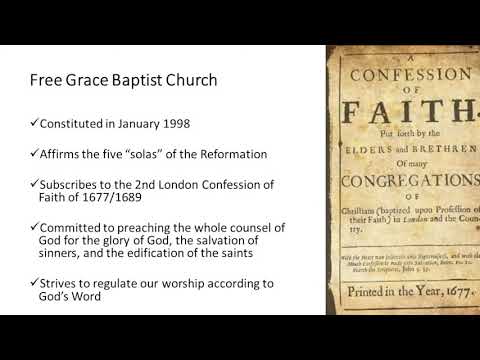
Why should a church bind itself to a confession of faith? This introductory lesson on the Second London Baptist Confession of 1677/1689 grounds the answer exegetically in Ephesians 4 — where Christ gives gifted men to the church so that the body attains doctrinal unity and is no longer tossed about by every wind of teaching — and then traces the historical origins of the 1689 among the Particular Baptists, distinguishing them from Anabaptists, Presbyterians, and Congregationalists. Four functions of a confession are developed: defining, defending, discriminating, and disciplining with reference to the doctrine of the church. The lesson closes by distinguishing Reformed theology (Calvinism plus covenant theology plus the regulative principle) from mere five-point Calvinism, and by defending the confession's silence on matters of Christian liberty as a feature, not a defect.

The Second Missionary Journey, Part 7
Paul's sermon at the Areopagus (Acts 17:22–34) confronts Athenian idolatry by grounding the Christian worldview in the doctrines of creation, providence, and judgment. He establishes the Creator-creature distinction against both Epicurean deism and Stoic pantheism, exposes the guilt of all men through natural revelation and their own poets, and calls all men everywhere to repentance because God has appointed both a day of judgment and its judge — the resurrected Christ. The sermon closes by applying the abiding prohibition of idolatry from the Decalogue to contemporary life, pressing hearers toward faith in Christ as the only corrective to the idolatry that already invites God's temporal and eternal judgment.

The Second Missionary Journey, Part 2
Acts 16:6–15 traces the divine hand behind the second missionary journey's westward turn into Macedonia and the conversion of Lydia in Philippi. The Spirit's successive prohibitions of ministry in Asia and Bithynia are not judgments on those regions but demonstrations that God actively directs the missionary enterprise according to his sovereign purpose. The conversion of Lydia — a woman whose heart was dead in trespasses until God opened it to receive Paul's preaching — illustrates that the efficient cause of every conversion is divine grace, not human ingenuity, while the instrumentality of gospel proclamation and the responsibility of hearers to believe remain fully intact. The sermon calls the church to define missionary work precisely as the Spirit-sent, church-commissioned preaching of Christ crucified, rejecting both Arminian confidence in the sinner's free will and hyper-Calvinist reluctance to call sinners to faith.
The Resurrection and Justification
Romans 4:25 declares that Christ 'was delivered up because of our offenses and was raised because of our justification' — a verse Charles Hodge called a comprehensive statement of the gospel and Matthew Poole called an abridgment of the whole. The sermon works through two inseparable redemptive realities: the substitutionary, particular atonement accomplished in Christ's death, and the five-fold testimony of the resurrection to the validity of that work. The central application is that a robust grasp of justification by faith alone — the imputation of Christ's righteousness received through faith — is the irreplaceable foundation for Christian stability, comfort, and peace with God.

The Judgment Seat of Christ
Matthew 7:21–23 is often misread as a warning to believers to produce more good works, but the passage concerns entrance into the kingdom of heaven and exposes the damning error of self-righteousness. The false professors are condemned not because they lacked works but because they rested their hope for acceptance with God on those works rather than on Christ's blood and righteousness — a form of lawlessness that is an assault on the cross. The will of the Father in Matthew 7:21, rightly understood through John 6:28–40, is to believe on the Son whom He sent; justification is by faith alone, received once, and the Sermon on the Mount functions as law to drive sinners to the foot of the cross rather than to self-congratulation.

The Capture of the Ark
Israel's decision to fetch the Ark of the Covenant as a battlefield talisman in 1 Samuel 4 exposes a perennial human tendency: taking the good gifts of God and treating them as instruments of manipulation rather than means of worship. The chapter's three movements — Israel's defeat, Eli's death, and the naming of Ichabod — together declare that God will not be controlled by technique, and that He would sooner allow the symbol of His presence to fall into pagan hands than permit His people to profane it through superstition. The sermon presses believers to examine whether their own acts of piety — prayer, fasting, corporate worship — are genuine communion with God or covert attempts to secure desired outcomes from Him.

The Healing of the Lame Man
Acts 3:1–10 records the healing of a man lame from birth at the gate called Beautiful, and this exposition argues that the miracle is not an isolated wonder but a typological and redemptive event that displays the name and power of Jesus Christ while setting the stage for apostolic gospel proclamation. The man's condition — congenital, public, and long-standing — ensures that the miracle is conspicuous and undeniable, functioning to authenticate the apostles as God's spokesmen and to magnify the glory of the enthroned Christ. The church's calling, illustrated by Peter's declaration that he possesses no silver or gold but only the name of Christ, is the proclamation of the gospel and the forgiveness of sins, not the amelioration of every temporal need society presents. Those genuinely conquered by sovereign grace, like the healed man, are marked by worship, praise, and desire for the public means of grace.
2LCF Chapter 19 - Of the Law of God
God's moral law — first written on Adam's heart in the covenant of works, codified in the Ten Commandments at Sinai, and distinguished from the temporary ceremonial and judicial laws of Moses — remains perpetually binding on all humanity because it perfectly expresses the unchangeable holy character of its divine Author. This study works through chapter 19 of the 1689 London Baptist Confession of Faith, examining the original revelation of the law, its survival after the fall, the threefold distinction of moral, ceremonial, and judicial law, and the abiding obligation of the Decalogue across all covenants. The threefold use of the moral law is treated in sequence: its civil use in restraining sin, its pedagogical use in exposing sin and driving the conscience to Christ, and its normative use in directing the regenerate life of the believer. Believers are called to embrace the moral law not as a covenant of works but in gratitude, enabled by the Spirit through the ordinary means of grace, standing in Christ's righteousness alone before the holy lawgiver.