
Cited in sermons
Philip Towner
27 sermons · All people cited

The Gospel Foundation for Corporate Prayer

The apostle Paul grounds the church's corporate prayer in a three-part theological rationale drawn from 1 Timothy 2:3–7: the nature of God, the office of Christ, and the ministry of Paul. The phrase 'all men' in verses 1–4 refers not to every individual without exception but to all kinds of men without distinction — Jew and Gentile, slave and king — a reading demanded by Paul's own doctrine of reprobation in Romans 9 and confirmed by the scope of his apostolic commission to the Gentiles. Christ's mediatorship is shown to require both a divine and a human nature, and his ransom is definite in its design — paid for all kinds of men, not all men without exception — precluding both universalism and any notion of unmet desires in God. The sermon closes by pressing the congregation to show up for corporate prayer, to pray specifically for the salvation of those in civil authority, and to exhort all around them to flee to Christ.

The Exhortation to Wage the Good Warfare
The closing verses of 1 Timothy 1 resume Paul's charge to Timothy to wage the good warfare against false teaching in Ephesus. This exposition works through two movements: the charge itself (vv. 18–19a), grounded in Timothy's apostolic authority and prophetic calling, and the conflict that necessitates it (vv. 19b–20), illustrated in the defection and discipline of Hymenaeus and Alexander. The sermon argues that gospel ministry in every age requires holding the objective content of the Christian faith, maintaining a good conscience, and exercising church discipline against those who blaspheme by contradicting the truth of Christ.

The Gospel Committed to the Apostle Paul
1 Timothy 1:15–17 contains one of five 'faithful sayings' in the Pastoral Epistles, and Paul deploys it here to contrast the life-giving gospel with the idle speculations of the false teachers troubling the church at Ephesus. The sermon works through three elements: the faithful saying as a standard confession received and guarded by the church; the glorious content of that saying — the incarnation of the Son and his effectual, definite work to save sinners; and the merciful application illustrated in Paul himself, who as the chief of sinners functions as a pattern of Christ's longsuffering for all who will believe. The doxology of verse 17 demonstrates that rightly understood soteriology issues in worship, and believers are called to keep this faithful saying at the centre of their hearts and to press it upon the unconverted.

The Conversion of the Apostle Paul
Paul's gratitude in 1 Timothy 1:12–14 is inseparable from the radicalism of his own conversion. Working through these three verses, this exposition traces the apostle's pre-conversion state — blasphemer, persecutor, and insolent man — as deliberately set up to magnify the sovereign mercy that overthrew him on the road to Damascus. The sermon gives careful attention to the nature of Paul's ignorance in unbelief, distinguishing it from the willful, light-rejecting sin of those who witnessed Christ's signs and wonders firsthand, and shows how effectual calling brought not only forgiveness but a hermeneutical key that unlocked the entire Old Testament. The governing application is that every believer, like Paul, stands before God not on the ground of moral reformation or law-keeping but solely on received mercy and exceedingly abundant grace — and that this reality is the wellspring of genuine Christian gratitude.

The Apostle's Charge to Timothy
Paul's charge to Timothy in 1 Timothy 1:3–7 commands the silencing of false teachers in Ephesus who taught other doctrine, devoted themselves to fables and endless genealogies, and generated disputes rather than godly edification. The charge is not motivated by power or animosity but by love flowing from a pure heart, a good conscience, and sincere faith — the fruit of regeneration. The false teachers compounded their error by combining ignorance of the law with arrogant confidence in their own assertions, a combination the apostle deems disqualifying. Churches today must hold the same line: qualifying teachers rigorously, refusing platforms to the heterodox, and measuring all teaching against the truth as it is in Jesus.
The Departure of Paul
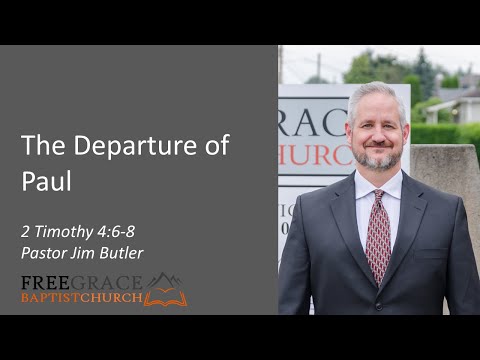
Paul's final written words in 2 Timothy 4:6–8 disclose the mind of a man at the eleventh hour of his life: conscious of imminent martyrdom, yet unshaken in confidence. The sermon works through three movements — the apostle's present situation as a drink offering poured out (v. 6), his past perseverance in fight, race, and faith (v. 7), and his future hope in the crown of righteousness (v. 8). Central to the exposition is the insistence that the crown of righteousness is not a reward for performance but a confirmation of justification by faith alone, the imputed righteousness of Christ conveyed freely by the righteous judge. The application presses every believer to live now in such a way that the eleventh hour may be faced with the same God-graced confidence Paul displays here.

The Conduct of a Faithful Minister
Paul's charge to Timothy in 1 Timothy 4:12–16 sets forth the pattern for every faithful gospel minister: exemplary character, diligent public ministry, ongoing personal growth, and tenacious perseverance to the end. Preached at an ordination service for a newly commissioned pastor, this exposition works through each element of the apostle's command — from the six spheres of a minister's example (word, conduct, love, spirit, faith, purity) to the three pillars of public ministry (reading, exhortation, doctrine). The sermon insists that Christian virtue, however admirable, cannot save souls; it is the word of God, proclaimed boldly and accurately, that the Spirit uses as the instrument of salvation. The congregation is charged alongside the minister: receive the word with joy, reject heresy, prize the public means of grace, and honour those who watch for your souls.

The Conduct of a Faithful Minister
What does faithfulness look like in the life and ministry of a gospel minister? Expounding 1 Timothy 4:12–16 as a capstone to a study of elder qualifications in 1 Timothy 3:1–7, this sermon examines four dimensions of ministerial conduct: the minister's example before the congregation, his public ministry of reading, exhortation, and doctrine, his personal growth through sustained meditation on the Word, and his perseverance in both personal piety and sound teaching. The closing application extends these same marks to the congregation, calling the saints to receive the Word with joy, reject heresy with discernment, pursue Christian virtue, and prize the public means of grace.

The Good Soldier of Jesus Christ
The qualifications and character of faithful gospel ministry are examined through 2 Timothy 2:1–7, where Paul gives Timothy three interlocking commands: be strong in the grace of Christ, commit sound doctrine to faithful men who can teach others, and endure hardship as a soldier of Jesus Christ. Three metaphors — the devoted soldier, the disciplined athlete, and the diligent farmer — together with the dedication of the disciple, frame what faithfulness in pastoral ministry demands. The sermon presses both pastors and congregations to resist the pressure of cultural and governmental opposition, to identify and train men for ministry, and to understand that the dignity of gospel preaching warrants the highest standards of devotion, discipline, and endurance.

Titus 2:7 - Reverence and Humour in Preaching
Titus 2:7 calls the preacher to manifest dignity and gravity (Greek: semnotes) in the proclamation of the word. This brief exposition distinguishes judicious, fitting humor — illustrated from Spurgeon, Elijah's mockery of Baal's prophets, and Christ's condemnation of the Pharisees — from the coarse, shock-value language that has characterised certain celebrity preachers, treating reverence in preaching as a positive imperative with direct application to contemporary ministry.

The Instruction of the Church, Part 2
Titus 2:6–10 addresses young men, Titus himself as minister, and bondservants, calling each group to a specific pattern of conduct grounded in the gospel. Young men are summoned to comprehensive self-control, while Titus is charged to exemplify good works and to teach with integrity, gravity, and incorruptible soundness — precisely so that opponents are silenced and put to shame. Bondservants are exhorted to willing obedience, pleasing service, honest fidelity, and freedom from back-talk or pilfering. The overarching motive uniting every group is that their conduct may adorn the doctrine of God our Savior — not earn salvation, which rests solely on the redemptive work of Christ received through faith alone.

The Instruction of the Church, Part 1
Titus 2:1–5 instructs specific people groups within the church to live in a manner consistent with sound doctrine — not as a means of salvation, but as the fruit of it. This exposition works through the virtues required of older men (sobriety, reverence, temperance, soundness in faith, love, and patience), the conduct and teaching role of older women, and the domestic calling of younger women. The complementarian ordering of church and home is grounded not in culture but in the creation and fall account of Genesis 1–3, with particular attention to 1 Timothy 2 as a cross-reference. The governing purpose of all these exhortations is stated in verse 10: that the conduct of God's people would adorn, rather than blaspheme, the doctrine of God our Savior.

The Appointment of Elders
Titus 1:5–9 gives the apostolic mandate for appointing elders in every city, a task Paul left Titus to complete on the young and unstructured island churches of Crete. The sermon works through two main divisions: the purpose of Titus's ministry as setting things in order (v. 5), and the qualifications for elders in terms of domestic faithfulness, personal faithfulness, and the gift of sound teaching (vv. 6–9). Elders are not essential to the existence of a church but are essential to its well-being, and their appointment must involve the common suffrage of the congregation under the direction of existing leadership. The sermon closes with a call to pray for a plurality of qualified elders, to enforce the qualifications without compromise, and to trust in a willing Savior who gathers a great multitude from every nation.
The Introduction to the Book of Titus
Titus 1:1–4 contains one of Paul's longer epistolary introductions, and the reason is pastoral and strategic: Paul is authenticating the ministry of Titus among a difficult, newly-planted congregation on Crete by anchoring his own apostolic authority in the eternal decree of God. The sermon surveys the historical and biographical background of the pastoral epistles before working through Paul's self-designation as bondservant and apostle, his two-fold apostolic purpose (the salvation and sanctification of God's elect), and the grounding of that purpose in the covenant of redemption purposed before time began. The greeting's triad of grace, mercy, and peace — flowing from both God the Father and the Lord Jesus Christ, each called 'Savior' — opens a rich vein of covenant theology, Christology, and soteriology that will run through the entire book.
The Warning and Report
Paul closes his final letter by warning Timothy against Alexander the coppersmith, whose opposition was directed not against Paul personally but against the Word of God, and by giving a theologically ordered account of his own imprisonment. The sermon traces how Paul's confidence in God's retributive justice, his experience of the Lord's present strengthening, and his certainty of future heavenly preservation together produce doxology rather than complaint. Seven marks of Paul's apostolic character — vigilance for God's Word, concern for the church, dependence on the Lord, worship, care for friends, hope for glory, and faithful ministry to the end — are set before the congregation as a pattern for gospel ministers and the church alike. The primary application is that faithful proclamation of God's truth, not celebrity or popularity, is what God requires of his ministers.

The Defection from the Truth
When the apostle Paul commands Timothy to 'preach the Word' in 2 Timothy 4:2, he immediately supplies the reason: a time is coming when professing Christians will not endure sound doctrine. This sermon expounds 2 Timothy 4:3–5, tracing four sequential steps of doctrinal defection — boredom and apathy toward the truth, heaping up teachers who satisfy itching ears, active turning away from the truth, and final embrace of fables — and sets over against that decline the fourfold call to Timothy: be watchful, endure afflictions, do the work of an evangelist, and fulfill your ministry. The church's responsibility is to receive the truth, recognize its proper mission defined by the marks of the church, and rejoice in the means God has ordained rather than demanding a prescription of its own devising.
The Usefulness of Scripture
Paul's claim in 2 Timothy 3:16–17 that all Scripture is God-breathed and profitable is examined across four categories of usefulness — doctrine, reproof, correction, and instruction in righteousness — before turning to Scripture's specific function in completing and thoroughly equipping the man of God for every good work. The sermon challenges the anti-doctrinal sentiment prevalent in contemporary evangelicalism, arguing that indifference to biblical doctrine is indifference to God himself. Ministers in particular are shown to be completed not by leadership models or charismatic gifts but by deep saturation in the word of God. The hearer is called to approach Scripture not as a duty to discharge but as a daily feast — mining its treasures with diligence and gratitude.

Free Grace Baptist Church - November 29, 2015 PM
Evil men and impostors will grow worse and worse, yet the people of God are called not to despair but to persevere in the things they have learned — above all, the Holy Scriptures. Expounding 2 Timothy 3:13–15, this sermon contrasts the downward trajectory of false teachers with the upward call to Timothy: continued faithfulness grounded in the Word of God, which is able to make one wise for salvation through faith in Christ Jesus. The Old Testament is shown to be thoroughly Christ-centred, pointing to one way of salvation in both testaments — by grace alone, through faith alone, in Christ alone. Parents are charged to bring their children under the Scripture from childhood, and all believers are urged to persevere through faithful use of the means God has ordained.

The Instruction on Marriage
Titus 1:1–9 provides Paul's instructions to Titus for establishing gospel order on the island of Crete, centering on the appointment of qualified elders. The sermon works through the twofold purpose of Titus's ministry — setting things in order and appointing elders in every city — before examining the elder's domestic faithfulness (blamelessness, sexual fidelity, faithful children) and personal faithfulness (five vices to avoid, six virtues to exemplify). The exposition closes with the elder's indispensable giftedness: holding fast sound doctrine so as to both exhort the people of God and silence those who contradict. The whole is applied to the congregation as a call to pray for qualified men, to know the qualifications, and to insist that the church install only those who demonstrably meet them.

The Minister's Duty to Endure Hardship
Paul's command in 2 Timothy 2:3–7 that Timothy endure hardship is not a gentle suggestion but an apostolic imperative addressed to every minister of the gospel in every age. Working through three interlocking metaphors — the soldier, the athlete, and the farmer — this exposition shows that faithful gospel ministry requires the devoted single-mindedness of a soldier who lives to please his commander, the disciplined self-denial of an athlete training for an imperishable crown, and the diligent hard work of a farmer who knows that cause and effect govern his harvest. A fourth element, drawn from verse 7, calls the minister to be a dedicated disciple who meditates on apostolic doctrine and trusts the Lord to give understanding through that Word alone. The whole passage is set within the larger purpose of the ministry: the glory of God, the edification of the saints, and the salvation of sinners by sovereign grace.

The Pattern for Gospel Ministry
Second Timothy 1:8 calls Timothy — and by extension all ministers and believers — to an unashamed allegiance to the gospel of the Lord Jesus Christ and a readiness to suffer for it. The sermon traces two movements in the verse: a prohibition against shame and a positive exhortation to share in the sufferings of the gospel according to the power of God. Four temptations toward shame are examined — the person of Christ, the work of Christ, the doctrine of Christ, and the cause of Christ — before the message closes with the assurance that the Spirit supplies power, not fear, to those who must persevere under opposition and trial.

The Apostle's Prayer and Reminder
Paul's prayer for Timothy in 2 Timothy 1:3–7 reveals the anatomy of apostolic intercession — gratitude to God, constancy of remembrance, and earnest desire — and grounds a pastoral reminder to stir up the God-given ministerial gift. The sermon traces the connection between a pure conscience and an effective prayer life, drawing on Psalm 66:18 and 1 Peter 3:7 to press the point that those who live well tend to pray well. Timothy's genuine, unhypocritical faith is traced to the effectual calling of God, nurtured through his grandmother Lois and mother Eunice, establishing a pattern for covenantal family religion. The exhortation to stir up the gift is not a rebuke but a reminder: God has given his ministers not a spirit of fear but of power, love, and a sound mind, and faithful ministry demands that these resources be actively employed.

The Instructions for the Rich
Paul's closing instructions to Timothy in 1 Timothy 6:17–19 carry a twofold charge to the wealthy: resist the twin sins of pride and idolatry, and actively pursue generosity. The sermon works through two prohibitions (do not be haughty; do not trust in uncertain riches) and three positive exhortations (do good; be rich in good works; be ready to give and willing to share), grounding each in the character of the living God who gives richly for enjoyment, not for hoarding. The concluding section sets out ten biblical perspectives on wealth, insisting that godliness neither requires the renunciation of riches nor permits their idolization, and that the benevolence of the rich man is itself evidence of the eternal life God has graciously given him — received by grace alone, through faith alone, in Christ alone.

The Indictment of False Teachers
False teachers are identified in 1 Timothy 6:3–5 not only by their departure from apostolic doctrine but by the character it produces: pride, ignorance, an obsessive craving for controversy, and a materialistic motivation that treats religion as a revenue stream. The sermon argues that what a man believes concerning God inevitably shapes how he lives under God, so that heterodoxy and ungodliness are inseparable fruits of the same root. The congregation is called to cultivate discernment through saturation in Scripture and confessional theology, so that the orthodox may recognize and withdraw from ravenous wolves before damage is done to Christ's flock.

The Duties Toward Elders: Discipline
First Timothy 5:19–21 establishes a precise, legally grounded process for receiving accusations against elders, publicly rebuking those found guilty, and doing so without partiality or personal prejudice. The passage roots its discipline procedure in the Old Testament two-or-three-witnesses requirement (Deuteronomy 17; 19), which Paul applies through the same logic as Matthew 18, protecting both the accused elder from frivolous charges and the congregation from the corruption of unchecked sin in its leadership. The sermon argues that church discipline is not a pastoral option but a solemn obligation, witnessed by God the Father, the Lord Jesus Christ, and the elect angels — as binding on Timothy as the charge to preach the word. The controlling application is that congregations must follow biblical due process faithfully, neither shielding sinning elders behind their gifts nor condemning them on the basis of unverified accusation.
The Gospel Committed to Paul
What does it mean that Christ Jesus came into the world to save sinners? Expounding 1 Timothy 1:15–17, this sermon traces the faithful saying of verse 15 from its roots in the eternal decree of God through the covenant of grace to its historical execution in the incarnation and atoning work of Christ. Paul's own conversion is examined as a paradigm of sovereign mercy — not a unique case, but a pattern establishing that even the chief of sinners may obtain grace — and the sermon closes with Paul's doxology as the only fitting response to the gospel of free and sovereign grace.
The Thankfulness and Conversion of Paul
Paul's digression in 1 Timothy 1:12–14 contains a compressed account of his own conversion that he offers not as autobiography for its own sake but as living proof of the gospel he preaches. The sermon works through three elements: Paul's thankfulness to Christ who enabled and appointed him to apostolic ministry, the three actions and two conditions that characterised his pre-conversion state (blasphemer, persecutor, insolent man; ignorant and an unbeliever), and the exceedingly abundant grace that overwhelmed and reversed every one of those conditions. The central application is that no sinner stands beyond the reach of a grace that is, by Paul's own coinage, super-abundant — and that the same Christ who staffs his church by sovereign appointment, not human aspiration, has furnished everything requisite for salvation through faith and love in Christ Jesus.